
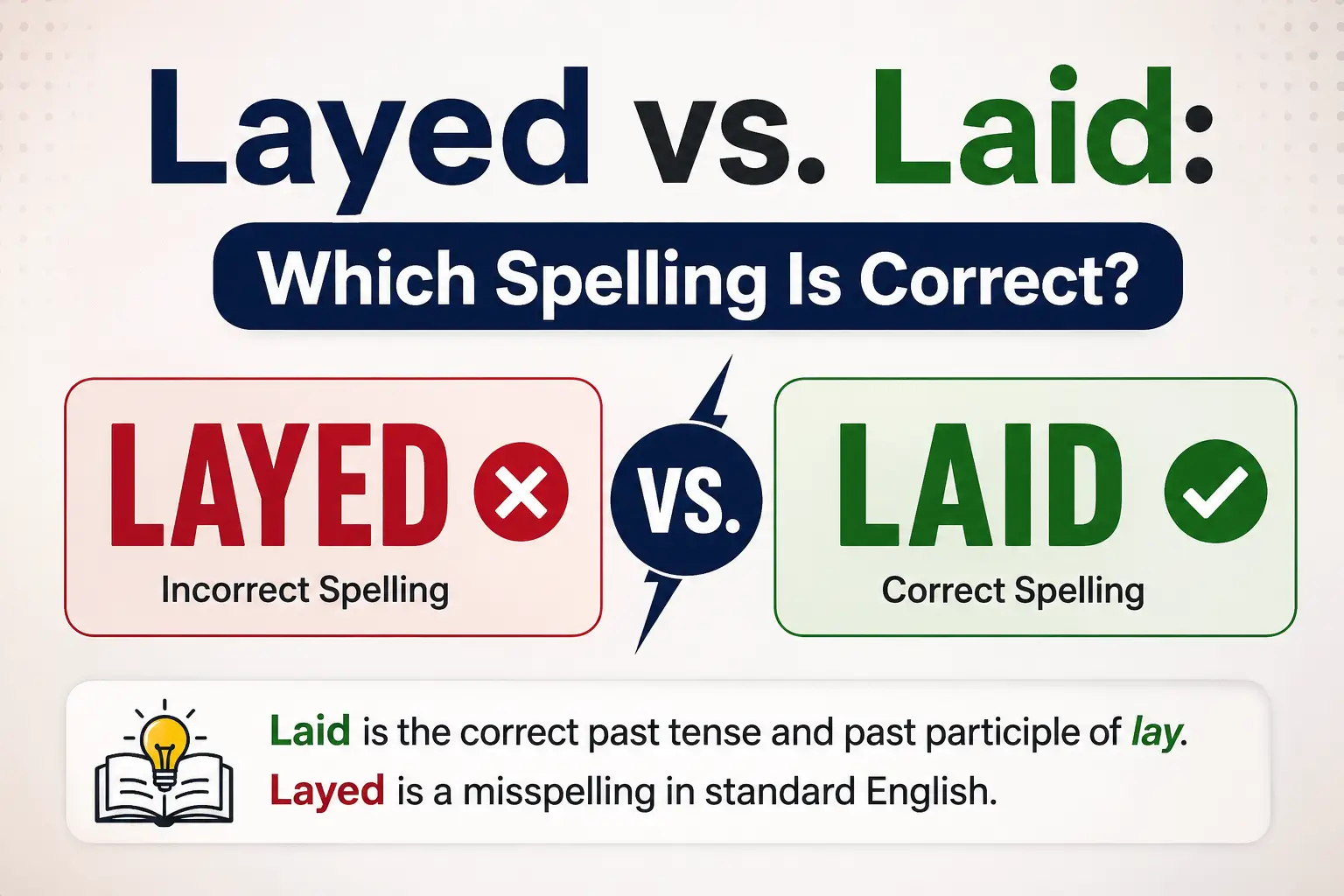
Layed vs. Laid is a common spelling question, but the rule is simple. Laid is the correct past tense and past participle of lay, while layed is a misspelling in standard English. You should write, “She laid the book on the table,” not “She layed the book on the table.” The word lay means to place or put something somewhere, so it usually needs a direct object.
The confusion often grows because lay and lie have similar forms. Lay means to place something, while lie means to rest or recline. For example, you lay a phone on a desk, but you lie on a bed.
Learning this difference helps you avoid common grammar mistakes in schoolwork, emails, workplace writing, and daily conversation. Once you check whether the sentence has an object, choosing between laid, lay, and lie becomes much easier.
Quick Answer: Is It Layed or Laid?
Use laid when you need the past tense or past participle of lay.
- Correct: He laid the phone on the desk.
- Incorrect: He layed the phone on the desk.
- Correct: They have laid new flooring.
- Incorrect: They have layed new flooring.
The verb lay is irregular. Therefore, you cannot form its past tense by simply adding -ed.
Simple rule: You lay something down today, but you laid it down yesterday.
However, do not confuse laid with the past tense of lie. If a person or animal rested without placing an object, the correct past-tense form is lay.
- Correct: I lay on the couch yesterday.
- Incorrect: I laid on the couch yesterday.
- Correct: I laid my head on the pillow.
- Incorrect: I layed my head on the pillow.
Layed vs. Laid at a Glance
| Feature | Laid | Layed |
| Standard spelling | Yes | No, in ordinary modern English |
| Verb | Past tense and past participle of lay | Common misspelling of laid |
| Meaning | Put or placed something | Usually intended to mean laid |
| Requires an object | Usually yes | Not applicable as a standard form |
| Correct example | She laid the book down. | — |
| Incorrect example | — | She layed the book down. |
| Used in American English | Yes | No |
| Used in British English | Yes | No |
Although layed may appear in informal, dialectal, or historical writing, it is not the standard past form of lay. In school, professional, academic, and edited writing, use laid.
What Does Laid Mean?
Laid is the simple past tense and past participle of lay.
The verb lay usually means to put, place, or arrange something in a particular position. Because the action affects something, lay normally requires a direct object.
Consider this sentence:
- Maya laid the folder on the desk.
The direct object is the folder. It receives the action. Maya placed the folder somewhere.
You can often replace laid with placed to test the meaning:
- Maya placed the folder on the desk.
- Maya laid the folder on the desk.
Both sentences express the same basic action.
Laid as the Simple Past Tense
Use laid for a completed action in the past.
- I laid the package by the door.
- She laid her coat across the chair.
- The workers laid the carpet yesterday.
- He laid the baby gently in the crib.
- We laid the documents on the conference table.
Each sentence includes something that was placed:
- Package
- Coat
- Carpet
- Baby
- Documents
That object is an important clue. If someone placed an object in the past, laid is usually the correct choice.
Laid as a Past Participle
The past participle also uses laid. It appears with helping verbs such as has, have, and had.
- She has laid the papers on your desk.
- They have laid new pipes under the road.
- We had laid the foundation before winter.
- The hen has laid three eggs.
- He had laid his phone beside the laptop.
Do not write has layed, have layed, or had layed.
Correct forms include:
- Has laid
- Have laid
- Had laid
The spelling does not change in perfect tenses.
Laid in Passive Voice
Laid can also appear in passive sentences. In passive voice, the thing receiving the action becomes the subject.
Active:
- The workers laid the pipes underground.
Passive:
- The pipes were laid underground.
More examples include:
- The table was laid before dinner.
- New cables were laid beneath the street.
- The plans were laid out clearly.
- The foundation had been laid by June.
- The evidence was laid before the committee.
Passive voice is useful when the action or result matters more than the person who performed it.
Why Layed Is Usually Incorrect
Many English verbs form the past tense by adding -ed.
- Play → played
- Stay → stayed
- Display → displayed
- Spray → sprayed
Because lay ends in the same letters, writers may assume its past tense should be layed. However, lay is an irregular verb.
Its correct forms are:
- Lay
- Lays
- Laying
- Laid
- Laid
English contains many irregular verbs whose past forms do not follow the usual -ed pattern.
For example:
- Buy → bought
- Teach → taught
- Say → said
- Pay → paid
- Lay → laid
Therefore, layed is not the standard past tense of lay.
Correct:
- She laid the blanket on the grass.
Incorrect:
- She layed the blanket on the grass.
Correct:
- The company has laid new cables.
Incorrect:
- The company has layed new cables.
The Correct Verb Forms of Lay
The following table shows every main form of lay:
| Grammar Form | Correct Word | Example |
| Base form | Lay | Please lay the book here. |
| Third-person singular | Lays | She lays the files on my desk. |
| Present participle | Laying | He is laying tile in the kitchen. |
| Simple past | Laid | He laid the tile yesterday. |
| Past participle | Laid | He has laid the tile correctly. |
Notice that laying keeps the letter y. You do not change it to “laing.”
- Correct: She is laying the clothes on the bed.
- Incorrect: She is laing the clothes on the bed.
Also, do not use layed for the past.
- Correct: She laid the clothes on the bed.
- Incorrect: She layed the clothes on the bed.
Lay vs. Lie: The Main Source of Confusion
The hardest part of this topic is not simply layed vs. laid. It is understanding the difference between lay and lie.
These verbs have different meanings and sentence patterns.
- Lay means to put or place something.
- Lie means to rest, recline, or remain in a position.
The key difference is the object.
When to Use Lay
Use lay when someone puts something somewhere. The verb normally needs a direct object.
- Lay the blanket on the floor.
- Please lay your phone on the table.
- She lays her keys beside the door.
- They are laying the cables underground.
Ask, “Lay what?”
- Lay the blanket
- Lay your phone
- Lays her keys
- Laying the cables
If you can identify the thing being placed, a form of lay may be correct.
When to Use Lie
Use lie when a person, animal, or object rests or remains in a position by itself.
- I need to lie down.
- The dog lies near the fireplace.
- She is lying on the couch.
- The papers lie on the desk.
The verb does not take a direct object in these examples. Nobody is placing something else.
Ask, “Who or what is resting?”
- I
- The dog
- She
- The papers
The subject itself is in the resting position.
Lay and Lie Verb Forms Compared
| Meaning | Base Form | Simple Past | Past Participle | Present Participle |
| Put or place something | Lay | Laid | Laid | Laying |
| Rest or recline | Lie | Lay | Lain | Lying |
This table explains why the verbs cause so much confusion. The simple past of lie is lay, which is also the present form of a different verb.
Compare:
- Today, I lie on the couch.
- Yesterday, I lay on the couch.
- I have lain on the couch for an hour.
Now compare the verb lay:
- Today, I lay the book on the table.
- Yesterday, I laid the book on the table.
- I have laid the book on the table.
Laid Down vs. Lay Down
The expressions lay down, laid down, and lie down are often confused.
Use lay down when someone places an object:
- Please lay the baby down gently.
- I always lay my phone down before dinner.
- Lay the tools down before you leave.
Use laid down when that placement happened in the past:
- She laid the baby down gently.
- I laid my phone down before dinner.
- The worker laid the tools down.
Use lie down when a person or animal reclines:
- I need to lie down.
- The dog likes to lie down near the door.
- You should lie down and rest.
For the past tense of lie down, use lay down:
- I lay down after lunch yesterday.
- She lay down for an hour.
- The dog lay down beside the fire.
Therefore, this sentence is usually incorrect:
- Incorrect: I laid down after work.
The speaker did not place an object. The speaker reclined.
Use:
- Correct: I lay down after work.
However, laid down is correct when an object follows:
- I laid my bag down after work.
Common Meanings and Expressions With Laid
The word laid appears in many literal and figurative expressions. Understanding these phrases makes the verb easier to use naturally.
Laid Something on a Surface
This is the most direct meaning.
- She laid the book on the nightstand.
- He laid the tools on the floor.
- I laid my jacket across the chair.
- They laid the map on the hood of the car.
In each sentence, a person placed an object on a surface.
Laid a Foundation
The phrase laid a foundation can be literal or figurative.
Literal:
- The construction crew laid the foundation in March.
Figurative:
- The first course laid the foundation for advanced study.
- Her early research laid the foundation for later discoveries.
- Clear rules laid the foundation for a strong partnership.
In figurative use, the phrase means creating the basic support for future progress.
Laid the Table
In British English, laid the table means prepared the table for a meal.
- She laid the table before the guests arrived.
- The dining table had already been laid.
In American English, people more often say set the table.
- She set the table before dinner.
Both expressions are correct, but the regional preference differs.
Laid an Egg
Birds, reptiles, insects, fish, and some other animals lay eggs.
- The hen laid an egg.
- The turtle laid its eggs in the sand.
- The butterfly has laid eggs on the leaf.
- Several hens are laying eggs.
Because egg is the object, the verb follows the lay–laid–laid pattern.
Laid Off
Laid off usually means that an employer ended someone’s job because of reduced work, financial problems, restructuring, or staff cuts.
- The company laid off 50 workers.
- He was laid off last month.
- Several employees have been laid off.
Being laid off is not always the same as being fired. Fired often suggests poor performance or misconduct. Laid off usually points to a business decision rather than personal fault.
The correct spelling is always laid off, not layed off.
Laid Out
Laid out has several meanings.
It can mean arranged:
- She laid out the clothes on the bed.
- The tools were laid out in order.
It can mean explained or presented:
- The manager laid out the new plan.
- The report clearly laid out the risks.
It can also mean designed or organized:
- The website is laid out in a simple format.
- The neighborhood was carefully laid out.
In informal speech, laid out may also mean knocked unconscious or extremely tired:
- The punch laid him out.
- The flu had me laid out for three days.
Context tells the reader which meaning applies.
Laid-Back
Laid-back is an adjective meaning relaxed, calm, or easygoing.
- She has a laid-back personality.
- He works in a laid-back office.
- Our manager is laid-back.
Use a hyphen in the standard compound adjective laid-back.
Do not write layed-back.
Correct and Incorrect Examples of Layed vs. Laid
Placing an Object
Correct:
- She laid the jacket on the chair.
Incorrect:
- She layed the jacket on the chair.
The action happened in the past, and the jacket is the object. Therefore, use laid.
Using the Present Perfect
Correct:
- He has laid the documents on the table.
Incorrect:
- He has layed the documents on the table.
The past participle of lay is laid.
Reclining Without an Object
Correct:
- He lay on the couch yesterday.
Incorrect:
- He laid on the couch yesterday.
The person rested by himself. He did not place an object. Therefore, the verb is lie, whose past tense is lay.
Placing Part of the Body
Correct:
- He laid his head on the pillow.
The direct object is his head. He placed it on the pillow, so laid is correct.
Compare:
- He lay on the pillow.
In this sentence, he himself was resting. There is no direct object.
Talking About an Animal
Correct:
- The dog lay beside the door.
The dog rested.
Correct:
- The dog laid its head on my foot.
The dog placed its head somewhere.
The object determines which verb you need.
Common Mistakes With Laid, Lay, and Lie
Writing Layed
Incorrect:
- They layed new flooring.
Correct:
- They laid new flooring.
The verb lay is irregular. Its past form is not created with -ed.
Using Laid Without an Object
Incorrect:
- I laid down for a nap.
Correct:
- I lay down for a nap.
Because the speaker reclined, the past form of lie is needed.
However:
- I laid the child down for a nap.
This sentence is correct because the child is the object.
Using Lay Instead of Lie in the Present
Incorrect:
- I need to lay down.
Correct:
- I need to lie down.
There is no object. The speaker wants to recline.
Use lay only when something is being placed:
- I need to lay the papers down.
Confusing Laying and Lying
Laying comes from lay and normally takes an object.
- She is laying the books on the shelf.
- Workers are laying bricks.
- The hen is laying an egg.
Lying may mean reclining:
- She is lying on the bed.
- The dog is lying in the sun.
It can also mean saying something untrue:
- He is lying about what happened.
The spelling changes because these are different verbs.
Using Laid After Has When You Mean Rested
Incorrect:
- She has laid there all morning.
Correct:
- She has lain there all morning.
The verb means rested or remained in a position. Therefore, use the past participle of lie, which is lain.
However:
- She has laid the blanket there.
This sentence is correct because she placed the blanket.
How to Tell Whether Laid Is Correct
Use this short test when you are unsure.
First, identify the action. Ask whether someone put or placed something somewhere.
Next, look for a direct object. Ask, “What was placed?”
Then, check the time. If the placement happened in the past, use laid.
Example:
- She ___ the folder on my desk.
Ask:
- Did she place something? Yes.
- What did she place? The folder.
- Did it happen in the past? Yes.
Correct answer:
- She laid the folder on my desk.
Now consider:
- She ___ on the couch after work.
Ask:
- Did she place an object? No.
- Did she recline? Yes.
- Did it happen in the past? Yes.
Correct answer:
- She lay on the couch after work.
Easy Memory Tricks for Laid
A simple memory sentence is:
You lay something today and laid it yesterday.
Another useful test is to replace the word with placed.
- She laid the phone down.
- She placed the phone down.
The meaning still works, so laid is correct.
However:
- I placed on the couch.
That sentence does not work. Therefore, you need a form of lie:
- I lay on the couch.
You can also remember:
- Lay needs an object.
- Lie does not.
- Laid is the past of lay.
- Lay is the past of lie.
Layed or Laid in Formal and Informal English
Formal and Academic Writing
Use the standard form laid in essays, research papers, reports, and exams.
- The researchers laid the samples on a clean surface.
- The policy laid the basis for future reforms.
- The author laid out three main arguments.
Avoid layed, because readers and editors will usually treat it as a spelling error.
Professional Writing
In workplace communication, correct verb choice supports clarity and credibility.
- The contractor laid the cables correctly.
- Management laid out the new policy.
- The assistant laid the files on your desk.
- The company laid off several workers.
These phrases often appear in reports, emails, project notes, and business updates.
Casual Conversation
Native speakers often mix up lay and lie in conversation.
For example, many people say:
- I’m going to lay down.
Traditional grammar prefers:
- I’m going to lie down.
The informal version is common, especially in speech. However, edited writing still usually follows the standard distinction.
By contrast, layed is less accepted. It generally looks like a spelling mistake even in casual writing.
Texting and Social Media
People may use relaxed grammar in texts and posts. Still, the correct past form remains laid.
- Correct: I laid my phone down and forgot where.
- Incorrect: I layed my phone down and forgot where.
Using the standard spelling makes the message easier to read and avoids distraction.
American and British English Usage
Laid is standard in both American English and British English.
There is no major regional difference:
- American English: She laid the book on the table.
- British English: She laid the book on the table.
Layed is not the regular British alternative. It is normally incorrect in both varieties.
However, some expressions differ by region. British speakers may say:
- She laid the table.
American speakers usually say:
- She set the table.
The verb form remains laid, but the preferred phrase changes.
Synonyms for Laid
Several words can replace laid in certain contexts. However, the best synonym depends on the exact meaning.
| Synonym | Typical Meaning | Example |
| Placed | Put in a position | She placed the book on the shelf. |
| Put | Moved somewhere | He put the keys on the counter. |
| Set | Positioned carefully | They set the vase on the table. |
| Positioned | Arranged in a specific place | The camera was positioned near the door. |
| Arranged | Organized in an order | She arranged the papers neatly. |
| Spread | Opened or extended over a surface | He spread the map across the desk. |
| Installed | Put equipment into place | Workers installed the pipes. |
| Established | Created a basis or system | The policy established clear rules. |
These terms are not always interchangeable.
For example:
- The hen laid an egg.
You would not normally replace laid with positioned or arranged.
Likewise:
- The company laid off workers.
The phrase laid off has a fixed employment meaning, so a simple synonym may change the tone or detail.
Related Words and Phrases
The main related forms include:
- Lay: present form meaning to place something
- Lays: third-person present form
- Laying: present participle of lay
- Laid: past tense and past participle of lay
- Lie: present form meaning to rest or recline
- Lies: third-person present form of lie
- Lying: present participle of lie
- Lay: past tense of lie
- Lain: past participle of lie
- Laid down: placed something in the past
- Laid off: removed from a job because of business conditions
- Laid out: arranged, designed, or explained
- Laid-back: relaxed or easygoing
- Egg-laying: producing or depositing eggs
These words are connected, but they are not interchangeable. Their meanings depend on tense, grammar role, and whether an object receives the action.
Real-Life Examples
At Home
- I laid the groceries on the counter.
- She laid a blanket over the sleeping child.
- The dog lay near the heater.
- He has lain in bed all morning.
These examples show both verb families. Objects such as groceries and blanket take forms of lay. A resting dog or person takes forms of lie.
At Work
- The designer laid out the presentation.
- The technician laid the cable along the wall.
- Management laid off several employees.
- The documents have been laid on your desk.
Each sentence uses laid, but the expression changes the meaning.
In School
- The teacher laid the flash cards on the table.
- The textbook laid out the rule clearly.
- The student lay on the grass during lunch.
- The books had lain unopened for weeks.
The object test helps separate the forms.
In Construction
- Workers laid bricks along the wall.
- The crew has laid the foundation.
- New pipes were laid beneath the building.
- The plans were laid out before work began.
Construction writing often uses laid because materials are placed or installed.
Quick Grammar Tips
- Use laid as the past tense of lay.
- Use laid as the past participle of lay.
- Do not use layed in standard English.
- Remember that lay usually needs an object.
- Use lie when someone rests or reclines.
- The past tense of lie is lay.
- The past participle of lie is lain.
- Use laying for placing something.
- Use lying for reclining or saying something false.
- Check whether you can identify what was placed.
- Use laid off, not layed off.
- Use laid out, not layed out.
- Use laid-back, not layed-back.
Conclusion
The difference between layed vs. laid is straightforward. Laid is the correct past tense and past participle of lay, while layed is a common misspelling in standard English.
Use laid when someone places a misspelling in standard English.
Use laid when someone placed something in the past. For example, “She laid the book on the desk” is correct because the book is the direct object. However, when someone rested or reclined, use a form of lie, such as “He lay on the couch.”
Remember this simple rule: you lay something down today, but you laid it down yesterday. Checking whether the sentence has an object will help you choose the correct verb in school, work, emails, and everyday writing.
Frequently Asked Questions About Layed vs. Laid
Q1: Is layed a correct word?
Layed is not the standard past tense of lay. In most modern writing, it is treated as a spelling error. The correct word is laid.
Q2: What is the past tense of lay?
The past tense of lay is laid.
Correct example: She laid the keys on the table.
Q3: Is it laid down or layed down?
Laid down is correct when someone placed something in the past.
Correct: He laid the phone down.
Incorrect: He layed the phone down.
Q4: Is it I laid down or I lay down?
Use “I lay down” when you mean that you rested in the past.
Use “I laid something down” when you placed an object somewhere.
Q5: Is it laid off or layed off?
The correct phrase is laid off.
Correct: The company laid off several workers.
Incorrect: The company layed off several workers.