
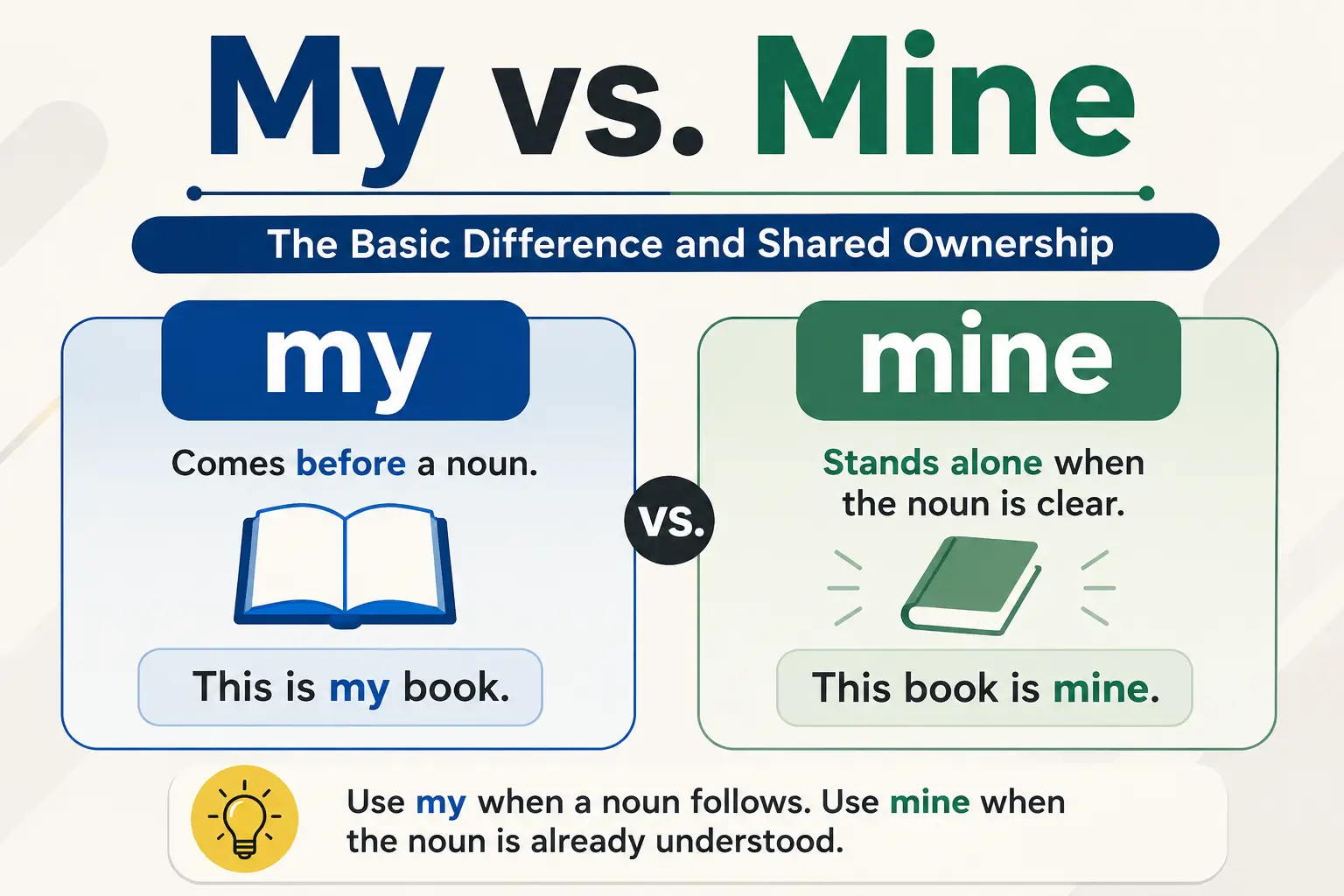
My vs. Mine becomes easy once you see that my comes before a noun, while mine stands alone when the noun is already clear from the full context. My is a possessive determiner, while mine is a possessive pronoun.
Use my in “This is my book” because book follows it. Use mine in “This book is mine” because the noun has already been named. This rule keeps the sentence structure clear and avoids needless repetition. It works in speech, school writing, emails, and professional communication.
The same pattern applies to shared ownership. Write “Gregg’s and my child,” not “mine and Gregg’s child,” because my must come before the shared noun child. However, you can say, “The child is Gregg’s and mine,” because both possessive forms stand alone. Checking whether a noun follows is the fastest way to choose the correct form and avoid common ownership errors.
Quick Answer: What Is the Difference Between My and Mine?
My is a possessive determiner. It comes before a noun and tells you that the noun belongs or relates to the speaker.
- my book
- my parents
- my opinion
- my responsibility
Mine is a possessive pronoun. It replaces a noun phrase and usually stands alone.
- The book is mine.
- Those keys are mine.
- The final decision was mine.
Compare these two sentences:
- This is my jacket.
- This jacket is mine.
Both sentences show the same ownership. However, my comes before the noun jacket, while mine replaces the phrase my jacket.
My vs. Mine at a Glance
| Word | Grammar role | Position | Does a noun follow? | Example |
| my | Possessive determiner | Before a noun | Yes | My laptop is new. |
| mine | Possessive pronoun | Usually stands alone | No | The new laptop is mine. |
The central difference is sentence structure, not formality.
- Use my + noun.
- Use mine without a following noun.
What Does My Mean?
My shows that a person, object, idea, feeling, relationship, or responsibility belongs or relates to the speaker.
Examples include:
- my house
- my sister
- my plan
- my problem
- my favorite song
- my work schedule
In grammar, my is called a possessive determiner because it helps determine which noun the speaker means.
Consider this sentence:
- My notebook is on the desk.
The word my identifies the notebook as the one connected to the speaker. However, my cannot normally stand alone because it needs a noun after it.
Correct:
- This is my notebook.
Incorrect:
- This notebook is my.
The correct stand-alone form is:
- This notebook is mine.
How My Works Before a Noun
The basic pattern is:
my + noun
Examples:
- My car is outside.
- I forgot my password.
- That is my seat.
- My manager approved the request.
- She borrowed my charger.
The noun may name a person, place, thing, idea, event, or feeling.
My With People
- my friend
- my teacher
- my parents
- my doctor
Here, my shows a relationship. It does not suggest that the speaker owns the person.
For example:
- My teacher explained the rule.
The phrase means “the teacher connected with me,” not “the teacher I own.”
My With Objects
- my phone
- my jacket
- my keys
- my desk
These phrases often express direct ownership.
- My keys are in the car.
My With Ideas and Experiences
- my opinion
- my memory
- my decision
- my childhood
Possession in grammar is broader than physical ownership.
- My opinion has changed.
- My childhood was peaceful.
My With Singular, Plural, and Uncountable Nouns
The form my does not change based on the noun.
Singular Nouns
- my book
- my friend
- my answer
Plural Nouns
- my books
- my friends
- my answers
Uncountable Nouns
- my advice
- my furniture
- my information
- my work
Correct:
- My advice is simple.
Incorrect:
- My advices are simple.
The mistake in the second sentence concerns the uncountable noun advice, not the word my.
What Does Mine Mean?
Mine is a possessive pronoun. It shows ownership or connection without placing a noun directly after it.
Examples:
- The blue bag is mine.
- That idea was mine.
- These documents are mine.
- Your keys are here, but mine are missing.
In each sentence, the missing noun is understood from context.
For example:
- Your keys are here, but mine are missing.
The word mine means my keys. Repeating keys would be correct, but less natural:
- Your keys are here, but my keys are missing.
Using mine avoids unnecessary repetition.
How Mine Replaces “My + Noun”
The relationship between the two forms is easy to see.
| Full noun phrase | Possessive pronoun |
| my phone | mine |
| my books | mine |
| my seat | mine |
| my idea | mine |
| my responsibility | mine |
Compare these sentence pairs:
- This is my phone.
- This phone is mine.
- Those are my books.
- Those books are mine.
- That was my idea.
- That idea was mine.
The meaning stays almost the same. However, the sentence structure changes.
Mine With Singular and Plural Meanings
The word mine can replace both singular and plural nouns.
Singular:
- That notebook is mine.
Plural:
- Those notebooks are mine.
The form never changes.
Correct:
- The coat is mine.
- The shoes are mine.
Incorrect:
- The shoes are mines.
When mine is a possessive pronoun, it never takes an extra -s.
The Main Difference Between My and Mine
The main difference is whether a noun follows the possessive word.
My Must Modify a Noun
Use my when the noun comes directly after it.
- my laptop
- my parents
- my meeting
- my choice
Correct:
- My laptop is charging.
Incorrect:
- The laptop is my.
Mine Stands Alone
Use mine when the noun has already been mentioned or is clear from the situation.
Correct:
- The laptop is mine.
Incorrect:
- This is mine laptop.
The phrase mine laptop is wrong because mine does not normally come before a noun.
Sentence Position Changes the Choice
Compare:
- My answer was correct.
- The correct answer was mine.
In the first sentence, my comes before answer. In the second, mine replaces my answer.
A useful pattern is:
- my + noun
- noun + be verb + mine
Examples:
- My desk is near the window.
- The desk near the window is mine.
Common Sentence Patterns With My and Mine
My + Noun
This is the most common structure with my.
- My brother works here.
- She borrowed my charger.
- My plans changed.
- I completed my assignment.
Noun + Be + Mine
This pattern identifies ownership.
- The charger is mine.
- Those seats are mine.
- The final decision was mine.
- The responsibility is mine.
Mine as the Subject
Mine can begin a sentence or clause when the missing noun is clear.
- Mine is the red one.
- Mine was delivered yesterday.
- Mine looks different from yours.
In these examples, the reader must know what mine refers to.
For example:
- Which suitcase is yours?
- Mine is the black one.
The noun suitcase is understood.
A Friend of Mine
The phrase a friend of mine is standard English.
- She is a friend of mine.
- A colleague of mine recommended this book.
- That was an idea of mine.
This structure is sometimes called a double possessive because it uses both of and a possessive pronoun.
Compare:
- my friend
- a friend of mine
Both are correct, but they may have slightly different uses.
My friend called me identifies a particular friend through context.
A friend of mine called me means one person from the group of people who are my friends.
Incorrect:
- a friend of my
Correct:
- a friend of mine
My vs. Mine in Questions and Answers
Questions about ownership often make the difference especially clear.
Asking Who Owns Something
- Is this your notebook?
- No, it is mine.
The noun notebook is already known, so mine replaces it.
Giving a Short Answer
- Whose jacket is this?
- Mine.
A one-word answer with mine is complete because the noun is understood.
However, my cannot normally answer the question alone.
Incorrect:
- Whose jacket is this?
- My.
Correct:
- Mine.
- My jacket.
Comparing Ownership
- Your desk is larger than mine.
- Her schedule is busier than mine.
- Their apartment is smaller than mine.
Here, mine avoids repeating the noun.
You could also write:
- Your desk is larger than my desk.
That sentence is correct, but more repetitive.
Common Mistakes With My and Mine
Using My Without a Noun
Incorrect:
- That bag is my.
Correct:
- That bag is mine.
- That is my bag.
The first correction uses mine alone. The second places my before the noun.
Putting Mine Before a Noun
Incorrect:
- Mine phone is new.
Correct:
- My phone is new.
Use my because phone follows directly.
Repeating a Noun After Mine
Incorrect:
- This is mine book.
Correct:
- This is my book.
- This book is mine.
Confusing Mine With Me
Mine shows possession. Me is an object pronoun.
- The book is mine.
- Give the book to me.
In the first sentence, the book belongs to the speaker. In the second, the speaker receives the book.
Using “My One” Unnecessarily
In American English, mine is usually more natural than my one.
Less natural:
- The red one is my one.
Natural:
- The red one is mine.
However, my one may appear in some regional varieties of English. For standard American usage, mine is the safer choice.
Using Mines as a Possessive Pronoun
Incorrect:
- That car is mines.
Correct:
- That car is mine.
The word mines can be correct as the plural of the noun mine, such as coal mines or explosive mines. However, it is not the possessive form of mine.
Why Learners Confuse My and Mine
The two words are easy to confuse because both refer to first-person possession.
Several factors cause the problem:
- Both connect something to the speaker.
- Some languages use one possessive form in both positions.
- The missing noun after mine may be difficult to notice.
- Learners may think possessive words need an extra -s.
- Informal speech can make sentence structure less obvious.
The best solution is to check whether a noun comes immediately after the word.
If yes, use my.
If no, and the word replaces the noun, use mine.
My vs. Mine in Everyday American English
At School
- My notebook is on the desk.
- The notebook on the desk is mine.
- My answer was different from yours.
- That project was mine.
At Work
- My report is almost finished.
- The report beside yours is mine.
- My manager approved the request.
- The final recommendation was mine.
In Text Messages
- Is that my charger?
- No, the black one is mine.
- My phone is almost dead.
- You can use mine.
In Emails
- My schedule is attached below.
- Your deadline is Friday, while mine is Monday.
- My comments are in the document.
- The final edits were mine.
In Conversation
- My coffee is cold.
- Mine is cold too.
- My seat is near the door.
- The one near the door is mine.
My and Mine in Formal and Informal Writing
Both forms are standard in formal and informal English.
The choice depends on grammar, not politeness or formality.
Formal Writing
- My conclusion differs from yours.
- The final responsibility was mine.
- My analysis focuses on cost.
- The earlier recommendation was mine.
Informal Speech
- Mine!
- That one’s mine.
- My bad.
- Is this mine?
The short response Mine! is common when claiming an object. However, tone matters. It may sound playful, childish, or forceful depending on the situation.
Academic and Professional Use
In academic writing, my may be acceptable when personal voice is allowed.
- My analysis suggests a different result.
In more impersonal writing, the sentence may be revised:
- The analysis suggests a different result.
This is a style choice, not a rule about my itself.
Possessive Determiners and Possessive Pronouns
My belongs to a group called possessive determiners.
| Subject | Possessive determiner | Example |
| I | my | my book |
| you | your | your book |
| he | his | his book |
| she | her | her book |
| it | its | its cover |
| we | our | our book |
| they | their | their book |
These words normally come before nouns.
Mine belongs to the possessive pronoun group.
| Subject | Possessive pronoun | Example |
| I | mine | The book is mine. |
| you | yours | The book is yours. |
| he | his | The book is his. |
| she | hers | The book is hers. |
| we | ours | The book is ours. |
| they | theirs | The book is theirs. |
English usually does not use a common independent possessive pronoun for it.
My vs. Mine With Different Verb Types
After Be Verbs
Both forms can appear near is, are, was, or were, but their positions differ.
- This is my desk.
- This desk is mine.
- Those were my notes.
- Those notes were mine.
After Action Verbs
Use my before a noun:
- I lost my keys.
- She borrowed my pen.
Use mine when the noun is omitted:
- She found mine.
- He borrowed yours but returned mine.
After Prepositions
Mine can follow prepositions when it stands for a noun phrase.
- A colleague of mine called.
- Your desk is next to mine.
- Her result was different from mine.
- Your car is faster than mine.
By contrast, my needs a noun:
- next to my desk
- different from my result
My vs. Mine in Comparisons
Possessive pronouns are especially useful in comparisons because they prevent repetition.
Repetitive:
- Your car is newer than my car.
Smoother:
- Your car is newer than mine.
Another example:
- Her presentation was shorter than my presentation.
- Her presentation was shorter than mine.
Both versions are grammatical. However, the second sounds more natural.
Keep the Reference Clear
The reader must understand what mine replaces.
Clear:
- Your coat is warmer than mine.
The word mine clearly means my coat.
Less clear:
- Mine is better.
This sentence is correct only if the reader already knows what item is being discussed.
Good grammar also requires clear context.
My, Mine, and Related Forms
My vs. Me
- My shows possession before a noun.
- Me receives an action or follows a preposition.
Examples:
- My friend called me.
- She gave the package to me.
Mine vs. Myself
- Mine shows possession.
- Myself is reflexive or emphatic.
Examples:
- The decision was mine.
- I made the decision myself.
Incorrect:
- The decision was myself.
My vs. I
- My is possessive.
- I is a subject pronoun.
Examples:
- My friend called.
- I called my friend.
Incorrect:
- My called the office.
Correct:
- I called the office.
Mine as a Noun With Other Meanings
The word mine is not always a possessive pronoun.
It can also refer to a place where minerals are removed from the ground.
- He works in a coal mine.
- The company owns several gold mines.
It can also refer to an explosive device.
- The area was checked for mines.
Context usually makes the meaning clear.
Compare:
- That helmet is mine.
Possessive pronoun - They entered the mine.
Noun referring to a place
Synonyms and Alternatives
Possessive words do not always have exact synonyms. However, you can sometimes rewrite the sentence.
Alternatives for My
- belonging to me
- connected with me
- the one I own
- a specific noun phrase
Example:
- My laptop is new.
- The laptop I own is new.
The second version is longer and less natural in most situations.
Alternatives for Mine
- belonging to me
- the one I own
- my + repeated noun
Example:
- The laptop is mine.
- The laptop belongs to me.
- That laptop is my laptop.
The last sentence is grammatical but repetitive.
Easy Ways to Remember My and Mine
The Noun Test
If a noun comes next, use my.
- my bag
- my answer
- my teacher
The Stand-Alone Test
If the possessive word replaces the noun, use mine.
- The bag is mine.
- The answer was mine.
The Swap Test
Ask whether you can replace my + noun with mine after the noun has already been mentioned.
- My seat is near the door.
- The seat near the door is mine.
Memory Line
My names it; mine replaces it.
This memory trick covers the main rule.
Quick Decision Guide
Use my when:
- A noun comes directly after it.
- You are naming the person, object, or idea.
- You are introducing the owned item.
Use mine when:
- The word stands alone.
- The noun is already understood.
- You are answering whose?
- You are comparing your item with someone else’s.
- You want to avoid repeating a noun.
Practice: Choose My or Mine
Fill in the blanks.
- This is ___ favorite book.
- The blue backpack is ___.
- ___ parents live nearby.
- Your answer is different from ___.
- That idea was ___.
- A friend of ___ recommended this restaurant.
- She borrowed ___ charger.
- The charger on the table is ___.
Answers
- my — A noun follows.
- mine — The word stands alone.
- my — It comes before parents.
- mine — It replaces my answer.
- mine — It follows a be verb and replaces the noun phrase.
- mine — The correct expression is a friend of mine.
- my — It comes before charger.
- mine — It identifies ownership without repeating charger.
Correct the Sentences
Incorrect:
- That is my.
Correct:
- That is mine.
- That is my bag.
Incorrect:
- Mine phone is charging.
Correct:
- My phone is charging.
Incorrect:
- The larger office is my.
Correct:
- The larger office is mine.
Incorrect:
- Your shoes are cleaner than my.
Correct:
- Your shoes are cleaner than mine.
- Your shoes are cleaner than my shoes.
Incorrect:
- She is mine best friend.
Correct:
- She is my best friend.
Incorrect:
- That answer is mines.
Correct:
- That answer is mine.
Conclusion
The difference between my vs. mine depends on sentence structure. Use my before a noun, as in my book, my idea, or my child. Use mine when the noun is already clear and does not need to be repeated.
This rule also applies to shared ownership. Write Gregg’s and my child before the noun. However, when the noun comes first, you can write The child is Gregg’s and mine. The easiest way to remember the rule is: my names the thing, while mine replaces it.
Frequently Asked Questions
Q1: What is the difference between my and mine?
My comes before a noun, while mine stands alone.
- This is my bag.
- This bag is mine.
Q2: Can mine come before a noun?
No. In standard English, mine does not come directly before a noun.
Incorrect:
- mine book
Correct:
- my book
Q3: Is it “my friend” or “mine friend”?
The correct phrase is my friend because friend is a noun that comes directly after the possessive word.
Q4: Is “Gregg’s and my child” correct?
Yes. Gregg’s and my child is correct when both people share a connection to the same child. You can also write The child is Gregg’s and mine when the possessive forms stand alone.
Q5: Can mine refer to plural things?
Yes. Mine can replace both singular and plural nouns.
- That book is mine.
- Those books are mine.