
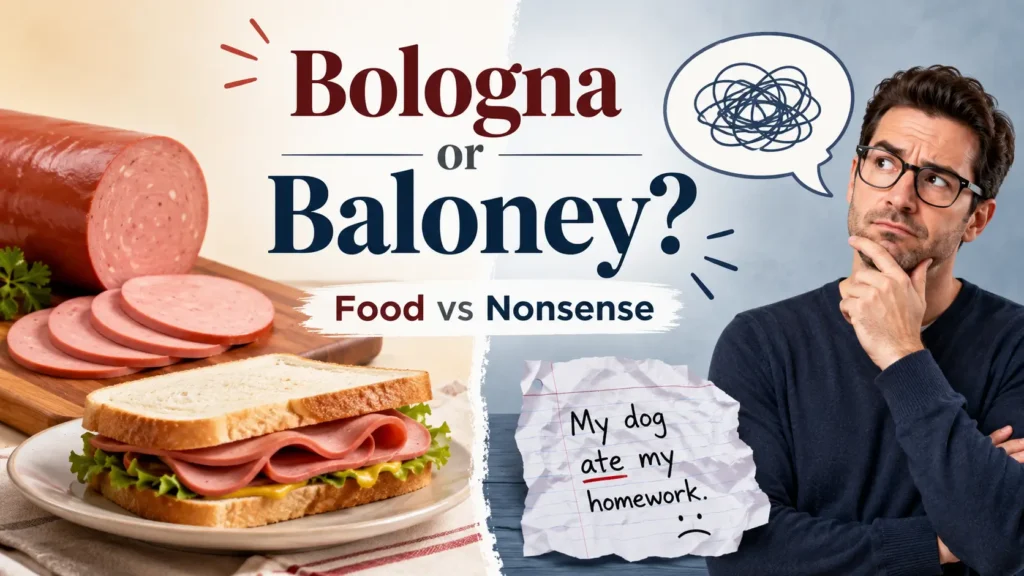
Bologna or Baloney confuses many readers because the two words sound almost the same, but they don’t mean the same thing. The purpose of this guide is simple: help you know when to use bologna for lunch meat and when to use baloney for nonsense or foolish talk.
In everyday English, bologna usually means a type of sausage made from finely ground meat. People often eat it in sandwiches, especially in America, where it became a popular deli food.
On the other hand, baloney means something false, silly, or hard to believe. So, if you’re talking about food, write bologna. If you’re talking about a fake excuse or deceptive talk, write baloney.
Quick Answer: Is It Bologna or Baloney?
Use bologna when you’re talking about the food.
Use baloney when you’re talking about nonsense.
That’s the cleanest rule.
| Word | Main Meaning | Best Use | Example |
| Bologna | A cooked sausage or deli meat | Food, recipes, grocery lists, sandwiches | I packed a bologna sandwich. |
| Baloney | Nonsense, foolish talk, or a false claim | Casual speech, criticism, informal writing | That story sounds like baloney. |
Here’s the easiest way to remember it:
If it goes between two slices of bread, it’s bologna. If it sounds like a lie, it’s baloney.
That one sentence solves most of the problem.
What Does Bologna Mean?
Bologna is a type of cooked sausage. In the United States, it’s usually sold as thin slices of lunch meat. People use it in sandwiches, fried bologna plates, lunchboxes, and deli trays.
Most American bologna has a smooth texture because the meat gets finely ground. It can include beef, pork, chicken, turkey, or a blend of meats. The exact ingredients depend on the brand, product type, and label.
Common types include:
- Beef bologna
- Turkey bologna
- Chicken bologna
- Garlic bologna
- Ring bologna
- Lebanon bologna
- Fried bologna
- Deli-sliced bologna
Bologna usually tastes mild, salty, and slightly smoky. It doesn’t have the bold spice of salami or the coarse texture of many traditional sausages. That’s part of its appeal. It’s simple, familiar, and easy to use.
For many Americans, bologna also carries a bit of nostalgia. It shows up in school lunches, cheap sandwiches, family picnics, and old-fashioned diners. It’s not fancy food. It’s practical food.
And sometimes, practical food sticks around because it does the job.
What Does Baloney Mean?
Baloney is an informal word that means nonsense, foolishness, or something untrue.
You use baloney when someone says something that sounds fake, exaggerated, or ridiculous.
For example:
- “That excuse is baloney.”
- “I don’t believe a word of that baloney.”
- “His story sounded like complete baloney.”
- “Stop feeding me baloney.”
The word has a casual tone. It’s not as harsh as calling someone a liar, but it still pushes back. It says, “That doesn’t sound right, and I’m not buying it.”
In formal writing, though, baloney can sound too conversational. Instead, use words like:
- nonsense
- false claim
- unsupported statement
- misleading argument
- fabrication
- empty rhetoric
So, in a text to a friend, “That’s baloney” works fine. In an academic essay or professional report, “That claim lacks evidence” sounds much better.
Read this also:https://grammarspark.com/fix-zenvekeypo4-software-issue/
Bologna or Baloney: Key Differences
The difference between bologna or baloney comes down to meaning, usage, and tone.
| Feature | Bologna | Baloney |
| Part of speech | Noun | Noun |
| Main meaning | Sausage or lunch meat | Nonsense or foolish talk |
| Tone | Neutral | Informal and dismissive |
| Common context | Food, cooking, grocery shopping | Arguments, excuses, claims, jokes |
| Pronunciation | Often “buh-LOH-nee” in American English | “buh-LOH-nee” |
| Example | She bought bologna at the deli. | His explanation was baloney. |
The confusion makes sense because the words sound almost identical. Still, their jobs are different.
Bologna belongs in the kitchen.
Baloney belongs in conversation.
Why Is Bologna Pronounced Like Baloney?
This is where English does what English loves to do: make things weird.
Bologna comes from Bologna, Italy, a city with a long food history. The Italian pronunciation doesn’t sound exactly like the American lunch meat pronunciation. Over time, English speakers reshaped the word into something easier and more familiar in everyday speech.
That’s how bologna became “buh-LOH-nee” in American English.
The spelling stayed close to the original place name. The pronunciation wandered off and bought a sandwich.
This happens often in English. Some words keep old spellings even after pronunciation changes. Think about:
- colonel
- Wednesday
- debris
- indict
- yacht
The letters don’t always behave. Bologna belongs in that same awkward club.
How to Pronounce Bologna and Baloney
In American English, both words usually sound like this:
buh-LOH-nee
That’s why people often spell bologna as baloney when they’re thinking by sound.
However, the spelling still matters.
| Word | Common American Pronunciation | Meaning |
| Bologna | buh-LOH-nee | Lunch meat or sausage |
| Baloney | buh-LOH-nee | Nonsense |
Here are examples with pronunciation in mind:
- “I want a bologna sandwich.”
Sounds like: “I want a buh-LOH-nee sandwich.” - “That excuse is baloney.”
Sounds like: “That excuse is buh-LOH-nee.”
The sound is almost the same. The spelling tells the reader what you mean.
Is Baloney Ever Correct for the Food?
Yes, but don’t lean on it.
Some dictionaries recognize baloney as a variant spelling for the sausage. However, in polished writing, recipes, menus, grocery content, and food articles, bologna looks more correct and professional.
For example:
Better:
- “Add two slices of bologna to the sandwich.”
- “The deli sells beef bologna by the pound.”
- “Fry the bologna until the edges crisp.”
Less polished:
- “Add two slices of baloney to the sandwich.”
Readers will probably understand “baloney sandwich.” Still, it looks casual, and some people will see it as a misspelling.
So, unless you’re writing dialogue, jokes, or a playful brand voice, use bologna for the food.
Why Does Baloney Mean Nonsense?
The slang meaning of baloney grew from the American pronunciation of bologna. By the early 20th century, people were using baloney to mean nonsense, foolish talk, or empty claims.
That shift isn’t as random as it looks.
Food words often become slang. Think about phrases like:
- “That’s cheesy.”
- “Don’t sugarcoat it.”
- “He’s full of beans.”
- “She spilled the tea.”
- “That idea is half-baked.”
Language loves turning everyday objects into colorful expressions. Baloney joined that tradition.
The word also has a funny sound. It feels light, goofy, and dismissive. That makes it useful when you want to reject something without sounding too severe.
Calling a claim “false” sounds serious.
Calling it “baloney” sounds like you swatted it away with a lunch tray.
Bologna vs Baloney in Real Sentences
Examples make the difference easier to see.
| Meaning | Correct Sentence |
| Food | I made a bologna and cheese sandwich. |
| Food | The butcher sliced the bologna thin. |
| Food | Fried bologna tastes better with crispy edges. |
| Nonsense | That excuse is pure baloney. |
| Nonsense | I’m tired of hearing political baloney. |
| Nonsense | Her sales pitch sounded like baloney. |
Now compare the wrong or awkward versions:
| Awkward or Incorrect | Better |
| I ate a baloney sandwich. | I ate a bologna sandwich. |
| That story is bologna. | That story is baloney. |
| The deli sells garlic baloney. | The deli sells garlic bologna. |
| Stop giving me bologna. | Stop giving me baloney. |
A few people may use “bologna” jokingly to mean nonsense. However, if you want clear standard usage, stick with baloney for nonsense.
What Is Bologna Made Of?
Bologna is usually made from finely ground meat, seasoning, curing ingredients, and sometimes smoke flavoring or real smoke. The meat may come from beef, pork, chicken, turkey, or a combination.
Typical bologna ingredients may include:
- Ground meat
- Water
- Salt
- Sugar or corn syrup
- Spices
- Garlic or onion powder
- Curing agents
- Smoke flavoring
- Preservatives
- Binders or fillers, depending on the product
The exact ingredient list changes by brand. That’s why the label matters.
Cheap bologna and premium bologna can taste very different. Some products are basic lunch meat. Others come from regional smokehouses or butcher shops and have deeper flavor, better seasoning, and firmer texture.
The “mystery meat” reputation comes from the smooth texture and processed nature of the product. Since the meat is finely ground, you can’t see individual cuts. That doesn’t automatically mean it’s unsafe or suspicious. It means the product has been processed into a uniform sausage.
Still, if you care about quality, read the label. Look for the meat type, sodium level, additives, and whether the product uses fillers.
Bologna and Mortadella: Are They the Same?
Bologna and mortadella are related, but they’re not the same thing.
Mortadella is an Italian sausage associated with Bologna, Italy. It’s usually richer, more aromatic, and more delicate than standard American bologna. Traditional mortadella may include visible cubes of fat, spices, and sometimes pistachios.
American bologna is more uniform. It’s smoother, milder, and often sold as sandwich slices.
Here’s the basic comparison:
| Feature | Bologna | Mortadella |
| Origin | American-style lunch meat with Italian roots | Italian sausage from Bologna |
| Texture | Smooth and uniform | Smooth but often richer, sometimes with visible fat cubes |
| Flavor | Mild, salty, lightly smoky | Richer, more aromatic, often more complex |
| Common use | Sandwiches, fried bologna, deli meat | Charcuterie boards, sandwiches, antipasto |
So, bologna isn’t “fake mortadella,” but it is a simpler American relative. Think of it as the lunchbox cousin.
How Long Does Bologna Last?
Food safety matters, especially with deli meats.
Packaged bologna should stay refrigerated at 40°F or below. Once opened, most lunch meats should be eaten within 3 to 5 days. Unopened packaged lunch meat often lasts around 2 weeks in the refrigerator, or until the date on the package if that comes first.
Freezing can extend storage, but it may change the texture.
| Bologna Type | Refrigerator Storage | Freezer Storage |
| Unopened packaged bologna | About 2 weeks or package date | 1 to 2 months for best quality |
| Opened packaged bologna | 3 to 5 days | 1 to 2 months for best quality |
| Deli-sliced bologna | 3 to 5 days | 1 to 2 months for best quality |
Throw bologna away if you notice:
- Sour or strange smell
- Slimy surface
- Gray or green discoloration
- Mold
- Sticky texture
- Package swelling
- Meat left out too long
Don’t taste questionable lunch meat to “check.” That’s not brave. That’s a stomachache audition.
Common Types of Bologna
Not all bologna tastes the same. Some types are mild and soft. Others are smoky, tangy, or garlicky.
| Type | What It’s Like | Common Use |
| Regular bologna | Mild, smooth, classic lunch meat | Sandwiches |
| Beef bologna | Made from beef, usually firmer flavor | Deli sandwiches |
| Turkey bologna | Lighter alternative, often lower in fat | School lunches, lighter sandwiches |
| Garlic bologna | Stronger seasoning | Cold cuts, snacks |
| Ring bologna | Sold in a ring shape, often smoked | Sliced, fried, or served with crackers |
| Lebanon bologna | Tangy, smoky, fermented-style meat | Regional sandwiches and snack trays |
| Fried bologna | Pan-fried until browned | Breakfast or diner-style sandwiches |
If you only know basic supermarket bologna, regional styles may surprise you. Some have enough personality to make the plain pink slices look sleepy.
Bologna in American Food Culture
Bologna became popular in the United States because it was affordable, convenient, and easy to pack. It didn’t need fancy preparation. You could slap it on bread, add mustard, and call lunch done.
That convenience made it a staple in:
- School lunches
- Factory lunches
- Road trips
- Diner menus
- Picnic baskets
- Budget meals
- Family refrigerators
The classic bologna sandwich usually includes white bread, bologna slices, and a simple condiment like mustard or mayonnaise. Some people add American cheese, pickles, lettuce, tomato, or potato chips for crunch.
Then there’s fried bologna.
Frying changes everything. The edges curl. The surface browns. The flavor gets saltier and deeper. A slice that seemed plain in the package suddenly earns its keep in a hot skillet.
Popular fried bologna additions include:
- Fried egg
- Melted American cheese
- Mustard
- Pickles
- Grilled onions
- Toasted white bread
- Hot sauce
It’s not elegant. It doesn’t need to be. Sometimes food wins because it knows exactly what it is.
Grammar Tips for Bologna or Baloney
The grammar is simple because both words usually work as nouns.
Use bologna as a noun for food
Examples:
- “The bologna is in the fridge.”
- “She ordered a bologna sandwich.”
- “He fried two slices of bologna.”
You don’t usually use bologna as an adjective unless it’s modifying another food noun.
Examples:
- bologna sandwich
- bologna slices
- bologna roll
- bologna lunch meat
Use baloney as a noun for nonsense
Examples:
- “That’s baloney.”
- “I’ve heard enough baloney today.”
- “The claim was complete baloney.”
You can also use it before another noun in casual phrases.
Examples:
- baloney excuse
- baloney story
- baloney argument
- baloney claim
These phrases sound informal. They work in blogs, dialogue, opinion writing, and casual conversation. They don’t work as well in legal, academic, or technical writing.
Read this also:https://grammarspark.com/attorney-or-lawyer/
Common Mistakes With Bologna and Baloney
Most mistakes happen because people spell the word the way it sounds.
Writing “baloney sandwich”
This is common, but it’s not the best spelling.
Use:
- “I made a bologna sandwich.”
Not:
- “I made a baloney sandwich.”
Again, people will understand the second version. But if you want clean writing, use bologna for the food.
Writing “that’s bologna”
This one looks odd unless you’re making a joke.
Use:
- “That’s baloney.”
Not:
- “That’s bologna.”
The phrase “that’s baloney” means the statement is nonsense. “That’s bologna” sounds like you’re pointing at lunch meat.
Using baloney in formal writing
“Baloney” sounds casual. That’s fine in a blog or conversation, but weak in formal contexts.
Instead of this:
- “The author’s argument is baloney.”
Write this:
- “The author’s argument is unsupported.”
- “The claim lacks evidence.”
- “The conclusion doesn’t follow from the data.”
Confusing pronunciation with spelling
The pronunciation may match, but the spelling changes the meaning.
That’s the whole trap.
Bologna and baloney sound alike in many American accents, but they don’t do the same job on the page.
Memory Tricks for Bologna or Baloney
A good memory trick saves you from second-guessing the word every time.
Use these:
- Bologna has “log” in it. Imagine a log-shaped sausage.
- Baloney has “bal” like “blah.” Imagine someone talking blah, blah, blah.
- Bologna belongs in a sandwich.
- Baloney belongs in an argument.
- Bologna is food. Baloney is foolishness.
Here’s the strongest shortcut:
Bread needs bologna. Bad excuses need baloney.
Simple. Sticky. Hard to forget.
Synonyms for Baloney
Since baloney is informal, synonyms help you choose the right tone.
| Word | Tone | Example |
| Nonsense | Neutral | That claim is nonsense. |
| Rubbish | Informal, common in British English | What a load of rubbish. |
| Hogwash | Playful, old-fashioned | That theory is hogwash. |
| Malarkey | Folksy, humorous | I’m tired of this malarkey. |
| Bunk | Informal | His excuse was bunk. |
| Claptrap | Sharp, old-fashioned | The speech was full of claptrap. |
| Garbage | Direct, blunt | That argument is garbage. |
| Fabrication | Formal | The story was a fabrication. |
| Falsehood | Formal | The statement was a falsehood. |
Use baloney when you want a casual, slightly playful word. Use falsehood or unsupported claim when you need a serious tone.
Related Words for Bologna
If you’re writing about food, these related terms may help:
- Lunch meat
- Cold cuts
- Deli meat
- Processed meat
- Sausage
- Mortadella
- Hot dogs
- Frankfurters
- Ring bologna
- Charcuterie
- Cured meat
- Smoked sausage
Don’t use all of these in one paragraph just to look optimized. That feels forced. Instead, use the terms where they naturally fit.
For example, if you’re comparing bologna with salami, “cold cuts” and “deli meat” make sense. If you’re explaining the origin, “mortadella” belongs there. If you’re discussing storage, “processed meat” or “lunch meat” may fit better.
Good SEO doesn’t mean stuffing words. It means answering the full question clearly.
Real-Life Examples of Bologna and Baloney
Let’s put both words into everyday situations.
At the grocery store
Correct:
- “Can you grab bologna from the deli counter?”
- “Do you want beef bologna or turkey bologna?”
- “This bologna expires next week.”
Incorrect or awkward:
- “Can you grab baloney from the deli counter?”
During an argument
Correct:
- “That’s baloney, and you know it.”
- “His explanation sounded like baloney.”
- “She didn’t fall for the baloney.”
Incorrect or awkward:
- “That’s bologna, and you know it.”
In a recipe
Correct:
- “Fry the bologna for two minutes per side.”
- “Layer bologna, cheese, and pickles on white bread.”
- “Cut a small slit in the bologna so it doesn’t puff up in the pan.”
Incorrect:
- “Fry the baloney for two minutes per side.”
In a review or opinion piece
Correct:
- “The company’s promise sounded like marketing baloney.”
- “The claim wasn’t just weak. It was pure baloney.”
More formal:
- “The company’s promise lacked evidence.”
- “The claim was misleading.”
Bologna or Baloney for Writers, Students, and Editors
If you’re writing for school, work, or publication, choose the word based on meaning first and tone second.
Use bologna when the topic is food.
Use baloney when the topic is nonsense, but only if the tone allows it.
Here’s a practical editing test:
| Sentence | Best Word | Why |
| I ate a ___ sandwich. | bologna | It refers to lunch meat. |
| That excuse is ___. | baloney | It means nonsense. |
| The deli sliced the ___. | bologna | A deli slices meat. |
| The speech was full of ___. | baloney | It means empty talk. |
| We fried ___ for breakfast. | bologna | It refers to food. |
| Don’t give me that ___. | baloney | It means false talk. |
This is also useful for ESL learners because pronunciation can mislead them. English spelling often tells you the meaning even when sound doesn’t help.
Should You Use “Bologna” or “Baloney” in SEO Content?
If you’re writing SEO content, use both words carefully because searchers may type either one.
For a language article, the focus keyword bologna or baloney works well because it captures the user’s confusion. Related headings like bologna vs baloney, is it bologna or baloney, and why is bologna pronounced baloney also match real search intent.
However, don’t overload the article with the exact phrase. That reads badly.
Use natural variations:
- bologna or baloney
- bologna vs baloney
- baloney vs bologna
- difference between bologna and baloney
- how to spell bologna
- meaning of baloney
- bologna pronunciation
The best SEO approach is simple: answer the question completely, then support it with examples, tables, and practical usage notes.
Search engines don’t need keyword soup. Readers don’t either.
FAQs About Bologna or Baloney
Q1:What is the difference between bologna and baloney?
Bologna means a cooked sausage or lunch meat. Baloney means nonsense, false talk, or a foolish statement. They often sound alike, but they have different meanings.
Q2:Is it correct to say bologna sandwich or baloney sandwich?
The correct phrase is bologna sandwich. Some people write baloney sandwich casually, but bologna is the proper spelling when talking about food.
Q3:Why is bologna pronounced like baloney?
Bologna comes from Bologna, an Italian city, but its pronunciation changed in American English. That’s why many people pronounce it like baloney, even though the spelling looks different.
Q4:What does baloney mean in slang?
In slang, baloney means nonsense, foolish talk, or something that sounds untrue. For example, “That excuse is baloney” means the excuse is hard to believe.
Q5:Is baloney a real word?
Yes, baloney is a real word. It is commonly used in informal English to mean nonsense or deceptive talk. However, for the food, bologna is the better spelling.
Conclusion: Bologna Is Lunch Meat, Baloney Is Nonsense
The difference between Bologna or Baloney becomes easy once you connect each word to its real use. Bologna is the correct word for the sausage, lunch meat, or sandwich filling. Baloney is the better word when you mean nonsense, foolish talk, or an unbelievable claim.
Both words may sound alike in American English, which is why the confusion happens. Still, their spellings and meanings are different. One belongs at the deli counter. The other belongs in a conversation when something sounds false.
The easiest rule is this: if you can eat it, use bologna. If you don’t believe it, call it baloney.
