
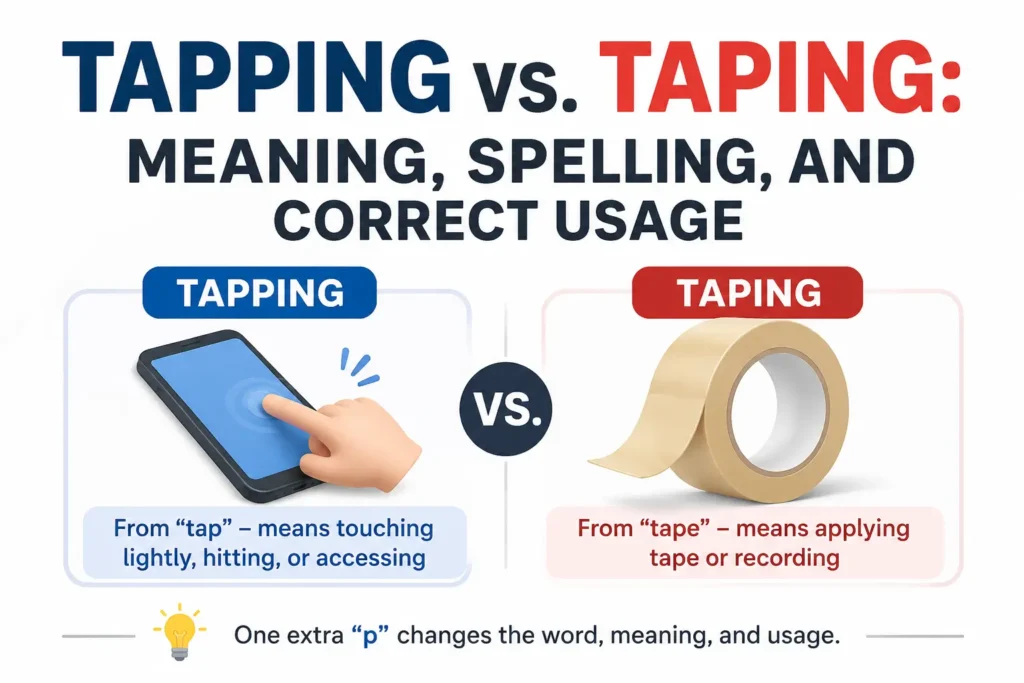
Tapping vs. Taping looks like a small spelling issue, but one extra “p” changes the base verb, meaning, pronunciation, and correct usage in English. Tap becomes tapping or tapped, while tape becomes taping or taped. This spelling difference helps you choose the right word in each context.
Use tapping for lightly touching, small repeated hits, screen selection, phone tapping, system access, drawing sap, or thread cutting. For example, you may tap a phone screen, notice drumming fingers on a desk, or tap into a useful resource. In each case, the action involves touch, access, or repeated pressure.
Use taping for sealing, attaching, wrapping, support, or recording. You may tape a box for delivery, apply athletic taping or medical taping, secure items during electrical work, or record an interview. This simple comparison prevents common mistakes in school and professional writing. It also improves clarity for readers.
Quick Answer: What Is the Difference Between Tapping and Taping?
Use tapping when someone lightly touches, hits, selects, or gains access to something.
- She was tapping her fingers on the desk.
- He opened the app by tapping the icon.
- The company is tapping into a new customer base.
Use taping when someone applies tape or records something.
- She is taping the box shut.
- The trainer is taping his ankle.
- They are taping the interview this afternoon.
Easy rule: If the action involves a light touch, repeated hit, or access, use tapping. If it involves adhesive tape or recording, use taping.
Tapping vs. Taping at a Glance
| Word | Base verb | Main meaning | Pronunciation | Example |
| Tapping | Tap | Touching lightly, striking, selecting, accessing, or intercepting | TAP-ing | She is tapping the screen. |
| Taping | Tape | Applying tape or recording | TAY-ping | He is taping the package. |
| Tapped | Tap | Past tense of tap | TAPT | She tapped on the door. |
| Taped | Tape | Past tense of tape | TAYPT | He taped the sign to the wall. |
The vowel sound offers another useful clue. Tapping has the short a sound heard in cat. Taping has the long a sound heard in day.
What Does “Tapping” Mean?
Tapping is the present participle and gerund form of the verb tap. A present participle helps form continuous verb tenses, while a gerund acts as a noun.
- She is tapping the table.
Here, tapping forms the present continuous tense. - Tapping the table was distracting.
Here, tapping acts as a noun and names the action.
The exact meaning changes with context.
Tapping as Light or Repeated Touching
The most common meaning of tapping is touching or striking something lightly, often more than once.
- Marcus kept tapping his pen during the meeting.
- Someone was tapping on the window.
- She got my attention by tapping my shoulder.
- The dancer was tapping her foot to the music.
A tap is usually gentle. Therefore, tapping doesn’t normally suggest a hard hit.
Compare these sentences:
- He was tapping the door with one finger.
- He was pounding on the door with his fist.
Both describe contact with the door. However, pounding suggests much more force.
Tapping a Screen or Digital Device
In modern American English, tapping often means touching a touchscreen to choose an option.
- Tap the blue button to continue.
- She opened the message by tapping the notification.
- You can pay by tapping your card on the reader.
- He accidentally deleted the photo after tapping the wrong icon.
People often use tap instead of click when talking about phones and tablets. A mouse usually clicks, while a finger usually taps.
However, informal speakers sometimes use click for any digital selection. The word is understandable, but tap is more precise for a touchscreen.
Read this also: Symptomatology vs. Symptomology: Meaning, Difference, and Correct Usage
Tapping Into a Resource, Skill, or Opportunity
The phrasal verb tap into means to access, use, or benefit from a resource.
That resource may be physical, financial, social, emotional, or intellectual.
- The company is tapping into demand for affordable electric cars.
- Students can tap into the school’s online research database.
- She tapped into her previous experience to solve the problem.
- The campaign hopes to tap into younger voters’ concerns.
- Small businesses can tap into local grant programs.
In these examples, no one is physically touching anything. Instead, the phrase describes gaining access to something useful.
Tap into is common in business, marketing, education, and professional writing. Still, it can sound vague when the resource isn’t clearly named.
Vague:
- We need to tap into new possibilities.
Clearer:
- We need to tap into new distribution channels in the Midwest.
The second sentence tells the reader exactly what the company plans to access.
Phone Tapping and Wiretapping
Phone tapping means secretly intercepting or monitoring phone communications. The more formal word is wiretapping.
- Police obtained legal authorization before tapping the suspect’s phone.
- The investigation involved allegations of illegal phone tapping.
- Federal law limits when authorities may conduct a wiretap.
This use can cause confusion because intercepted calls may also be recorded. However, tapping a phone focuses on gaining access to the communication.
By contrast, taping a phone conversation focuses on recording it.
- They were accused of tapping the phone line.
They intercepted the communication. - She was taping the phone conversation.
She was recording the conversation.
The legal rules for recording or intercepting calls vary by location. Therefore, the grammar distinction doesn’t tell you whether the action is lawful.
Tapping in Music
In music, tapping may describe keeping a beat or using a special playing technique.
- He was tapping his foot in time with the song.
- The drummer kept tapping the cymbal softly.
- The guitarist used two-handed tapping during the solo.
In guitar playing, tapping involves pressing or striking notes directly on the fretboard with the fingers of one or both hands.
Tapping a Tree
Tapping a tree means making an opening so that sap can flow out.
- Farmers begin tapping maple trees near the end of winter.
- The workers tapped the trees and collected the sap in containers.
This meaning comes from gaining access to a natural resource. It connects closely with the figurative phrase tap into.
Tapping in Manufacturing
In mechanical work, tapping means cutting internal threads inside a hole. Those threads allow a screw or bolt to fit.
- The technician is tapping holes in the metal plate.
- Use the correct tool before tapping the hole.
- Poor alignment can damage the threads during the tapping process.
A tool called a tap creates the internal thread. In contrast, a die usually cuts external threads on a rod or bolt.
This technical meaning is valid, but it appears mainly in manufacturing, machining, and engineering contexts.
Tapping as a Therapy Term
Tapping may also refer to Emotional Freedom Techniques, often called EFT tapping. The method involves tapping certain points on the body while focusing on emotions or distress.
In grammar terms, the word still describes repeated light touches. However, claims about therapeutic results should be judged separately from the meaning of the word.
What Does “Taping” Mean?
Taping is the present participle and gerund form of tape.
- He is taping the package.
Here, taping forms a continuous verb tense. - Taping the package took only a minute.
Here, taping acts as a noun.
The verb tape has two main meanings: applying adhesive tape and recording something.
Taping Something With Adhesive Tape
Use taping when someone attaches, seals, repairs, covers, or secures something with tape.
- She is taping the shipping label to the box.
- We’re taping plastic over the broken window.
- He spent the afternoon taping the walls before painting.
- The teacher was taping student artwork to the bulletin board.
- They are taping the cable to the floor to prevent tripping.
The type of tape often gives more information about the action.
- Packing tape seals boxes.
- Painter’s tape protects edges during painting.
- Electrical tape insulates electrical wires.
- Medical tape holds dressings or equipment in place.
- Duct tape handles temporary repairs and other general tasks.
Because different tapes have different purposes, taping alone may not provide enough detail in technical instructions.
Less precise:
- Tape the wire.
More precise:
- Wrap the connection with approved electrical tape.
Taping Audio or Video
Taping can also mean recording audio or video.
- The station is taping the show in front of a live audience.
- We’ll be taping the podcast on Friday.
- She asked whether the meeting was being taped.
- They taped the interview before it aired.
This usage began when recordings were commonly stored on magnetic tape. Today, most recordings are digital. Even so, tape, taping, and taped remain common in American English.
However, recording is often clearer in formal or technical communication.
Casual:
- We’re taping the presentation tomorrow.
More precise:
- We’re recording the presentation tomorrow.
Both are correct. Still, recording avoids any possible confusion about the format or method.
Taping in Sports and Medical Settings
In sports and health-related contexts, taping means applying athletic, medical, or kinesiology tape to part of the body.
- The athletic trainer is taping the player’s ankle.
- She began taping her wrist before practice.
- The nurse was taping the bandage in place.
- Proper taping can help keep protective padding from moving.
The word identifies the action being performed. It doesn’t, by itself, prove that a technique is safe or effective for a specific injury.
Also, taping an ankle and tapping an ankle mean different things:
- Taping an ankle means applying tape.
- Tapping an ankle means touching or striking it lightly.
The Key Differences Between Tapping and Taping
| Situation | Correct word | Why |
| Touching a phone screen | Tapping | You’re making a light touch. |
| Sealing a cardboard box | Taping | You’re using adhesive tape. |
| Recording an interview | Taping | Tape can mean record. |
| Touching someone’s shoulder | Tapping | You’re making light physical contact. |
| Accessing a new market | Tapping into | You’re making use of a resource or opportunity. |
| Applying athletic tape | Taping | Tape is being placed on the body. |
| Intercepting phone calls | Tapping | You’re accessing a communication line. |
| Keeping time with your foot | Tapping | You’re making a repeated light movement. |
| Attaching a poster to a wall | Taping | Adhesive tape is being used. |
| Cutting internal screw threads | Tapping | This is the technical machining term. |
The central difference is the base verb. Ask yourself whether the intended verb is tap or tape. Once you identify the base word, the correct -ing form becomes clear.
Why Do People Confuse Tapping and Taping?
These words are easy to mix up for several reasons.
First, they look almost identical. The only visible difference is the second p in tapping.
Second, both words describe common actions. As a result, spell-check software may not flag the mistake. Tapping and taping are both real words.
Third, their pronunciation can sound similar in fast speech. However, the vowel sounds are different:
- Tapping: /ˈtæpɪŋ/, with the vowel sound in cat
- Taping: /ˈteɪpɪŋ/, with the vowel sound in day
Finally, autocorrect may replace one word with the other. Therefore, you should check the meaning instead of relying only on spelling software.
The Spelling Rule Behind Tapping and Taping
The difference between tapping and taping follows standard English spelling patterns.
Why “Tap” Becomes “Tapping”
The verb tap ends in a consonant-vowel-consonant pattern:
- t is a consonant.
- a is a vowel.
- p is a consonant.
For many one-syllable verbs with this pattern, double the final consonant before adding -ing.
tap + p + ing = tapping
Other examples include:
| Base verb | Correct -ing form |
| Run | Running |
| Sit | Sitting |
| Plan | Planning |
| Stop | Stopping |
| Swim | Swimming |
| Cut | Cutting |
Doubling the consonant helps preserve the short vowel sound.
Without the extra p, taping would follow the silent-e pattern and have a long a sound.
Why “Tape” Becomes “Taping”
The verb tape ends with a silent e. In most cases, you remove the silent e before adding -ing.
tape − e + ing = taping
Other examples include:
| Base verb | Correct -ing form |
| Make | Making |
| Hope | Hoping |
| Use | Using |
| Write | Writing |
| Drive | Driving |
| Smile | Smiling |
The silent e affects the earlier vowel sound. For example, tap has a short a, while tape has a long a.
When the Final Consonant Isn’t Doubled
Not every verb ending in a consonant-vowel-consonant pattern doubles its last letter.
For example:
- open → opening
- visit → visiting
- listen → listening
- happen → happening
These words have more than one syllable, and the final syllable isn’t stressed.
Compare:
- begin → beginning
- visit → visiting
The final syllable in begin is stressed, so the n doubles. The final syllable in visit isn’t stressed, so the t doesn’t double.
American and British spelling sometimes differ in this area. For instance:
- American English: traveling
- British English: travelling
However, tapping and taping are spelled the same in both varieties.
Tap vs. Tape: Understanding the Base Verbs
The easiest way to choose between the two forms is to study the original verbs.
Common Meanings of “Tap”
As a verb, tap can mean:
- To touch lightly
- To strike gently or repeatedly
- To select something on a touchscreen
- To access a resource
- To intercept communication
- To collect liquid from a source
- To cut internal threads in a hole
Examples:
- Tap the icon to begin.
- She tapped me on the arm.
- The company tapped a new source of funding.
- Workers tapped the maple trees.
- The machinist tapped the hole.
Common Meanings of “Tape”
As a verb, tape can mean:
- To attach something with adhesive tape
- To seal or repair something with tape
- To apply athletic or medical tape
- To record sound or video
Examples:
- Tape the receipt to the form.
- They taped the broken handle.
- The trainer taped his knee.
- We taped the episode last week.
Tap and Tape as Nouns
Both words can also function as nouns.
A tap may mean:
- A light touch or hit
- A faucet, especially in British English
- A tool used to cut internal threads
- A device or connection used to access a flow
A tape may mean:
- A narrow strip of material with adhesive
- A measuring tape
- Magnetic recording material
- A recording
Examples:
- I heard a tap at the window.
- She bought a roll of tape.
- Measure the wall with a tape.
- The station discovered an old interview tape.
In everyday American English, faucet is more common than tap for the device that controls water. Still, Americans understand expressions such as tap water.
Tapped vs. Taped: Past-Tense Forms
The past tense of tap is tapped. The past tense of tape is taped.
| Base verb | Present participle | Past tense | Past participle |
| Tap | Tapping | Tapped | Tapped |
| Tape | Taping | Taped | Taped |
When to Use “Tapped”
Use tapped when the past action involved touching, striking, selecting, accessing, or intercepting.
- She tapped the screen twice.
- He tapped me on the shoulder.
- The company tapped into its emergency funds.
- Investigators allegedly tapped the phone.
- The musician tapped his foot throughout the song.
When to Use “Taped”
Use taped when the past action involved adhesive tape or recording.
- She taped the box shut.
- We taped the interview yesterday.
- The trainer taped the athlete’s wrist.
- He taped the note to the refrigerator.
- They taped cables to the floor.
The same distinction applies in perfect tenses:
- She has tapped the wrong button.
- She has taped the package securely.
Correct Examples of Tapping and Taping
Examples of “Tapping” in Sentences
- I heard someone tapping at the front door.
- Maya kept tapping her foot during the exam.
- Open the menu by tapping the three dots.
- The startup is tapping into demand for remote health services.
- He was tapping a rhythm on the steering wheel.
- Workers began tapping the maple trees in February.
- The technician finished tapping the holes for the bolts.
- She got his attention by tapping him gently on the elbow.
Examples of “Taping” in Sentences
- Carlos is taping the moving boxes.
- The crew is taping an episode in Chicago.
- She is taping the torn page back together.
- The painter spent an hour taping the window frames.
- A trainer was taping the quarterback’s ankle.
- They’re taping the wires down before the event.
- The student is taping photos to the presentation board.
- We’ll be taping the webinar instead of streaming it live.
Side-by-Side Examples
These pairs show how one letter changes the meaning.
A Box
- She was tapping the box to hear what was inside.
- She was taping the box before shipping it.
In the first sentence, she lightly struck the box. In the second, she sealed it with tape.
A Phone
- He was tapping the phone screen.
- He was taping a phone conversation.
The first action involves touch. The second involves recording.
An Ankle
- The doctor was tapping the ankle to test a response.
- The trainer was taping the ankle for support.
The actions may happen in similar settings, but they aren’t the same.
A Performance
- The child was tapping along with the song.
- The producer was taping the performance.
The child was keeping the rhythm. Meanwhile, the producer was recording the event.
Taping or Tapping a Video?
Both phrases can be correct, but they mean different things.
Use taping a video when you mean recording it:
- We’re taping a video for the company website.
- They taped the training video last Monday.
Use tapping a video when you mean touching or selecting a video on a screen:
- She opened the clip by tapping the video.
- Try tapping the video to display the controls.
In modern professional writing, recording a video is often clearer than taping a video. Still, both expressions are grammatically correct.
Taping or Tapping a Phone?
The correct choice depends on the action.
Tapping a Phone Screen
Use tapping for touching the screen.
- I opened the email by tapping my phone.
- Stop tapping the screen so quickly.
For extra clarity, say tapping the phone screen rather than simply tapping the phone.
Tapping a Phone Line
Use tapping for intercepting communications.
- The agency was accused of tapping journalists’ phones.
- A court order may be required before tapping a phone line.
Taping a Phone Conversation
Use taping for recording.
- He admitted to taping the phone conversation.
- The customer service call may be taped for training purposes.
However, recording is usually the clearest word in legal, professional, or technical contexts.
Taping or Tapping an Injury?
Use taping when adhesive tape is applied to an injured area, bandage, or joint.
- She is taping her injured wrist.
- The trainer taped the player’s ankle.
- He taped the bandage in place.
Use tapping when the area is touched lightly.
- The examiner was tapping the patient’s knee.
- She felt pain when he tapped the injured area.
Therefore, tapping an injury and taping an injury describe entirely different actions.
Common Mistakes and Corrections
Mistake: “Taping the Screen”
Incorrect:
- Open the app by taping the icon.
Correct:
- Open the app by tapping the icon.
You touch an icon. You don’t attach tape to it.
Mistake: “Tapping a Package Shut”
Incorrect:
- He is tapping the package shut.
Correct:
- He is taping the package shut.
The action uses adhesive tape, so the base verb is tape.
Mistake: “Tapping an Interview”
Incorrect:
- We’re tapping an interview this afternoon.
Correct:
- We’re taping an interview this afternoon.
- We’re recording an interview this afternoon.
An interview may be taped or recorded. It isn’t normally tapped.
Mistake: Using the Wrong Past Tense
Incorrect:
- She taped on the window.
Correct:
- She tapped on the window.
The action was a light knock, so the verb is tap.
Mistake: Assuming Taping Always Uses Physical Tape
The word taping doesn’t always involve an adhesive strip.
- The studio is taping a new game show.
Here, taping means recording. The expression remains common even when the recording is digital.
Mistake: Writing “Tappping”
Incorrect:
- She is tappping her foot.
Correct:
- She is tapping her foot.
Double the final p only once. The correct word contains two consecutive p’s, not three.
Mistake: Writing “Tapeing”
Incorrect:
- He is tapeing the box.
Correct:
- He is taping the box.
Drop the silent e before adding -ing.
Formal, Informal, and Professional Usage
Both words appear in casual and formal English. However, some meanings fit certain settings better than others.
Everyday English
Common casual uses include:
- Tapping a phone screen
- Tapping someone’s shoulder
- Taping a package
- Taping a television show
These phrases sound natural in conversation, texting, and informal writing.
Business and Professional English
In professional settings, tapping into is common:
- The company plans to tap into overseas markets.
- The program helps graduates tap into industry networks.
However, it can become overused. A more exact verb may improve formal writing.
Instead of:
- We will tap into the data.
Consider:
- We will analyze the data.
- We will access the database.
- We will use the customer records.
Choose the verb that states the action most clearly.
Academic and Technical English
Academic writing usually favors precise wording.
Instead of:
- The session was taped.
A researcher might write:
- The interview was audio-recorded.
- The session was digitally recorded.
- The lecture was recorded for later analysis.
Similarly, a technical manual should identify the type of taping or tapping involved.
- Apply electrical tape to the insulated connection.
- Cut an M6 internal thread by tapping the hole.
Specific language reduces confusion.
Synonyms and Related Words
Words Related to “Tapping”
Depending on the context, possible alternatives include:
| Meaning | Related words |
| Touching lightly | Patting, touching, nudging |
| Striking repeatedly | Knocking, drumming, beating |
| Using a screen | Pressing, selecting, touching |
| Accessing a resource | Using, accessing, drawing on |
| Phone surveillance | Wiretapping, intercepting, monitoring |
| Making a rhythm | Drumming, beating, keeping time |
These words aren’t always interchangeable. For example, patting usually involves a flat hand, while tapping often involves fingers or a small object.
Words Related to “Taping”
Possible alternatives include:
| Meaning | Related words |
| Using adhesive tape | Attaching, fastening, sealing, securing |
| Recording | Filming, recording, capturing |
| Medical or sports use | Wrapping, supporting, securing |
| Painting preparation | Masking, covering, protecting |
Again, context matters. Filming refers specifically to video or motion-picture recording, while recording can refer to audio, video, or data.
Easy Memory Tricks
A simple memory trick can help you choose the right spelling.
Look for “Tape” Inside “Taping”
The word taping begins with the complete word tape, except the silent e disappears before -ing.
Think:
tape → taping
If the action involves adhesive tape or making a recording, choose the one-p spelling.
Remember the Double Tap
A double tap involves tapping twice. Likewise, tapping contains a double p.
Think:
tap → tapping
This isn’t the formal spelling rule, but it’s an effective memory aid.
Listen to the Vowel
- Tapping sounds like rapping.
- Taping sounds like shaping.
If you hear the long a sound, the word is probably taping.
Quick Decision Checklist
Before writing either word, ask these questions:
- Am I describing a light touch or repeated hit? Use tapping.
- Am I selecting something on a touchscreen? Use tapping.
- Am I accessing a resource or opportunity? Use tapping into.
- Am I intercepting a communication line? Use tapping.
- Am I collecting sap from a tree? Use tapping.
- Am I cutting internal screw threads? Use tapping.
- Am I attaching or sealing something with tape? Use taping.
- Am I applying athletic or medical tape? Use taping.
- Am I recording audio or video? Use taping or recording.
Real-Life Cases Where the Difference Matters
Workplace Email
Unclear:
- We’ll be tapping the client presentation tomorrow.
Correct:
- We’ll be taping the client presentation tomorrow.
- We’ll be recording the client presentation tomorrow.
The first version suggests light touching rather than recording. In a workplace message, recording gives the clearest meaning.
Shipping Instructions
Incorrect:
- Finish tapping the boxes before pickup.
Correct:
- Finish taping the boxes before pickup.
Because the workers are sealing boxes with tape, taping is required.
Mobile App Directions
Incorrect:
- Continue by taping the arrow.
Correct:
- Continue by tapping the arrow.
The user needs to touch the arrow on the screen. Therefore, tapping is the correct action.
Business Strategy
Correct:
- The retailer is tapping into demand for same-day delivery.
Here, tapping into means using or benefiting from a market opportunity. No physical tapping takes place.
Frequently Asked Questions
Q1.What is the main difference between tapping and taping?
Tapping means touching, hitting, or pressing something lightly. It can also mean selecting an option on a screen or accessing a resource. Taping means using adhesive tape or recording audio or video.
Q2.Why does tapping have two p’s?
The verb tap ends in a short vowel followed by one consonant. Therefore, the final p doubles before adding -ing:
tap + p + ing = tapping
Q3.Why is taping spelled with only one p?
Taping comes from the verb tape. English spelling rules require you to remove the silent e before adding -ing:
tape − e + ing = taping
Q4.Is it tapping or taping a phone?
Use tapping when touching a phone screen or secretly intercepting phone calls. Use taping when recording a phone conversation. The correct word depends on the action.
Q5.Is it tapping or taping a video?
Use taping a video when you mean recording it. Use tapping a video when you mean touching or selecting the video on a phone, tablet, or touchscreen.
Conclusion
The difference between Tapping vs. Taping becomes easy once you identify the original verb. Tapping comes from tap and describes light touching, repeated hitting, screen selection, accessing resources, or phone interception. Taping comes from tape and refers to attaching, sealing, supporting, or recording something.
Remember the spelling pattern: tap becomes tapping, while tape becomes taping. Before choosing a word, think about the action. If it involves a touch, hit, or access, use tapping. If it involves adhesive tape or recording, use taping. This simple check will help you avoid common mistakes and write with greater clarity, accuracy, and confidence.
