
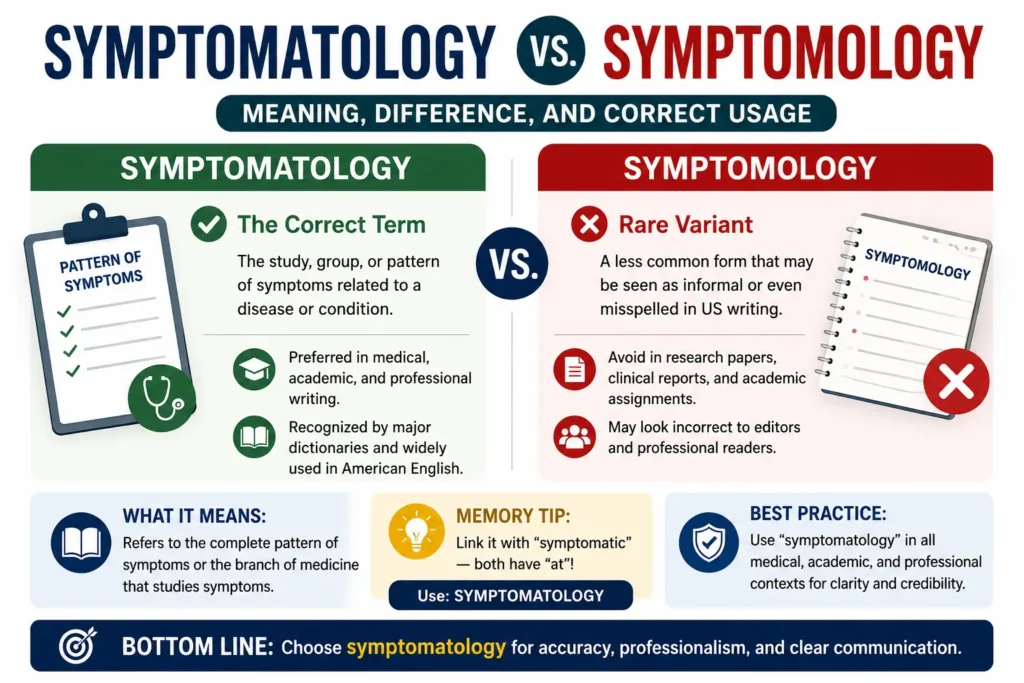
Symptomatology vs Symptomology is simple: symptomatology is the standard medical term, while symptomology is a rare variant in formal US writing.
Use symptomatology in a clinical report, research paper, academic assignment, or professional health article. It means the study, group, or pattern of symptoms linked to a patient or condition. Although some dictionaries record symptomology, many US readers may see it as an informal or mistaken form. Therefore, the longer spelling protects clarity and professional credibility. This choice also follows common American medical and academic usage.
The confusion happens because the words look and sound almost identical. A useful memory trick is to connect symptomatology with symptomatic; both keep the letters “at.” Before submitting medical or scientific work, check your spelling and replace symptomology with the preferred term. In patient-facing writing, however, use the simpler word symptoms when the technical term adds no useful precision.
Quick Answer: Symptomatology or Symptomology?
Use symptomatology in standard American English.
Merriam-Webster defines symptomatology in two ways:
- The complete group or pattern of symptoms linked to a disease
- The branch of medical science concerned with disease symptoms
Meanwhile, Collins Dictionary records symptomology as a British variant. Therefore, it isn’t accurate to say that the shorter form has never existed. Still, it is far less established in American medical writing.
Best rule: Use symptomatology in medical, academic, and professional work. Use the simpler word symptoms when technical language isn’t needed.
Symptomatology vs. Symptomology at a Glance
| Feature | Symptomatology | Symptomology |
| Standard in American English | Yes | Generally no |
| Meaning | A symptom pattern or the study of symptoms | Usually intended to mean the same thing |
| Common in medical writing | Yes | Rare |
| Suitable for academic papers | Yes | Best avoided |
| Dictionary status | Widely recognized | Listed as a variant by some sources |
| Likely reader reaction | Professional and familiar | May look shortened or misspelled |
| Recommended choice | Use it | Replace it in most US writing |
The key point is simple. These aren’t usually two separate medical concepts. Instead, symptomology functions as a rare variant of the established word symptomatology.
What Does Symptomatology Mean?
Symptomatology is a noun that describes either a collection of symptoms or the study of those symptoms.
Its exact meaning depends on the sentence.
A Group or Pattern of Symptoms
In clinical writing, symptomatology often means the complete pattern of symptoms linked to a patient, illness, or disorder.
For example:
- The condition has a complex symptomatology.
- Her neurological symptomatology developed gradually.
- Researchers compared the symptomatology of the two disorders.
In these sentences, the word covers more than a list. It may include:
- Which symptoms occur
- When they begin
- How severe they are
- How long they last
- How often they appear
- What makes them better or worse
- Whether they change over time
- Which symptoms occur together
Therefore, a symptom pattern may tell a fuller story than one symptom alone.
The Study of Symptoms
The word can also refer to the branch of medicine that studies and classifies symptoms.
For example:
- The textbook includes a chapter on respiratory symptomatology.
- Students reviewed the symptomatology of infectious diseases.
This meaning is more academic. You’re more likely to see it in medical textbooks, lectures, research papers, and professional reports. Merriam-Webster recognizes both the symptom-pattern meaning and the field-of-study meaning.
Is Symptomology a Real Word?
The most accurate answer is: it exists as a limited variant, but it isn’t the preferred American form.
Some articles make the issue too simple by claiming that symptomology is completely meaningless. Others present both forms as equally standard. Neither position gives US writers the full picture.
Collins Dictionary includes symptomology as an alternative form in British English. However, its American English entry uses symptomatology. Merriam-Webster also lists symptomatology as the main term.
As a result, symptomology may be understood, but it remains risky in:
- Medical reports
- Research papers
- College assignments
- Health websites
- Clinical documentation
- Professional presentations
- Journal submissions
An editor may replace it because readers could assume it is a spelling mistake.
Online comparison pages often treat the terms as direct equals or completely unrelated forms. That inconsistent framing adds to the confusion.
Read this also: Encorporate vs Incorporate: Which Spelling Is Correct?
Why Do People Confuse the Two Terms?
The shorter form looks logical. English contains many familiar words ending in -ology, including:
- Biology
- Psychology
- Neurology
- Cardiology
- Pathology
- Dermatology
Because of this pattern, people may combine symptom and -ology to create symptomology. The result looks believable, even though symptomatology is the established American term.
The Middle Syllables Are Easy to Miss
Symptomatology is a long word. During fast speech, the middle sounds may become unclear. A listener may hear something closer to symptomology.
That shortened pronunciation can influence spelling.
Search Results Repeat the Variant
A misspelling or rare form can appear thousands of times online. However, frequent online use doesn’t automatically make a term standard in professional English.
Search engines also try to understand user intent. Therefore, they may return results for symptomatology when someone searches for symptomology.
Spell-Check Tools Aren’t Final Authorities
Some writing programs may accept both forms, while others may flag the shorter one. Dictionaries, editorial standards, and professional usage provide better guidance than one software tool.
How the Word Is Formed
The safest way to remember the word is to keep symptomat- together:
symptomat + ology = symptomatology
The same letter pattern appears in related words:
- Symptomatic
- Symptomatologic
- Symptomatological
- Symptomatologically
This shared pattern explains why the accepted word contains the extra at.
English medical vocabulary often comes through Greek or Latin forms. Therefore, a technical word may not follow the shortest pattern that modern speakers expect. Merriam-Webster traces the related root through the Greek form associated with symptom.
How to Pronounce Symptomatology
In American English, symptomatology can be pronounced approximately as:
simp-tuh-muh-TAH-luh-jee
The main stress falls on TAH.
Break it into smaller sound groups:
symp-to-ma-TOL-o-gy
You don’t need to pronounce every syllable with equal force. However, slowing down the word can help you remember the symptomat- spelling.
The shorter variant, symptomology, removes part of the middle. That simpler sound pattern is one reason people find it natural. Still, pronunciation convenience doesn’t determine the preferred written form. Merriam-Webster provides the American pronunciation and related adjective forms under symptomatology.
What Part of Speech Is Symptomatology?
Symptomatology is a noun.
It usually works as a singular collective or uncountable noun:
- The patient’s symptomatology was unusual.
- Depressive symptomatology is common in the sample.
Because the noun is grammatically singular, use is or was, not are or were, in most sentences.
Incorrect:
- The symptomatology were difficult to interpret.
Correct:
- The symptomatology was difficult to interpret.
The plural symptomatologies can appear when writers compare separate symptom patterns. However, that form is rare and often sounds heavy.
Instead of:
- The disorders have different symptomatologies.
You could write:
- The disorders have different symptom patterns.
The second version is clearer for most readers.
Related Forms of Symptomatology
Several related forms appear in technical writing.
| Form | Part of speech | Example |
| Symptomatology | Noun | The symptomatology changed over time. |
| Symptomatologic | Adjective | The groups showed symptomatologic differences. |
| Symptomatological | Adjective | The report included a symptomatological review. |
| Symptomatologically | Adverb | The conditions were symptomatologically similar. |
| Symptomatic | Adjective | The patient became symptomatic. |
Both symptomatologic and symptomatological are accepted adjective forms. However, they sound highly technical.
In plain writing, a simpler phrase often works better:
- Technical: The groups had symptomatological differences.
- Clearer: The groups had different symptom patterns.
How Symptomatology Is Used in Medicine
In medicine, symptomatology helps describe a patient’s overall clinical picture. It may include the kind, severity, duration, and progression of symptoms.
For example, two patients may have headaches. However, their broader symptomatology may differ.
One patient may report:
- Sudden, severe pain
- Blurred vision
- Nausea
- Neck stiffness
Another may report:
- Mild pressure
- Nasal congestion
- Facial tenderness
- Symptoms that worsen when bending forward
The headache alone provides limited information. The broader pattern gives clinicians more context.
However, symptomatology doesn’t prove a diagnosis. A diagnosis may also require medical history, a physical exam, laboratory work, imaging, or other tests. The National Cancer Institute defines diagnosis as the process of identifying a disease or condition using signs, symptoms, history, examination, and tests.
Symptomatology in Different Medical Fields
The term works across many areas of health care.
Neurology
Neurological symptomatology may include:
- Headaches
- Dizziness
- Weakness
- Numbness
- Tremors
- Memory problems
- Changes in speech
A writer might say:
The patient developed progressive neurological symptomatology.
This means the person showed a developing pattern of symptoms related to the nervous system.
Infectious Disease
In infectious disease, symptomatology may include fever, fatigue, cough, pain, or digestive problems.
For example:
The infections produced similar early symptomatology.
The sentence doesn’t mean the infections were identical. It means their early symptom patterns looked similar.
Oncology
Cancer-related symptomatology can vary by cancer type, location, stage, and treatment. However, the term still refers to the pattern or collection of symptoms rather than the disease itself.
Psychiatry and Psychology
Mental health researchers commonly use phrases such as:
- Depressive symptomatology
- Anxiety symptomatology
- Trauma-related symptomatology
- Psychotic symptomatology
Here, the term refers to a group, pattern, or severity of psychological symptoms.
Symptomatology vs. Psychopathology
These words are related, but they aren’t interchangeable.
Symptomatology focuses on symptoms or their study.
Psychopathology is broader. The American Psychological Association defines it as the scientific study of mental disorders, including their causes, development, symptoms, diagnosis, and treatment. Therefore, symptomatology is one part of psychopathology rather than a complete synonym for it.
| Term | Main focus |
| Symptomatology | Symptoms and symptom patterns |
| Psychopathology | The broader study of mental disorders |
| Psychiatry | The medical specialty that diagnoses and treats mental disorders |
| Psychology | The study of behavior and mental processes |
Example:
- Correct: The study measured depressive symptomatology.
- Correct: The course examined the psychopathology of mood disorders.
- Less accurate: The study measured the patient’s psychopathology.
The last sentence may be too broad if researchers measured only a set of symptoms.
Symptoms, Signs, Syndromes, and Diagnoses
Medical terms can overlap in everyday speech. In clinical writing, however, each one has a more precise role.
| Term | Meaning | Example |
| Symptom | Something the patient feels or experiences | Pain, nausea, fatigue |
| Sign | Something observed or measured | Swelling, high blood pressure |
| Syndrome | A recognizable group of signs and symptoms | A pattern linked to a condition |
| Symptomatology | The overall symptoms or their pattern | The condition’s clinical symptom pattern |
| Diagnosis | Identification of a disease or condition | A conclusion based on available evidence |
Symptom
A symptom is something a person experiences and reports. The National Cancer Institute gives pain, nausea, fatigue, and anxiety as examples.
Examples include:
- Headache
- Dizziness
- Shortness of breath
- Nausea
- Fatigue
- Anxiety
Sign
A sign is something another person can observe or measure. It may appear during a physical exam, laboratory test, or imaging test.
Examples include:
- Swelling
- High blood pressure
- High blood glucose
- A visible rash
- An abnormal scan
The National Cancer Institute distinguishes signs from symptoms by noting that signs can be observed by a health care provider or detected through testing.
Syndrome
A syndrome is a group of signs and symptoms that occur together and suggest a recognizable condition or pattern. It doesn’t always identify one known cause.
Diagnosis
A diagnosis identifies a disease, disorder, injury, or condition after the available evidence has been evaluated.
Therefore, symptomatology may guide diagnosis, but the two words don’t mean the same thing.
Symptomatology vs. Symptoms
Sometimes symptoms is the better word.
Use symptomatology when you mean:
- A complete symptom pattern
- A clinical presentation
- The development of symptoms over time
- A scientific study of symptoms
- A comparison of symptom patterns
- A formal description in medical research
Use symptoms when you mean:
- Individual experiences
- A simple list of health problems
- Patient instructions
- General health information
- Everyday conversation
Compare these examples:
Tell your doctor about your symptoms.
This sentence is clear, direct, and appropriate for patients.
The researchers compared the symptomatology of the two conditions.
Here, the technical term works because the researchers are comparing broader patterns.
Avoid choosing a long medical term only because it sounds more expert. Strong writing uses the clearest word that fits the meaning.
Symptomatology vs. Pathology
Symptomatology and pathology describe different parts of disease.
Symptomatology concerns symptoms.
Pathology concerns disease processes and the structural or functional changes caused by disease.
For example, a patient may experience pain and fatigue. Those experiences belong to the symptomatology. Meanwhile, tissue damage or abnormal cell changes belong to the pathology.
| Symptomatology | Pathology |
| What the patient experiences | What the disease does to the body |
| Pattern of symptoms | Disease process or physical changes |
| May be reported in an interview | May be studied through tests or tissue samples |
| Supports clinical reasoning | Helps explain the underlying condition |
A person may have clear symptoms before the underlying pathology is fully understood. In contrast, a test may reveal abnormal pathology before noticeable symptoms develop.
Correct Examples of Symptomatology
The following sentences use the standard term correctly.
Medical Writing
The patient presented with complex respiratory symptomatology.
The word refers to a group or pattern of breathing-related symptoms.
Her symptomatology improved after treatment.
Here, it means that the patient’s overall symptom pattern improved.
Academic Writing
The study examined anxiety symptomatology among college students.
The researchers studied a group, pattern, or level of anxiety symptoms.
Participants reported less severe depressive symptomatology at follow-up.
The phrase describes the measured severity of depression-related symptoms.
Professional Discussion
The two disorders share some symptomatology but require different evaluations.
This means the conditions have some symptoms in common. However, similar symptoms don’t make them the same disorder.
Less Suitable Uses of Symptomology
The following sentences may be understood, but they should be revised in standard US professional writing.
Less suitable:
The study measured depressive symptomology.
Preferred:
The study measured depressive symptomatology.
Less suitable:
The doctor reviewed the patient’s neurological symptomology.
Preferred:
The doctor reviewed the patient’s neurological symptomatology.
Less suitable:
The paper explains the symptomology of the disease.
Clearer:
The paper explains the symptomatology of the disease.
In general writing, an even simpler correction may work:
The paper explains the disease’s symptoms.
Real-Life Editing Scenario
Imagine a medical student writes this sentence in a research paper:
The symptomology of the disorder includes fatigue, pain, and sleep problems.
The meaning is understandable. However, an academic editor is likely to change symptomology to symptomatology because the longer form is standard in American medical writing.
A stronger revision would be:
The disorder’s symptomatology includes fatigue, pain, and sleep problems.
Still, the best wording depends on the paper’s purpose. For a general audience, this version is clearer:
Common symptoms include fatigue, pain, and sleep problems.
The lesson isn’t that the longest term is always best. Instead, choose the standard term and match it to your audience.
Common Mistakes to Avoid
Treating Both Forms as Equally Standard
Symptomology has limited dictionary recognition, but that doesn’t make it equally common in US medical English.
For reliable professional writing, choose symptomatology.
Calling Symptomology Meaningless
That statement goes too far. Some dictionaries record the word as a variant. The real issue is that it is less standard and less suitable for American professional use.
Using Symptomatology for One Isolated Symptom
Awkward:
Headache is a symptomatology of the condition.
Better:
Headache is a symptom of the condition.
Symptomatology usually refers to a collection, pattern, or study of symptoms.
Treating Symptomatology as a Diagnosis
Incorrect:
The doctor gave the patient a symptomatology.
Better:
The doctor reviewed the patient’s symptomatology.
Or:
The doctor made a diagnosis after reviewing the patient’s symptoms and test results.
Confusing Symptoms With Signs
A symptom is usually experienced by the patient. A sign can be observed or measured.
For example:
- Nausea is a symptom.
- High blood pressure is a sign.
- A rash may be a reported symptom and an observable sign, depending on context.
Using Technical Language Without a Reason
Heavy:
Contact your physician if the symptomatology continues.
Clearer:
Contact your doctor if your symptoms continue.
Technical language should improve precision. It shouldn’t make simple advice harder to understand.
Grammar and Style Tips
Use a Singular Verb
Correct:
The symptomatology is unusual.
Incorrect:
The symptomatology are unusual.
Add a Clear Modifier
The noun often works best with a word that identifies the type of symptoms:
- Respiratory symptomatology
- Neurological symptomatology
- Psychiatric symptomatology
- Depressive symptomatology
- Acute symptomatology
- Persistent symptomatology
Avoid Unnecessary Repetition
Wordy:
The patient’s symptomatology included several different symptoms.
Better:
The patient showed several symptoms.
Or:
The patient’s symptomatology was complex.
Define It for General Readers
When writing for a public audience, explain the term at first use:
The researchers studied the condition’s symptomatology, or overall pattern of symptoms.
Afterward, you can use the shorter word symptoms where appropriate.
Synonyms and Clear Alternatives
No single synonym works in every sentence. However, these phrases may replace symptomatology depending on context:
- Symptoms
- Symptom pattern
- Pattern of symptoms
- Symptom profile
- Clinical presentation
- Clinical features
- Symptom complex
- Reported symptoms
- Clinical picture
Compare:
- Technical: The condition has a varied symptomatology.
- Clearer: The condition causes a varied pattern of symptoms.
- Patient-friendly: People may experience many different symptoms.
Clinical presentation is related, but it may include signs, examination findings, and test results in addition to symptoms. Therefore, it isn’t always an exact synonym.
Related Medical Words
Understanding nearby terms can improve accuracy.
Symptomatic
Symptomatic means showing symptoms or relating to symptoms.
- The patient became symptomatic on Monday.
- Symptomatic treatment focuses on relieving symptoms.
Asymptomatic
Asymptomatic means showing no noticeable symptoms.
- A person may have an infection but remain asymptomatic.
Etiology
Etiology means the cause or causes of a disease. It answers a different question from symptomatology.
- Symptomatology: What symptoms occur?
- Etiology: What caused the condition?
MedlinePlus defines etiology as the cause or causes of a disease.
Morbidity
Morbidity may refer to having a disease, experiencing illness-related problems, or measuring disease within a population. It is not a synonym for symptomatology.
How to Remember the Correct Term
Use one of these memory tricks.
Connect It With Symptomatic
Both words keep the same core:
- Symptomatic
- Symptomatology
If you remember symptomatic, you can remember the at in symptomatology.
Break It Into Parts
Write:
symptomat + ology
Avoid building the word as symptom + ology.
Use a Memory Sentence
A symptom pattern has symptomatology.
Match the Word to the Audience
- Medical or academic writing: symptomatology
- General health writing: often symptoms
- Rare British variant: symptomology
- Standard US recommendation: symptomatology
Frequently Asked Questions
Q1. Which is correct, symptomatology or symptomology?
Symptomatology is the standard and preferred term in American English. Symptomology is a rare variant and is best avoided in formal writing.
Q2. What does symptomatology mean?
Symptomatology means the full group or pattern of symptoms linked to a patient, illness, or medical condition. It can also mean the study of symptoms.
Q3. Is symptomology a real word?
Some dictionaries record symptomology as a variant. However, it is uncommon and may look like a spelling mistake in US medical or academic writing.
Q4. Is symptomatology the same as symptoms?
Not exactly. Symptoms are individual problems, such as pain or nausea. Symptomatology describes the complete symptom pattern or the study of those symptoms.
Q5. Can symptomatology be used in psychology?
Yes. Psychology and mental health research often use phrases such as depressive symptomatology, anxiety symptomatology, and trauma-related symptomatology.
Conclusion
The difference between symptomatology vs symptomology is mainly about standard usage. Symptomatology is the preferred term in American medical, academic, and professional writing. It refers to a group or pattern of symptoms, or the study of those symptoms.
Although symptomology appears as a rare variant in some sources, many US readers may view it as informal or incorrect. Therefore, use symptomatology when accuracy and credibility matter. For general readers, the simpler word symptoms may be clearer.
