
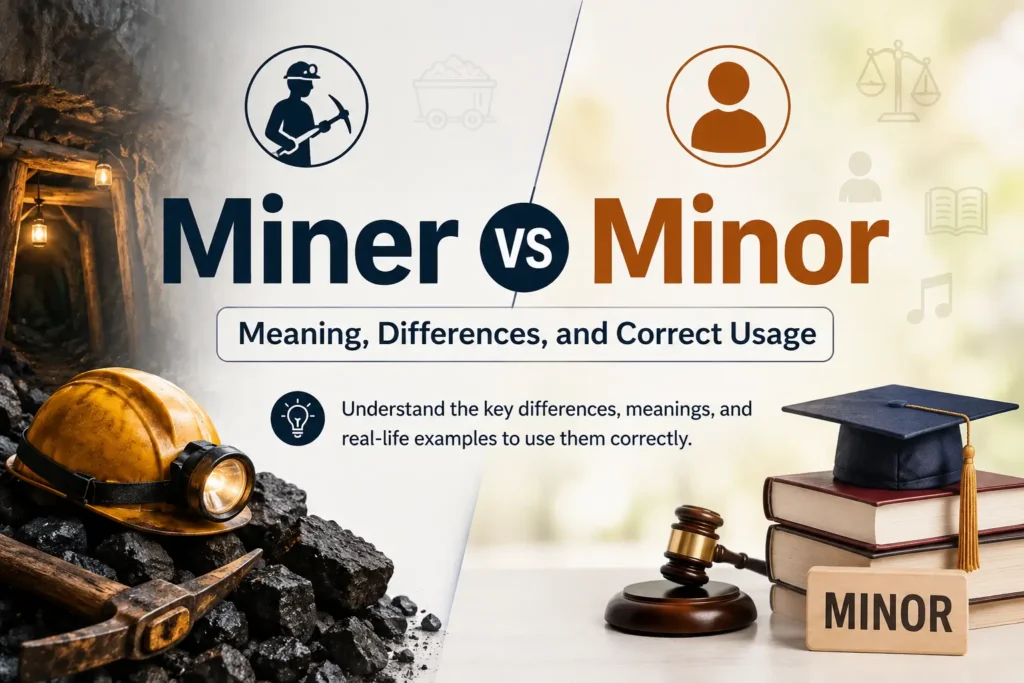
The miner vs minor difference is easy to understand: a miner works in a mine, while a minor is young or describes something less serious in context.
These homophones have an almost identical sound, yet both words have entirely different definitions, usage, and implications. A miner is a person or mining worker who works in mining, often extracting valuable resources from the earth. These valuable resources include coal, gold, salt, and other minerals.
A minor is an individual below legal adulthood or something less significant, such as a minor error or delay. The mix-up and confusion over their different meanings are surprisingly common among students, educated writers, and professionals. Misusing these words can cause legal errors, professional errors, or academic errors. To prevent word misuse, understand the difference and remember the crucial distinction. This supports correct word choice, correct usage, and helps you apply them correctly from the start.
Quick Answer: What Is the Difference Between Miner and Minor?
Use miner when you’re talking about mining, extraction, or a system that performs mining work.
Use minor when you mean:
- Small or less serious
- Less important or secondary
- A person below the legal age of adulthood
- A secondary subject in college
- A musical key, scale, or chord
- A specialized term in mathematics or geometry
Compare these examples:
- The miner entered the tunnel.
- The patient had a minor injury.
- She chose history as her college minor.
- The song is written in a minor key.
Here is the simplest memory rule:
A miner works in a mine. A minor is younger, smaller, secondary, or less serious.
Miner vs. Minor at a Glance
| Word | Main meaning | Part of speech | Common context | Example |
| Miner | A person or system involved in mining | Noun | Coal, gold, minerals, cryptocurrency | The miner checked the equipment. |
| Minor | Small, less serious, underage, or secondary | Adjective, noun, or verb | Law, college, medicine, music | The mistake was minor. |
The two words usually have the same pronunciation in American English. However, their spellings and meanings are not interchangeable.
Read this also: Shown vs Showed: Meaning, Rules, and Easy Examples
Why Miner and Minor Are Often Confused
Miner and minor are homophones. A homophone is a word that sounds like another word but has a different spelling or meaning.
Other common homophone pairs include:
- Their and there
- Right and write
- Principal and principle
- Brake and break
- Flour and flower
Since “miner” and “minor” sound alike, you must rely on sentence context.
Consider this sentence:
- There was a miner problem at the site.
This sentence suggests that the problem involved a mine worker.
Now compare it with:
- There was a minor problem at the site.
This version means that the problem was small or less serious.
One letter completely changes the meaning.
What Does Miner Mean?
A miner is usually a person who removes coal, metals, minerals, salt, or other materials from the earth.
The word comes from mine plus the ending -er. In English, -er often identifies a person who performs an action.
For example:
- Teach → teacher
- Drive → driver
- Bake → baker
- Mine → miner
Therefore, a miner is literally someone who mines.
Miner as a Mining Worker
A miner may work underground or at a surface mining site. The exact job can include drilling, operating machinery, setting supports, checking safety systems, or moving extracted material.
Common types of miners include:
- Coal miners
- Gold miners
- Salt miners
- Underground miners
- Surface miners
- Mineral miners
Examples:
- The coal miner wore protective equipment.
- Several miners left the tunnel safely.
- Her grandfather worked as a gold miner.
- The company trained each miner in emergency procedures.
In each case, “miner” is a noun because it names a person.
Miner in Historical Writing
The word often appears in history lessons, news reports, and discussions about labor.
For example:
- Miners traveled west during the gold rush.
- Coal miners helped support many industrial towns.
- The rescue team searched for trapped miners.
In these contexts, “miner” refers to workers connected to natural resources and extraction.
Miner in Cryptocurrency
A cryptocurrency miner can be a person, a computer, or a group of machines that helps process blockchain transactions.
In this use, mining doesn’t mean digging into the earth. Instead, the system performs computer calculations and may receive digital rewards.
Examples:
- The company operates several cryptocurrency miners.
- A miner verifies transactions on the network.
- The mining machine uses a large amount of processing power.
Although the technology is different, the idea is similar. The miner performs work to obtain or process something valuable.
Miner in Data and Technology
The term may also appear in phrases such as data miner or data-mining tool.
A data miner searches large amounts of information for useful patterns.
- The software acts as a data miner.
- A data miner identified changes in customer behavior.
However, “data analyst” may be clearer in many professional contexts. Choose the term that best matches the actual role.
What Does Minor Mean?
Minor has several meanings. It can function as an adjective, a noun, or a verb.
Its meaning depends on the sentence.
Minor Meaning Small or Less Important
As an adjective, minor means small, limited, or less important compared with something else.
Examples:
- We made a minor change to the schedule.
- The car had minor damage.
- She noticed a minor spelling error.
- The meeting started after a minor delay.
In these sentences, “minor” describes a noun.
A minor issue may still need attention. The word only means that the issue is less serious or less important than a larger one.
For example:
- A minor leak can become a major problem.
- A minor mistake in a legal form may still require correction.
Therefore, don’t assume that “minor” means meaningless.
Minor Meaning Less Serious
“Minor” often describes injuries, accidents, illnesses, offenses, or disagreements.
Common phrases include:
- Minor injury
- Minor accident
- Minor symptom
- Minor offense
- Minor disagreement
- Minor repair
Examples:
- The driver suffered a minor injury.
- The doctor treated a minor burn.
- They had a minor disagreement about the budget.
- The building needs only minor repairs.
In medical or safety situations, “minor” should be used carefully. A condition that appears small may still need professional attention.
Minor Meaning a Young Person
As a noun, a minor is generally a person who has not reached the legal age of adulthood.
Example:
- A minor may need permission from a parent or guardian.
- The form must be signed if the applicant is a minor.
- The law provides additional protections for minors.
The exact legal age and rights may vary by place and situation. Therefore, official documents should define the term when precision matters.
In everyday American English, “minor” often means someone under 18. However, age rules can differ for contracts, medical decisions, employment, driving, and other legal matters.
Minor as a College Subject
In college, a minor is a secondary area of study. It usually requires fewer courses than a major.
Examples:
- Her major is biology, and her minor is chemistry.
- He completed a minor in business.
- I’m considering psychology as a minor.
A major is the student’s main field. In contrast, a minor is an additional subject.
The word can also function as a verb:
- She minors in economics.
- He minored in history.
- They are minoring in computer science.
Minor in Music
In music, minor describes a type of key, chord, or scale.
Common terms include:
- Minor key
- Minor chord
- Minor scale
- A minor
- D minor
For example:
- The song is written in a minor key.
- The musician played an A minor chord.
- Students practiced the minor scale.
Here, “minor” is a technical music term. It does not simply mean less important.
A minor key may sound sad, serious, tense, or reflective. However, the emotional effect depends on the full musical context.
Minor in Mathematics and Geometry
“Minor” also appears in specialized technical language.
In mathematics, a matrix minor is a value related to a smaller part of a matrix.
In geometry, the minor axis is the shorter axis of an ellipse.
Examples:
- Calculate the minor of the matrix element.
- The ellipse has a major axis and a minor axis.
These meanings are specialized, so the surrounding subject usually makes them clear.
Parts of Speech: Miner and Minor
Understanding the grammar role of each word can help you choose the correct spelling.
Miner Is Mainly a Noun
“Miner” names a person, machine, or system connected to mining.
Singular:
- miner
Plural:
- miners
Examples:
- The miner entered the shaft.
- The miners attended a safety meeting.
You normally won’t use “miner” as an adjective by itself. Instead, it may appear before another noun as part of a compound phrase.
- Miner safety
- Miner training
- Miner rescue operation
Minor Can Be an Adjective
As an adjective, “minor” describes a noun.
- minor issue
- minor error
- minor injury
- minor change
- minor character
Example:
- The report contained a minor error.
Minor Can Be a Noun
As a noun, “minor” may refer to:
- A young person
- A secondary college subject
- A technical musical or mathematical idea
Examples:
- The customer is a minor.
- Marketing is her minor.
- The song moves from major to minor.
Minor Can Be a Verb
In college contexts, “minor” can mean to study a secondary subject.
- I minor in French.
- She minors in journalism.
- He minored in political science.
- They are minoring in art history.
This verb use is common in American college conversations.
Key Differences Between Miner and Minor
Meaning
A miner is connected to mining.
A minor may mean small, less serious, underage, secondary, or related to music and technical fields.
Spelling
“Miner” ends in -er.
That ending helps connect it with a person who performs an action.
“Minor” ends in -or.
It has several meanings that do not involve mining.
Grammar Function
“Miner” is mainly a noun.
“Minor” can be:
- An adjective
- A noun
- A verb
Common Context
Use “miner” in discussions about:
- Coal
- Gold
- Mines
- Natural resources
- Extraction
- Cryptocurrency
- Data mining
Use “minor” in discussions about:
- Size
- Importance
- Injuries
- Law
- Age
- College
- Music
- Mathematics
Detailed Miner vs. Minor Comparison
| Context | Correct word | Explanation | Example |
| Mining worker | Miner | A person who works in a mine | The miner entered the tunnel. |
| Small problem | Minor | Something less serious | We had a minor problem. |
| Young person | Minor | Someone below legal adulthood | A parent signed for the minor. |
| College subject | Minor | Secondary field of study | Her minor is English. |
| Music | Minor | A type of key or chord | The song uses a minor key. |
| Cryptocurrency | Miner | A system that processes mining work | The miner verified the transaction. |
| Small injury | Minor | An injury considered less serious | He received treatment for a minor injury. |
| Gold worker | Miner | Someone who mines gold | The gold miner found a new deposit. |
Correct Examples of Miner
These examples show how “miner” works in different settings.
Mining and Industry
- The miner inspected the equipment before work.
- Rescue crews contacted the trapped miners.
- Each coal miner received safety training.
- The company hired experienced underground miners.
History
- Many miners moved west during the gold rush.
- The town grew around the coal-mining industry.
- A former miner described working underground.
Technology
- The cryptocurrency miner processed a block of transactions.
- Several mining machines worked at the same time.
- The program acts as a data miner.
Correct Examples of Minor
Everyday Life
- We experienced a minor delay.
- The wall has a minor crack.
- She made a minor correction to the email.
- The problem requires only a minor repair.
Law and Age
- A parent must sign for the minor.
- The website restricts certain content for minors.
- The law treats a minor differently from an adult.
College
- She chose Spanish as her minor.
- He majors in finance and minors in economics.
- The student completed all minor requirements.
Medicine and Safety
- The patient reported a minor injury.
- The accident caused only minor damage.
- The nurse treated a minor cut.
Music
- The piece begins in a minor key.
- He played an E minor chord.
- The class practiced major and minor scales.
Common Sentence Confusions
Minor Problem or Miner Problem?
Use minor problem when you mean a small or less serious problem.
- Correct: We found a minor problem in the report.
- Incorrect: We found a miner problem in the report.
However, “miner problem” can be correct if you mean a problem involving a mining worker.
- The supervisor discussed a miner problem involving protective gear.
Even then, “a problem affecting the miners” may sound clearer.
Coal Miner or Coal Minor?
Use coal miner.
- Correct: The coal miner worked underground.
- Incorrect: The coal minor worked underground.
A person who mines coal is a miner.
Minor Injury or Miner Injury?
Use minor injury for a less serious injury.
- She suffered a minor injury.
Use miner injury only when describing an injury involving a mining worker.
- The report examined the causes of the miner’s injury.
The possessive form is usually clearer than “miner injury.”
Minor in Business or Miner in Business?
Use minor in business for a college subject.
- She completed a minor in business.
A “miner in business” would mean a mining worker involved in business, which is a different idea.
SEE MUST: Yours Sincerely vs Sincerely Yours: Meaning, Difference, and Correct Use
Common Mistakes and Corrections
Using Miner for Something Small
Incorrect:
- It was a miner mistake.
Correct:
- It was a minor mistake.
“Minor” describes the mistake as small or less serious.
Using Minor for a Mine Worker
Incorrect:
- The coal minor entered the shaft.
Correct:
- The coal miner entered the shaft.
“Miner” names someone who mines.
Assuming Minor Means Unimportant
A minor issue is less serious, but it may still matter.
For example:
- A minor error changed the total.
- A minor symptom became worse overnight.
Use “minor” carefully when the situation involves safety, health, law, or money.
Confusing Minor and Major
“Minor” often contrasts with major.
- minor change / major change
- minor injury / major injury
- minor role / major role
- minor subject / major subject
However, “minor” does not always mean the exact opposite of “major.” In legal contexts, “minor” contrasts with “adult.”
Using Minor Without Enough Context
The sentence “She is a minor” usually means she is under legal adulthood.
However, “She has a minor” usually refers to a college field of study.
Small grammar changes can affect meaning.
- She is a minor.
She is below legal adulthood. - She has a minor in art.
Art is her secondary college subject.
Formal, Informal, and Professional Usage
Everyday Conversation
“Minor” is common in casual speech.
- It’s only a minor issue.
- We had a minor delay.
- He made a minor mistake.
“Miner” usually appears when the discussion actually involves mining or technology.
- Her father is a miner.
- The crypto miner stopped working.
Professional Writing
In professional emails, “minor” can help describe a limited change.
- We made a minor update to the schedule.
- The document needs two minor corrections.
However, avoid using the word to downplay a serious concern.
Instead of writing:
- There was a minor safety issue.
You may need to give exact details:
- A guardrail was missing from the second-floor platform.
Specific language builds trust and prevents misunderstanding.
Academic Writing
In academic writing, define specialized meanings when needed.
For example:
- The student completed a minor in sociology.
- The composition moves into a minor key.
- The minor axis measures 12 centimeters.
The subject area makes the meaning clear.
News and Public Information
News reports may use both words in very different contexts.
- Two miners were rescued from the site.
- Three passengers suffered minor injuries.
- The case involved a minor.
- The study found minor differences between the groups.
Correct spelling matters because an error can completely change the report.
Pronunciation of Miner and Minor
In most American English accents, miner and minor sound the same.
Both usually have two syllables:
- mi-ner
- mi-nor
The first syllable receives the main stress.
Because the pronunciation is nearly identical, listening alone may not reveal the spelling. You need to understand the meaning.
In speech, context usually prevents confusion.
- The miner entered the tunnel.
- The injury was minor.
No listener expects an injury to be a mine worker. Therefore, the surrounding words make the meaning clear.
Spelling and Memory Tricks
Miner Works in a Mine
The easiest memory trick is:
Mine + er = miner
The -er ending often refers to a person who performs an action.
- runner
- writer
- teacher
- miner
Minor Means Smaller or Younger
Connect minor with words such as:
- minor issue
- minor injury
- minor change
- minor student
- minor key
The -or spelling belongs to meanings unrelated to mining.
Use the Replacement Test
Replace “miner” with mine worker.
- The miner entered the tunnel.
- The mine worker entered the tunnel.
The meaning stays the same, so “miner” is correct.
Replace “minor” with small, less serious, or secondary.
- It was a minor mistake.
- It was a small mistake.
Again, the meaning stays the same.
Check the Topic
Ask what the sentence is about.
- Mining or extraction → miner
- A small issue → minor
- A young person → minor
- A college subject → minor
- Music → minor
- Cryptocurrency mining → miner
Synonyms for Miner and Minor
Synonyms and Related Words for Miner
Possible alternatives include:
- Mine worker
- Coal worker
- Prospector
- Driller
- Extractor
- Mining operator
These words are not always interchangeable.
A prospector searches for valuable natural resources. A miner usually extracts them. A driller may operate drilling equipment but may not perform every mining task.
Synonyms for Minor Meaning Small
Possible alternatives include:
- Small
- Slight
- Limited
- Modest
- Lesser
- Secondary
- Insignificant
Be careful with “insignificant.” It can sound stronger than “minor.”
Compare:
- A minor concern may still deserve attention.
- An insignificant concern may suggest that it does not matter.
Related Legal and Age Terms
Terms connected to “minor” include:
- Child
- Juvenile
- Adolescent
- Underage person
- Dependent
These terms are not exact synonyms in every context.
For example, “juvenile” may have a specific legal meaning. “Dependent” may refer to financial or tax status instead of age.
Related Academic Terms
Words related to a college minor include:
- Major
- Concentration
- Specialization
- Elective
- Degree program
A minor is not always the same as a concentration. Schools may define these programs differently.
Opposites of Minor
The opposite depends on the meaning.
| Meaning of minor | Possible opposite |
| Small or less serious | Major, serious, severe |
| Less important | Important, primary |
| Under legal age | Adult |
| Secondary college field | Major |
| Minor musical mode | Major |
Examples:
- minor injury / severe injury
- minor role / major role
- minor / adult
- minor key / major key
There is no single opposite that works in every sentence.
Real-Life Examples
School and College
- I made a minor error in my essay.
- Our class learned about coal miners.
- She chose communication as her minor.
- He majors in biology and minors in chemistry.
Workplace and Email
- We made a minor change to the deadline.
- The report covers miner safety.
- The update fixed several minor issues.
- The company purchased a new cryptocurrency miner.
Texting and Social Media
- “Sorry, there’s a minor delay.”
- “My uncle used to be a coal miner.”
- “I’m choosing a college minor next semester.”
- “The app has a minor bug.”
Autocorrect may replace one word with the other. Therefore, check the spelling before sending important messages.
News and Public Reports
- Rescue workers found the missing miners.
- Two people received treatment for minor injuries.
- Officials questioned a minor with a guardian present.
- The report found only minor changes.
Precise wording helps readers understand the situation quickly.
SEE THIS ALSO: Creator vs Creater: Correct Spelling, Meaning, and Usage
Case Study: One Letter Changes the Message
Imagine a manager writes:
We found a miner issue during the software update.
This sentence appears to describe a problem involving a mining worker. However, the manager probably means that the software issue was small.
The corrected sentence is:
We found a minor issue during the software update.
Now imagine a safety officer writes:
The team investigated a minor accident underground.
This sentence says the accident was less serious.
However, if the officer wants to describe an accident involving a mine worker, clearer wording would be:
The team investigated an accident involving a miner.
Context and precise wording prevent confusion.
How to Choose Between Miner and Minor
Follow this simple process:
- Identify what the word refers to.
- Ask whether it involves a mine, mining worker, or mining system.
- If yes, choose miner.
- If not, check whether it means small, less serious, underage, academic, musical, or technical.
- If it matches one of those meanings, choose minor.
- Read the complete sentence again to confirm the meaning.
A fast test is:
- Can you replace it with mine worker? Use miner.
- Can you replace it with small, secondary, or underage person? Use minor.
Quick Practice: Miner or Minor?
Choose the correct word.
- The coal ___ checked his helmet.
- We found a ___ mistake in the report.
- The applicant is still a ___.
- She chose art as her college ___.
- The song begins in a ___ key.
- The rescue team contacted the missing ___.
- The car suffered only ___ damage.
- The cryptocurrency ___ processed the transaction.
- He had a ___ disagreement with his supervisor.
- Each ___ received new safety equipment.
Answers:
- miner
- minor
- minor
- minor
- minor
- miner
- minor
- miner
- minor
- miner
Frequently Asked Questions About Miner vs Minor
Q1: What Is the Main Difference Between Miner and Minor?
A miner is someone or something involved in mining. A minor is a young person or something small, secondary, or less serious.
- The miner entered the tunnel.
- The car had minor damage.
Q2: Are Miner and Minor Homophones?
Yes. Miner and minor are homophones because they usually sound the same in American English.
However, they have different spellings and meanings. Therefore, you must use context to choose the correct word.
Q3: What Does Miner Mean?
A miner is usually a person who extracts coal, gold, salt, metals, or other resources from the earth.
The word may also refer to a machine, computer, or program used for cryptocurrency or data mining.
Q4: What Does Minor Mean?
Minor can mean:
- Small or less serious
- Less important or secondary
- A person below legal adulthood
- A secondary college subject
- A musical key, scale, or chord
The correct meaning depends on the sentence.
Q5: Which Is Correct: Minor Problem or Miner Problem?
Use minor problem when you mean a small or less serious problem.
- Correct: We found a minor problem.
- Incorrect: We found a miner problem.
“Miner problem” would describe a problem involving a mining worker.
Q6: Is Minor a Noun or an Adjective?
Minor can be both a noun and an adjective.
As an adjective:
- It was a minor mistake.
As a noun:
- The applicant is a minor.
- English is her college minor.
Q7: Can Minor Be Used as a Verb?
Yes. In American college usage, minor can be a verb meaning to study a secondary subject.
- She minors in history.
- He minored in business.
- They are minoring in Spanish.
Q8: What Is a Minor in College?
A minor is a secondary field of study. It usually requires fewer courses than a student’s major.
For example:
- Her major is biology, and her minor is chemistry.
Q9: Does Minor Always Mean Unimportant?
No. Minor usually means smaller, less serious, or secondary. It does not mean that something has no importance.
For example, a minor medical symptom or legal error may still need attention.
Q10: How Can I Remember Miner vs Minor?
Use this memory trick:
- A miner works in a mine.
- A minor issue is a smaller issue.
Also, replace the word in your sentence. If “mine worker” fits, use miner. If “small,” “secondary,” or “underage person” fits, use minor.
Conclusion
The difference between miner vs minor becomes easy when you focus on meaning. A miner is a person, machine, or system connected to mining. For example, a coal miner works in a mine, while a cryptocurrency miner processes digital transactions.
A minor can describe something small, less serious, or secondary. It can also mean a person below the legal age of adulthood, a secondary college subject, or a musical key.
Because miner and minor are homophones, they sound alike in American English. However, their spellings and meanings are different. Remember this simple rule: a miner works in a mine, while minor means younger, smaller, or less serious. Always check the sentence’s context before choosing the word.

1 thought on “Miner vs Minor: Meaning, Differences, and Correct Usage”