
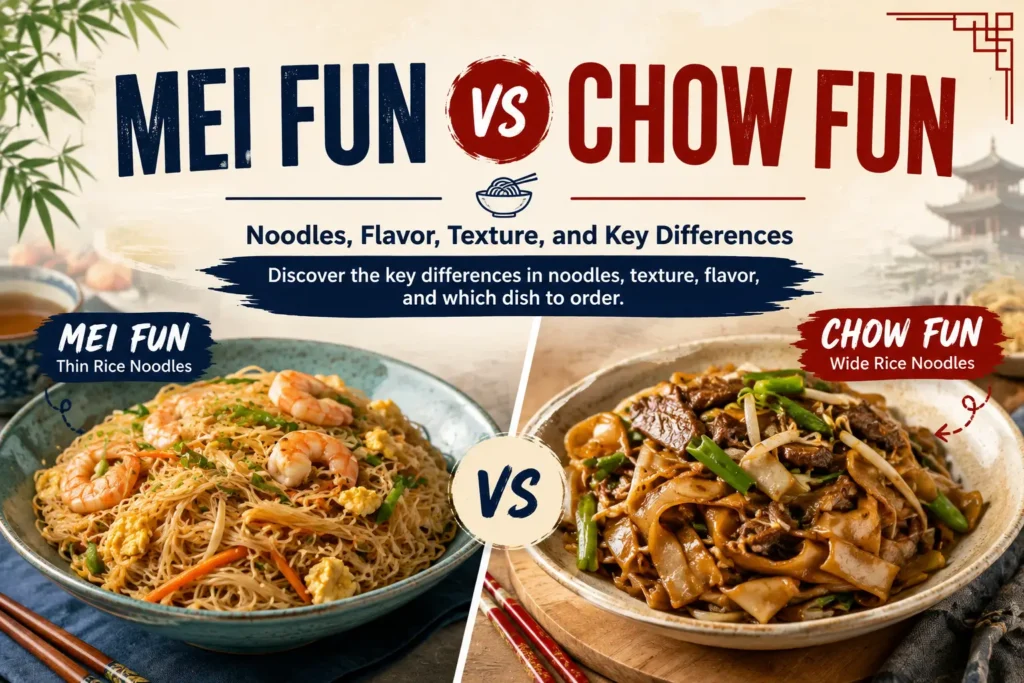
The mei fun vs chow fun difference is easy to spot: Mei Fun uses thin rice noodles, while Chow Fun uses broad, chewy noodles in Chinese cuisine.
The main dish differences come from noodle type, noodle texture, and cooking style. Mei Fun has a light, fine texture and small strands that absorb seasoning quickly. Chow Fun uses wide noodles with a softer, fuller bite. Its cooking methods may also create a smoky, wok-seared flavor and a richer flavor profile.
When ordering food at Chinese restaurants, check the noodle shape on the restaurant menu. Choose Mei Fun for fine Chinese noodles and a lighter meal choice. Pick Chow Fun when you prefer broad noodle dishes and a chewier texture. This simple restaurant ordering rule helps you select the correct dish, understand these commonly confused terms, and enjoy appreciating each dish despite their similar names.
Mei Fun vs Chow Fun: Quick Answer
- Explain that both are Chinese rice-noodle dishes.
- State the central difference:
- Mei fun uses thin rice vermicelli.
- Chow fun uses broad, flat rice noodles.
- Clarify that neither term is a misspelling of the other.
- Give a one-sentence ordering rule based on noodle thickness and texture.
Mei Fun and Chow Fun at a Glance
Side-by-Side Comparison Table
Include:
- Noodle shape
- Noodle thickness
- Typical texture
- Common cooking method
- Sauce absorption
- Common proteins
- Vegetables
- Flavor profile
- Serving style
- Best choice for different preferences
The Main Difference in One Sentence
- Mei fun is thin, light, and good at absorbing seasoning.
- Chow fun is wide, soft, chewy, and often valued for its wok-seared flavor.
What Is Mei Fun?
Read this also: Rational vs Rationale: Meaning, Difference, and Correct Usage
Meaning of Mei Fun
- Define mei fun as thin rice noodles or rice vermicelli.
- Explain that spellings may include mai fun, mi fun, and related regional forms.
- Note that the term may refer to the noodle itself or a prepared noodle dish.
Shape, Size, and Texture
- Thin, narrow strands
- Light and delicate texture
- Quick cooking time
- Greater risk of becoming soft or mushy when overcooked
How Mei Fun Is Commonly Prepared
- Stir-fried
- Added to soups
- Mixed with vegetables, eggs, meat, or seafood
- Seasoned with soy sauce, curry powder, or other sauces, depending on the dish
Common Mei Fun Dishes
- Singapore mei fun
- House special mei fun
- Chicken mei fun
- Shrimp mei fun
- Vegetable mei fun
- Xiamen-style mei fun
Is Mei Fun Always Spicy?
- Explain that mei fun describes the noodle type, not one fixed flavor.
- Clarify that curry-based Singapore mei fun may be seasoned or spicy, while other versions may be mild.
What Is Chow Fun?
Meaning of Chow Fun
- Define chow fun as a dish made with wide, flat rice noodles.
- Explain related names such as ho fun, hor fun, or he fen, depending on language and region.
- Clarify that restaurant naming varies.
Shape, Size, and Texture
- Broad, flat noodle sheets or strips
- Soft, smooth, and chewy texture
- Heavier bite than rice vermicelli
- More likely to tear if handled roughly during stir-frying
How Chow Fun Is Commonly Prepared
- Stir-fried over high heat
- Cooked with soy-based sauces
- Combined with beef, chicken, shrimp, tofu, bean sprouts, or green onions
- Served in dry-fried or saucier versions
Common Chow Fun Dishes
- Beef chow fun
- Chicken chow fun
- Shrimp chow fun
- Vegetable chow fun
- Dry-fried chow fun
- Chow fun with gravy
Why Chow Fun May Taste Smoky
- Introduce wok hei, the smoky, lightly charred flavor created by intense wok heat.
- Explain that high heat, proper timing, and small-batch cooking help create it.
- Clarify that not every restaurant version will have strong wok hei.
The Key Differences Between Mei Fun and Chow Fun
Noodle Width and Appearance
- Compare fine rice-vermicelli strands with broad rice-noodle strips.
- Explain how diners can identify each dish visually.
Texture and Mouthfeel
- Mei fun: light, fine, springy, or tender
- Chow fun: smooth, soft, slippery, and chewy
- Explain how cooking time changes each texture.
Flavor and Sauce Absorption
- Explain why thin noodles distribute seasoning throughout the dish.
- Explain how broad noodles provide larger surfaces for soy-based sauce and wok searing.
- Avoid claiming that one always has a stronger flavor because recipes differ.
Cooking Method
- Mei fun can be stir-fried or served in broth.
- Chow fun is strongly associated with high-heat stir-frying.
- Explain why wide fresh noodles require gentle handling.
Portion and Fullness
- Discuss how chow fun may feel heavier because of its wide, dense noodles.
- Explain that portion size, oil, sauce, meat, and vegetables matter more than the dish name alone.
Mei Fun vs. Chow Fun Comparison Table
Create a detailed table with:
- Primary ingredient
- Noodle form
- Typical thickness
- Texture
- Cooking speed
- Common preparation
- Sauce style
- Typical add-ins
- Risk when overcooked
- Ideal diner preference
How Mei Fun and Chow Fun Taste
Typical Mei Fun Flavor
- Explain that mei fun itself has a mild rice flavor.
- Discuss how thin noodles carry curry, soy sauce, garlic, and other seasonings.
- Note that flavor changes greatly by recipe.
Typical Chow Fun Flavor
- Describe savory soy seasoning, tender noodles, and possible wok-charred notes.
- Explain how beef, bean sprouts, onions, and sauces affect the final taste.
Which One Has More Flavor?
- Clarify that neither noodle is automatically more flavorful.
- Compare seasoning absorption with wok-seared character.
- Emphasize the restaurant’s recipe and cooking skill.
Common Ingredients in Each Dish
Ingredients Often Used in Mei Fun
- Rice vermicelli
- Eggs
- Cabbage
- Carrots
- Onions
- Bean sprouts
- Chicken
- Pork
- Shrimp
- Curry powder in Singapore-style versions
Ingredients Often Used in Chow Fun
- Wide rice noodles
- Beef
- Chicken
- Shrimp
- Tofu
- Bean sprouts
- Green onions
- Chinese broccoli
- Light soy sauce
- Dark soy sauce
- Oyster sauce
Vegetarian and Vegan Options
- Explain how both dishes can be prepared without meat.
- Mention the need to check oyster sauce, meat broth, eggs, and fish-based seasonings.
Are Mei Fun and Chow Fun Gluten-Free?
Rice Noodles and Gluten
- Explain that plain rice noodles are usually made from rice and water.
- Clarify that the complete dish may still contain gluten.
Ingredients to Check
- Regular soy sauce
- Oyster sauce
- Hoisin sauce
- Marinades
- Shared cooking surfaces
- Cross-contact in restaurant kitchens
How to Order More Safely
- Ask whether gluten-free soy sauce is available.
- Confirm the noodles’ ingredients.
- Ask about shared woks and preparation areas when medically necessary.
Which Is Healthier: Mei Fun or Chow Fun?
Why the Noodle Name Is Not Enough
- Explain that health value depends on portion size, oil, sauce, sodium, protein, and vegetables.
- Avoid labeling either dish as automatically healthy or unhealthy.
Factors That Change the Nutrition
- Fried versus soup preparation
- Amount of cooking oil
- Sweet or salty sauces
- Meat choice
- Vegetable content
- Restaurant portion size
How to Make a Lighter Choice
- Choose more vegetables.
- Request less oil or sauce when possible.
- Select lean protein or tofu.
- Share a large serving.
- Avoid assuming thin noodles always contain fewer calories.
Mei Fun vs. Chow Fun: Which Should You Order?
Choose Mei Fun If You Prefer
- Thin noodles
- A lighter mouthfeel
- Seasoning distributed through every strand
- Curry-style or mixed stir-fried dishes
- Smaller, finer noodle texture
Choose Chow Fun If You Prefer
- Wide noodles
- A soft, chewy bite
- Soy-based flavors
- Beef-and-noodle combinations
- Smoky wok-seared notes
Quick Restaurant Decision Guide
- Want thin strands? Order mei fun.
- Want broad ribbons? Order chow fun.
- Want curry seasoning? Look for Singapore mei fun.
- Want chewy soy-sauced noodles? Consider beef chow fun.
Can You Substitute Mei Fun for Chow Fun?
Why the Substitution Changes the Dish
- Explain how noodle width changes texture, sauce absorption, and cooking time.
- Note that the finished meal will no longer have the same traditional character.
Adjustments for Using Mei Fun
- Soak or cook briefly.
- Reduce tossing time.
- Watch closely for overcooking.
- Use less liquid at first.
Adjustments for Using Chow Fun
- Separate fresh noodles gently.
- Use enough heat to prevent sticking.
- Avoid aggressive stirring.
- Adjust sauce for the larger noodle surface.
When Substitution Works Best
- Flexible home recipes
- Leftover vegetable stir-fries
- Nontraditional noodle bowls
When Not to Substitute
- When recreating traditional beef chow fun
- When a recipe depends on a specific noodle texture
- When authentic presentation matters
How to Cook Mei Fun Without Making It Mushy
Soaking Versus Boiling
- Follow the package directions because noodle thickness varies.
- Explain why many rice-vermicelli noodles need only a short soak.
Control Moisture
- Drain the noodles well.
- Avoid adding too much sauce.
- Let vegetables release excess moisture before combining.
Limit Cooking Time
- Add noodles near the end.
- Toss gently and remove them from heat once tender.
- Explain that carryover heat continues softening them.
How to Cook Chow Fun Without Breaking the Noodles
Use Fresh Noodles When Available
- Explain the texture advantage of fresh wide rice noodles.
- Describe how to loosen them carefully.
Heat the Wok Before Cooking
- Discuss why a properly heated wok improves searing and reduces sticking.
- Recommend cooking in batches on weaker home burners.
Handle the Noodles Gently
- Toss rather than stir aggressively.
- Avoid overcrowding.
- Add sauce around the sides of the hot wok when appropriate.
Prevent Sticking
- Use enough oil for the cooking method.
- Separate ingredients when needed.
- Avoid placing cold, wet noodles into an underheated pan.
Common Mistakes and Misconceptions
Read this also: Miner vs Minor: Meaning, Differences, and Correct Usage
Treating Mei Fun and Chow Fun as Two Spellings of One Dish
- Explain that they refer to different rice-noodle forms.
Assuming “Chow” Describes the Noodle Shape
- Clarify that menu terms may describe both preparation and established dish names.
- Explain that English restaurant menus do not always translate Chinese terms consistently.
Assuming All Mei Fun Is Singapore Mei Fun
- Separate the noodle category from the curry-seasoned dish.
- Note that mei fun can appear in many recipes.
Assuming All Chow Fun Is Beef Chow Fun
- Explain that beef is common but not required.
- Mention chicken, shrimp, tofu, and vegetable versions.
Calling Chow Fun Wheat Noodles
- Clarify that chow fun is normally made with rice noodles.
- Contrast it briefly with lo mein and chow mein.
Confusing Chow Fun With Chow Mein
- Chow fun: broad rice noodles
- Chow mein: usually wheat-based noodles
- Explain why the similar menu names cause confusion.
Mei Fun, Chow Fun, Chow Mein, and Lo Mein
Four-Way Comparison Table
Compare:
- Noodle base
- Shape
- Texture
- Typical cooking method
- Common dishes
Mei Fun vs. Chow Mein
- Thin rice vermicelli versus wheat noodles
- Explain differences in texture and ingredient base.
Chow Fun vs. Lo Mein
- Wide rice noodles versus wheat-and-egg-style noodles
- Compare chewiness, shape, and sauce style.
Chow Fun vs. Pad See Ew
- Explain that both may use wide rice noodles.
- Clarify that they belong to different culinary traditions and use different seasonings.
Names, Pronunciation, and Menu Variations
How to Pronounce Mei Fun
- Give a simple American-English pronunciation guide.
- Note that pronunciation can vary by dialect and romanization.
How to Pronounce Chow Fun
- Provide a simple pronunciation guide.
- Avoid presenting one English approximation as the only authentic pronunciation.
Alternate Spellings and Names
- Mei fun, mai fun, mi fun, bee hoon
- Chow fun, ho fun, hor fun, he fen
- Explain why packaging and restaurant menus may use different spellings.
How to Ask About the Dish at a Restaurant
- Ask whether the noodles are thin or wide.
- Ask whether the dish is dry-fried, saucy, mild, or spicy.
- Confirm the protein and vegetables.
- Ask whether “Singapore noodles” contain curry seasoning.
Practical Ordering Examples
Ordering Mei Fun
- “I’d like chicken mei fun, please.”
- “Is the Singapore mei fun spicy?”
- “Can I get vegetable mei fun without egg?”
Ordering Chow Fun
- “I’d like beef chow fun.”
- “Is this chow fun dry-fried or served with gravy?”
- “Can you make the vegetable chow fun without oyster sauce?”
Correcting an Unclear Order
- Explain how to describe the noodle visually:
- “I mean the thin rice noodles.”
- “I mean the wide, flat rice noodles.”
Quick Memory Tricks
Mei Fun Means Thin Strands
- Connect mei fun with fine rice vermicelli.
Chow Fun Means Wide Ribbons
- Picture broad, flat noodle strips.
Use Texture as the Fastest Clue
- Thin and light: mei fun
- Wide and chewy: chow fun
Practice: Identify the Dish
- Include 8–10 short descriptions.
- Ask the reader to choose mei fun or chow fun.
- Cover noodle width, texture, curry seasoning, wok hei, and common proteins.
Answer Key
- Give each answer with a one-sentence explanation.
- Reinforce that noodle shape is the most reliable clue.
Frequently Asked Questions
Q1: What Is the Main Difference Between Mei Fun and Chow Fun?
The main difference is the noodle shape. Mei Fun uses thin rice noodles, while Chow Fun uses wide, flat rice noodles.
Q2: Are Mei Fun and Chow Fun Made From Rice?
Yes. Both dishes usually use rice noodles. However, their size, texture, and cooking style are different.
Q3: Which Is Thinner, Mei Fun or Chow Fun?
Mei Fun is much thinner. Its noodles look like fine strands, while Chow Fun noodles are broad and flat.
Q4: Which Has a Chewier Texture?
Chow Fun usually has a softer and chewier bite. Mei Fun feels lighter and more delicate.
Q5: Is Mei Fun Always Spicy?
No. Mei Fun describes the noodle type, not the spice level. Some versions, such as Singapore-style mei fun, may use curry seasoning, but many are mild.
Q6: Why Does Chow Fun Sometimes Taste Smoky?
Chow Fun may have a smoky flavor because cooks prepare it over very high heat. This wok-seared taste is often called wok hei.
Q7: Can I Substitute Mei Fun for Chow Fun?
You can substitute them in some home recipes, but the texture will change. Thin Mei Fun absorbs sauce quickly, while wide Chow Fun provides a fuller bite.
Q8: Which Dish Is More Filling?
Chow Fun may feel more filling because the noodles are wider and heavier. However, serving size, sauce, oil, vegetables, and protein also matter.
Q9: Are Mei Fun and Chow Fun Gluten-Free?
The plain rice noodles are often gluten-free. However, soy sauce, oyster sauce, marinades, and shared cooking surfaces may contain gluten.
Q10: How Can I Tell Them Apart When Ordering?
Look at the noodle shape. Order Mei Fun when you want thin strands, and choose Chow Fun when you want wide, flat, chewy noodles.
Conclusion
The mei fun vs chow fun difference mainly comes down to noodle shape and texture. Mei Fun uses thin rice noodles that feel light and absorb seasoning quickly. In contrast, Chow Fun uses wide rice noodles with a soft, smooth, and chewy texture.
Both are popular dishes in Chinese cuisine, and neither is automatically better. Your choice depends on the eating experience you prefer. Pick Mei Fun for fine strands and lighter texture. Choose Chow Fun for broad noodles, a fuller bite, and possible wok-seared flavor.
The easiest memory rule is simple: Mei Fun means thin noodles, while Chow Fun means wide noodles. Knowing that difference will help you read a restaurant menu, order confidently, and select the dish that matches your taste.
