
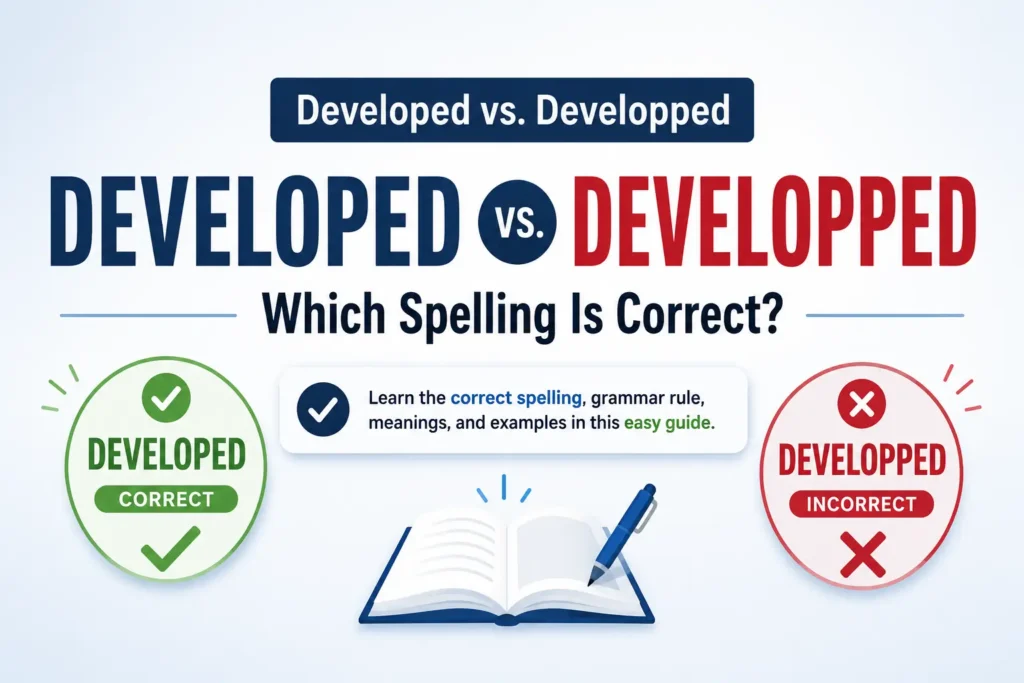
Developed vs. Developped has one correct answer: developed is standard English, while developped is a misspelling with an unnecessary extra p.
The base verb is develop. To form its past tense and past participle, simply add -ed: develop + ed = developed. The final p stays single because the last syllable is unstressed. This is why stop becomes stopped, but develop becomes developed. The same rule gives us developing, not developping.
Developed can mean created, grown, improved, or brought to a later stage. For example, “The team developed a new app” describes a finished past action. “She has developed stronger skills” uses the past participle. Correct spelling matters in emails, essays, reports, and professional documents because it supports clear writing and reader trust. A useful memory tip is simple: develop has one final p, so developed also keeps one p.
Developed vs. Developped: Quick Answer
Developed is the only correct standard spelling.
- Correct: The company developed a new security system.
- Incorrect: The company developped a new security system.
The past tense and past participle of develop are both developed. The present participle is developing, not developping.
Memory rule: Develop has one final p, so developed keeps one final p.
Developed and Developped at a Glance
| Feature | Developed | Developped |
| Correct English spelling | Yes | No |
| Standard dictionary word | Yes | No |
| Past tense of develop | Yes | No |
| Past participle of develop | Yes | No |
| Can function as an adjective | Yes | No |
| Used in American English | Yes | No |
| Used in British English | Yes | No |
| Example | She developed a useful skill. | She developped a useful skill. |
The difference isn’t regional. Developed is correct in both American and British English.
Is “Developped” a Real English Word?
Developped isn’t a standard English word. It is an incorrect spelling of developed.
You may still find it in online comments, social media posts, quick messages, or unedited documents. However, seeing a spelling mistake online doesn’t make it acceptable.
Consider these examples:
- Incorrect: The team developped the software last year.
- Correct: The team developed the software last year.
The corrected sentence uses the simple past tense of develop.
Read this also: Comprable vs. Comparable: Which Spelling Is Correct?
Why “Developped” Sometimes Appears
Writers usually add the extra p for one of these reasons:
- They apply the consonant-doubling rule incorrectly.
- They compare develop with verbs such as stop and admit.
- They type too quickly.
- They rely on pronunciation instead of spelling rules.
- They confuse the English form with a spelling pattern from another language.
- Their spell-checker fails to flag the error.
The mistake is understandable, but the correction is always the same: remove the extra p.
Is “Developped” Ever Acceptable?
It may appear as part of a username, brand name, quotation, or intentionally misspelled title. In those cases, it may be reproduced exactly.
However, developped isn’t acceptable as the English past tense or past participle of develop.
Use developed in:
- Academic papers
- Business emails
- Job applications
- News articles
- School assignments
- Research reports
- Product descriptions
- Website copy
- Professional presentations
Why the Final “P” Is Not Doubled
English sometimes doubles a final consonant before adding -ed or -ing. However, the rule applies only under specific conditions.
A final consonant is commonly doubled when:
- The word ends in a consonant-vowel-consonant pattern.
- The final syllable carries the main stress.
- The suffix begins with a vowel, such as -ed or -ing.
For example:
- stop → stopped
- plan → planned
- admit → admitted
- occur → occurred
However, develop doesn’t meet the stress condition.
Where the Stress Falls in “Develop”
The word develop is pronounced roughly as:
de-VEL-op
The main stress falls on the second syllable, VEL. The final syllable, op, is unstressed.
Because the final syllable isn’t stressed, the final p stays single:
- develop → developed
- develop → developing
Not:
- develop → developped
- develop → developping
Verbs That Do and Don’t Double the Final Consonant
| Base Verb | Correct Past Tense | Reason |
| stop | stopped | One syllable ending in consonant-vowel-consonant |
| plan | planned | One syllable ending in consonant-vowel-consonant |
| admit | admitted | Final syllable is stressed |
| occur | occurred | Final syllable is stressed |
| prefer | preferred | Final syllable is stressed |
| visit | visited | Final syllable isn’t stressed |
| open | opened | Final syllable isn’t stressed |
| benefit | benefited | Final syllable isn’t stressed in American English |
| develop | developed | Final syllable isn’t stressed |
Stress matters most in words with more than one syllable. If the stress falls earlier in the word, the final consonant usually remains single.
The Same Rule Applies to “Developing”
The present participle is developing.
- Correct: The company is developing a new app.
- Incorrect: The company is developping a new app.
Again, the final p isn’t doubled because the last syllable of develop is unstressed.
How to Spell “Developed” Correctly
The spelling follows a simple pattern:
develop + ed = developed
You don’t remove a final letter, and you don’t add another p. You simply attach -ed to the base verb.
The key forms are:
- develop
- develops
- developed
- developing
- development
- developer
Each word keeps one p after the final o.
A Simple Memory Trick
Say the base word before adding the ending:
Develop has one final p. Developed keeps one final p.
You can also connect developed with development. Most writers recognize that development has one p, which can help them remember the past-tense form.
What Does “Developed” Mean?
Developed can mean created, formed, improved, expanded, matured, or brought to a later stage.
Its exact meaning depends on the sentence.
For example:
- “The company developed a new product” means the company created it.
- “She developed strong leadership skills” means her skills grew over time.
- “The patient developed a fever” means the fever began.
- “The area was developed for housing” means buildings and infrastructure were added.
Therefore, context tells you which meaning applies.
Developed as the Past Tense of “Develop”
Use developed for an action completed in the past.
- The student developed the idea during class.
- Our team developed the website last month.
- Scientists developed the method in 2024.
- She developed an interest in photography.
Time expressions such as yesterday, last year, and during the project often signal the simple past tense.
Developed as a Past Participle
The past participle also uses developed. It appears with helping verbs such as has, have, and had.
- The company has developed three new products.
- Researchers have developed a faster test.
- She had developed the plan before the meeting.
- We have developed a stronger process.
The form doesn’t change between the simple past and past participle. The helping verb shows the difference.
Developed as an Adjective
Developed can also describe a noun.
- a developed economy
- a well-developed argument
- a fully developed plan
- developed land
- highly developed skills
In these examples, developed describes the condition or level of the noun.
Compare:
- The team developed the plan.
Here, developed is a verb. - The team presented a well-developed plan.
Here, developed is an adjective.
Common Sentence Patterns With “Developed”
Learning common sentence structures helps you use the word accurately.
Active Voice
In active voice, the subject performs the action.
Subject + developed + object
- The engineer developed a new tool.
- The teacher developed a reading program.
- Our company developed the software.
- Scientists developed a new material.
Active voice often sounds direct and clear.
Passive Voice
In passive voice, the subject receives the action.
Subject + was or were + developed
- The tool was developed by an engineer.
- The program was developed for young readers.
- The software was developed in California.
- The materials were developed during the study.
Passive voice is useful when the result matters more than the person who created it.
Present Perfect
Use has developed or have developed when a past action connects to the present.
- The city has developed rapidly.
- We have developed a better system.
- She has developed excellent writing skills.
- Researchers have developed several possible treatments.
Past Perfect
Use had developed for an action completed before another past action.
- They had developed the product before the launch.
- She had developed the outline before class began.
- The storm had developed by early afternoon.
Developed as an Adjective
When developed functions as an adjective, it often follows words such as fully, highly, or well.
- The author presented a well-developed argument.
- The company uses highly developed technology.
- The plant has a fully developed root system.
Hyphenate combinations such as well-developed when they come before a noun.
- a well-developed plan
- a well-developed character
However, the hyphen is usually unnecessary after the noun:
- The plan is well developed.
- The character is well developed.
Complete Verb Forms of “Develop”
| Grammar Form | Correct Word | Example |
| Base form | develop | We develop educational tools. |
| Third-person singular | develops | She develops training materials. |
| Present participle | developing | They are developing a new course. |
| Simple past | developed | He developed the first version. |
| Past participle | developed | We have developed a solution. |
| Noun | development | The project is under development. |
| Person noun | developer | She works as a software developer. |
These forms belong to the same word family, but they play different roles in sentences.
How to Pronounce “Developed”
In American English, developed is pronounced approximately:
dih-VEL-uhpt
The final -ed has a t sound because the base word ends with the voiceless sound p.
Therefore, the ending doesn’t create a separate “ed” syllable.
- develop: dih-VEL-up
- developed: dih-VEL-uhpt
The word usually has three syllables, not four.
Why the “-ed” Ending Sounds Like “T”
Regular past-tense endings have three common pronunciations:
| Final Sound of Base Verb | “-ed” Sound | Example |
| Voiceless sound, except t | /t/ | developed, stopped, laughed |
| Voiced sound, except d | /d/ | played, cleaned, called |
| t or d | /ɪd/ | wanted, needed, decided |
Because develop ends in the voiceless sound p, developed ends with a t sound.
American and British Pronunciation
American and British speakers may use slightly different vowel sounds. However, both pronounce the final ending without adding a full extra syllable.
More importantly, both use the same spelling: developed.
Developed vs. Developped in American and British English
Developed is correct in both American English and British English.
Some English words do have different regional spellings. For example:
- American: traveled
- British: travelled
However, this difference doesn’t apply to developed.
Both forms use:
- developed
- developing
- development
- developer
Therefore, developped isn’t a British spelling.
Why “Traveled” and “Travelled” Don’t Change the Rule
British English sometimes doubles the final l in words where American English doesn’t.
- American: traveled
- British: travelled
- American: canceled
- British: cancelled
However, that regional pattern mainly concerns final l. It doesn’t create a general rule that allows extra consonants in every verb.
As a result, both varieties use developed, not developped.
Real-Life Examples of “Developed”
The word appears in everyday speech, schoolwork, business, technology, medicine, and news writing.
Everyday Conversation
- I developed a taste for spicy food.
- She developed an interest in gardening.
- Their friendship developed slowly.
- The situation developed overnight.
Here, the word may describe growth, change, or the beginning of a new condition.
School and Academic Writing
- The student developed a strong thesis statement.
- Researchers developed a new method of analysis.
- The author developed the main character gradually.
- The theory was developed during the nineteenth century.
Academic writing often uses developed to describe ideas, methods, arguments, or theories.
Workplace Communication
- Our team developed a better workflow.
- She developed strong leadership skills.
- The company developed a new training program.
- Managers developed the policy after reviewing employee feedback.
In professional writing, the word often refers to creating or improving a process.
Technology and Product Design
- The company developed a mobile application.
- Engineers developed a faster processor.
- The feature was developed after user testing.
- The platform was developed for small businesses.
Technology writing often uses active and passive forms depending on what matters most.
Medicine and Health Writing
- The patient developed a fever.
- He developed a rash after taking the medication.
- Some participants developed mild symptoms.
- She developed back pain after the accident.
In these examples, developed means that a condition began or appeared.
Real Estate and Urban Growth
- The land was developed for housing.
- The company developed a new shopping center.
- The neighborhood developed around the train station.
- The city developed rapidly during the twentieth century.
Here, developed may describe construction, expansion, or urban growth.
Media and Journalism
- The story developed throughout the day.
- Police developed a new lead in the case.
- A storm developed over the Gulf.
- The conflict developed into a larger crisis.
Journalists often use the word for changing situations or emerging events.
Correct and Incorrect Examples
| Incorrect Sentence | Corrected Sentence | Explanation |
| The company developped a new product. | The company developed a new product. | The final p isn’t doubled. |
| We are developping a new website. | We are developing a new website. | Use one p before -ing. |
| She has develop a strong argument. | She has developed a strong argument. | Has requires the past participle. |
| The app developed by our team. | The app was developed by our team. | Passive voice requires was. |
| The project is in developed. | The project is in development. | A noun is needed after in. |
| The plan is still developed. | The plan is still developing. | Use developing for an ongoing process. |
Developed vs. Developing
Developed usually refers to a past action or a completed stage. Developing describes an action or process that is still happening.
Compare:
- The company developed a new product.
- The company is developing a new product.
The first product has already been created. The second is still in progress.
More examples:
- She has developed strong writing skills.
- She is developing strong writing skills.
The first sentence describes skills she already has. The second focuses on continued growth.
Developed vs. Development
Developed is a verb form or adjective. Development is a noun.
- They developed the software.
- The software is under development.
- The city developed quickly.
- The city’s development happened quickly.
Use developed when describing an action or condition. Use development when naming the process, result, project, or stage.
Developed vs. Improved
Developed and improved can overlap, but they don’t always mean the same thing.
Developed can mean created, expanded, formed, or brought to a later stage.
Improved specifically means made better.
Compare:
- The team developed a new scheduling system.
- The team improved the existing scheduling system.
The first sentence suggests they created a system. The second says they made an existing system better.
Something can be developed without being successful or better than earlier options. Therefore, don’t use improved unless a real increase in quality occurred.
Developed vs. Evolved
Developed often suggests purposeful action or a clear process. Evolved usually describes gradual change over time.
- Engineers developed the machine.
- The machine’s design evolved over several decades.
The engineers intentionally created the machine. Meanwhile, its design changed gradually.
In biology, evolved has a specific scientific meaning related to inherited change across generations. Therefore, it shouldn’t be replaced casually with developed.
Developed vs. Advanced
Advanced often describes a high level of progress, skill, or complexity.
- a developed plan
- an advanced system
- developed communication skills
- advanced mathematical skills
A plan can be well developed because its details are complete. A system may be advanced because it uses complex or modern technology.
The two words sometimes overlap, but advanced often carries a stronger sense of high-level ability or progress.
Developed vs. Mature
Mature can describe full growth, readiness, emotional judgment, or an established stage.
- a developed idea
- a mature idea
- a developed market
- a mature market
A developed idea has been expanded and explained. A mature idea has often reached a stable or complete stage.
Likewise, a business can be developed without being fully mature.
What Does “Developed Country” Mean?
A developed country generally has high income levels, strong infrastructure, broad access to education and health care, and established public institutions.
However, the label is broad. Different organizations may group countries according to different measures.
Common measures include:
- Income per person
- Life expectancy
- Education levels
- Infrastructure
- Industrial capacity
- Access to public services
- Human development measures
Therefore, a country may rank highly under one system but differently under another.
Developed vs. Developing Countries
| Area | Developed Country | Developing Country |
| Income | Usually higher average income | Usually lower or middle average income |
| Infrastructure | More established systems | Systems may still be expanding |
| Industry | Often diverse and advanced | May rely more heavily on emerging sectors |
| Public services | Usually broader access | Access may vary by region |
| Human development | Often higher measures | Often improving but uneven |
| Label limitation | Can hide inequality | Can oversimplify major differences |
These terms remain common, but they can be too general. For precise writing, name the measure you mean.
For example:
- high-income country
- lower-middle-income country
- advanced economy
- country with a high level of human development
Specific wording usually gives readers more useful information.
Common Spelling and Grammar Mistakes
Doubling the Final “P”
- Incorrect: developped
- Correct: developed
The final syllable of develop isn’t stressed, so the final consonant remains single.
Doubling the “P” Before “-ing”
- Incorrect: developping
- Correct: developing
The same stress rule applies before -ing.
Writing “Developt”
- Incorrect: developt
- Correct: developed
Although the ending sounds like t, regular past-tense spelling still uses -ed.
Confusing “Developed” With “Development”
- Incorrect: The product is under developed.
- Correct: The product is under development.
Use the noun development after the preposition under.
However, this sentence has a different meaning:
- The area is underdeveloped.
Here, underdeveloped is one word. It means insufficiently developed.
Using “Developed” for an Ongoing Action
- Incorrect: We are developed a new plan.
- Correct: We are developing a new plan.
Use the -ing form after are when the action is happening now.
Using “Developed” When “Improved” Is More Precise
- The company developed its customer service.
- The company improved its customer service.
The first sentence sounds possible but unclear. The second directly states that the service became better.
Precise word choice strengthens your message.
Why Correct Spelling Matters
A single spelling error rarely prevents readers from understanding a sentence. However, repeated errors can affect credibility.
Correct spelling matters in:
- Resumes
- Cover letters
- Academic papers
- Business proposals
- Client emails
- Website content
- Product pages
- Professional profiles
The wrong form may also distract readers from your main point. Therefore, proofread the whole sentence instead of relying only on autocorrect.
Memory Tricks for “Developed”
Use any of these methods:
- Remember that develop has one final p.
- Add -ed directly: develop + ed.
- Connect the word with development.
- Notice that the stress falls on VEL, not the final syllable.
- Compare it with opened and visited.
- Use spell-check, but confirm the spelling yourself.
The simplest reminder is often the best:
One p in develop, one p in developed.
Synonyms for “Developed”
The best synonym depends on what developed means in the sentence.
When It Means Created
- designed
- produced
- built
- invented
- formulated
- established
Example:
- The company developed a new tool.
- The company designed a new tool.
When It Means Improved or Expanded
- improved
- strengthened
- expanded
- refined
- advanced
- enhanced
Example:
- She developed her writing skills.
- She strengthened her writing skills.
When It Means Appeared or Began
- emerged
- appeared
- arose
- formed
- started
Example:
- A problem developed during testing.
- A problem appeared during testing.
When It Describes Growth or Maturity
- mature
- established
- advanced
- evolved
- well-formed
- complete
Example:
- The writer presented a developed argument.
- The writer presented a well-formed argument.
Antonyms of “Developed”
Possible opposites include:
- undeveloped
- underdeveloped
- unfinished
- immature
- basic
- incomplete
- unformed
- undeveloped
The correct opposite depends on the meaning.
- developed land → undeveloped land
- developed skill → undeveloped skill
- developed plan → incomplete plan
- developed economy → less industrialized economy
Quick Editing Checklist
Before submitting your writing, ask:
- Did I spell developed with one final p?
- Did I avoid developped and developping?
- Am I describing a completed action or an ongoing process?
- Should I use developing instead?
- Do I need the noun development?
- Would improved, evolved, or advanced be more precise?
- Does the sentence need active or passive voice?
- Have I checked the surrounding grammar?
Practice: Choose the Correct Form
Choose from develop, develops, developed, developing, development, or developer.
- The company is ______ a new website.
- She ______ the original training program.
- He works as a software ______.
- The project remains under ______.
- Our team ______ educational materials.
- The city has ______ rapidly.
Answer Key
Developing: The company is developing a new website.
The present continuous tense describes an ongoing action.
Developed: She developed the original training program.
The action happened in the past.
Developer: He works as a software developer.
A developer is a person who creates software or another product.
Development: The project remains under development.
A noun is needed after under.
Develops: Our team develops educational materials.
A singular collective subject such as team often takes develops in American English.
Developed: The city has developed rapidly.
The helping verb has requires the past participle.
Frequently Asked Questions
Q1.Is developed or developped correct?
Developed is correct. Developped is not accepted in standard English because it incorrectly doubles the final p.
Q2.Why is developped spelled incorrectly?
The final syllable of develop is not stressed. Therefore, the consonant-doubling rule does not apply when adding -ed.
Q3.What is the past tense of develop?
The simple past tense of develop is developed.
Example: “The company developed a new mobile app.”
Q4.Is developing spelled with one or two p’s?
Developing is spelled with one p. The form developping is incorrect.
Q5.Is developed correct in British English?
Yes. Developed is the correct spelling in both British English and American English.
Conclusion
The choice between Developed vs. Developped is easy once you know the rule. Developed is the correct spelling in both American and British English. Developped is a misspelling and should not be used in standard writing.
The base verb develop has one final p, so its past tense and past participle also keep one p: developed. The same pattern gives us developing, not developping. Using the correct form will make your emails, essays, reports, and professional documents clearer and more accurate.
