
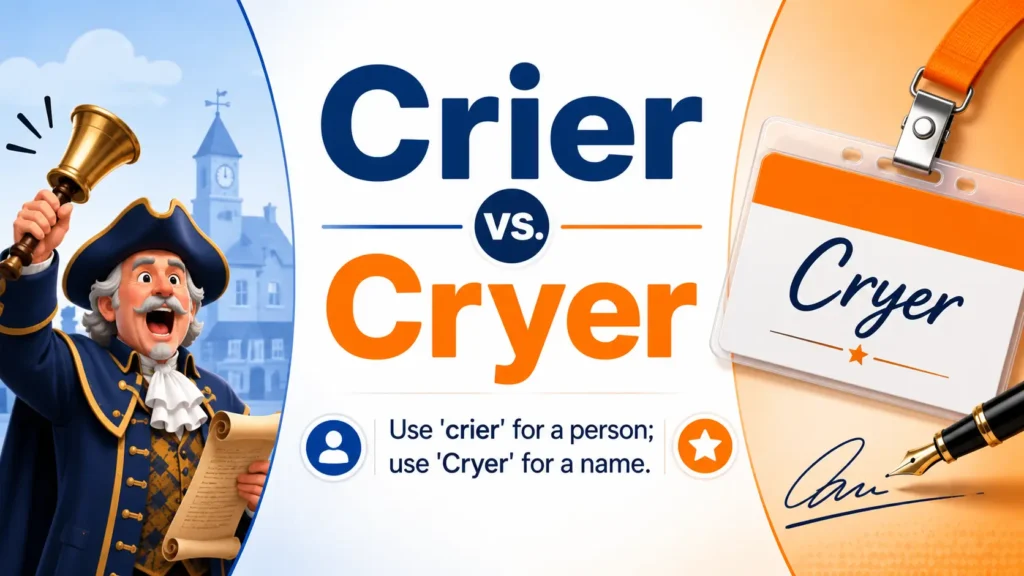
Crier vs. Cryer becomes easy once you know that crier is the standard noun, while Cryer is usually a surname or another official proper name. In modern English, a crier is someone who cries or makes a public announcement, such as a town crier.
The spelling follows a simple grammar rule. When cry takes the ending -er, the y changes to i: cry becomes crier. However, the y stays in crying. This spelling pattern helps students avoid common mistakes in essays, captions, emails, and everyday writing.
Context gives the final clue. Use crier for a person who cries easily, a court announcer, or someone who publicly shares news. Keep Cryer when it is a family name, business name, or title. Although both forms have the same sound, their written uses differ. Checking meaning, capitalization, and sentence context helps you choose the correct word confidently.
Quick Answer: Is It Cryer or Crier?
The standard common noun is crier.
A crier can be:
- A person who cries
- Someone who cries easily
- A person who publicly announces news
- An official who makes formal announcements
Cryer is usually correct only when it’s a proper name, such as a surname, company name, character name, or title.
Simple rule: Use crier for a type of person. Use Cryer when it’s someone’s actual name.
Correct:
- My sister is a crier during emotional movies.
- The town crier rang a bell.
- Ms. Cryer signed the document.
Usually incorrect:
- My sister is a cryer.
- The town cryer announced the news.
Cryer vs. Crier at a Glance
| Word | Standard use | Meaning | Capitalization | Plural |
| crier | Common noun | Someone who cries or announces something publicly | Usually lowercase | criers |
| Cryer | Proper noun | A surname, brand, title, or name | Usually capitalized | Cryers when referring to a family |
| cryer | Usually nonstandard | Common misspelling of crier | Lowercase | Usually incorrect |
The two forms may sound alike. However, their spelling and grammatical roles are different.
What Does “Crier” Mean?
Crier is a countable noun formed from the verb cry. It refers to a person who cries or calls something out loudly.
The meaning depends on context.
A Person Who Cries
In everyday American English, a crier is someone who cries often, easily, or in a particular situation.
Examples:
- I’m a crier when I watch emotional movies.
- He isn’t usually a crier, but the graduation speech moved him.
- She’s a happy crier at weddings.
- My son was never much of a crier as a baby.
This use is often informal. It may describe a person’s emotional response without criticizing them.
For example, someone might say:
“I’m not sad. I’m just a crier when I feel proud.”
Here, crier simply means the speaker expresses strong feelings through tears.
Read this also: Tapping vs. Taping: Meaning, Spelling, and Correct Usage
A Person Who Makes Public Announcements
A crier can also be someone who calls out news, notices, names, or instructions in public.
The best-known example is a town crier.
- The town crier announced the start of the festival.
- A costumed crier read the mayor’s message.
- The crier called for everyone’s attention.
In this meaning, the word comes from an older sense of cry, meaning to call out loudly. It doesn’t refer to tears.
Crier as a Countable Noun
Because crier is countable, it can be singular or plural.
Singular:
- She is a quiet crier.
- The crier entered the town square.
Plural:
- Both children were loud criers as babies.
- The festival invited several town criers.
You can also use articles and possessives:
- a crier
- the crier
- one crier
- several criers
- the crier’s voice
- the criers’ uniforms
What Does “Cryer” Mean?
Cryer is most often a proper noun rather than a standard common noun.
You may see it as:
- A surname
- A family name
- A company or brand name
- A fictional character’s name
- A title
- A preserved spelling in an older text
For example:
- Dr. Cryer will speak at the meeting.
- The Cryer family moved to Oregon.
- I read a novel by an author named Cryer.
- The business operates under the name Cryer & Sons.
In these cases, changing Cryer to Crier would be wrong because names keep their official spelling.
Is “Cryer” a Real Word?
Cryer is real as a name. However, lowercase cryer is usually not the standard spelling for a person who cries.
In normal modern writing:
- crier is the standard common noun.
- Cryer is usually a proper name.
- cryer is often a spelling mistake.
Rare or older uses of cryer may appear in historical material. Creative writers may also choose it for style. Still, those uses don’t make it the best spelling for school, business, academic, or general writing.
Why Does “Cry” Become “Crier”?
The spelling follows a common English rule.
When a word ends in a consonant plus y, the y often changes to i before adding a suffix such as -er.
The word forms like this:
cry → cri + er → crier
The suffix -er creates a noun for someone who performs an action.
- teach → teacher
- write → writer
- sing → singer
- work → worker
- cry → crier
Because cry ends in a consonant followed by y, the spelling changes before -er is added.
Similar Y-to-I Spelling Changes
| Base word | Person noun |
| carry | carrier |
| supply | supplier |
| occupy | occupier |
| deny | denier |
| apply | applier |
| cry | crier |
The exact form can sometimes look unusual. However, the same basic pattern applies.
Why Isn’t It “Cryer”?
A writer may think that adding -er directly to cry should produce cryer. That spelling looks logical, but standard English spelling changes the final y to i.
Therefore:
- Incorrect common noun: cryer
- Correct common noun: crier
This is similar to the past-tense form:
- cry → cried
- try → tried
- carry → carried
The final y changes because a consonant comes before it.
Why Is “Crying” Spelled With a Y?
The y doesn’t always change to i.
Before the suffix -ing, English usually keeps the y. This avoids awkward letter combinations.
Correct:
- cry → crying
- try → trying
- carry → carrying
- study → studying
Incorrect:
- criing
- triing
- carriing
- studiing
Compare the forms:
| Grammar form | Correct spelling |
| Base verb | cry |
| Third-person singular | cries |
| Past tense | cried |
| Present participle | crying |
| Person noun | crier |
This comparison helps explain why crier has an i, while crying keeps the y.
How to Pronounce Crier and Cryer
Crier is pronounced CRY-er.
Its pronunciation can be shown as two parts:
- cry
- er
The spelling changes from y to i, but the first syllable still sounds like the word cry.
The surname Cryer is commonly pronounced the same way. Therefore, you may not know the correct spelling from speech alone.
For example, when someone says “Jordan Cryer,” you need the person’s official spelling. Guessing Crier based only on pronunciation could produce an error.
The Main Differences Between Crier and Cryer
| Feature | Crier | Cryer |
| Main role | Common noun | Proper noun |
| Standard meaning | Someone who cries or announces news | Usually a name |
| Normal capitalization | Lowercase | Capitalized |
| Standard plural | criers | Cryers |
| Example | She’s a crier. | Ms. Cryer called. |
| Town announcer | town crier | Usually incorrect |
| Person who cries | crier | Usually incorrect |
The most important difference is not pronunciation. Instead, it’s whether you’re using a common noun or an official name.
How to Use “Crier” Correctly
Use crier when you’re describing a person by what they do.
Crier in Emotional Situations
- I’m a crier at weddings.
- She became a crier after having children.
- He’s a silent crier who doesn’t show much emotion.
- My friend is a happy crier.
- The movie turned everyone in the room into a crier.
Some of these examples are informal. In formal writing, a clearer phrase may work better.
Informal:
- He’s a crier.
More formal:
- He cries easily when he feels overwhelmed.
- He tends to become tearful during emotional events.
- He expresses strong emotions openly.
Crier in Public Announcements
- The town crier read the official notice.
- The court crier called the session to order.
- A ceremonial crier welcomed visitors.
- The crier announced the winning bidder.
- The historical reenactor played the role of a crier.
The word may sound old-fashioned in modern settings. However, it remains correct in historical, legal, ceremonial, and literary contexts.
When “Cryer” Is Correct
You should use Cryer whenever it’s the official spelling of a name.
A Person’s Surname
- Attorney Morgan Cryer reviewed the contract.
- I spoke with Daniel Cryer yesterday.
- Professor Cryer teaches American history.
Never “correct” a person’s surname based on a general spelling rule. Proper names may preserve spellings that don’t follow ordinary word-building patterns.
A Family Name
Use the Cryers to refer to multiple members of a family named Cryer.
- The Cryers live next door.
- We invited the Cryers to dinner.
- The Cryers’ house is on the corner.
Notice the possessive forms:
- One person: Cryer’s
- The family: Cryers
- Something belonging to the family: Cryers’
A Business or Organization
A business may choose Cryer as part of its official name.
- Cryer Consulting
- Cryer Family Dental
- Cryer Publishing Group
Brand names don’t have to follow common-noun spelling rules. Use the spelling chosen by the organization.
A Title or Fictional Name
Keep Cryer when it appears in an official title, stage name, character name, or work of art.
For example:
- The Midnight Cryer
- Captain Cryer
- Cryer House
A creative title may intentionally use a nonstandard spelling. That choice doesn’t change the standard spelling of crier in ordinary prose.
Cryer or Crier for Someone Who Cries?
Use crier for someone who cries.
Correct:
- She has always been a crier.
- He’s an emotional crier.
- The baby was a loud crier.
Incorrect in standard writing:
- She has always been a cryer.
- He’s an emotional cryer.
- The baby was a loud cryer.
The spelling changes because cry ends with a consonant followed by y. When you add -er, change y to i.
What Does “I’m a Crier” Mean?
The phrase I’m a crier means the speaker cries easily, often, or during certain emotional moments.
It may refer to tears caused by:
- Sadness
- Happiness
- Pride
- Stress
- Anger
- Relief
- Emotional movies
- Weddings or graduations
For example:
- I’m a crier when I’m proud of someone.
- I’m not upset; I’m just a crier.
- I’m a happy crier, especially at weddings.
The phrase is informal and usually neutral. In fact, people often use it to describe themselves honestly or humorously.
However, tone matters. Calling someone else “a crier” could sound judgmental if they’re already embarrassed or upset.
Crier vs. Crybaby
Crier and crybaby aren’t exact synonyms.
Crier
A crier is simply someone who cries. The term may be neutral and factual.
- She’s a crier during sad movies.
- He was a frequent crier as a toddler.
Crybaby
A crybaby is usually a negative or insulting word. It may suggest that someone cries too much, complains, or reacts in an immature way.
- Stop being a crybaby.
- They called him a crybaby after he complained.
Because crybaby can sound rude, use it carefully. It’s often better to describe the behavior rather than label the person.
Respectful alternatives include:
- cries easily
- becomes tearful
- feels emotional
- expresses emotions openly
- is sensitive to criticism
- became upset
What Is a Town Crier?
A town crier was a person who publicly announced official news, laws, events, and notices.
Before newspapers, radio, television, and the internet became widely available, spoken announcements helped communities receive important information.
A town crier might:
- Ring a bell
- Stand in a public square
- Call for attention
- Read an official message
- Announce a new rule
- Report a public event
Example:
- The town crier rang his bell before reading the notice.
The title uses crier, not cryer, because the person “cried” or called out the news.
Town Criers Today
Modern town criers may appear at:
- Festivals
- Historical reenactments
- Tourism events
- Royal or civic ceremonies
- Community celebrations
Their role is now mostly ceremonial. However, the traditional title remains town crier.
Other Uses of “Crier”
Court Crier
A court crier makes formal announcements in a courtroom. Depending on the court, another official may handle these duties.
A court crier may:
- Open a court session
- Call a case
- Ask people to rise
- Announce the judge
- Read formal instructions
Example:
- The court crier asked everyone to stand.
Ceremonial Crier
A ceremonial crier performs public announcements at special events.
- The ceremonial crier welcomed the guests.
- A costumed crier opened the parade.
Auction Crier
In some contexts, a person who calls bids or announces auction activity may be described as a crier. However, auctioneer is the more familiar modern term.
Crier vs. Announcer, Herald, and Caller
Several words can describe a person who delivers information aloud. Still, they aren’t always interchangeable.
| Word | Main meaning | Typical context |
| crier | Someone who publicly calls out news | Historical or ceremonial |
| announcer | Someone who presents information to an audience | Radio, television, sports, events |
| herald | A messenger or person who announces an important arrival | Formal, literary, or historical |
| caller | Someone who calls names, bids, instructions, or responses | Games, auctions, events |
| spokesperson | Someone who speaks officially for a group | Business, government, media |
For example, a person describing a football game is usually an announcer, not a crier. Meanwhile, someone reading a public decree in historical clothing may be a town crier.
Criers vs. Cryers: Which Plural Is Correct?
The correct plural of the common noun crier is criers.
- one crier
- two criers
- several criers
Examples:
- The babies were loud criers.
- Several town criers attended the ceremony.
- Both actors played public criers.
Use Cryers when referring to members of a family whose surname is Cryer.
- The Cryers joined us for lunch.
- We visited the Cryers last summer.
- The Cryers’ dog is friendly.
Possessive Forms
| Meaning | Form | Example |
| Belonging to one crier | crier’s | The crier’s bell was loud. |
| Belonging to several criers | criers’ | The criers’ uniforms were red. |
| Belonging to one person named Cryer | Cryer’s | Mr. Cryer’s office is upstairs. |
| Belonging to the Cryer family | Cryers’ | The Cryers’ home was renovated. |
Capitalization helps show whether the word is a common noun or a family name.
How Capitalization Changes the Meaning
A lowercase crier usually describes a person by role or behavior.
- The crier stood near the courthouse.
- She’s a nervous crier.
A capitalized Cryer usually identifies a specific person, family, brand, or title.
- Ms. Cryer entered the courthouse.
- The Cryers moved away.
However, capitalization alone doesn’t always solve the problem. Every word begins with a capital letter at the start of a sentence.
For example:
- Crier is the correct spelling.
Here, Crier is capitalized only because it starts the sentence. It’s still being discussed as a common noun.
Therefore, always check the meaning and context.
Common Mistakes With Cryer and Crier
Writing “Cryer” for Someone Who Cries
Incorrect:
- She’s a cryer during emotional scenes.
Correct:
- She’s a crier during emotional scenes.
The y changes to i before -er.
Writing “Town Cryer”
Incorrect:
- The town cryer rang a bell.
Correct:
- The town crier rang a bell.
Town crier is the established spelling of the historical title.
Treating the Words as Interchangeable
Incorrect:
- Either spelling is fine.
Correct:
- Crier is the standard common noun, while Cryer is usually a proper name.
Their pronunciation may match, but their written uses don’t.
Changing a Surname
Incorrect:
- Correcting Ms. Cryer’s name to Ms. Crier
Correct:
- Keep the person’s official spelling: Ms. Cryer
Grammar rules don’t give you permission to alter someone’s name.
Forgetting to Capitalize a Name
Incorrect:
- I emailed Jordan cryer.
Correct:
- I emailed Jordan Cryer.
Surnames are proper nouns and require a capital letter.
Applying the Y-to-I Rule Before “-ing”
Incorrect:
- The child is criing.
Correct:
- The child is crying.
The y stays before -ing.
Using “Crier” as an Insult
The word may be grammatically correct but socially unhelpful.
Harsh:
- You’re such a crier.
More respectful:
- You seem upset.
- You’ve been feeling emotional lately.
- It’s okay to cry.
Good writing considers both correctness and tone.
Correct and Incorrect Examples
| Incorrect sentence | Correct sentence | Reason |
| She’s a happy cryer. | She’s a happy crier. | The common noun changes y to i. |
| The town cryer read the notice. | The town crier read the notice. | Town crier is the standard title. |
| The two cryers announced the news. | The two criers announced the news. | The plural of crier is criers. |
| Mr. Crier called, although his surname is Cryer. | Mr. Cryer called. | Proper names keep their official spelling. |
| The baby is criing. | The baby is crying. | Keep y before -ing. |
| The criers invited us over. | The Cryers invited us over. | The sentence refers to a family named Cryer. |
Real-Life Examples
A Social Media Caption
Incorrect:
- I’m such a cryer during wedding videos.
Better:
- I’m such a crier during wedding videos.
The sentence describes someone who cries, so crier is correct.
A Historical Event Description
Incorrect:
- The town cryer announced the festival.
Correct:
- The town crier announced the festival.
The person is a public announcer, not someone named Cryer.
A Workplace Email
Correct:
- Please send the completed form to Ms. Cryer.
Here, Cryer is a surname. Changing it would be disrespectful and inaccurate.
A Family Invitation
Correct:
- We’re having dinner with the Cryers on Saturday.
The sentence refers to the Cryer family. Therefore, the capitalized plural form is correct.
Easy Memory Tricks
Connect Crier With Cried
Both words change y to i:
- cry → cried
- cry → crier
If you can remember cried, you can remember crier.
Think of a Town Crier
The familiar phrase town crier always uses i. That phrase can help you remember the standard spelling.
Treat Cryer as a Name
When you see Cryer with a capital C, think:
“This is probably someone’s name.”
That idea won’t cover every rare use, but it works well in everyday writing.
Use the Meaning Test
Ask yourself:
- Am I describing someone who cries? Use crier.
- Am I describing a public announcer? Use crier.
- Am I writing someone’s official name? Use Cryer if that is the correct spelling.
Synonyms and Related Words
Words Related to a Person Who Cries
Possible alternatives include:
- weeper
- mourner
- sobber
- tearful person
- emotional person
These words don’t always have the same tone.
Weeper sounds literary or old-fashioned. Mourner describes someone grieving a death or loss. Sobber focuses on loud, broken crying. Meanwhile, tearful person is often more neutral.
Words Related to a Public Crier
Depending on the context, alternatives include:
- announcer
- herald
- messenger
- caller
- broadcaster
- spokesperson
Choose the word that matches the setting. A broadcaster works in modern media, while a herald fits formal or historical writing.
Quick Grammar Tips
Keep these points in mind:
- Use crier as the standard noun.
- Use Cryer for an official name.
- Change y to i before adding -er.
- Keep y before adding -ing.
- Use criers as the common-noun plural.
- Use Cryers for a family named Cryer.
- Don’t change the spelling of a person’s surname.
- Check context instead of relying only on pronunciation.
Frequently Asked Questions
Q1.Is “crier” or “cryer” correct for someone who cries?
Crier is the correct standard word for someone who cries. For example, “She is a happy crier.” The spelling cryer is usually incorrect unless it is a name.
Q2.Why does “cry” change to “crier”?
When -er is added to a word ending in a consonant plus y, the y usually changes to i. Therefore, cry becomes crier, just as carry becomes carrier.
Q3.Is “Cryer” a real word?
Cryer is commonly used as a surname, family name, business name, or title. However, lowercase cryer is not the standard common noun for a person who cries.
Q4.Is it “town crier” or “town cryer”?
The correct phrase is town crier. A town crier was a person who announced public news and official notices in a loud voice.
Q5.What is the plural of “crier”?
The plural of crier is criers. For example, “Several town criers attended the ceremony.” However, the Cryers may refer to a family whose surname is Cryer.
Conclusion
The difference between Crier vs. Cryer depends on meaning and context. Use crier for a person who cries or someone who makes public announcements, such as a town crier or court crier. The standard plural is criers.
Use Cryer when it is an official surname, family name, company name, or title. Remember the simple spelling pattern: cry becomes crier, while crying keeps the y. Checking the word’s meaning and capitalization will help you choose the correct spelling in essays, emails, captions, and everyday writing.
