
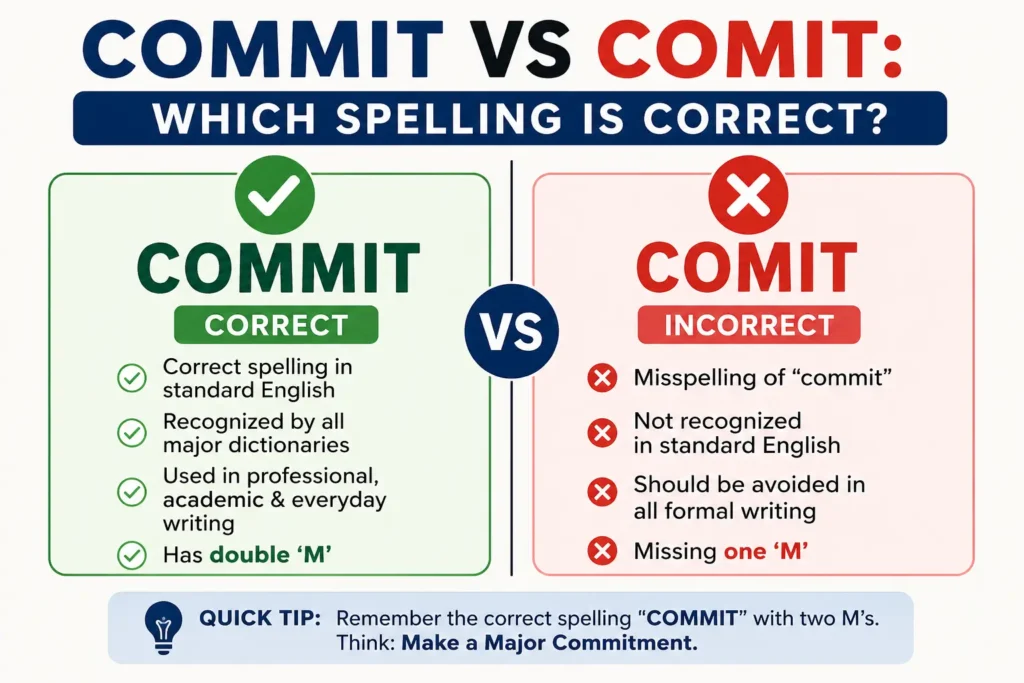
The commit vs comit choice is simple: commit is correct in standard English, while comit is a misspelling with one m missing from the word itself. Dictionaries recognize only the double-m form, pronounced “kuh-MIT,” when the verb means to promise, dedicate, or carry out an action.
This common spelling error often appears when writers, students, or professionals are typing quickly. Because the pronunciation doesn’t reveal the double letters, people may type comit in emails, essays, business documents, online discussions, or SEO content. Even a small spelling mistake can weaken academic writing, professional communication, and reader trust.
To remember the difference, split the word as “com + mit” or use the memory line “Make a Major commitment.” Both memory tricks highlight the two m’s. Then check related forms: committed and committing double the final t, while commitment doesn’t. This quick rule supports accurate everyday English and formal writing.
Commit vs. Comit: Quick Answer
Commit is the only correct spelling when you mean to make a firm decision, dedicate yourself, carry out an act, or assign resources.
Comit is not an accepted alternative spelling of the English verb.
| Word | Correct? | Meaning | Example |
| commit | Yes | To promise, dedicate, carry out, or assign | We can commit to the deadline. |
| comit | No | No standard English meaning as a verb | We can comit to the deadline. |
Quick rule: Write commit, not comit. The word always contains two m’s.
Read this also: Grately vs Greatly: Correct Spelling, Meaning, Grammar, and Examples
Correct and incorrect examples
Correct: She plans to commit more time to studying.
Incorrect: She plans to comit more time to studying.
The meaning and sentence structure are fine in both examples. However, the second sentence misspells the verb.
Correct: The company won’t commit to a launch date yet.
Incorrect: The company won’t comit to a launch date yet.
Again, the only problem is the missing m.
What Does Commit Mean?
Commit is mainly a verb. Its exact meaning depends on the words and context around it.
In general, it describes a firm action. You may commit to a plan, commit money to a project, commit a crime, or commit an idea to writing.
To make a firm promise or decision
You can use commit when someone makes a definite choice or promise.
- I can’t commit to Saturday yet.
- The team committed to finishing the project on time.
- She isn’t ready to commit to a long-term relationship.
- We’ve committed to reducing unnecessary expenses.
In these examples, the person or group moves beyond simple interest. The decision involves a real obligation.
For example, saying “I’d like to attend” expresses interest. Saying “I commit to attending” expresses a firm decision.
To dedicate yourself to something
Commit can also mean giving your attention, energy, or effort to a goal.
- You’ll need to commit to regular practice.
- He committed himself to improving his writing.
- They are fully committed to the program.
- Success requires you to commit time and effort.
This meaning often appears in discussions about education, fitness, work, and personal development.
However, commitment doesn’t always guarantee success. It describes the decision and effort, not the final result.
To assign time, money, or resources
Businesses, schools, governments, and individuals often commit resources to a purpose.
- The company committed $50,000 to employee training.
- We can’t commit more staff to the project.
- The school has committed additional funds to its science department.
- She committed three evenings a week to volunteer work.
Here, commit means to officially set something aside or make it available.
The object can be tangible, such as money or equipment. It can also be less concrete, such as time, attention, or labor.
To carry out an action
The verb frequently appears with crimes, offenses, and serious acts.
- The suspect was accused of committing fraud.
- It is illegal to commit perjury.
- Investigators found no evidence that she committed the offense.
- A person can commit a serious breach of trust.
In this pattern, commit means to perform or carry out the act.
You may also see phrases such as commit an error. That phrase is grammatically correct, especially in formal writing. However, Americans usually say make a mistake in everyday conversation.
- Formal: The accountant committed an error in the report.
- Natural everyday wording: The accountant made a mistake in the report.
To place something in a permanent form
In formal English, commit can mean putting information into writing or memory.
- Please commit the agreement to writing.
- She committed the speech to memory.
- He committed his thoughts to paper.
- The final decision was committed to the official record.
These expressions sound more formal than ordinary phrases such as “write it down” or “memorize it.”
To place someone under official care or authority
In legal, medical, and institutional contexts, commit may describe placing someone in custody or care.
- The judge committed the defendant to custody.
- The patient was committed to a treatment facility.
- The court may commit a juvenile to state care.
This meaning requires careful wording because it concerns legal or medical authority. It is less common in casual conversation.
How to Pronounce Commit
In American English, commit is pronounced kuh-MIT.
The stress falls on the second syllable:
com-MIT
Because the first syllable is unstressed, you may not clearly hear both m’s. That is one reason writers sometimes produce the incorrect spelling comit.
Breaking the word into parts
A useful visual division is:
com + mit
The first part ends with m, and the second begins with m. Together, they create the double m in commit.
The spelling also reflects the word’s history. It comes from a Latin form built from com- and mittere, meaning “to send.” You don’t need to memorize the Latin, but the origin helps explain why the double m belongs in the word.
Why Do People Write Comit?
Most people who write comit know the word’s meaning. They simply miss one of the repeated letters.
Several factors make this error common.
Pronunciation doesn’t reveal the spelling
English spelling doesn’t always match pronunciation exactly.
When people say commit, they don’t pause between the two m’s. As a result, the word may sound as though it contains only one.
Spelling the word only by sound can therefore lead to comit.
Double consonants are easy to overlook
Repeated letters often cause typing mistakes.
Writers commonly struggle with forms such as:
- accommodate
- beginning
- necessary
- occurrence
- recommend
- committed
The eye may skip one repeated letter, especially during fast reading or typing.
Fast typing causes omissions
When you type quickly, your fingers may press the m key only once.
This problem often appears in:
- Text messages
- Work emails
- Online comments
- Social media captions
- Search queries
- First drafts
A spell-checker may correct the error. However, automatic correction can also hide the fact that you haven’t learned the spelling.
English learners may spell by sound
Non-native speakers often use pronunciation as a spelling guide. That strategy works for some words, but not for all English vocabulary.
Since commit doesn’t strongly pronounce two separate m sounds, comit may appear logical. Still, standard written English requires commit.
Is Comit Ever a Real Word?
Lowercase comit is not a standard English spelling of commit.
You may occasionally see COMIT as a name, acronym, product label, or historical technical term. For example, COMIT was used as the name of an early programming language.
However, that specialized proper name doesn’t make comit an acceptable spelling in ordinary sentences.
Use commit in school assignments, professional documents, emails, websites, applications, and general writing.
Verb Forms of Commit
The spelling becomes more confusing when suffixes are added.
| Grammar form | Correct spelling | Example |
| Base form | commit | I will commit to the plan. |
| Third-person singular | commits | She commits fully to her work. |
| Simple past | committed | They committed more money. |
| Past participle | committed | We have committed to the schedule. |
| Present participle | committing | He is committing more time to practice. |
| Noun | commitment | The course requires commitment. |
The key forms to remember are:
- commit
- commits
- committed
- committing
- commitment
Why Committed Has Two T’s
The correct past-tense spelling is committed, not commited.
English often doubles a final consonant before adding a suffix that begins with a vowel. This happens when the word ends in a consonant-vowel-consonant pattern and the final syllable carries the stress.
Look at the end of commit:
- m is a consonant.
- i is a vowel.
- t is a consonant.
- The stress falls on mit.
Therefore, the final t doubles before -ed:
commit + ed = committed
Examples with committed
- She committed to the new schedule.
- We committed additional resources to the campaign.
- He committed several errors in the first draft.
- The company has committed to improving workplace safety.
This consonant-doubling rule applies in both American and British English because the final syllable is stressed.
Why Committing Has Two T’s
The same spelling rule applies before -ing.
commit + ing = committing
The final t doubles because -ing begins with a vowel.
- They are committing more staff to the project.
- She is committing herself to daily practice.
- The organization is committing funds to local schools.
- He admitted to committing the offense.
The spelling commiting is incorrect because it fails to double the final consonant.
Why Commitment Doesn’t Have a Double T
The correct noun is commitment, not committment.
This form confuses many writers because committed and committing double the final t. However, commitment follows a different pattern.
The suffix -ment begins with a consonant. Therefore, the final t in commit doesn’t double.
commit + ment = commitment
Look closely at the spelling
c-o-m-m-i-t-m-e-n-t
The word contains two t’s in total. However, they do not appear next to each other.
- First t: at the end of commit
- Second t: at the end of -ment
That is why committment is wrong. It adds an unnecessary extra t in the middle.
Common Spelling Forms Compared
| Incorrect form | Correct form | Why |
| comit | commit | The base word needs two m’s. |
| committ | commit | The base word has only one final t. |
| commited | committed | Double the final t before -ed. |
| comitted | committed | The word needs two m’s and two t’s. |
| committted | committed | Three t’s are never needed. |
| commiting | committing | Double the final t before -ing. |
| comitting | committing | The word still needs two m’s. |
| committment | commitment | Do not double the t before -ment. |
| comitment | commitment | The base word needs two m’s. |
How to Use Commit in a Sentence
Commit appears in several sentence patterns. Learning these structures will help you use the word naturally.
Commit to a noun
Use commit to + noun when someone makes a firm decision about a plan, person, responsibility, or goal.
- We can commit to the deadline.
- She won’t commit to a final price.
- He is ready to commit to the relationship.
- The board committed to the proposal.
In this structure, to is a preposition.
Commit to an -ing verb
When a verb comes after the preposition to, the -ing form is usually the clearest choice.
- We committed to finishing the project.
- She is committed to helping new employees.
- The school committed to reducing class sizes.
- They won’t commit to paying the additional fee.
This structure is especially natural when you are describing an ongoing activity or responsibility.
Can you say “commit to do”?
Yes, commit to do something can be grammatical, especially when it means making a promise to perform one specific action.
- The company committed to deliver the equipment by Friday.
- The candidate committed to release the report.
However, many American writers and editors prefer the gerund structure:
- The company committed to delivering the equipment by Friday.
- The candidate committed to releasing the report.
The -ing form often sounds smoother because to commonly functions as a preposition after commit.
Therefore, when you are unsure, use commit to doing something.
Commit something to something
Use this structure when assigning money, time, effort, or resources.
- The city committed more money to road repairs.
- We committed two employees to the account.
- She commits several hours to study each evening.
- The charity committed most of its budget to food assistance.
Here, the first object identifies what is being assigned. The phrase after to identifies the purpose.
Commit yourself to something
The reflexive form adds emphasis.
- You must commit yourself to the process.
- She committed herself to learning the language.
- He has committed himself to public service.
- They refused to commit themselves to one approach.
You can often remove yourself, herself, or themselves without changing the basic meaning.
- She committed to learning the language.
Still, the reflexive form sounds more deliberate and formal.
Be committed to something
Committed can act as an adjective meaning dedicated, loyal, or firmly involved.
- She is committed to her students.
- We’re committed to quality.
- He remains committed to the original goal.
- The company is committed to protecting customer data.
This pattern is extremely common in professional statements. However, it can sound empty when the sentence offers no proof.
For example:
“We’re committed to excellent service” sounds stronger when the writer explains what the organization actually does.
A more specific version would be:
“We’re committed to answering customer requests within one business day.”
Commit, Committed, and Commitment
These related words don’t play the same role in a sentence.
| Word | Part of speech | Function | Example |
| commit | Verb | Names the action | They commit time to the project. |
| committed | Verb or adjective | Shows a past action or dedication | She is committed to the project. |
| committing | Verb form | Shows an ongoing action | He is committing more resources. |
| commitment | Noun | Names the promise or obligation | The job requires commitment. |
Commit is an action
Use commit when someone does something.
- I commit to the plan.
- They will commit more money.
- She refuses to commit.
Committed describes a past action or state
Use committed as the past tense:
- They committed to the project last week.
You can also use it as an adjective:
- They are committed employees.
In the second sentence, committed describes the employees as dedicated.
Commitment is a thing or idea
Use commitment when naming a promise, responsibility, or state of dedication.
- This job requires a major commitment.
- She honored her commitment.
- Their commitment to safety is clear.
- I can’t make that commitment yet.
Common Phrases With Commit
Some words naturally appear together. These common combinations are called collocations.
Commit to a plan or decision
- commit to a deadline
- commit to a schedule
- commit to a strategy
- commit to a course of action
- commit to a final decision
- commit to a long-term goal
Example: The client hasn’t committed to the final design.
Commit time, money, or resources
- commit time
- commit funds
- commit staff
- commit resources
- commit energy
- commit equipment
Example: Management committed additional staff to the product launch.
Commit a crime or offense
- commit a crime
- commit fraud
- commit theft
- commit perjury
- commit an offense
- commit a violation
Example: The evidence showed that someone had committed fraud.
A sensitive usage note is also important. Many modern writers avoid the phrase commit suicide because the word commit can suggest a crime or moral offense. In many contexts, die by suicide is clearer and more neutral.
Commit something to writing or memory
- commit an agreement to writing
- commit a poem to memory
- commit an idea to paper
- commit a decision to the record
Example: The two parties committed the agreement to writing.
Commit in Everyday American English
The word appears in casual speech, education, business, law, and technology.
Everyday conversation
- I can’t commit to dinner until I check my schedule.
- Are you ready to commit to the relationship?
- You’ll need to commit more time to training.
- She wants to help, but she won’t commit yet.
In conversation, commit often implies that someone is hesitant about making a firm choice.
School and academic writing
- Students must commit to attending every session.
- The university committed funding to the research project.
- Participants committed to completing three surveys.
- The writer committed several factual errors.
Academic writers should choose the object carefully. You can commit funds, commit an error, or commit to a method. However, you wouldn’t normally say that a study “committed results.”
A study may produce, report, support, or confirm results.
Workplace communication
- We can commit to delivering the report by Thursday.
- The department has committed additional resources.
- The supplier won’t commit to a fixed price.
- Our team is committed to meeting the new standard.
These sentences work because they name a specific obligation.
Vague promises sound weaker:
- Vague: We’re committed to doing better.
- Specific: We’re committed to reducing response times to one business day.
Legal and formal writing
- The defendant was accused of committing fraud.
- The agreement commits both parties to confidentiality.
- The judge committed the defendant to custody.
- The court committed the issue to further review.
Legal meanings are often more precise than everyday ones. Therefore, avoid replacing commit with a synonym unless the new word preserves the exact meaning.
Read this also: Courtesy vs Curtesy: Difference, Meaning, and Correct Usage
What Does Commit Mean in Programming?
In software development, commit can function as both a verb and a noun.
A commit is a saved record of changes in a version-control system. It usually includes the changed files, information about the author, and a brief message describing the update.
Commit as a verb
- Commit your changes before switching branches.
- She committed the bug fix this morning.
- I haven’t committed the updated file yet.
- The developer is committing a security patch.
Commit as a noun
- That commit fixed the login issue.
- Review the latest commit before merging the branch.
- The project contains several small commits.
- Each commit should have a clear message.
A useful commit message briefly explains what changed.
For example:
Fix password-reset validation error
That message is clearer than a vague description such as Update files.
The spelling remains commit in technology. Comit is still incorrect unless it forms part of a specific product name, acronym, or historical proper noun.
Commit vs. Similar Words
Several verbs overlap with commit, but they aren’t always interchangeable.
| Word | Main meaning | Natural example |
| commit | Accept a firm obligation or assign resources | We committed to the deadline. |
| promise | Give your word that something will happen | I promise I’ll call. |
| pledge | Make a serious or formal promise | The company pledged $1 million. |
| dedicate | Give time, effort, or attention to a purpose | She dedicated her career to teaching. |
| devote | Give a large amount of time or energy | He devoted the weekend to studying. |
| allocate | Officially distribute resources | The manager allocated funds to each team. |
| perpetrate | Carry out a harmful or illegal act | They perpetrated a complex fraud. |
Commit vs. promise
Promise focuses on what you say or assure another person.
Commit focuses more on accepting an obligation.
- I promise I’ll send the email.
- I commit to sending weekly progress reports.
In casual conversation, promise usually sounds more natural. In business or formal planning, commit may sound more precise.
Commit vs. dedicate
Dedicate often describes long-term effort or purpose.
- She dedicated her life to medicine.
- She committed to completing medical school.
The first sentence emphasizes devotion. The second emphasizes a firm decision.
Commit vs. allocate
Both words can refer to resources. However, allocate focuses on distribution, while commit emphasizes a firm decision to make the resources available.
- The manager allocated $10,000 among three departments.
- The company committed $10,000 to the training program.
Commit vs. perpetrate
Both words may appear with harmful acts. However, perpetrate is more formal and strongly negative.
- He committed fraud.
- He perpetrated an elaborate fraud scheme.
You wouldn’t use perpetrate with a promise, relationship, or resource.
Common Mistakes With Commit
Writing comit
Incorrect: We can comit to the new deadline.
Correct: We can commit to the new deadline.
The base word always has two m’s.
Writing commited
Incorrect: She commited to the program.
Correct: She committed to the program.
The final t doubles before -ed.
Writing commiting
Incorrect: They are commiting more resources.
Correct: They are committing more resources.
The final t also doubles before -ing.
Writing committment
Incorrect: The role requires a major committment.
Correct: The role requires a major commitment.
The -ment suffix doesn’t require an extra t.
Using the wrong preposition
Incorrect: She committed on the new plan.
Correct: She committed to the new plan.
Use commit to for plans, promises, goals, and responsibilities.
Using commit with an unnatural object
Incorrect: He committed his homework.
Correct: He completed his homework.
Incorrect: She committed an accident.
Correct: She caused an accident.
Incorrect: We committed a meeting.
Correct: We scheduled a meeting.
The verb commit doesn’t simply mean “do.” It needs an object or structure that matches one of its established meanings.
Mini Case Study: Fixing a Professional Email
Consider this realistic draft:
We can comit to deliver the updated proposal by Thursday. Our team is commited to provide accurate pricing.
The reader can understand the message. Still, the spelling errors reduce its professional quality.
A stronger revision is:
We can commit to delivering the updated proposal by Thursday. Our team is committed to providing accurate pricing.
The revision fixes three problems:
- Comit becomes commit.
- Commited becomes committed.
- The verbs after committed to change to the natural -ing form.
The final version is correct, direct, and easy to read.
How to Remember the Correct Spelling
Break it into com + mit
Visualize the word as:
COM + MIT
One m ends the first part. Another m begins the second.
Use a simple memory sentence
Remember:
Make a Major commitment.
The two capital M’s can remind you that commit contains two m’s.
Learn the whole word family
Memorize these four forms together:
- commit
- committed
- committing
- commitment
Seeing them as a group makes the pattern easier to remember.
- The base form has two m’s and one final t.
- Add -ed or -ing, and the final t doubles.
- Add -ment, and the final t stays single.
Use a spelling formula
commit + ed = committed
commit + ing = committing
commit + ment = commitment
Proofread the middle of the word
Writers often check only the beginning and ending of a word. With commit, the mistake usually occurs in the middle.
Pause and check:
c-o-m-m-i-t
Then check the ending you added.
Quick Editing Checklist
Before publishing or submitting your writing, ask:
- Did I write commit with two m’s?
- Did I avoid the misspelling comit?
- Did I write committed with two t’s?
- Did I write committing with two t’s?
- Did I spell commitment without an extra middle t?
- Did I use commit to for a promise or decision?
- Does the word after commit fit its meaning?
- Would a more specific verb sound clearer?
Practice Quiz
Choose the correct spelling
We can’t _____ to that price.
- comit
- commit
Answer: commit
The base word contains two m’s.
Correct the misspelled word
She commited herself to the training program.
Answer: She committed herself to the training program.
The final t doubles before -ed.
Choose the correct form
The city is _____ more money to public transportation.
- commiting
- committing
Answer: committing
The final t doubles before -ing.
Correct the noun
His committment to the team was clear.
Answer: His commitment to the team was clear.
The suffix -ment doesn’t require a doubled t.
Complete the sentence
The organization is committed to _____ waste.
- reduce
- reducing
Answer: reducing
After committed to, the -ing form is usually the most natural choice.
Read this also: Unorganized vs Disorganized: Meaning, Difference, and Examples
Frequently Asked Questions
Q1: Is commit or comit correct?
Commit is the correct spelling in standard English. Comit is an incorrect form caused by leaving out one m.
- Correct: I can commit to the new schedule.
- Incorrect: I can comit to the new schedule.
Q2: Why does commit have two m’s?
The accepted spelling is c-o-m-m-i-t. Although the word has a double m, its pronunciation doesn’t make both letters easy to hear. That is why comit is a common spelling mistake.
Q3: Is it committed or commited?
Committed is correct. The final t doubles before the ending -ed because the stress falls on the final syllable of commit.
- Correct: She committed to the project.
- Incorrect: She commited to the project.
Q4: Is it committing or commiting?
Committing is the correct form. The final t doubles before -ing.
- Correct: They are committing more resources.
- Incorrect: They are commiting more resources.
Q5: Is it commitment or committment?
Commitment is correct. Unlike committed and committing, it does not add another t before -ment.
- Correct: The role requires a serious commitment.
- Incorrect: The role requires a serious committment.
Conclusion
The difference between commit vs comit is simple: commit is the correct spelling, and comit is a misspelling. Always write the base word with a double m.
Remember the main forms: commit, committed, committing, and commitment. The final t doubles before -ed and -ing, but it stays single before -ment.
A quick way to remember the spelling is to divide the word into com + mit. Once you recognize the two m’s, you can use commit correctly in professional writing, academic work, business messages, and everyday English.
