
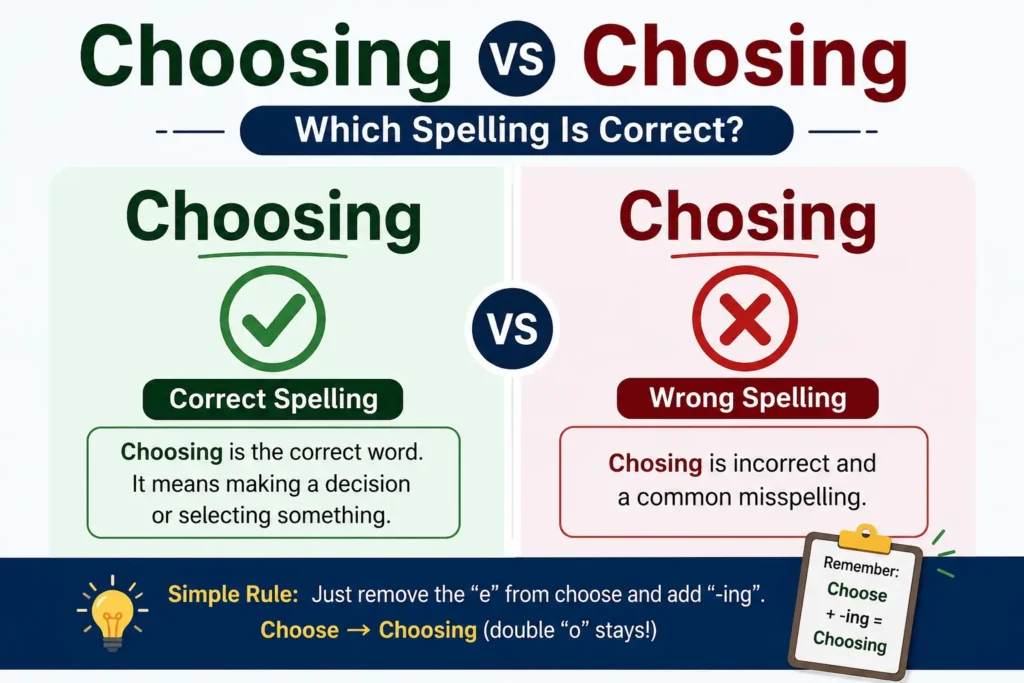
Choosing vs chosing is a common spelling question, and the purpose of this guide is to show which form is correct and how to use it without mistakes. Choosing is the correct spelling in standard English, while chosing is a common misspelling. Knowing this difference helps you write clear emails, assignments, messages, and professional documents.
The confusion happens because both forms look similar and may sound the same when spoken. However, the grammar rule is easy to remember. When “-ing” is added to choose, the final “e” is removed, but the double o remains. Therefore, choose becomes choosing, not chosing.
Choosing is a verb that means making a decision, selecting, or picking something from different options. For example, you may be choosing a restaurant, a movie, a course, or a career path. Using the right word keeps your writing clear, accurate, and professional.
Choosing or Chosing? The Quick Answer
Choosing is correct. Chosing is incorrect.
| Word | Correct? | Meaning or status | Example |
| Choosing | Yes | The -ing form of choose | She is choosing a new laptop. |
| Chosing | No | A common misspelling | She is chosing a new laptop. |
| Chose | Yes | The simple past tense of choose | She chose a new laptop yesterday. |
| Chosen | Yes | The past participle of choose | She has chosen a new laptop. |
Use choosing when someone is making a decision, selecting an option, or deciding between possibilities.
Correct: Thank you for choosing our service.
Incorrect: Thank you for chosing our service.
The second sentence is wrong because chosing isn’t an accepted English word.
Read this also: IKK Meaning in Text: What Does IKK Mean in Texting?
What Does Choosing Mean?
Choosing means deciding which person, object, action, or option you want from two or more possibilities.
It is the present participle and gerund form of the verb choose. Although those grammar terms may sound technical, the difference is simple.
Choosing as a Present Participle
A present participle often works with a helping verb, such as am, is, are, was, or were. Together, they describe an action that is in progress.
- I am choosing a topic for my essay.
- She is choosing between two job offers.
- We were choosing paint colors when you called.
- The students are choosing their classes for next semester.
In each example, the decision-making process is happening over a period of time.
Choosing as a Gerund
A gerund is an -ing form that functions like a noun. In other words, it names an activity.
- Choosing a college can feel stressful.
- Choosing wisely takes patience.
- His biggest challenge was choosing between the two positions.
- Choosing the right words can improve your email.
Here, choosing refers to the activity or process of making a choice.
A Simple Way to Tell the Difference
Look at the word’s job in the sentence.
In “She is choosing a dress,” choosing is part of the verb phrase is choosing.
In “Choosing a dress takes time,” choosing acts as the subject of the sentence. Therefore, it functions as a gerund.
Both uses have the same spelling.
Why Is Choosing Spelled With Two O’s?
The spelling becomes easier when you start with the correct base word: choose.
The verb choose contains two o’s. When you add -ing, you remove only the final silent e.
- choose
- remove the final e
- add -ing
- choosing
Therefore, the correct form is choosing, not chosing.
The Silent-E Rule
Many English verbs end with an e that isn’t strongly pronounced. When you add a suffix beginning with a vowel, such as -ing, you usually drop that final e.
| Base verb | Remove final e | Add -ing | Correct form |
| make | mak | ing | making |
| write | writ | ing | writing |
| use | us | ing | using |
| take | tak | ing | taking |
| choose | choos | ing | choosing |
However, dropping the final e doesn’t mean removing any other letters. The two o’s are part of the root of choose, so they stay.
Why One O Doesn’t Disappear
The spelling chosing would suggest that the word was formed from chose. However, chose is already a past-tense verb. English doesn’t normally create present participles by adding -ing to a simple past form.
For example:
- write → writing, not wroting
- speak → speaking, not spoking
- drive → driving, not droving
- choose → choosing, not chosing
You form the -ing version from the base verb, not from the past tense.
Why Chosing Looks Believable
The misspelling chosing can look reasonable because chose is a real word. Writers may see the pair choose/chose and assume that one o should disappear before -ing.
That assumption is incorrect. The vowel change in chose marks the past tense. It doesn’t create a general spelling rule for other forms of the verb.
Choosing vs. Chosing: Key Differences
The main difference is simple: choosing is a real word, while chosing is not.
| Feature | Choosing | Chosing |
| Standard English word | Yes | No |
| Correct spelling | Yes | No |
| Base word | Choose | None |
| Part of speech | Verb form or gerund | Not applicable |
| Meaning | Making a decision or selection | No standard meaning |
| Used in American English | Yes | No |
| Used in British English | Yes | No |
| Example | We are choosing a restaurant. | We are chosing a restaurant. |
Some spelling differences change between American and British English. For example, Americans usually write color, while British writers use colour. However, choosing doesn’t vary by region.
Choose, Chose, Chosen, and Choosing
The verb choose is irregular. That means its past forms don’t follow the usual pattern of adding -ed.
You wouldn’t write choosed. Instead, the simple past is chose, and the past participle is chosen.
| Verb form | Word | Typical use | Example |
| Base form | choose | Present actions, commands, and infinitives | Please choose a seat. |
| Third-person singular | chooses | Present action with he, she, or it | She chooses carefully. |
| Simple past | chose | Completed past action | He chose the blue shirt. |
| Past participle | chosen | Used with has, have, or had | They have chosen a winner. |
| Present participle or gerund | choosing | Ongoing action or named activity | We are choosing a date. |
Choose for Present or Future Decisions
Use choose for general habits, present choices, instructions, and future decisions after words such as will, can, or should.
- I usually choose the cheaper option.
- You can choose any seat.
- Please choose a secure password.
- We will choose the winner on Friday.
- You should choose your words carefully.
Chose for a Completed Past Decision
Use chose when the decision happened and ended in the past.
- I chose the red jacket yesterday.
- She chose biology as her major.
- We chose that restaurant because it had good reviews.
- The manager chose three candidates for interviews.
Time expressions such as yesterday, last week, in 2024, or two hours ago often signal the simple past.
Chosen With Has, Have, or Had
Use chosen after has, have, or had.
- She has chosen a new career.
- We have chosen a date for the meeting.
- They had chosen another supplier before we submitted our offer.
- He hasn’t chosen a topic yet.
The word chosen can also appear in passive sentences.
- The winner was chosen by the judges.
- Three applicants were chosen for the final interview.
- This design has been chosen for the new website.
Choosing for an Ongoing Action
Use choosing when the decision process is still happening.
- I am choosing a gift for my sister.
- She is choosing between two apartments.
- They are choosing a new company name.
- We were choosing a movie when the power went out.
The action may be happening right now, or it may be taking place during a broader period.
For example, “I’m choosing a college this month” doesn’t mean you’re making the decision at this exact second. It means the process is currently underway.
Choosing vs. Chose
Choosing and chose both come from choose, but they express different times and sentence structures.
Choosing usually refers to an ongoing process. Chose refers to a completed past decision.
| Sentence | Meaning |
| I am choosing a new phone. | The decision is still in progress. |
| I chose a new phone yesterday. | The decision is complete. |
| She is choosing her classes. | She is deciding now or during the current period. |
| She chose her classes last week. | She completed the decision last week. |
Common Errors With Choosing and Chose
Incorrect: I am chose the red one.
Correct: I am choosing the red one.
The helping verb am needs the -ing form when it describes an ongoing action.
Incorrect: Yesterday, I was choosing the blue one and bought it.
This sentence may be grammatically possible if you want to focus on the decision process. However, it sounds unclear if you only mean that you made the final choice.
Clearer: Yesterday, I chose the blue one and bought it.
Use chose when the past decision is complete.
Choosing vs. Chosen
The difference between choosing and chosen depends on whether the decision is still in progress or already completed.
- Choosing: the selection process is happening.
- Chosen: the selection has been completed.
Compare these examples:
- We are choosing a new team leader.
- We have chosen a new team leader.
In the first sentence, the team is still considering candidates. In the second, the decision is complete.
Why Chosen Needs a Helping Verb
Because chosen is a past participle, it usually needs a helping verb.
Common combinations include:
- has chosen
- have chosen
- had chosen
- was chosen
- were chosen
- has been chosen
Incorrect: She chosen the green dress.
Correct: She chose the green dress.
Also correct: She has chosen the green dress.
The first correction uses the simple past. The second uses the present perfect tense.
How to Pronounce Choosing
In American English, choosing is pronounced approximately as:
CHOO-zing
Its phonetic form is /ˈtʃuːzɪŋ/.
The first syllable sounds like chew. The middle consonant sounds like a z, not a sharp s.
Break it into two parts:
- choos
- ing
That pronunciation can help you remember the spelling. The long oo sound appears in both choose and choosing.
Compare:
- choose: CHOOZ
- choosing: CHOO-zing
- chose: CHOHZ
- chosen: CHOH-zən
Notice that choose and choosing share the same vowel sound. Meanwhile, chose and chosen have a different vowel sound.
Is Choosing Spelled Differently in British English?
No. Choosing is spelled the same way in American and British English.
It is also the standard spelling in:
- Canadian English
- Australian English
- New Zealand English
- Irish English
- International English
Chosing isn’t a British spelling, informal spelling, or regional alternative. It is simply an error.
This point matters because some online explanations wrongly treat every spelling variation as a regional difference. In this case, there is no regional exception.
How to Use Choosing in a Sentence
The word choosing can appear in several common sentence patterns. Understanding these patterns will help you use it naturally.
Choosing Between Two Options
Use between when discussing two clear options. It can also be used for several distinct choices when each one is considered separately.
- I’m choosing between the black shoes and the brown ones.
- She is choosing between staying in Chicago and moving to Boston.
- The committee is choosing between three qualified candidates.
- We had trouble choosing between the available plans.
Although some older rules claim that between must refer to only two things, modern standard English allows it with more than two distinct options.
Choosing From a Group
Use from when someone selects one or more items from a larger set.
- Customers are choosing from six meal options.
- Students can choose from several elective courses.
- He spent an hour choosing from the available templates.
- We’re choosing from a list of approved vendors.
Choosing Something for a Purpose
Use for to identify the person, event, or purpose connected to the selection.
- She is choosing a gift for her father.
- We are choosing music for the wedding.
- He’s choosing a topic for his presentation.
- The designer is choosing colors for the new logo.
Choosing to Do Something
Use choosing to + base verb when someone makes a deliberate decision to act.
- She is choosing to wait before responding.
- More employees are choosing to work remotely.
- He’s choosing to focus on his health.
- They are choosing to invest in staff training.
This structure often suggests intention or personal control.
For instance, “He isn’t speaking” only describes what is happening. However, “He is choosing not to speak” emphasizes that silence is his decision.
Choosing Not to Do Something
The negative structure is choosing not to + verb.
- I’m choosing not to argue about it.
- The company is choosing not to comment.
- She is choosing not to attend the event.
- They are choosing not to renew the contract.
Place not before the infinitive phrase to + verb.
Real-Life Examples of Choosing
The word choosing appears in school, business, technology, conversation, and many other everyday settings.
School and Academic Writing
- Choosing a research question is an important first step.
- The students are choosing their classes for the fall semester.
- When choosing sources, check the author’s qualifications.
- She had difficulty choosing a topic for her history paper.
Academic writing often uses choosing when explaining a process or giving advice.
Workplace and Business Communication
- We are choosing a new software provider.
- Thank you for choosing our company.
- The hiring panel is choosing between four applicants.
- Before choosing a supplier, compare prices and delivery times.
In professional writing, spelling the word correctly matters. A phrase such as “Thank you for chosing us” can make a polished message look careless.
Emails and Customer Messages
- Thank you for choosing the premium plan.
- We appreciate you choosing our team for your project.
- Are you still choosing a meeting time?
- I’m having trouble choosing between the two proposals.
A natural customer-service phrase is:
“Thank you for choosing us.”
The form thank you for choosing is correct because a verb after a preposition usually takes the -ing form. Here, for is the preposition.
Texting and Casual Conversation
- I’m still choosing what to wear.
- Why are you choosing that one?
- We’re choosing a movie right now.
- Thanks for choosing the restaurant!
In casual messages, people often use contractions such as I’m, we’re, and you’re. However, the spelling of choosing stays the same.
Technology and Online Shopping
- Choosing a strong password can help protect your account.
- Users can customize the page by choosing a theme.
- I’m choosing between the 128 GB and 256 GB models.
- Before choosing a subscription, review the renewal terms.
These examples show how the word often appears in instructions, product pages, and user interfaces.
Common Mistakes With Choosing
Most errors come from confusing the verb’s different forms. Fortunately, each mistake has a clear correction.
Writing Chosing With One O
Incorrect: Thanks for chosing our store.
Correct: Thanks for choosing our store.
Remember that the base word is choose, with two o’s. You remove only the final e.
Forming the Word From Chose
Incorrect reasoning: chose + ing = chosing
Correct reasoning: choose − e + ing = choosing
The word chose is the simple past. It isn’t the base form used to create choosing.
Using Chosen for an Ongoing Action
Incorrect: She is chosen a paint color.
Correct: She is choosing a paint color.
The phrase is choosing describes an action in progress.
However, is chosen can be correct in a passive sentence:
- She is chosen for the role every year.
Here, someone else selects her. Therefore, is chosen has a different meaning.
Using Choosing for a Finished Past Action
Incorrect: Yesterday, we choosing the cheaper option.
Correct: Yesterday, we chose the cheaper option.
The word yesterday shows that the action happened in the past. As a result, you need chose.
Adding -ed to Choose
Incorrect: We choosed the best candidate.
Correct: We chose the best candidate.
Because choose is irregular, its simple past isn’t formed with -ed.
Confusing Choose and Choice
Choose is a verb. Choice is usually a noun.
- You can choose the red one.
- The red one is a good choice.
- She needs to choose soon.
- It was a difficult choice.
The plural of choice is choices.
Incorrect: You have to choice one.
Correct: You have to choose one.
Also correct: You have to make a choice.
Choosing, Selecting, and Picking
Choosing, selecting, and picking can all describe deciding among options. However, their tone and typical contexts differ.
| Word | Usual tone | Common context | Example |
| Choosing | Neutral | General decisions | She is choosing a new car. |
| Selecting | More formal or technical | Business, research, menus, systems | The panel is selecting a finalist. |
| Picking | Casual | Everyday conversation | I’m picking a movie. |
| Deciding | Neutral | Reaching a conclusion | We’re deciding where to eat. |
| Opting for | Slightly formal | Choosing one option over another | He is opting for the monthly plan. |
Choosing as the General Word
Choosing fits most situations. You can use it in casual conversations, academic instructions, business emails, and formal reports.
- She is choosing a dress.
- The board is choosing a new chairperson.
- Choosing reliable evidence improves an argument.
Selecting as a Formal Alternative
Selecting often suggests a careful or organized process.
- The committee is selecting scholarship recipients.
- Select a file from the menu.
- Researchers are selecting participants for the study.
In software, forms, and instructions, select is often more common than choose.
Picking as a Casual Alternative
Picking sounds more relaxed and conversational.
- I’m picking a pizza topping.
- He’s picking a team for the game.
- We’re picking a place to meet.
However, picking can have other meanings, such as removing fruit from a plant or touching something with your fingers. Context makes the intended meaning clear.
Deciding vs. Choosing
Deciding focuses on reaching a conclusion. Choosing focuses on selecting an option.
- We are deciding whether to move.
- We are choosing between Dallas and Austin.
The first sentence is about making a broader decision. The second names the specific alternatives.
Related Words From Choose
Learning the related forms can help you avoid spelling errors.
| Word | Part of speech | Meaning | Example |
| Choose | Verb | Select or decide | Choose one answer. |
| Chooses | Verb | Third-person present form | He chooses carefully. |
| Chose | Verb | Simple past form | She chose the window seat. |
| Chosen | Verb/adjective | Past participle or selected | They have chosen a date. |
| Choosing | Verb/gerund | Selecting or the act of selecting | Choosing takes time. |
| Choice | Noun/adjective | A decision, option, or high-quality item | That was a wise choice. |
| Choosy | Adjective | Hard to please or very selective | He is choosy about food. |
| Chosen one | Noun phrase | A person selected for a special role | The story follows the chosen one. |
The spelling chooser also exists. It refers to a person or system that chooses, although it is less common in everyday writing.
Easy Ways to Remember Choosing
A useful memory trick should connect the spelling to a real rule. These methods do that.
Keep Choose Inside Choosing
Start by writing choose. Then cross out only the final e.
choose + ing = choosing
Both o’s remain because they belong to the base word.
Remember the Long OO Sound
The words choose and choosing share the same oo sound.
Think of this sentence:
“I choose while I’m choosing.”
Seeing the forms together can strengthen the connection.
Don’t Build It From Chose
Ask yourself whether the decision is happening now or happened before.
- happening now: choosing
- happened before: chose
This tense contrast can stop you from treating chose as the base word.
Practice a Familiar Phrase
Repeat or write this common sentence:
Thank you for choosing us.
Businesses use this phrase often, so it gives you an easy spelling model.
Use the Remove-One-Letter Rule
When changing choose to choosing, remove just one letter: the final e.
You don’t remove an o, and you don’t change the vowel pattern.
A Practical Spelling Scenario
Consider a business preparing an automatic confirmation email.
The draft says:
“Thank you for chosing our annual plan.”
The message is understandable, but the misspelling may reduce the professional tone. A customer could wonder whether the company reviews its communication carefully.
The corrected version is:
“Thank you for choosing our annual plan.”
The change is small. However, it makes the sentence accurate and polished.
This example shows why spelling matters most in visible places, including:
- Email subject lines
- Website buttons
- Advertisements
- Product pages
- School assignments
- Job applications
- Client proposals
- Social media graphics
A spellchecker may catch chosing, but you shouldn’t depend on software alone. Knowing the rule lets you correct the word even when a tool misses it.
Quick Grammar Tips
Keep these points in mind when using choosing:
- Use choosing for an action in progress: “I am choosing.”
- Use choosing as the name of an activity: “Choosing is difficult.”
- Use chose for a completed past decision.
- Use chosen after has, have, or had.
- Use choose after to, will, can, should, and must.
- Use choice when you need a noun.
- Never remove either o when forming choosing.
- Don’t treat chosing as a regional or informal spelling.
Quick Practice
Choose the correct word in each sentence.
- Thank you for choosing/chosing our service.
- She is choosing/chose a new apartment right now.
- We have chose/chosen the final design.
- He choose/chose the blue shirt yesterday.
- Choosing/Chosing a career takes time.
- You can choice/choose any available seat.
Answers
Thank you for choosing our service.
Choosing is correct because it comes from choose.
She is choosing a new apartment right now.
The helping verb is and the phrase right now call for the present participle.
We have chosen the final design.
Use the past participle chosen after have.
He chose the blue shirt yesterday.
The decision happened in the past, so chose is correct.
Choosing a career takes time.
Here, choosing is a gerund and acts as the subject.
You can choose any available seat.
A modal verb such as can is followed by the base form choose.
SEE Must: OM Meaning in Text: What Does OM Mean in Chat and Social Media?
Frequently Asked Questions
1. Is choosing or chosing correct?
Choosing is correct. Chosing is a common misspelling and is not accepted in standard English.
2. Why does choosing have two o’s?
The word comes from choose, which already contains a double o. When adding “-ing,” only the final “e” is removed, creating choosing.
3. What does choosing mean?
Choosing means making a decision, selecting, or picking one thing from a set of options.
4. Can chosing be used in informal writing?
No. Chosing is incorrect in both formal and informal writing. You should always write choosing.
5. How can I remember the correct spelling?
Start with choose, remove the final “e,” and add “-ing.” The result is choosing. Remember: keep the double o.
Conclusion: Choosing Is the Correct Spelling
The difference between choosing vs chosing is based on spelling, not meaning. Choosing is the only correct word recognized in standard English, while chosing is a spelling error. Remember that choose keeps its double o when “-ing” is added. Checking this small detail can help you avoid spelling mistakes and make your writing look more polished and professional.
