
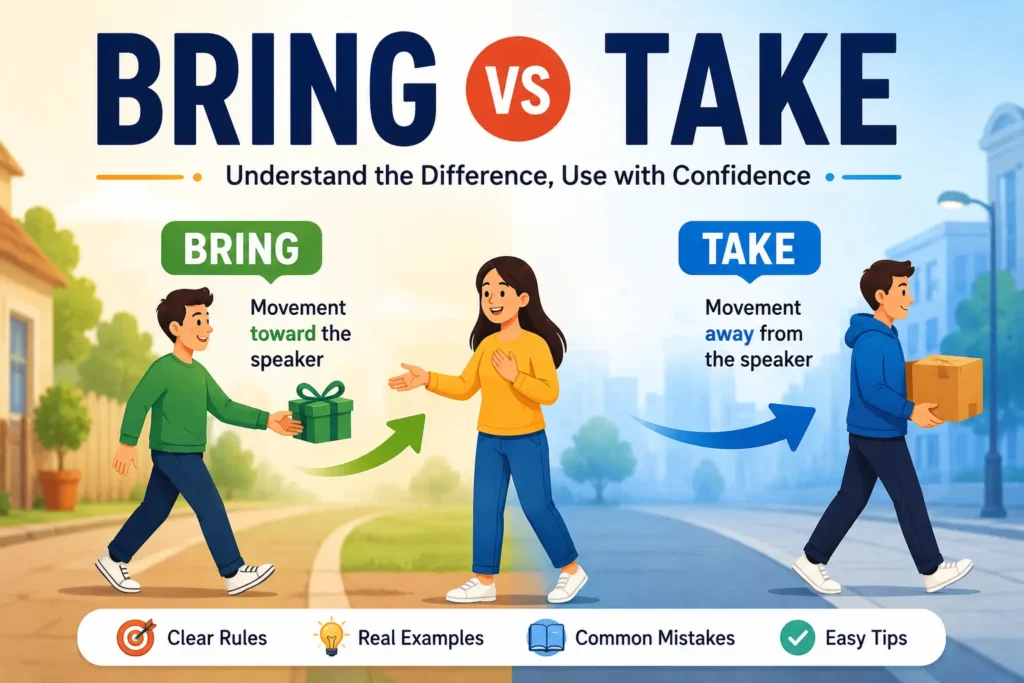
Bring vs take can be confusing because both verbs describe moving a person or thing from one place to another. The main difference is direction and perspective. Generally, use bring when something moves toward the speaker, listener, or a relevant destination. Use take when something moves away from that point. For example, “Please bring your notebook to class” focuses on arriving at class, while “Please take this package to the front desk” focuses on moving it elsewhere.
The key is to look at the context, not just memorize “bring means here” and “take means there.” In everyday English grammar, the speaker’s location, the listener’s location, and the intended destination can all affect the choice. This is why bring and take sometimes seem confusing in conversations, emails, school, work, and travel.
Once you understand this direction, you can choose the right verb more naturally. You’ll also avoid common errors such as using take it here when bring it here is more appropriate. The examples and practical rules in this guide will help you use bring, take, and related movement verbs with confidence.
Quick Answer: Bring vs Take
The simplest way to remember bring vs. take is:
- Bring = move something toward a person, place, or destination that matters in the conversation.
- Take = move something away from the current speaker, listener, or location toward another place.
- Bring often relates to something arriving at a relevant destination.
- Take often relates to something leaving one location for another.
- The speaker’s or listener’s perspective can change which verb sounds natural.
Compare these sentences:
Bring the documents to my office.
Take the documents to the front desk.
In the first sentence, the documents are moving toward the speaker’s office. In the second, they’re moving away from the speaker toward another location.
The important point is that bring and take aren’t simply synonyms for “move.” The choice depends on how the speaker views the movement.
Read this also: Momma vs Mama: Meaning, Difference, Correct Usage, and Spelling Guide
Bring vs Take at a Glance
| Feature | Bring | Take |
| Basic idea | Movement toward a relevant person or place | Movement away toward another place |
| Common direction | Toward | Away |
| Example with an object | Bring the report to me. | Take the report to Sarah. |
| Example with a person | Bring your friend to the party. | Take your friend home. |
| With “here” | Bring it here. | Usually not “take it here.” |
| With “there” | Bring it there can be correct in context | Take it there is very common |
| Past tense | brought | took |
| Past participle | brought | taken |
| Common abstract use | bring change, bring results | take action, take responsibility |
A simple direction pattern
Think of the two verbs this way:
BRING → toward a relevant point
TAKE → away from a relevant point
However, don’t turn this into an inflexible rule. English speakers consider the conversation, destination, and perspective when choosing the verb.
What Does “Bring” Mean?
Bring is a verb that commonly describes carrying, moving, or causing someone or something to come to a particular person or place.
Its basic forms are:
- Present: bring
- Past: brought
- Past participle: brought
- -ing form: bringing
For example:
Please bring your ID to the appointment.
Here, the speaker wants the listener to arrive at the appointment with the ID.
Bring can describe physical movement:
Can you bring me a glass of water?
It can also describe a person accompanying someone:
Bring your sister to the party.
However, bring isn’t limited to physical objects. It also has several important abstract meanings.
The new policy brought major changes.
Here, “brought” doesn’t mean physically carried. It means caused or produced the changes.
Bring something toward the speaker
This is the most familiar use of bring.
Bring the folder to my desk.
The folder moves toward the speaker’s location.
Another example:
Can you bring me your notes?
The notes are moving toward the person who is speaking.
Bring something toward the listener
The listener’s location can also establish the direction.
Imagine you’re talking to a friend who is already at a restaurant:
I’m on my way. I’ll bring the tickets.
The tickets are moving toward the friend or the location where the friend is waiting.
Therefore, bring doesn’t always mean “toward the person who says the sentence.” The listener can also provide the relevant point of view.
Bring something to an event or destination
English frequently uses bring when talking about items needed at an event.
Please bring a notebook to class.
Can you bring dessert to dinner?
Don’t forget to bring your passport to the appointment.
The destination becomes important because the object is being moved there for the event or activity.
Bring someone with you
Bring can also describe taking someone along to a relevant destination.
Can I bring my friend to the meeting?
You should bring your parents to the school event.
She brought her children to the picnic.
The meaning is not simply “carry.” It means have someone accompany you to the relevant place.
Bring results, effects, or changes
The verb bring also appears frequently with abstract nouns.
For example:
- bring change
- bring attention
- bring results
- bring benefits
- bring problems
- bring happiness
- bring opportunities
- bring improvement
Consider:
The campaign brought more attention to the issue.
The training program brought positive results.
In these sentences, bring means something like cause, produce, or lead to.
What Does “Take” Mean?
Take commonly describes moving a person or thing from one location to another, especially when the movement is away from the current or relevant location.
Its main forms are:
- Present: take
- Past: took
- Past participle: taken
- -ing form: taking
For example:
Take these papers to the manager.
The papers are leaving the speaker’s current location and going somewhere else.
Another common example is:
I’ll take you to the airport.
The speaker will accompany or transport the listener from the current location to the airport.
Take something to another place
When you want someone to move an object away from the current location, take is often the natural choice.
Take these boxes upstairs.
Please take the dishes to the kitchen.
Can you take this package to the mailroom?
The object begins at the current location and moves somewhere else.
Take someone somewhere
Take is especially common when one person transports or guides another person.
I’ll take you home.
My dad takes me to school every morning.
She took her son to the doctor.
In each example, the person moves from one location toward another destination.
Take something away
Take can emphasize removal.
Please take your shoes outside.
Someone took my chair.
The waiter took the plates away.
Here, the idea is that something leaves its current location.
Take something with you
When you’re leaving a place, take is usually used for something you carry along.
Take your umbrella with you.
Don’t forget to take your keys.
Take your phone with you when you leave.
The person is moving away from the current location and carrying the object.
The Main Difference Between Bring and Take
The biggest difference between bring and take is the direction of movement from the relevant point of view.
Consider this situation:
You’re at home, and your friend is at your office.
You might tell your friend:
Bring the documents to me at the office.
The documents are moving toward the location associated with the speaker.
Now imagine you’re at the office and asking your coworker to move the documents to another department:
Take the documents to accounting.
The documents are moving away from the current location toward another destination.
Perspective is the key
The same object can be described with either verb depending on the situation.
| Situation | Natural sentence |
| An object moves toward you | Bring the book to me. |
| An object moves away to another location | Take the book to the library. |
| Someone arrives at your party with a gift | Bring a gift. |
| Someone leaves the party with an umbrella | Take your umbrella. |
| Someone transports you to work | Take me to work. |
| Someone asks you to arrive with documents | Bring the documents. |
This is why memorizing only “bring means here” and “take means there” can cause problems.
The real question is:
Where is the movement going in relation to the relevant person or destination?
Bring vs Take With “Here” and “There”
The words here and there provide useful clues, but they don’t create an absolute grammar rule.
“Bring it here”
Bring it here is very natural because here normally represents the speaker’s current location.
Please bring the box here.
Bring your laptop here so I can look at it.
The object is moving toward the speaker.
“Take it there”
Take it there is also very common.
Take these papers there.
Can you take this package there?
The object is moving from the current location to another place.
Can you say “bring it there”?
Yes. Bring it there can be correct when the destination is viewed as a relevant location for the speaker or listener.
For example, imagine you’re discussing a meeting that everyone will attend tomorrow:
Bring the completed forms there tomorrow.
The word “there” identifies the meeting location, and the speaker may be treating that location as the relevant destination.
So avoid memorizing:
here = bring
there = take
Instead, use the words as clues and consider the perspective and context.
Bring vs Take in Social Plans and Invitations
Social situations create many common examples of bring vs. take.
Suppose a friend invites you to dinner:
Can I bring my friend?
This is natural because the friend will accompany you to the dinner.
You might also ask:
What should I bring to the party?
The answer could be:
Bring a dessert if you can.
The item is being moved to the event.
Now imagine the party is over:
I’ll take the leftovers home.
Here, the food is leaving the party and moving to another location.
“Can I bring a friend?”
This sentence is especially common in American English.
Can I bring a friend to the concert?
Is it okay if I bring my sister?
The speaker is focusing on the destination or event as the relevant point.
“Take someone somewhere”
Use take when someone is being transported to another destination.
I’ll take you to the restaurant.
She took her friend home.
Can you take me to the station?
These sentences focus on movement from the current location to another place.
Bring and Take at Work and School
The difference becomes easy to see in school and professional settings.
At work
Please bring the report to the meeting.
The report needs to arrive at the meeting.
However:
Please take the report to the accounting department.
The report is being moved from the current location to another department.
At school
Bring your textbook to class.
Take your textbook home after class.
The first sentence focuses on getting the book to class. The second focuses on removing it from school and carrying it home.
At an appointment
Please bring your insurance card.
The card needs to arrive with you at the appointment.
Afterward, you might say:
Take these papers home and read them.
The papers are moving away from the appointment.
Bring vs Take in Travel
Travel provides some of the clearest examples.
Suppose you’re preparing for a flight:
Bring your passport.
The passport needs to be with you at the airport or destination.
But when you’re leaving the hotel, you might say:
Take your passport with you.
The focus is now on leaving the hotel with the passport.
Both sentences can be correct in different contexts.
| Situation | Example |
| Preparing for an appointment | Bring your ID. |
| Leaving the house | Take your ID with you. |
| Moving something to a meeting | Bring the presentation. |
| Moving something from the meeting room | Take the presentation with you. |
| Transporting a person | Take your child to the airport. |
| Asking someone to arrive with something | Bring your luggage. |
Take with transportation
Take has another very common use involving transportation.
Take the bus.
Take the train.
Take a taxi.
Take the subway.
Here, take doesn’t mean simply “move away.” It means use a particular form of transportation.
This is a separate meaning that learners should remember.
Other Important Uses of “Bring”
The word bring has many meanings beyond physical movement.
Bring means “cause”
The announcement brought confusion.
The announcement caused confusion.
Bring means “produce”
The new strategy brought better results.
The strategy produced better results.
Bring means “lead to”
The decision could bring major changes.
The decision could lead to major changes.
Common expressions with bring
Some common combinations include:
- bring attention
- bring change
- bring results
- bring an idea
- bring good news
- bring a problem
- bring someone joy
- bring something to an end
For example:
The report brought attention to a serious problem.
She brought good news to the team.
These uses don’t involve literal physical movement.
Other Important Uses of “Take”
Take is even more flexible in English.
Take means “accept” or “choose”
I’ll take the blue shirt.
She decided to take the job.
Here, take means accept or choose.
Take means “require”
The trip takes three hours.
It took me 20 minutes to finish.
In this use, take refers to the amount of time or effort required.
Take means “perform an action”
English uses take in many everyday expressions:
- take a break
- take a shower
- take a look
- take a seat
- take a picture
- take notes
- take action
- take responsibility
For example:
Please take a seat.
I’ll take a picture of the group.
These meanings have little to do with physical direction.
Bring vs Take in Different Tenses
Both bring and take are irregular verbs, so their past forms don’t simply add -ed.
| Tense/Form | Bring | Take |
| Base form | bring | take |
| Simple past | brought | took |
| Past participle | brought | taken |
| Present participle | bringing | taking |
| Example | She brought her notes. | She took her notes. |
Common incorrect forms
Don’t say:
She bringed the documents.
Say:
She brought the documents.
Don’t say:
He taked the bus.
Say:
He took the bus.
Also remember that the past participle of take is taken, not “took.”
She has taken the train.
Not:
She has took the train.
Common Mistakes With Bring and Take
Mistake 1: Treating bring and take as interchangeable
Incorrect:
Please bring these boxes to the warehouse.
If the boxes are leaving the current location and moving elsewhere, take may be more appropriate:
Please take these boxes to the warehouse.
However, context matters. If the warehouse is the relevant destination in the conversation, bring can sometimes be natural.
Mistake 2: Thinking “there” always requires take
This is too simple.
Bring the documents there tomorrow.
can be natural if “there” refers to a relevant destination for the speaker or listener.
Therefore, don’t rely on one-word substitutions.
Mistake 3: Ignoring the listener’s location
Imagine your friend is already at your house.
You are at work and call:
Bring the package to my house.
The destination is your house, and the conversation makes it the relevant point.
Perspective can extend beyond the speaker’s physical location.
Mistake 4: Using “bring” when you mean transport someone away
I’ll bring you home.
This can be heard in some contexts, but standard American English generally uses:
I’ll take you home.
The destination is home, and the speaker is transporting the listener there from another location.
Mistake 5: Confusing “take” with “carry”
Take and carry overlap in some contexts, but they aren’t identical.
Take this box to the garage.
focuses on the movement to another location.
Carry this box carefully.
focuses on the physical action of holding and moving the box.
Real-Life Examples of Bring vs Take
Case Study: A Party
Imagine you’re hosting a birthday party.
You tell a guest:
Please bring a dessert.
The dessert needs to arrive at the party.
After the party, another guest says:
I’m going to take some cake home.
Now the cake is leaving the party.
The same type of object can use either verb because the direction and perspective have changed.
Case Study: An Office File
You’re sitting at your desk.
You tell your assistant:
Please bring the contract to me.
The contract should come toward you.
Later, you tell the assistant:
Please take the signed contract to the legal department.
The contract is now leaving your location.
Case Study: A School Day
A parent might tell a child:
Bring your homework to school.
After school, the parent might say:
Take your homework home.
The destination and direction determine the natural verb.
A Simple Memory Trick for Bring and Take
A useful shortcut is:
Bring it toward the relevant point. Take it away to another point.
Another way to remember it is to ask two questions.
Question 1: Where is it going?
If the object or person is moving toward the speaker, listener, or relevant destination, bring is often appropriate.
If it is moving away toward another destination, take is often appropriate.
Question 2: Who is the destination relevant to?
This question helps when the basic “toward/away” rule isn’t enough.
For example:
Can you bring the documents to the meeting?
The meeting is the relevant destination.
But:
Can you take the documents back to the office?
The office is another destination away from the current location.
Bring vs Take: Correct and Incorrect Examples
| Incorrect or confusing | Better choice | Reason |
| Take me your report. | Bring me your report. | The report comes toward the speaker. |
| Bring these boxes to the garage. | Take these boxes to the garage. | Usually focuses on moving them away. |
| Take your ID to the appointment. | Bring your ID to the appointment. | The ID needs to arrive with you at the appointment. |
| Bring me home. | Take me home. | The speaker is being transported elsewhere. |
| Bring the trash outside. | Take the trash outside. | The trash is being removed from the current location. |
| Take your friend to the party. | Bring your friend to the party. | If speaking from the party’s perspective, bring is natural. |
The last example shows why context matters. Neither verb should be selected without considering the viewpoint.
Usage Tips for American English
For everyday American English, these habits will help:
- Use bring when asking someone to arrive with something.
- Use take when asking someone to leave with something.
- Use bring for items needed at an event or appointment.
- Use take for transporting someone to another place.
- Use take with common transportation expressions such as “take the bus.”
- Don’t assume there always requires “take.”
- Consider the speaker, listener, and destination before choosing the verb.
- Remember the irregular past forms: brought and took.
- In professional communication, choose the verb that clearly identifies the intended destination.
Most importantly, don’t treat the difference as a rigid mathematical formula. Natural English depends on perspective and context.
Read this also: In Person vs In-Person: The Correct Usage, Difference, and Examples
Bring vs Take: Quick Practice Quiz
Choose bring or take for each sentence.
- Please ___ your notebook to class.
- Can you ___ these files to my desk?
- I’ll ___ you to the airport.
- Don’t forget to ___ your umbrella with you.
- What should I ___ to the party?
- Please ___ the dishes to the kitchen.
- Can you ___ me a glass of water?
- She ___ her children to the museum.
- He ___ his passport to the appointment.
- Please ___ this package to the mailroom.
Answer Key
- bring — The notebook needs to arrive at class.
- bring — The files are moving toward the speaker’s desk.
- take — The speaker is transporting the listener to another destination.
- take — The person is leaving with the umbrella.
- bring — The item is coming to the party.
- take — The dishes are moving to another location.
- bring — The water comes toward the speaker.
- took — The children were transported to another destination.
- brought — The passport arrived at the appointment with him.
- take — The package is being moved to another location.
Bring vs Take: Related Words and Useful Alternatives
Bring and take belong to a larger group of movement verbs. Understanding their related words can make your writing more precise.
Bring-related words
Depending on the context, related verbs can include:
- carry
- deliver
- transport
- move
- return
- lead
- cause
- provide
However, these aren’t perfect synonyms.
For example, deliver emphasizes getting something to a recipient:
The courier delivered the package.
Bring focuses more on the movement toward a relevant person or place:
Please bring the package inside.
Take-related words
Depending on context, related verbs include:
- carry
- transport
- move
- remove
- lead
- drive
- escort
Again, the meaning isn’t identical.
Please take the documents upstairs.
focuses on movement.
Please carry the documents upstairs.
focuses more on the physical act of carrying them.
FAQs About Bring vs Take
Q1. What is the main difference between bring and take?
Bring generally means moving someone or something toward the speaker, listener, or relevant destination. Take generally means moving someone or something away from the current location toward another destination.
Q2. Is “bring it here” correct?
Yes. “Bring it here” is correct when something is moving toward the speaker’s current location.
Please bring it here so I can see it.
Q3. Should I say “bring it there” or “take it there”?
Both can be correct depending on the context. Take it there commonly describes movement away from the current location. Bring it there can also work when that destination is treated as relevant to the speaker or listener.
Q4. Do you bring or take something to a party?
Usually, you bring something to a party.
Can you bring some dessert to the party?
The item is being moved to the event.
Q5. Do you bring or take someone to the airport?
Usually, you take someone to the airport.
I’ll take you to the airport.
The person is being transported from the current location to the airport.
Q6. Is “bring to school” grammatically correct?
Yes. Bring to school is completely correct when something needs to arrive at school.
Please bring your textbook to school tomorrow.
Q7. Can bring and take describe the same object?
Yes. The correct verb can change when the direction or perspective changes.
Bring the files to my office.
Take the files to the storage room.
The files are the same, but the destinations are different.
Q8. Why do people confuse bring and take?
Both verbs describe movement, and their meanings overlap in many situations. The confusion usually comes from forgetting to consider the speaker, listener, and destination.
Q9. What are the past-tense forms of bring and take?
The simple past of bring is brought.
The simple past of take is took.
Their past participles are brought and taken.
She brought her notes.
She took her notes home.
Q10. What is an easy way to remember bring and take?
Use this simple memory rule:
Bring = toward a relevant point.
Take = away toward another point.
Then check the context and perspective before choosing the verb.
Final Takeaway
The difference between bring vs take mainly depends on direction, perspective, and context. Use bring when a person or thing moves toward the speaker, listener, event, or another relevant destination. Use take when it moves away from the current or relevant point toward another place.
For example, you can say, “Please bring your laptop to the meeting,” but “Please take your laptop home.” The object is the same, but the direction and perspective have changed.
Instead of relying on a rigid “here means bring, there means take” rule, ask yourself: Where is the person or thing going, and whose location matters? This simple check will help you use these common English verbs correctly in everyday conversations, school, work, travel, emails, and professional writing.
