
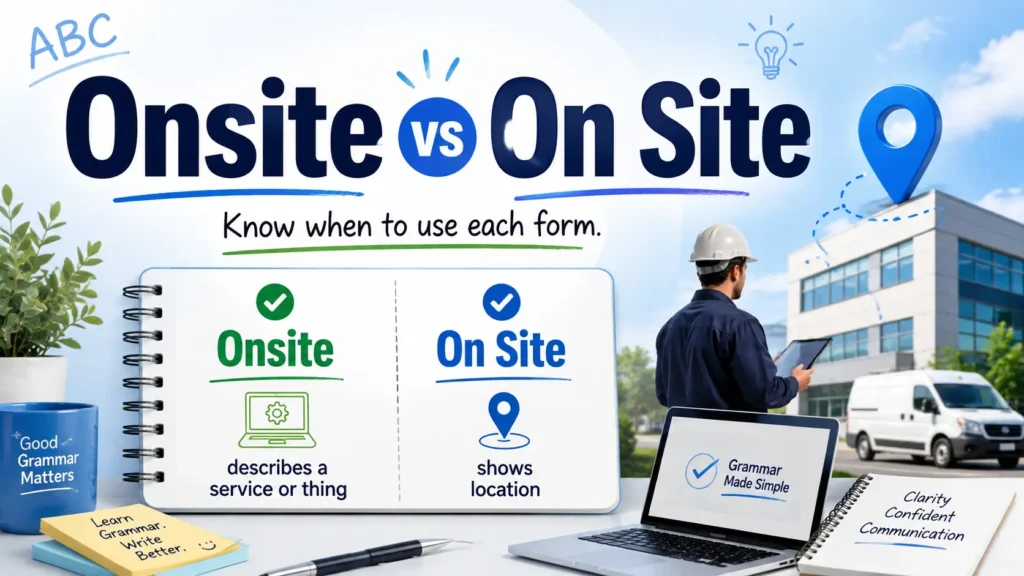
Understanding onsite vs on site becomes easier when you focus on meaning, grammar, and context. Onsite is often used as a compound adjective before a noun, such as onsite support or onsite training. On site is commonly used to show a location, as in “The technician is on site.” In American English, both forms appear in professional writing, business, and workplace writing, while on-site is also used as a hyphenated form. The right choice depends on the sentence and the preferred style guide.
For example, onsite support describes a service provided at a customer’s location. However, “The technician is on site” explains that the technician is physically present there. Similarly, onsite training and on-site training describe training held at a specific place. By contrast, in-person focuses on face-to-face contact, while remote and virtual describe online or distant work.
In modern usage, onsite is common in business writing, digital content, and workplace communication. Still, spelling preferences can differ between a dictionary, publication, or organization. For clear and consistent professional writing, choose the form that fits the grammatical function and follow your chosen editorial style consistently.
Quick Answer: Onsite vs. On Site
The simplest distinction is this:
- Onsite is commonly used as a compound adjective to describe something that happens or exists at a particular location.
- On site is traditionally a two-word phrase meaning at the location.
- On-site is a hyphenated compound adjective that is also widely used.
Examples
We offer onsite support.
Here, onsite describes the type of support.
The technician is on site.
Here, on site tells you where the technician is.
We provide on-site training.
Here, on-site works as a compound adjective describing the training.
In modern American English, onsite is increasingly common in business, workplace, technology, and service-related writing. However, on site remains a clear and widely accepted choice when you’re simply describing someone’s or something’s location.
The exact spelling can also depend on the dictionary or style guide you’re following. Therefore, context and consistency both matter.
Onsite vs. On Site vs. On-Site at a Glance
| Form | Common grammatical role | Meaning | Example |
| onsite | Adjective; increasingly used adverbially | At or connected with a particular location | We provide onsite support. |
| on site | Phrase, often functioning adverbially | At the location | The technician is on site. |
| on-site | Compound adjective | Located or happening at a particular site | We offer on-site training. |
The key point is that these forms are related, but they don’t always work in exactly the same way.
For example, onsite support describes a type of support. By contrast, the technician is on site tells you where the technician is.
That difference in sentence function is often more useful than simply memorizing spelling rules.
What Does Onsite Mean?
Onsite generally means at a particular location or provided at the location where a person, company, event, or activity is based.
In American English, the word is especially common in professional and workplace contexts.
For example:
The company offers onsite training.
This means the training takes place at the relevant physical location.
We provide onsite technical support.
This means technical support is provided at the customer’s or organization’s location.
The hotel has an onsite restaurant.
This means the restaurant is located at the hotel itself.
In these examples, onsite helps describe the noun that follows it.
Onsite as an Adjective
The most familiar use of onsite is as an adjective.
An adjective describes or gives more information about a noun. Therefore, in phrases such as onsite training and onsite support, the word tells you something about the type or location of the noun.
Common examples include:
- onsite training
- onsite support
- onsite services
- onsite staff
- onsite technician
- onsite interview
- onsite parking
- onsite childcare
- onsite clinic
- onsite inspection
Consider this sentence:
The company offers onsite training for new employees.
The word onsite describes training. It tells readers that the training takes place at a specific physical location.
Similarly:
The customer requested onsite technical support.
The phrase onsite technical support describes the kind of support the customer requested.
Onsite in Modern Workplace English
You’ll often see onsite in modern workplace communication.
For example:
The position requires three onsite days each week.
Employees can receive onsite IT support.
The final interview will be onsite.
We have an onsite team available during business hours.
This usage is particularly common when companies distinguish between onsite, hybrid, and remote work arrangements.
However, style preferences vary. Some organizations may prefer on-site, while others use onsite throughout their communications.
For professional writing, consistency is usually more important than switching between forms without a clear reason.
What Does On Site Mean?
On site is a two-word phrase that traditionally means at the location or at the place where something is happening.
It commonly tells readers where a person or thing is located.
For example:
The technician is on site.
This means the technician is physically at the relevant location.
The workers arrived on site at 7 a.m.
The workers arrived at the place where the work is taking place.
The manager will be on site tomorrow.
The manager will physically be at that location tomorrow.
In each example, on site gives information about location.
Examples of On Site in Sentences
Here are some common examples:
The engineer is on site now.
The engineer is currently at the location.
Our specialist will be on site during the inspection.
The specialist will be physically present at the inspection location.
The construction crew arrived on site early.
The crew arrived at the construction location.
We have someone on site to answer your questions.
A person is physically available at the location.
The equipment remains on site.
The equipment is still at the location.
The phrase can be used in many situations, including construction, technology, business, events, education, and customer service.
The Main Difference Between Onsite and On Site
The easiest way to understand onsite vs. on site is to consider what the phrase is doing in the sentence.
Use Onsite to Describe Something
Use onsite when you want to describe a service, activity, facility, employee, or other noun associated with a particular location.
For example:
We offer onsite support.
The word onsite describes support.
The company provides onsite training.
The word onsite describes training.
The hotel has an onsite gym.
The word onsite describes gym.
Use On Site to Describe Location
Use on site when you’re saying that someone or something is physically at a location.
For example:
The support technician is on site.
The phrase tells you where the technician is.
The manager is on site today.
The phrase tells you where the manager is today.
The equipment is on site.
The phrase tells you where the equipment is located.
A useful memory rule is:
Onsite often describes what or who is connected with the location.
On site often tells you where someone or something is.
This isn’t an absolute rule for every modern use. However, it’s a practical guide that works well in everyday writing.
Onsite vs. On Site: Side-by-Side Examples
The difference becomes clearer when you compare similar sentences.
| Example | Why it works |
| We provide onsite support. | Onsite describes the type of support. |
| Our technician is on site. | On site identifies the technician’s location. |
| The company offers onsite training. | Onsite describes the training. |
| The trainer is on site today. | On site tells you where the trainer is. |
| We hired an onsite consultant. | Onsite describes the consultant’s work arrangement or location. |
| The consultant is on site this week. | On site explains where the consultant is. |
| The hotel has an onsite restaurant. | Onsite describes the restaurant’s location. |
| The restaurant staff are on site. | On site tells you where the staff are. |
Notice how the basic idea of location stays the same. The main difference is how the expression functions in the sentence.
Onsite vs. On-Site: Which Spelling Is Correct?
The forms onsite and on-site are both used as compound adjectives.
For example:
We provide onsite training.
We provide on-site training.
Both expressions communicate that the training takes place at the relevant location.
However, modern American business writing increasingly uses onsite as a closed compound. This is especially common in technology, human resources, corporate communications, and job listings.
At the same time, on-site remains common and is preferred by some dictionaries, publications, and style guides.
Therefore, it’s not always accurate to say that one form is universally “correct” and the other is always wrong.
Instead, consider the context.
A Practical Usage Guide
Use on site when the meaning is clearly at the location:
The technician is on site.
Use onsite when you’re using it as a modern compound adjective:
We offer onsite support.
Use on-site when a style guide or publication prefers the hyphenated form:
We offer on-site support.
The most important point is to avoid treating on site as automatically interchangeable with the compound adjective in every sentence.
Why Does the Hyphen Matter?
Hyphens can help readers understand when two or more words work together as a single modifier.
For example:
We offer on-site training.
The phrase on-site works together to describe training.
However, modern English often closes familiar compounds over time. That’s why onsite has become increasingly common.
This is part of a broader pattern in English. Compound words can move through different stages:
two words → hyphenated form → closed compound
Not every word follows this exact path, and different dictionaries may record different preferences. Still, this pattern helps explain why you may encounter on site, on-site, and onsite in different sources.
For professional writing, follow the style used by your organization or publication when one exists.
Onsite vs. On Site in American English
For a US audience, onsite is very common in business and professional contexts.
You might see it in:
- Job descriptions
- Human resources documents
- Company websites
- IT support agreements
- Customer service policies
- Construction reports
- School information
- Healthcare services
- Event planning
- Workplace policies
For example:
This is an onsite position.
Employees receive onsite technical support.
The final interview will be onsite.
We offer onsite childcare.
At the same time, on site remains natural when you’re describing someone’s physical presence.
The hiring manager will be on site during the interview.
This distinction is especially useful in professional writing because workplace language often uses both forms in the same document.
Onsite vs. On Site vs. In-Person
The terms onsite, on site, and in-person are sometimes confused. However, they emphasize different ideas.
| Term | Main focus | Example |
| onsite | A service, activity, or thing connected with a physical location | onsite training |
| on site | Physical presence at a location | The trainer is on site. |
| in-person | Face-to-face interaction rather than virtual communication | an in-person meeting |
| remote | Work or activity performed away from the physical workplace | a remote position |
| virtual | Participation through digital technology | a virtual meeting |
Consider a training program.
We offer onsite training.
The training takes place at a particular physical location.
We offer in-person training.
The training happens face-to-face instead of online.
We offer remote training.
The training takes place from a distance.
These terms can overlap, but they don’t mean exactly the same thing.
For instance, an in-person meeting might take place at a rented conference center. It is face-to-face, but it isn’t necessarily onsite if the location isn’t the organization’s own site.
Real-Life Examples of Onsite vs. On Site
Workplace Example
Imagine a company that provides IT services.
The company provides onsite IT support.
This describes the company’s service.
Now consider:
The IT specialist is on site today.
This describes the specialist’s current location.
Both sentences are correct. However, they answer different questions.
The first answers:
What kind of support does the company provide?
→ Onsite IT support
The second answers:
Where is the specialist?
→ On site
Construction Example
The contractor provides onsite inspections.
Here, onsite describes the inspections.
The inspector is on site.
Here, on site tells you where the inspector is.
Education Example
The school offers onsite tutoring.
The tutoring takes place at the school.
A tutor is on site every afternoon.
The sentence tells you that a tutor is physically present at the school.
Technology Example
Customers can request onsite technical support.
The service is provided at the customer’s location.
A technician will be on site within two hours.
The technician will physically arrive at the location.
Healthcare Example
The company has an onsite clinic.
The clinic is located at the company’s facility.
A nurse is on site during business hours.
The nurse is physically present there.
Common Mistakes With Onsite and On Site
Mistake: Writing “On Site Support”
Consider this sentence:
We provide on site support.
This wording may be understood, but it can look awkward because the phrase is being used as a compound modifier before support.
Better options include:
We provide onsite support.
Or:
We provide on-site support.
Both forms clearly show that the words work together to describe support.
Mistake: Assuming Onsite Is Always Wrong
Some writers believe that onsite must always be written as on site.
That isn’t accurate in modern American English.
Onsite is widely used, especially as a compound adjective.
For example:
onsite training
onsite support
onsite services
However, style preferences can vary. Therefore, always check the style guide you’re expected to follow.
Mistake: Treating the Forms as Completely Interchangeable
The forms are related, but sentence structure matters.
Compare:
We provide onsite support.
Our technician is on site.
Replacing one with the other without considering grammar can make the sentence less natural.
The first expression describes a service. The second describes a location.
Mistake: Confusing Onsite With In-Person
These terms aren’t always synonyms.
We scheduled an in-person interview.
This emphasizes that the interview will happen face-to-face.
We scheduled an onsite interview.
This emphasizes that the interview will take place at a particular physical site.
In many workplace situations, both descriptions may be true. However, each phrase highlights a different aspect of the interview.
Mistake: Mixing Different Style Preferences
A document might use:
onsite training
on-site support
onsite services
This isn’t necessarily grammatically wrong. However, inconsistent spelling can make professional writing look less polished.
If you’re writing a report, website, or company document, choose a consistent style whenever possible.
A Simple Decision Guide
When you’re unsure about onsite vs. on site, follow these steps.
Ask: Am I Describing a Noun?
If you’re describing a service, activity, person, or facility, onsite or on-site may be appropriate.
onsite training
onsite support
on-site inspection
Ask: Am I Saying Someone Is at the Location?
If you’re describing physical location, on site is a clear choice.
The technician is on site.
The manager is on site.
The workers arrived on site.
Ask: Do I Mean Face-to-Face?
If your focus is on face-to-face interaction rather than virtual communication, in-person may be better.
We scheduled an in-person meeting.
Ask: Does Your Organization Have a Style Guide?
If you’re writing professionally, check the style guide first.
Some organizations prefer onsite. Others prefer on-site. Traditional editing may favor on site for certain location-based uses.
Following one consistent system makes your writing clearer and more professional.
Common Synonyms and Related Words
Depending on context, several related expressions can replace onsite or on site.
Synonyms for Onsite
Depending on the sentence, you might use:
- at the location
- at the facility
- at the workplace
- local
- in-house
- on-premises
- at the premises
However, these aren’t perfect substitutes in every context.
For example, in-house often means something is handled by an organization’s own employees rather than an outside provider.
We have an in-house legal team.
That doesn’t necessarily mean the team is physically onsite every day.
Similarly, on-premises is common in technology and property-related contexts. It can have a more specific meaning than onsite.
Related Words and Phrases
Other terms connected with this topic include:
- off-site
- remote
- hybrid
- in-person
- virtual
- on-location
- on-premises
- field-based
- workplace
- facility
- location
The best choice depends on exactly what you want to emphasize.
Memory Tricks for Remembering Onsite vs. On Site
A simple memory trick is:
Onsite = describes.
On site = location.
Think about these examples:
onsite training
Ask: What kind of training?
Answer: Onsite training.
Now consider:
The trainer is on site.
Ask: Where is the trainer?
Answer: On site.
You can also remember the difference with three words:
Onsite = what
On site = where
In-person = how
This isn’t a complete grammar rule, especially because modern usage allows onsite in additional contexts. Still, it’s a useful shortcut for choosing the clearest form.
Conclusion
Understanding onsite vs. on site is easier when you focus on how each form works in a sentence. Onsite is commonly used to describe a service, activity, person, or facility connected to a specific location, as in onsite training or onsite support. On site, meanwhile, is often used to show that someone or something is physically at a location, as in “The technician is on site.” You may also see on-site as a hyphenated compound adjective.
In modern American English, onsite is widely used in business and workplace writing, while on site remains a clear choice for describing location. When writing professionally, consider your sentence structure, meaning, and preferred style guide. Most importantly, stay consistent. Knowing the difference between onsite, on site, and on-site will help you write with greater clarity and confidence.
Frequently Asked Questions About Onsite vs. On Site
Q1.Is “onsite” one word or two?
Onsite is one word and is widely used in modern American English, especially in professional and workplace contexts. For example, you might write onsite training, onsite support, or onsite services. However, on site is also correct when it means at the location.
Q2.What is the difference between onsite and on site?
Onsite commonly describes something connected with a particular location, such as onsite support. On site usually means at the location, as in “The technician is on site.” The main difference often depends on the grammatical role and context.
Q3.Is “on-site” also correct?
Yes. On-site is a common hyphenated form, especially when it works as a compound adjective before a noun. For example, on-site training and on-site support are widely used. Some style guides prefer onsite, while others use on-site.
Q4.Should I write “onsite support” or “on-site support”?
Both onsite support and on-site support are used in American English. Onsite support is increasingly common in modern business writing. However, if your organization or publication follows a particular style guide, use its preferred spelling consistently.
Q5.Is “on site” correct in the sentence “The technician is on site”?
Yes. The technician is on site is a clear and standard way to say that the technician is physically present at the relevant location.
Q6.Is onsite an adjective?
Yes, onsite commonly functions as an adjective when it describes a noun. For example, in onsite training, the word onsite describes the type or location of the training.
Q7.Can onsite and on site be used interchangeably?
Not always. Although they have closely related meanings, their grammatical functions can differ. Onsite support describes a service, while the technician is on site describes where the technician is located.
Q8.Is onsite the same as in-person?
No. Onsite usually refers to a specific physical location, while in-person emphasizes face-to-face interaction. For example, an in-person meeting may happen at a rented location and doesn’t necessarily have to be at the company’s own site.
Q9.Which is correct: “onsite interview” or “on-site interview”?
Both onsite interview and on-site interview are commonly used. The choice often depends on the style guide being followed. For US professional writing, onsite interview is increasingly common, but on-site interview remains widely recognized.
Q10.How can I easily remember onsite vs. on site?
Use this simple memory trick: onsite often describes what kind of service, activity, or facility something is, while on site often answers where someone or something is. For example, onsite training describes the training, while “The trainer is on site” describes the trainer’s location.
Passed vs. Past: What’s the Difference and How Do You Use Each One?
Bare vs. Bear: What’s the Difference? Meaning, Examples, and Easy Ways to Remember
Council vs. Counsel: What’s the Difference? Meaning, Examples, and Easy Ways to Remember

1 thought on “Onsite vs On Site: What’s the Difference and Which One Is Correct?”