
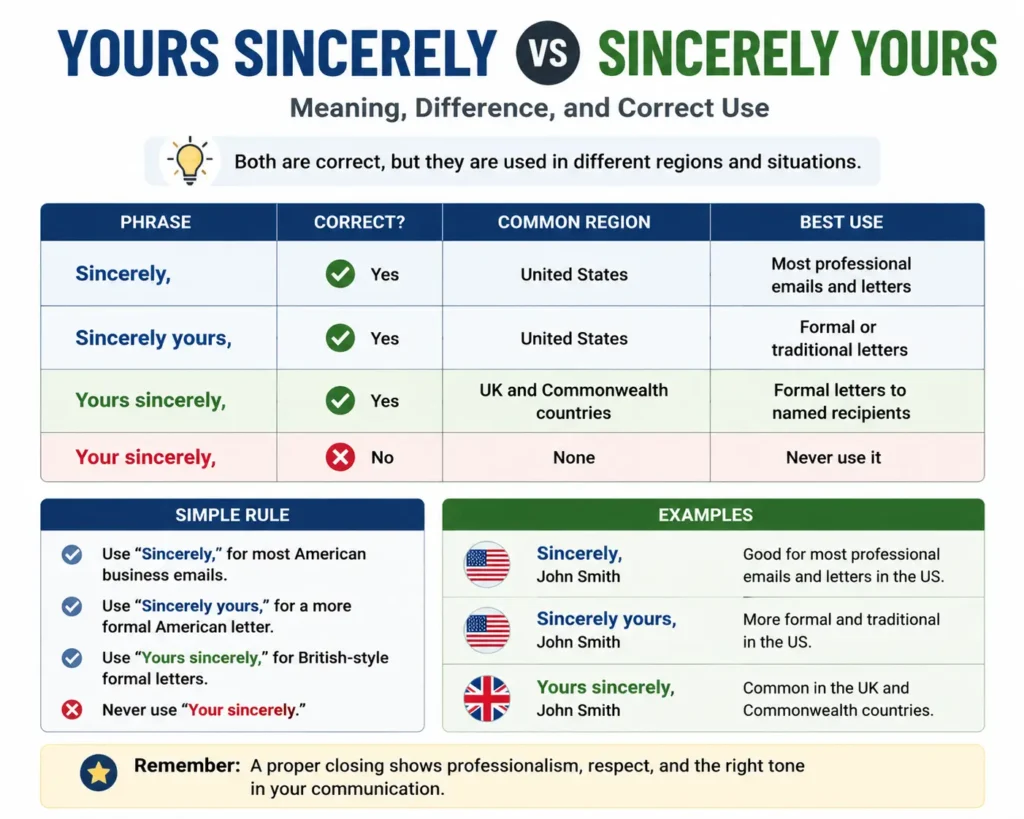
Choosing between Yours sincerely, Sincerely yours, and Sincerely may seem like a small detail, but the right letter closing can make your writing look more polished and professional.
These phrases are all connected to formal communication, yet they are not used in exactly the same way. The main difference depends on region, tone, and audience. In American English, Sincerely is usually the safest choice for professional emails and business letters, while Sincerely yours sounds more formal and traditional.
In British English, Yours sincerely is commonly used in a formal letter when you know the recipient’s name. Understanding the correct email closing, proper sign-off, and expected business etiquette helps you avoid awkward wording and maintain a respectful tone. This guide explains the meaning, difference, formatting, and best use of each closing.
Main Difference Between “Yours Sincerely” and “Sincerely Yours”
The difference is mainly regional, not meaning.
| Phrase | Correct? | Common Region | Best Use |
| Sincerely, | Yes | United States | Most professional emails and letters |
| Sincerely yours, | Yes | United States | Formal or traditional letters |
| Yours sincerely, | Yes | UK and Commonwealth countries | Formal letters to named recipients |
| Your sincerely, | No | None | Never use |
Both “Yours sincerely” and “Sincerely yours” express respect and sincerity. The better choice depends on your audience and writing style.
What Does “Sincerely” Mean?
“Sincerely” means honestly, genuinely, or with good faith.
At the end of a letter or email, it works as a polite professional closing. It tells the reader that your message is serious, respectful, and appropriate for formal communication.
Example:
Dear Ms. Carter,
Thank you for considering my application. I appreciate your time and look forward to your response.
Sincerely,
Daniel Brooks
“Sincerely” is one of the safest closings because it sounds professional without being too emotional or overly formal.
SEE MUST: Preform or Perform: Meaning, Difference, Grammar Rules, and Examples
What Does “Sincerely Yours” Mean?
“Sincerely yours” is a traditional American-style closing. It means the writer is ending the letter with sincere respect.
Example:
Dear Mr. Anderson,
Thank you for reviewing the attached proposal. I would be happy to discuss the details at your convenience.
Sincerely yours,
Rachel Morgan
This closing is correct, but it can sound slightly formal or old-fashioned in everyday email. In most modern American business communication, “Sincerely,” is usually the cleaner choice.
What Does “Yours Sincerely” Mean?
“Yours sincerely” has almost the same meaning as “Sincerely yours,” but it is mainly used in British English.
In British-style formal letters, people usually use “Yours sincerely” when they know the recipient’s name.
Example:
Dear Dr. Wilson,
Thank you for your guidance regarding the admissions process. I appreciate your time and support.
Yours sincerely,
Oliver Bennett
This sounds natural in British English. However, in American English, it may sound unusual or overly British.
American English Usage
In American English, the best default closing is usually:
Sincerely,
It works well for:
- job applications
- cover letters
- business emails
- formal requests
- complaint letters
- academic emails
- client communication
Example:
Dear Ms. Rivera,
Thank you for reviewing my application. I would welcome the opportunity to discuss how my experience fits your team’s needs.
Sincerely,
James Miller
“Sincerely yours” is also correct in American English, but it sounds more formal. Use it for traditional business letters or formal printed correspondence.
British English Usage
In British English, the traditional rule is:
Use “Yours sincerely” when you know the recipient’s name.
Use “Yours faithfully” when you do not know the recipient’s name.
| Opening | Correct Closing |
| Dear Mr. Harris, | Yours sincerely, |
| Dear Ms. Wilson, | Yours sincerely, |
| Dear Dr. Patel, | Yours sincerely, |
| Dear Sir or Madam, | Yours faithfully, |
| To whom it may concern, | Yours faithfully, |
Example:
Dear Ms. Campbell,
Thank you for your help with this matter. I appreciate your time and guidance.
Yours sincerely,
Aisha Rahman
For everyday British emails, simpler closings such as “Kind regards,”, “Best regards,”, or “Many thanks,” are also common.
Is “Your Sincerely” Correct?
No. “Your sincerely” is incorrect.
The word “your” is a possessive adjective. It needs a noun after it.
Correct examples:
- your letter
- your email
- your response
The word “yours” is a possessive pronoun. It can stand alone.
Correct examples:
- This book is yours.
- The decision is yours.
- Yours sincerely,
That is why “Yours sincerely” is correct and “Your sincerely” is not.
Correct Formatting
Use sentence-style capitalization and place a comma after the closing.
Correct:
Sincerely,
Amanda Lee
Sincerely yours,
Amanda Lee
Yours sincerely,
Amanda Lee
Incorrect:
Sincerely Yours,
Yours Sincerely,
Your sincerely,
Sincerely Amanda Lee
Only capitalize the first word unless a specific style guide says otherwise.
When “Sincerely” Is Too Formal
“Sincerely” works well in formal writing, but it can feel too stiff in casual emails.
Too formal:
Hi Alex,
Can you send me the meeting notes?
Sincerely yours,
Ben
Better:
Hi Alex,
Can you send me the meeting notes?
Thanks,
Ben
The closing should match the tone of the message. A short workplace email usually needs a simple closing.
Best Alternatives to “Sincerely”
Sometimes another closing sounds more natural.
| Closing | Best Use |
| Best regards, | General business emails |
| Kind regards, | Polite client communication |
| Respectfully, | Serious or formal requests |
| Thank you, | Requests and appreciation |
| Warm regards, | Friendly professional emails |
| Thanks, | Short workplace emails |
| Best, | Simple professional messages |
For most business emails, “Best regards,” is a strong alternative because it sounds professional but not overly formal.
Common Mistakes
1. Writing “Your sincerely”
Incorrect:
Your sincerely,
David
Correct:
Yours sincerely,
David
Correct:
Sincerely,
David
2. Mixing American and British styles
This may sound odd to a US reader:
Yours sincerely,
Laura Smith
A more natural American version is:
Sincerely,
Laura Smith
3. Using a closing that is too formal
“Sincerely yours” can sound too stiff in short or casual emails. Use “Thanks,” or “Best,” instead.
4. Forgetting the comma
Formal closings usually take a comma.
Correct:
Sincerely,
Mark Evans
Incorrect:
Sincerely
Mark Evans
Best Closing by Situation
| Situation | Best Closing |
| US job application | Sincerely, |
| US formal business letter | Sincerely yours, |
| UK formal letter to a named person | Yours sincerely, |
| UK formal letter to an unknown person | Yours faithfully, |
| Casual coworker email | Thanks, |
| Professional client email | Best regards, |
| Formal complaint | Sincerely, or Respectfully, |
| Friendly follow-up | Best, or Thanks again, |
Is “Sincerely Yours” Romantic?
No. In business writing, “Sincerely yours” is not romantic. It is a formal closing.
The word “yours” may sound personal, but it appears in many traditional letter closings, such as:
- Yours truly,
- Yours faithfully,
- Yours sincerely,
- Sincerely yours,
In professional writing, these phrases are polite formulas, not romantic expressions.
Final Verdict
Both “Yours sincerely” and “Sincerely yours” are correct, but they are not always interchangeable.
Use “Sincerely,” for most American professional emails and letters.
Use “Sincerely yours,” when you want a more formal American closing.
Use “Yours sincerely,” in British-style formal letters when you know the recipient’s name.
Use “Yours faithfully,” in British-style formal letters when you do not know the recipient’s name.
Never use “Your sincerely.”
The best closing is not always the most formal one. It is the one that fits your reader, region, and message.
FAQs
1. Which is correct: “Yours sincerely” or “Sincerely yours”?
Both are correct. Yours sincerely is common in British English, while Sincerely yours is more common in formal American English.
2. Is “Your sincerely” correct?
No. Your sincerely is incorrect because “your” needs a noun after it. The correct form is Yours sincerely.
3. Should I use “Sincerely” or “Sincerely yours” in American English?
Use Sincerely for most American emails and letters. Use Sincerely yours only when you want a more formal or traditional tone.
4. When should I use “Yours sincerely”?
Use Yours sincerely in British English when writing a formal letter to someone whose name you know.
5. What is the best professional email closing?
For most professional emails, Sincerely, Best regards, and Kind regards are safe choices. The best option depends on your tone and relationship with the reader.
Conclusion
The difference between Yours sincerely and Sincerely yours is mostly about region, tone, and writing style. Both are correct, but they fit different communication contexts. Use Sincerely for most American professional emails, Sincerely yours for traditional American letters, and Yours sincerely for British-style formal letters when the recipient is named. Avoid Your sincerely because it is grammatically incorrect. A strong letter closing should match your audience, message, and level of formality. Whether you are writing a business email, cover letter, complaint letter, or academic message, the right sign-off improves clarity and professionalism. Good business etiquette is not only about sounding formal; it is about choosing the phrase your reader expects. That small choice can leave a better final impression.
