
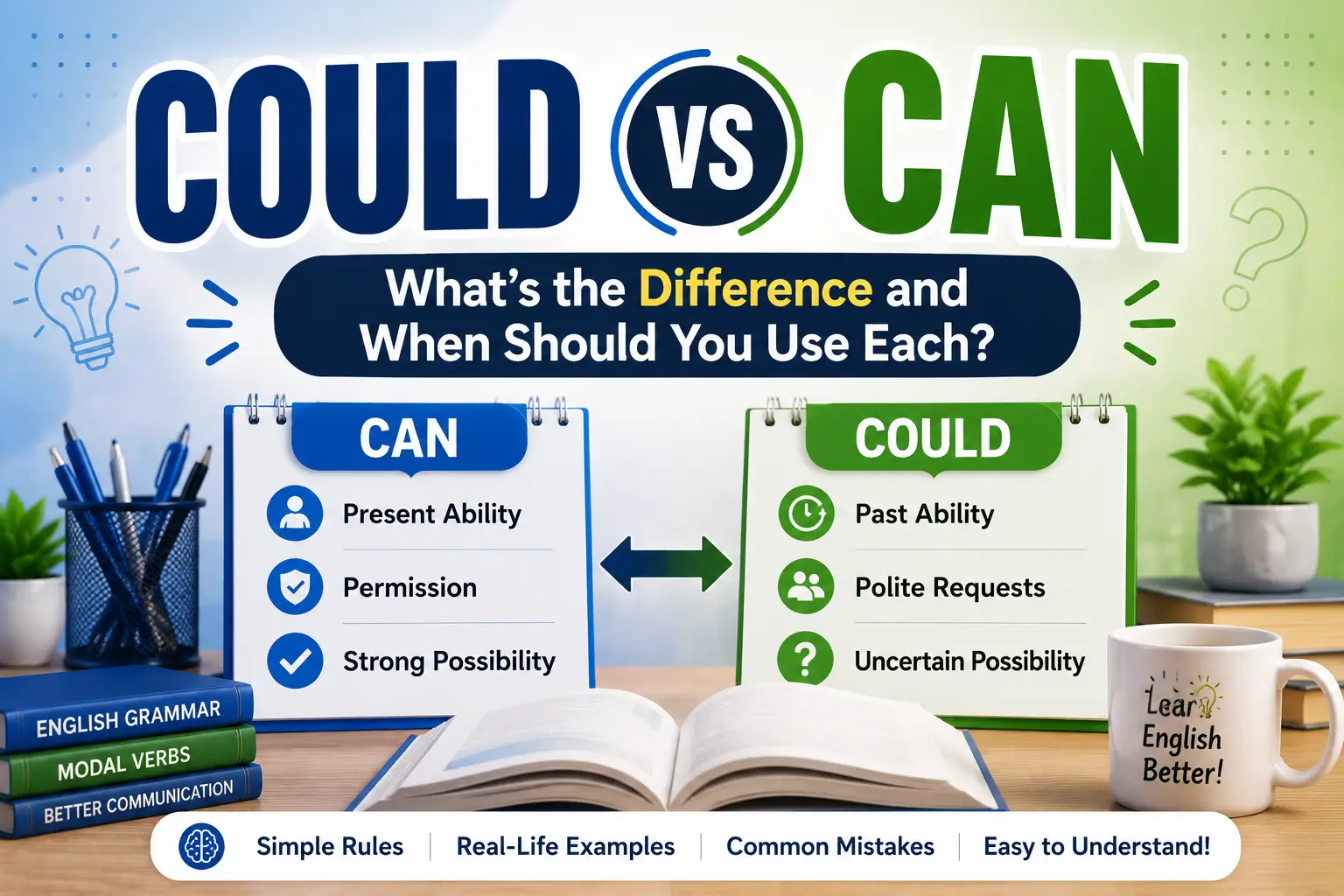
Could vs can is one of the most common grammar questions in English grammar, and understanding the difference can instantly improve your writing and speaking. Although both modal verbs express ability, possibility, and permission, they are used in different situations. Knowing when to use each word helps you avoid common mistakes, sound more natural, and communicate clearly in both everyday conversations and professional writing.
Many learners think can and could mean exactly the same thing, but that’s not true. In most cases, can refers to present ability or permission, while could is used for past ability, polite requests, uncertain possibilities, or hypothetical situations. Once you understand these simple rules, choosing the correct word becomes much easier.
This guide explains the difference between can and could using clear rules, comparison tables, real-life examples, common mistakes, grammar tips, and memory tricks. Whether you’re a student, writer, professional, or English learner, you’ll gain the confidence to use could vs can correctly in American English.
Quick Answer: Could vs Can
The main difference between can and could depends on time, certainty, and politeness.
| Use | Can | Could |
| Present ability | Common | Usually not used |
| Past ability | Not normally used | Common |
| Informal permission | Common | Possible and more polite |
| Giving permission | Common | Rare |
| Strong possibility | Common | Less common |
| Uncertain possibility | Less common | Common |
| Casual request | Common | Common |
| Polite request | Possible | Preferred |
| Hypothetical situation | Less common | Common |
| Tone | Direct and confident | Softer and more formal |
Simple Examples
- I can drive.
- She can speak French.
- When I was younger, I could run very fast.
- Could you open the window?
- It could rain tonight.
- If I had more time, I could help.
Quick rule: Use can for present ability and direct situations. Use could for past ability, politeness, uncertainty, and imaginary situations.
What Are Can and Could?
Both can and could are modal verbs.
A modal verb works with another verb to express ideas such as:
- Ability
- Permission
- Possibility
- Requests
- Suggestions
- Offers
- Necessity
- Advice
Modal verbs do not change according to the subject.
Examples:
- I can go.
- She can go.
- They can go.
The form can stays the same in each sentence.
Modal verbs are followed by the base form of another verb.
Correct:
- She can drive.
- We could leave.
- He can help.
Incorrect:
- She can drives.
- We could leaving.
- He can to help.
Meaning of Can
The word can usually expresses something that is true, possible, or allowed now.
It commonly refers to:
- Present ability
- Permission
- Strong or general possibility
- Direct requests
- Offers
- Practical suggestions
Examples:
- I can speak English.
- We can leave now.
- You can use my laptop.
- She can finish the project today.
- Summers can get very hot here.
In these sentences, can sounds confident and direct.
Meaning of Could
The word could has several meanings.
It can express:
- Past ability
- Polite requests
- Polite permission
- Uncertain possibility
- Gentle suggestions
- Hypothetical situations
Examples:
- I could swim when I was five.
- Could you open the window?
- We could go to the beach tomorrow.
- It could snow tonight.
- If I had more money, I could travel.
Although could is often the past form of can, it does not always refer to the past.
Can vs Could: The Main Differences
Difference in Time
A useful basic rule is:
- Can = present
- Could = past
Examples:
- I can cook.
Present ability. - I could cook when I was twelve.
Past ability.
However, could can also refer to present or future possibilities:
- We could order pizza tonight.
- It could rain tomorrow.
- She could be at home.
Therefore, time is important, but it is not the only difference.
Difference in Certainty
Can often sounds stronger or more certain.
Could usually sounds less certain.
Compare:
- This road can get busy during rush hour.
This regularly happens. - This road could get busy later.
It is possible, but not certain.
Another example:
- Exercise can improve your health.
A general possibility or known effect. - This treatment could improve the condition.
A possible result, but not guaranteed.
Difference in Politeness
Both words can be used in requests, but could usually sounds more polite.
Compare:
- Can you help me?
- Could you help me?
Both sentences are correct.
However:
- Can you help me? sounds casual and direct.
- Could you help me? sounds softer and more respectful.
For this reason, could is common in:
- Business emails
- Customer service
- Job interviews
- Professional meetings
- Conversations with strangers
- Requests to teachers or managers
Difference in Formality
In everyday American English, can is common in casual communication.
Could is often preferred when the speaker wants to sound more professional or courteous.
| Situation | More Natural Choice |
| Talking with friends | Can |
| Text messages | Can |
| Asking a manager | Could |
| Customer service | Could |
| Business email | Could |
| Classroom discussion | Either |
| Formal request | Could |
When to Use Can
Use can when talking about something that is true, possible, or allowed now.
Use Can for Present Ability
The most common use of can is present ability.
Examples:
- I can speak Spanish.
- She can play the piano.
- My brother can repair computers.
- We can finish the project before Friday.
- He can lift this box.
- They can solve the problem.
These abilities exist at the present time.
Incorrect:
- I could swim every day now.
Correct:
- I can swim every day now.
The sentence refers to a current ability, so can is the better choice.
Use Can for Permission
In everyday English, can is commonly used to ask for or give permission.
Examples:
- Can I borrow your pen?
- Can we use our phones during class?
- You can leave early today.
- You can use my laptop.
- Can I sit here?
Although may is traditionally associated with formal permission, can is completely natural in casual American English.
Use Can for General Possibility
Use can when describing something that is generally possible or commonly happens.
Examples:
- Summers can get very hot.
- Driving at night can be dangerous.
- Too much coffee can cause anxiety.
- Learning a language can take time.
- Children can become tired after a long trip.
These sentences describe general truths or repeated possibilities.
Use Can for Informal Requests
Use can when making friendly, direct requests.
Examples:
- Can you help me move this table?
- Can you call me later?
- Can you send the file today?
- Can you wait a minute?
- Can you open the door?
These requests are natural with friends, relatives, classmates, and coworkers.
Use Can to Offer Help
Can can show both ability and willingness.
Examples:
- I can carry those bags.
- We can drive you home.
- I can explain the assignment.
- She can help you with the software.
- I can review the document for you.
Use Can for Practical Suggestions
Use can when offering a clear or practical option.
Examples:
- We can order pizza tonight.
- You can restart your computer.
- We can meet after lunch.
- You can ask your teacher for help.
- We can take the train instead.
These suggestions sound direct and practical.
When to Use Could
Use could for past abilities, polite communication, uncertain possibilities, and hypothetical situations.
Use Could for Past Ability
Could commonly describes a general ability someone had in the past.
Examples:
- I could read before kindergarten.
- She could run faster when she was younger.
- My grandfather could repair almost anything.
- We could stay outside until dark.
- When I was ten, I could ride a bike.
Each sentence refers to an ability that existed in the past.
Incorrect:
- When I was eight, I can ride a horse.
Correct:
- When I was eight, I could ride a horse.
Use Could for Polite Requests
Could softens a request and makes it sound more respectful.
Examples:
- Could you explain that again?
- Could you send me the report?
- Could you please sign here?
- Could you help me find this address?
- Could you review my application?
Compare:
- Can you send the document?
- Could you send the document when you have time?
The second version sounds more courteous and professional.
Use Could to Ask Permission Politely
Both can and could can ask for permission.
However, could sounds more polite.
Examples:
- Could I leave a few minutes early?
- Could I ask you a question?
- Could I use your charger?
- Could we schedule another meeting?
- Could I speak with the manager?
Use Could for Uncertain Possibility
Use could when something is possible but not certain.
Examples:
- It could snow tomorrow.
- Prices could increase next month.
- She could be at the library.
- The meeting could last longer than expected.
- The package could arrive this afternoon.
The speaker is not saying that the event will definitely happen.
Use Could for Gentle Suggestions
Could makes suggestions sound cooperative rather than forceful.
Examples:
- We could watch a movie tonight.
- You could try another restaurant.
- They could leave earlier to avoid traffic.
- We could ask Sarah for advice.
- You could contact customer support.
Compare:
- Restart the computer.
Direct instruction. - You could restart the computer.
Gentle suggestion.
Use Could for Hypothetical Situations
Use could when describing something imaginary or dependent on a condition.
These sentences often include if.
Examples:
- If I had more money, I could travel.
- If we left earlier, we could avoid traffic.
- If she practiced every day, she could become a great musician.
- If they invited us, we could attend.
- If I had more experience, I could apply for the position.
These outcomes are possible only if the condition is met.
Can vs Could in Everyday Situations
At School
- Can I borrow your notebook?
- Could you explain this question?
- I can solve this problem now.
- When I was younger, I could memorize poems quickly.
- Can we submit the assignment online?
- Could I speak with you after class?
At Work
- Could you review this report?
- Could we reschedule the meeting?
- I can finish this project today.
- We can discuss the budget after lunch.
- Can you send me the latest file?
- Could you confirm the deadline?
In Professional Emails
Direct:
- Can you send the document?
More polite:
- Could you send the document when you have time?
Other examples:
- Could you please review the attached proposal?
- Could we arrange a meeting for next week?
- I can provide the additional information today.
- We can complete the revisions by Friday.
In Casual Conversations
- Can you come over tonight?
- I can drive.
- We can leave now.
- Could you pass the salt?
- Can you call me later?
- We could watch a movie.
Even among friends, could is often used to make a request sound kinder.
In Text Messages
Common informal examples:
- Can you call me?
- Can we meet later?
- I can be there in ten minutes.
- Could you send me the photo?
- We could grab coffee tomorrow.
In Customer Service
Customer service representatives often use could because it sounds professional.
Examples:
- Could you confirm your address?
- Could you provide your order number?
- Could you hold for one moment?
- Could you describe the problem?
- Could you verify your email address?
Can vs Could: Side-by-Side Examples
| Can | Could |
| I can help you now. | I could help if I had time. |
| Can you open the door? | Could you open the door, please? |
| She can drive. | She could drive when she was sixteen. |
| We can finish today. | We could finish tomorrow instead. |
| It can be expensive. | It could become expensive. |
| You can use my laptop. | Could I use your laptop? |
| Summers can be hot. | It could be hot tomorrow. |
Can vs Could for Ability
Present Ability
Use can:
- I can swim.
- She can drive.
- We can solve the problem.
- He can speak three languages.
Past Ability
Use could:
- I could swim when I was six.
- She could drive before she moved.
- We could stay awake all night when we were younger.
- He could speak French as a child.
Specific Past Achievement
For a specific successful action in the past, English often prefers was able to rather than could.
Example:
- After several attempts, she was able to open the door.
This distinction is especially useful in careful formal writing.
Can vs Could for Permission
Both forms can ask for permission.
Casual Permission
- Can I use your phone?
- Can I leave now?
- Can we sit here?
Polite Permission
- Could I use your phone?
- Could I leave a little early?
- Could we schedule another appointment?
Giving Permission
Can is more common when permission is granted.
- You can leave now.
- You can use the conference room.
- You can submit the form online.
Could is not normally used to give direct permission.
Can vs Could for Possibility
General or Strong Possibility
Use can for things that generally happen.
- Roads can become slippery in winter.
- Stress can affect sleep.
- This software can save time.
- Heavy traffic can cause delays.
Uncertain Possibility
Use could for a specific event that may happen.
- It could rain tonight.
- The delivery could be late.
- She could be at work.
- The price could increase next month.
Common Mistakes with Can and Could
Using Could for Present Ability
Incorrect:
- I could speak English very well now.
Correct:
- I can speak English very well now.
The sentence describes a current ability.
Using Can for Past Ability
Incorrect:
- When I was six, I can read.
Correct:
- When I was six, I could read.
The sentence refers to a past ability.
Thinking Could Always Refers to the Past
Incorrect assumption:
- Could only describes past events.
Correct explanation:
Could can also describe present or future possibility.
Examples:
- It could rain tomorrow.
- We could eat at the new restaurant.
- She could be at home.
- The project could take longer than expected.
Using Can in Every Formal Request
Grammatically correct:
- Can you send me the contract?
More professional:
- Could you send me the contract?
Both are correct, but could sounds less demanding.
Using the Wrong Verb Form
Incorrect:
- She can drives.
- Could you to help me?
- He could went home.
Correct:
- She can drive.
- Could you help me?
- He could go home.
Both modal verbs must be followed by the base form of the main verb.
Confusing Requests with Permission
Asking permission:
- Can I leave early?
- Could I leave early?
Making a request:
- Can you help me?
- Could you help me?
The difference depends on who performs the action.
Quick Correction Table
| Incorrect or Less Suitable | Correct or Better | Reason |
| I could swim now. | I can swim now. | Present ability |
| When I was six, I can read. | When I was six, I could read. | Past ability |
| She can drives. | She can drive. | Base verb required |
| Could you to help me? | Could you help me? | Do not use “to” |
| Can you review my application? | Could you review my application? | More formal and polite |
| Could only means past. | Could also expresses possibility and politeness. | Rule clarification |
Can vs Could vs May
These modal verbs can all relate to permission or possibility, but their tones and uses differ.
| Feature | Can | Could | May |
| Present ability | Yes | No | No |
| Past ability | No | Yes | No |
| Casual permission | Common | Possible | Less common |
| Polite permission | Possible | Common | Very formal |
| Possibility | General or strong | Uncertain | Possible |
| Everyday conversation | Very common | Very common | Less common |
| Formal permission | Acceptable | Polite | Most traditional |
Which Is Best for Permission?
In everyday American English:
- Can is the most common.
- Could sounds more polite.
- May sounds the most formal.
Examples:
- Can I use your phone?
Casual. - Could I use your phone?
Polite. - May I use your phone?
Formal.
Can vs Could vs Would
These modal verbs sometimes appear in similar situations, but their meanings differ.
| Modal Verb | Main Purpose |
| Can | Present ability, permission, general possibility |
| Could | Past ability, polite requests, uncertain possibility |
| Would | Preference, willingness, imagined result |
Examples:
- I can lift this box.
Present ability. - I could lift it if someone helped me.
Conditional possibility. - I would lift it if my back did not hurt.
Hypothetical willingness.
Choosing the Correct Modal Verb
Ask what you want to express:
- Present ability → Can
- Past ability → Could
- Polite request → Could
- General possibility → Can
- Uncertain possibility → Could
- Preference → Would
- Imaginary result → Could or would, depending on the meaning
A Simple Decision Guide
Ask yourself these questions:
Is It a Present Ability?
Use can.
- I can drive.
- She can sing.
Is It a Past Ability?
Use could.
- I could run faster when I was younger.
- He could read at age four.
Are You Making a Casual Request?
Use can.
- Can you help me?
Are You Making a Polite Request?
Use could.
- Could you help me?
Is It Generally Possible?
Use can.
- Exercise can improve your mood.
Is It Only a Possible Outcome?
Use could.
- The plan could fail.
Is the Situation Imaginary?
Use could.
- If I had time, I could help.
Memory Tricks for Can and Could
Can Means Current
Think:
Can = Current ability
Examples:
- I can drive.
- She can speak English.
- We can start now.
Could Means Courteous
Think:
Could = Courteous request
Example:
- Could you help me?
“When I Was” Often Signals Could
When a sentence includes a past-time phrase, could is often correct.
Examples:
- When I was nine, I could play chess.
- When she was younger, she could run quickly.
Could Often Means Less Certain
Compare:
- It can happen.
General possibility. - It could happen.
Specific but uncertain possibility.
Grammar Rules to Remember
- Can and could are modal verbs.
- They do not change according to the subject.
- They are followed by the base form of a verb.
- Do not add -s, -ed, or -ing directly after them.
- Do not place to before the main verb.
- Use can for present ability.
- Use could for general past ability.
- Use could for more polite requests.
- Use could for uncertain or hypothetical situations.
- Check the complete sentence before choosing the modal verb.
Practice Quiz
Choose can or could.
- I _____ swim very well now.
- When I was seven, I _____ ride a bicycle.
- _____ you please review this document?
- It _____ rain later tonight.
- You _____ use my laptop.
- If I had more money, I _____ travel more.
- _____ you call me after work?
- She _____ speak three languages when she was younger.
- Summers _____ become extremely hot.
- _____ I ask you a question?
Answers
- Can
- Could
- Could
- Could
- Can
- Could
- Can or could
- Could
- Can
- Can or could
Quick Summary Table
| Situation | Best Choice |
| Present ability | Can |
| Past ability | Could |
| Casual permission | Can |
| Polite permission | Could |
| Giving permission | Can |
| General possibility | Can |
| Uncertain possibility | Could |
| Casual request | Can |
| Polite request | Could |
| Practical suggestion | Can |
| Gentle suggestion | Could |
| Hypothetical situation | Could |
Frequently Asked Questions
What Is the Main Difference Between Could and Can?
Can usually refers to present ability, direct permission, or general possibility. Could commonly refers to past ability, polite requests, uncertain possibility, or hypothetical situations.
Is Could the Past Tense of Can?
Yes, could is traditionally the past form of can when talking about general ability.
Example:
- I can swim now.
- I could swim when I was five.
However, could also expresses polite requests and present or future possibilities.
Which Is More Polite: Can or Could?
Could is generally more polite.
Compare:
- Can you help me?
- Could you help me?
Both are correct, but the second sounds softer and more respectful.
Can I Use Could Instead of Can?
Sometimes.
Both words can work in requests:
- Can you open the door?
- Could you open the door?
However, they are not interchangeable in every sentence.
Present ability:
- I can drive.
Past ability:
- I could drive when I was sixteen.
When Should I Use Can?
Use can for:
- Present ability
- Casual permission
- Giving permission
- General possibility
- Informal requests
- Direct suggestions
- Offers of help
When Should I Use Could?
Use could for:
- Past ability
- Polite requests
- Polite permission
- Uncertain possibility
- Gentle suggestions
- Hypothetical situations
Can and Could Both Be Used for Permission?
Yes.
- Can I leave early?
- Could I leave early?
The first is more casual. The second is more polite.
Can Could Refer to the Future?
Yes.
Examples:
- It could rain tomorrow.
- Prices could increase next year.
- We could travel next month.
In these sentences, could expresses an uncertain future possibility.
Is Can More Common in Everyday English?
Can is very common in casual speech because it is direct and simple.
Could is also common, especially in polite requests and professional communication.
What Is the Easiest Way to Remember Could vs Can?
Use these memory rules:
- Can = current ability
- Could = past ability
- Could = courteous request
- Could = uncertain possibility
Conclusion
Understanding could vs can doesn’t have to be difficult. The key is to remember the purpose of each modal verb. In most situations, can expresses present ability, permission, or strong possibility, while could is used for past ability, polite requests, less certain possibilities, and hypothetical situations.
Instead of memorizing grammar rules, focus on how native speakers use these words in everyday conversations, emails, schoolwork, and professional communication. Reading authentic examples and practicing regularly will help you recognize which word fits naturally in different contexts.
As your confidence grows, you’ll make fewer grammar mistakes and communicate more clearly. Keep this guide as a reference whenever you’re unsure, and with regular practice, choosing between can and could will soon become second nature.