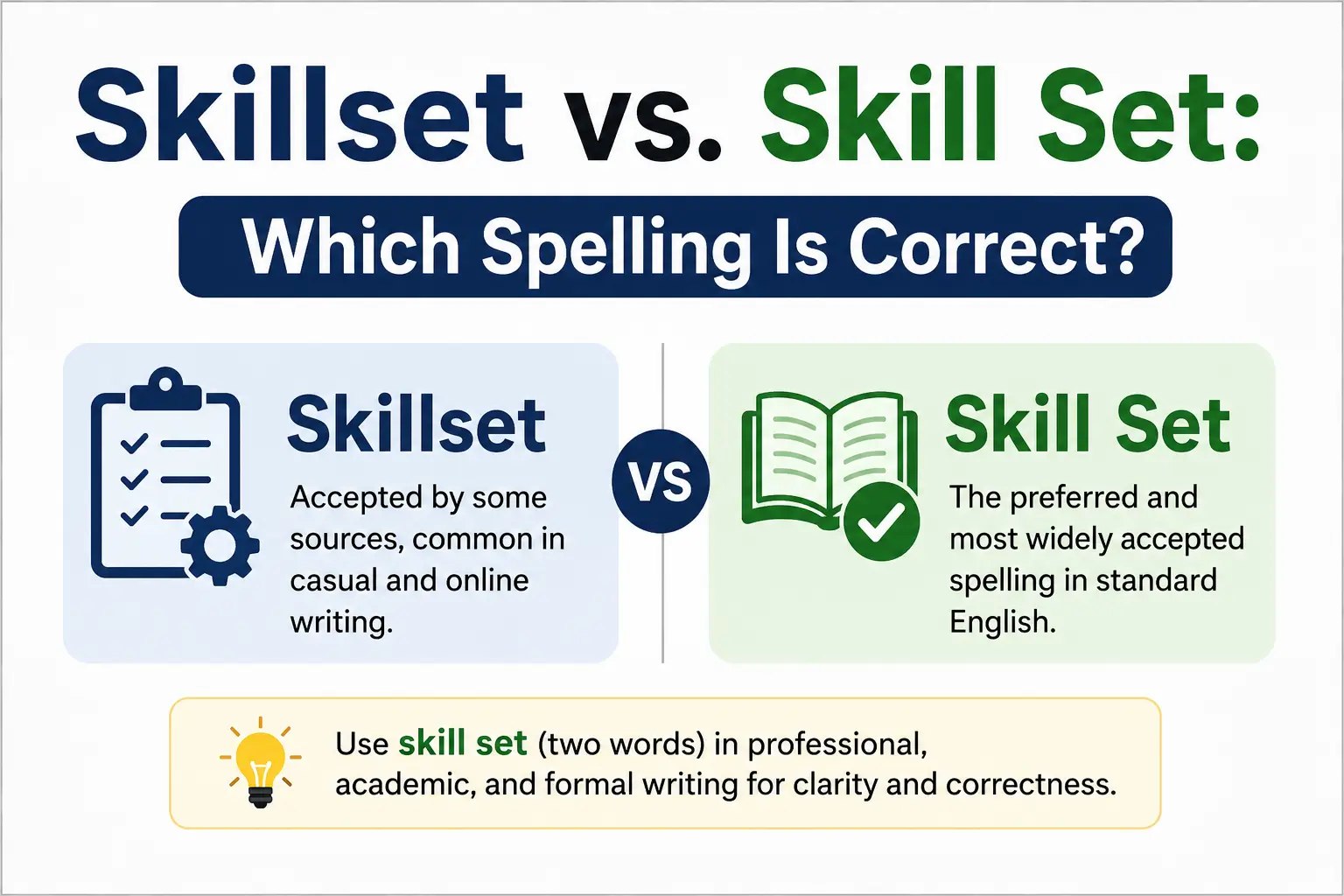
The key difference in skillset vs skill set is spelling: skill set is the safest and most widely accepted form in standard American English.
It refers to a group of abilities that a person uses for a job, activity, or purpose. The one-word form, skillset, also appears in modern writing. Some dictionaries recognize it as a variant, and many companies use it in job descriptions, websites, and other online content. It is especially common in casual business language.
However, skillset is not accepted as consistently as the two-word form. Therefore, choose skill set for resumes, college assignments, professional emails, reports, and formal writing. This spelling also makes plurals, hyphenation, and subject-verb agreement easier to understand. For example, write “one skill set” but “several skill sets.” Using the standard form helps you avoid common mistakes and keeps your writing clear, professional, and easy for readers to follow.
Quick Answer: Is It Skillset or Skill Set?
Skill set is the preferred spelling in standard written English.
- Preferred: skill set
- Accepted by some sources: skillset
- Usually unnecessary: skill-set
A skill set is a collection of related abilities. For example, writing, editing, research, and proofreading can form a professional writing skill set.
Simple rule: When you need a clear and professional spelling, write skill set as two words.
Although skillset is becoming more common, it may still look informal or inconsistent to some editors, teachers, and employers. Therefore, the two-word spelling remains the best default choice.
Skillset vs. Skill Set Comparison
The following table shows the main differences among the three possible spellings.
| Form | Status | Recommended use | Example |
| skill set | Standard and widely preferred | Formal, academic, business, and general writing | Her skill set matches the job. |
| skillset | Recognized variant in some dictionaries and workplaces | Informal, digital, technical, or company-specific writing | The platform helps users expand their skillset. |
| skill-set | Rare and usually unnecessary | Only when required by a specific style guide | The company conducted a skill-set review. |
In most situations, skill set gives you the least risk of being marked wrong. It also looks natural in resumes, cover letters, reports, and academic papers.
What Does “Skill Set” Mean?
A skill set is a group of abilities, knowledge, and practical strengths that help someone complete a task or perform a role.
The phrase functions as a compound noun. A compound noun contains two or more words that work together as one idea. In this case, skill describes the type of set being discussed.
For example:
- A teacher’s skill set may include lesson planning, classroom management, and communication.
- A software developer’s skill set may include coding, debugging, testing, and problem-solving.
- A student’s skill set may include research, note-taking, time management, and critical thinking.
The exact skills in a set depend on the situation. A person may have several skill sets for different areas of life.
For instance, someone could have:
- A professional skill set
- A creative skill set
- A technical skill set
- A communication skill set
- A leadership skill set
Each collection includes abilities that work together toward a specific goal.
Skill Set Meaning in Simple Words
In simple terms, a skill set means the things a person knows how to do.
Suppose Maria can create budgets, analyze spending, prepare financial reports, and use spreadsheet software. Those abilities make up her financial skill set.
Likewise, if Daniel can write articles, edit drafts, conduct interviews, and check facts, those abilities form his journalism skill set.
A skill set is more than a random list of talents. Usually, the abilities connect to a job, project, hobby, or responsibility.
Skill vs. Skill Set: What Is the Difference?
A skill is one ability. A skill set is a collection of abilities.
For example, typing is a skill. However, typing, document formatting, proofreading, email writing, and file organization can form an administrative skill set.
| Term | Meaning | Example |
| Skill | One learned ability | Public speaking |
| Skills | Two or more abilities listed separately | Writing and editing skills |
| Skill set | A collection of abilities used together | Writing, editing, research, and publishing |
Consider these sentences:
- Correct: Public speaking is a useful skill.
- Incorrect: Public speaking is a useful skill set.
The second sentence is usually incorrect because public speaking is one ability. However, presentation design, public speaking, audience analysis, and question handling could form a presentation skill set.
Can One Broad Ability Be Called a Skill Set?
Sometimes a broad field includes several smaller abilities. As a result, people may casually call it a skill set.
For example, “communication” can include:
- Listening
- Speaking
- Writing
- Giving feedback
- Reading body language
- Adjusting tone for different audiences
In casual conversation, someone might call communication a skill set because it contains several smaller abilities. Still, in precise writing, it is often clearer to say communication skills or list the exact abilities.
Why Is “Skill Set” Usually Written as Two Words?
Skill set is traditionally an open compound noun. An open compound contains separate words that work together to express one meaning.
Other open compounds include:
- Job interview
- Career path
- High school
- Customer service
- Training program
- Office manager
The words remain separate even though they describe one idea. Therefore, skill set follows the same general pattern.
English compounds often change over time. Some begin as separate words, later gain a hyphen, and may eventually become one word.
For example:
- Web site became website.
- E-mail became email.
- On-line became online.
The same change may be happening with skillset. The one-word spelling appears frequently in business, technology, recruiting, and online education. Even so, skill set remains the safer choice because it has broader acceptance.
Is “Skillset” a Real Word?
Yes, skillset is used as a real word. It appears in job ads, corporate training materials, software platforms, blogs, and everyday online writing.
Some dictionaries list it as an alternative form of skill set. However, not every dictionary, editor, or style guide treats it as the preferred spelling.
That difference matters because a word can be understandable without being the best choice in formal writing.
Consider these examples:
- Her technical skill set includes data analysis and programming.
- Her technical skillset includes data analysis and programming.
Both sentences communicate the same idea. Nevertheless, the first version is more widely accepted and less likely to distract a careful reader.
When “Skillset” May Be Acceptable
The one-word spelling may be acceptable in:
- Informal blog posts
- Social media content
- Internal company documents
- Software interfaces
- Product names
- Online course descriptions
- Brand language
- Direct quotations
A company may also use skillset consistently as part of its house style. In that case, following the organization’s preferred form may be appropriate.
When You Should Prefer “Skill Set”
Use the two-word form in:
- Resumes
- Cover letters
- College assignments
- Research papers
- Business reports
- Professional emails
- Job applications
- Client proposals
- News articles
- Edited website content
When no style guide gives a different rule, skill set is the most reliable option.
Should “Skill Set” Be Hyphenated?
In most cases, skill set does not need a hyphen.
Write:
- Her skill set is impressive.
- We reviewed his technical skill set.
- The course helps students build a stronger skill set.
Avoid:
- Her skill-set is impressive.
- We reviewed his technical skill-set.
- The course improves your skill-set.
Hyphens often connect words that work together before a noun. For example:
- decision-making process
- long-term plan
- well-written report
However, not every multiword expression needs a hyphen before another noun. Familiar open compounds often stay open.
For example:
- skill set analysis
- skill set development
- skill set assessment
- skill set requirements
Still, a writer may sometimes use skill-set analysis to prevent confusion in a dense sentence. This choice is possible, but it isn’t normally required.
The clearest solution is often to rewrite the phrase:
- Less natural: We completed a skill-set assessment.
- Clearer: We assessed the employee’s skill set.
How to Use “Skill Set” in a Sentence
The phrase skill set functions as a noun. It can appear as the subject, object, or complement of a sentence.
As the Subject
- Her skill set makes her a strong candidate.
- Your skill set will improve with practice.
- A broad skill set can create more career options.
As the Object
- The internship helped him develop a practical skill set.
- Employers value a balanced skill set.
- The course expands each student’s research skill set.
After a Linking Verb
- Her strongest asset is her communication skill set.
- The main requirement is a solid technical skill set.
- His greatest advantage was a flexible skill set.
Real-Life Examples of “Skill Set”
The phrase appears often in school, work, recruiting, technology, and casual conversation.
Workplace Examples
- Her leadership skill set includes coaching, delegation, and conflict resolution.
- The company needs someone with a strong sales skill set.
- Remote work requires a different skill set from office-based work.
- His project management skill set improved after he led the product launch.
- This position requires both technical knowledge and a customer service skill set.
Resume and Cover Letter Examples
- My skill set includes content planning, keyword research, and copy editing.
- I developed a strong administrative skill set while managing daily office operations.
- My technical skill set includes Python, SQL, and data visualization.
- This role matches my communication and problem-solving skill set.
- I hope to apply my marketing skill set to your growing team.
School and Academic Examples
- Group projects help students develop a collaborative skill set.
- The research assignment tests a different skill set from the final exam.
- Note-taking is an important part of a student’s academic skill set.
- The laboratory course builds a practical scientific skill set.
- Debate can strengthen a student’s reasoning and speaking skill set.
Everyday Conversation Examples
- Cooking for a large family requires a useful skill set.
- Fixing a bicycle takes a different skill set from driving one.
- Parenting often demands patience, organization, and communication.
- Video editing has become part of her creative skill set.
- That strategy game tests an entirely different skill set.
Email Examples
- Your skill set seems well suited to the project.
- We’re looking for someone with a broader design skill set.
- The training will help you develop the required skill set.
- Please explain how your skill set relates to this position.
- I’d like to discuss how my experience and skill set can support the team.
Correct and Incorrect Examples
Studying mistakes makes the rule easier to remember.
One Word Instead of Two
Less preferred:
She has the right skillset for the position.
Preferred:
She has the right skill set for the position.
Why: The one-word form is used, but the two-word spelling is safer in standard professional writing.
Calling One Ability a Skill Set
Incorrect:
Typing is an important skill set.
Correct:
Typing is an important skill.
Also correct:
Typing, formatting, and proofreading form an important office skill set.
Why: One ability is a skill. Several connected abilities make up a skill set.
Wrong Subject-Verb Agreement
Incorrect:
Her skill set include writing and editing.
Correct:
Her skill set includes writing and editing.
Why: The head noun is set, which is singular. Therefore, it takes the singular verb includes.
Unnecessary Hyphen
Incorrect:
His skill-set is valuable.
Correct:
His skill set is valuable.
Why: The standard form is an open compound, so the words usually remain separate.
Wrong Plural Form
Incorrect:
The employees have different skill set.
Correct:
The employees have different skill sets.
Why: More than one set requires the plural noun sets.
Incorrect Capitalization
Incorrect:
She has a strong Technical Skill Set.
Correct:
She has a strong technical skill set.
Why: Common nouns aren’t capitalized unless they begin a sentence or appear in a title.
Singular, Plural, and Possessive Forms
The grammar of skill set depends on whether you mean one set, several sets, or ownership.
| Form | Correct spelling | Example |
| Singular | skill set | Her skill set is useful. |
| Plural | skill sets | Their skill sets are different. |
| Singular possessive | skill set’s | The skill set’s value depends on the role. |
| Plural possessive | skill sets’ | The skill sets’ strengths were compared. |
Skill Set Is or Skill Set Are?
Use skill set is when discussing one collection.
- Her skill set is well suited to the role.
- The required skill set is difficult to find.
Use skill sets are when discussing more than one collection.
- Their skill sets are complementary.
- These skill sets are common in management roles.
A common mistake happens because the word skills sounds plural. However, in the phrase skill set, the main noun is set.
Think of similar expressions:
- The group is ready.
- The collection is complete.
- The set is valuable.
Therefore:
- The skill set is valuable.
Types of Skill Sets
A person’s skill set may contain several types of abilities. Understanding these categories can help you describe your strengths more clearly.
Technical Skills
Technical skills involve tools, systems, methods, or specialized knowledge.
Examples include:
- Coding
- Data analysis
- Accounting
- Machine operation
- Search engine optimization
- Graphic design
- Laboratory testing
- Spreadsheet management
A technical skill set usually relates directly to a job or industry.
Soft Skills
Soft skills affect how you communicate, organize work, and interact with others.
Examples include:
- Communication
- Teamwork
- Adaptability
- Time management
- Leadership
- Conflict resolution
- Emotional awareness
- Problem-solving
Employers often value soft skills because technical knowledge alone doesn’t guarantee strong job performance.
Transferable Skills
Transferable skills can be used in many roles and industries.
For example:
- Writing
- Research
- Planning
- Customer service
- Budgeting
- Public speaking
- Project coordination
A teacher moving into corporate training may use many of the same communication and presentation skills.
Job-Specific Skills
Job-specific skills apply to a particular role.
For example, a dental assistant may need:
- Sterilization procedures
- Patient record management
- Dental instrument preparation
- Chairside assistance
- Appointment scheduling
These abilities form a specialized job-related skill set.
Creative Skills
Creative skill sets may include:
- Illustration
- Storytelling
- Photography
- Video editing
- Music production
- Copywriting
- Design thinking
Creativity often works together with technical knowledge. For example, a video editor needs both visual judgment and editing software experience.
Skill Set vs. Related Terms
Several words overlap with skill set, but they don’t mean exactly the same thing.
Skill Set vs. Skills
Skills refers to abilities in general. Skill set presents those abilities as a connected group.
- Her skills include writing, editing, and research.
- Her writing skill set includes editing, research, and fact-checking.
The first sentence lists abilities. The second groups them within a professional area.
Skill Set vs. Ability
An ability is the capacity to do something. It may be natural, learned, or developed.
A skill usually becomes stronger through practice and experience.
For example:
- She has a natural ability to recognize patterns.
- She developed data analysis skills through training.
- Those skills are part of her research skill set.
Skill Set vs. Competency
A competency is the proven ability to perform a task according to a required standard.
A skill may be something you can do. A competency often shows how well you can apply that skill in a real situation.
For example, communication is a skill. The ability to explain a complex issue clearly to an upset customer is a workplace competency.
Skill Set vs. Expertise
Expertise means advanced knowledge or a high level of skill in a subject.
Someone can have a broad skill set without being an expert in every area.
For instance, a marketing assistant may have skills in email writing, social media, basic design, reporting, and keyword research. However, that person may not have expert-level knowledge in all five areas.
Skill Set vs. Qualifications
Qualifications include everything that makes a person suitable for a role.
They may include:
- Education
- Work experience
- Certifications
- Licenses
- Training
- Skills
- Professional achievements
A skill set is only one part of a person’s qualifications.
Skill Set vs. Strengths
A strength is something a person does especially well.
Not every skill is a major strength. Likewise, a strength may involve a personal quality, such as patience or dependability.
For example:
- Skill: Writing reports
- Strength: Explaining complex information clearly
- Skill set: Research, analysis, writing, editing, and presentation
Synonyms and Alternatives for “Skill Set”
Repeating skill set too often can make writing sound vague. Depending on the context, you can use a more specific alternative.
Possible alternatives include:
- Skills
- Abilities
- Capabilities
- Competencies
- Strengths
- Expertise
- Qualifications
- Talents
- Professional tools
- Areas of knowledge
- Technical abilities
- Practical experience
However, these words aren’t perfect synonyms in every sentence.
For example:
- “Her qualifications include a degree and five years of experience” is broader than “her skill set.”
- “His expertise is cybersecurity” suggests advanced knowledge, not simply a collection of abilities.
- “Her talents include drawing and music” may suggest natural ability rather than trained professional skills.
Choose the word that matches your exact meaning.
How to Use “Skill Set” on a Resume
The phrase skill set is correct on a resume, but it can sound weak when used without details.
Compare these examples:
Vague:
I have a strong skill set.
Better:
My skill set includes project planning, budget tracking, and client communication.
Stronger:
Managed schedules, budgets, and client updates for six active projects.
The final example is stronger because it proves the applicant can use those skills.
Resume Case Study
Imagine two candidates applying for a content marketing position.
Candidate A writes:
I have a diverse marketing skill set and excellent communication skills.
Candidate B writes:
Planned monthly content calendars, researched search keywords, edited blog posts, and increased newsletter engagement through audience testing.
Candidate A makes a general claim. Candidate B provides evidence.
Therefore, use skill set to introduce your abilities when needed. However, support the phrase with specific skills, tools, results, or examples.
Better Resume Phrases
Instead of:
- Strong skill set
- Excellent skill set
- Diverse skill set
- Impressive skills
- Many useful abilities
Write:
- Skilled in budget planning, forecasting, and financial reporting
- Experienced with Python, SQL, and Tableau
- Strong background in customer support and conflict resolution
- Proficient in copy editing, research, and content planning
- Trained in laboratory safety, sampling, and data recording
Specific language creates more trust.
Common Mistakes With “Skill Set”
Using “Skillset” Without Considering the Context
The spelling skillset may be accepted in some settings. However, it can appear informal in academic or highly edited writing.
Choose skill set unless you know the publication or company prefers the one-word form.
Adding a Hyphen Automatically
Writers sometimes believe every two-word modifier needs a hyphen. That isn’t true.
You can normally write:
- skill set assessment
- skill set review
- skill set gap
- skill set development
A hyphen may occasionally improve clarity, but it isn’t required in the standard expression.
Using the Phrase When You Mean One Skill
Avoid calling a single ability a complete skill set.
- Incorrect: Time management is a skill set.
- Better: Time management is a skill.
- Better: Planning, prioritizing, and scheduling form a time-management skill set.
Writing “Skill Set Are”
Remember that set is singular.
- Incorrect: Her skill set are impressive.
- Correct: Her skill set is impressive.
- Correct: Her skills are impressive.
- Correct: Her skill sets are impressive.
Using Vague Professional Language
Sentences such as “He has a great skill set” provide little useful information.
Instead, name the relevant abilities:
- His skill set includes negotiation, account management, and sales forecasting.
Better yet, show those abilities through results:
- He managed 40 client accounts and exceeded his annual sales target.
Overusing “Unique Skill Set”
The phrase unique skill set is common, but it is often exaggerated. A skill set is truly unique only when no one else has the same combination.
In many situations, these alternatives are more accurate:
- Specialized skill set
- Broad skill set
- Unusual combination of skills
- Role-specific skill set
- Valuable mix of abilities
Grammar Tips for Using “Skill Set”
Use “A” With a Singular Skill Set
Because skill set is a countable noun, it usually needs an article or another determiner.
- She has a skill set that suits the role.
- He developed a technical skill set.
- That skill set is valuable.
- Her skill set has improved.
Avoid:
- She has skill set that suits the role.
Use “Of” to Explain the Contents
You can use of when describing the abilities included in the set.
- A skill set of writing, editing, and research
- A skill set of technical and interpersonal abilities
However, the following structure often sounds more natural:
- A skill set that includes writing, editing, and research
- A skill set consisting of technical and interpersonal abilities
Use “Includes” for Examples
Use includes when naming some or all parts of the set.
- Her skill set includes copywriting and editing.
- The role requires a skill set that includes planning and leadership.
Since skill set is singular, use includes, not include.
Avoid Redundant Phrases
The phrase “a set of different skills” is grammatical, but skill set already implies multiple abilities.
Instead of:
- She has a skill set made up of many different skills.
Write:
- Her skill set includes research, writing, and editing.
The second sentence is shorter and more useful.
Memory Tricks for Skillset vs. Skill Set
A simple memory trick is to think of the phrase a set of skills.
Since you would write set of skills as separate words, you can also remember skill set as two words.
Try this quick test:
Can I replace the phrase with “group of skills”?
If yes, write skill set.
Example:
- Her skill set matches the position.
- Her group of skills matches the position.
The meaning remains similar, so the two-word spelling makes sense.
You can also connect it to familiar open compounds:
- Job title
- Career goal
- Training plan
- Office skills
- Skill set
Each expression contains separate words that form one complete idea.
Conclusion: Skill Set Is the Preferred Spelling
The main difference in skillset vs skill set is the way the term is written. Skill set is the standard and most widely accepted spelling in American English. It refers to a group of abilities that someone uses for a job, task, or activity.
The one-word form skillset appears in modern business and online writing. However, it isn’t accepted as consistently in formal English. Therefore, use skill set in resumes, professional emails, reports, academic assignments, and other edited content.
Also, remember that one ability is a skill, while several related abilities form a skill set. The plural is skill sets, and the phrase usually doesn’t need a hyphen. When you’re unsure, write skill set as two separate words.
Frequently Asked Questions
Q1: Is skillset one word or two words?
Skill set is normally written as two words in standard American English. The one-word spelling skillset is used by some companies and dictionaries, but the two-word form is safer for formal and professional writing.
Q2: Is skillset grammatically incorrect?
Skillset isn’t always considered incorrect because it is recognized as a variant in some sources. However, skill set remains the more widely accepted spelling and is the better choice for resumes, reports, and academic work.
Q3: Should skill set be hyphenated?
No, skill set usually doesn’t need a hyphen. Write “Her skill set includes writing and editing.” The hyphenated form skill-set is rare and should only be used when a specific style guide requires it.
Q4: What is the plural of skill set?
The correct plural is skill sets. For example, “The two candidates have different skill sets.” Add the plural ending to set, which is the main noun in the phrase.
Q5: What is the difference between a skill and a skill set?
A skill is one ability, such as typing or writing. A skill set is a group of related abilities. For example, writing, editing, research, and proofreading can form a complete content-writing skill set.