
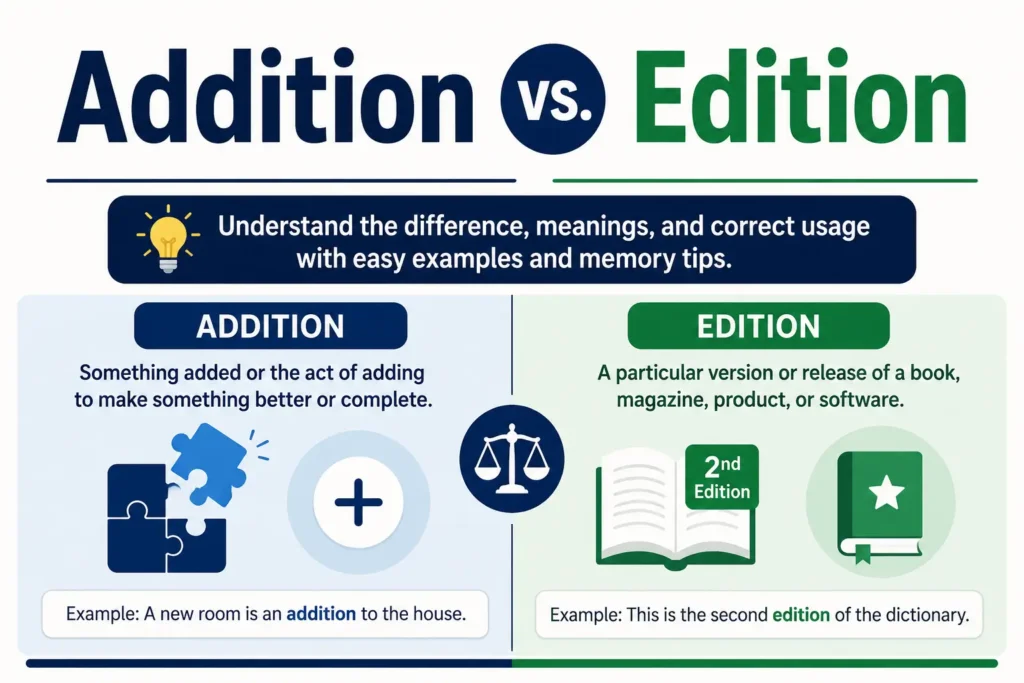
Addition vs. Edition becomes simple when you remember that an addition is something added, while an edition is a published version of a work. A publisher may release a revised edition of a specific book after correcting, updating, or reorganizing its content. The new publication may also use a different layout, design, or format.
Use addition when a new item, feature, member, or piece of material joins an existing collection, system, group, or structure. For example, a new chapter is an addition to a book, while the complete updated book is a new edition. This difference makes the correct choice clear in most sentences.
In mathematical contexts, addition means combining two or more quantities to find a sum. The same basic idea applies in daily English because something is being added. A useful memory tip is simple: connect addition with add, and connect edition with edit or a published version.
Addition vs. Edition: Quick Answer
The simplest difference is:
Addition comes from add. It refers to something added or the process of adding.
Edition comes from edit. It refers to a particular version or release.
Here’s a sentence that uses both words correctly:
The updated index is a useful addition to the latest edition of the book.
The index was added, so it’s an addition. The book is a particular published version, so it’s an edition.
Addition and Edition Comparison Table
| Word | Main meaning | Part of speech | Common pattern | Example |
| Addition | Something added; the act of adding; a math process | Noun | addition to something | The porch is a new addition to the house. |
| Edition | A particular version or release | Noun | edition of something | This is the newest edition of the dictionary. |
Both words are nouns. However, their usual prepositions can help you choose the correct one.
- Use addition to when something joins or improves another thing.
- Use edition of when discussing a version of a publication or product.
What Does Addition Mean?
Addition is a noun related to the verb add. It can describe something new that has been included, the process of including it, or the mathematical act of combining numbers.
Addition as Something That Is Added
An addition can be a person, object, feature, room, or other element that joins something that already exists.
Examples:
- The outdoor kitchen is a valuable addition to the backyard.
- Ava is the newest addition to our marketing team.
- Dark mode would be a helpful addition to the app.
- Their newborn baby is a joyful addition to the family.
- The museum’s new sculpture is an impressive addition to its collection.
In each example, something new has joined an existing group, place, system, or collection.
The phrase addition to is especially common:
- an addition to the team
- an addition to the family
- an addition to the building
- an addition to the menu
- an addition to the software
Notice that addition doesn’t always refer to a physical object. A feature, idea, rule, or person can also be an addition.
Addition as the Act of Adding
The word can also describe the action or process of adding something.
Examples:
- The addition of fresh herbs improved the soup.
- The addition of captions made the video more accessible.
- We approved the addition of two new positions.
- The addition of a conclusion made the report feel complete.
This structure often follows the pattern:
the addition of + noun
Compare these two common patterns:
- The new patio is an addition to the house.
- The addition of a patio increased the home’s value.
The first sentence focuses on the patio as a new part. The second focuses on the process or result of adding it.
Addition as a Math Term
In mathematics, addition means combining two or more numbers to find a total.
For example:
8 + 5 = 13
In this problem:
- 8 and 5 are addends.
- The plus sign shows addition.
- 13 is the sum.
You may hear the word in school, finance, shopping, accounting, and daily calculations.
Examples:
- The teacher introduced basic addition to the class.
- Please check the addition before submitting the expense report.
- Mental addition helps you estimate the total cost.
In this mathematical sense, addition is usually uncountable. You normally say “practice addition,” not “practice an addition.”
However, it can be countable when referring to a specific calculation:
- I found an error in one of the additions.
That use is less common in everyday American English.
Common Phrases With Addition
Several common expressions use addition.
In Addition
In addition means “also,” “furthermore,” or “as another point.”
Examples:
- The apartment is spacious. In addition, it’s close to downtown.
- The course teaches grammar. In addition, it covers academic writing.
- She manages the budget. In addition, she trains new employees.
When in addition begins a sentence, place a comma after it.
Correct:
In addition, the hotel offers free breakfast.
Incorrect:
In addition the hotel offers free breakfast.
In informal writing, you can often use also instead. However, in addition sounds slightly more formal and works well in reports, essays, and professional emails.
In Addition To
In addition to means “as well as” or “besides.” It must be followed by a noun, pronoun, or -ing form.
Examples:
- In addition to English, she speaks Spanish.
- In addition to his regular job, he teaches online.
- In addition to writing the report, Maya prepared the slides.
Avoid placing a base-form verb directly after the phrase.
Incorrect:
In addition to write the report, Maya prepared the slides.
Correct:
In addition to writing the report, Maya prepared the slides.
A Welcome Addition
A welcome addition is something new that people are pleased to receive.
Examples:
- The shaded seating area is a welcome addition to the park.
- Flexible scheduling would be a welcome addition to the benefits package.
- The new teacher is a welcome addition to the school.
The Latest Addition
The latest addition means the newest member or item added to a group.
Examples:
- This painting is the latest addition to her collection.
- Jordan is the latest addition to our design department.
- The bakery’s chocolate tart is its latest addition.
Be careful: latest addition is not the same as latest edition.
- The latest addition to the library is a new reading room.
- The latest edition of the magazine includes an interview.
What Does Edition Mean?
Edition is a noun that refers to a specific version of a book, newspaper, magazine, software program, product, or other published or released item.
The word is connected to edit, although an edition doesn’t always contain major edits. Sometimes it differs because of its publication date, format, features, design, or intended audience.
Edition as a Version of a Book
Books often appear in more than one edition. A new edition may contain corrections, updated information, added chapters, or a different layout.
Examples:
- We’re using the eighth edition of the textbook.
- The second edition includes updated research.
- She owns a rare first edition of the novel.
- Make sure you buy the student edition, not the instructor’s copy.
An edition isn’t the same as a single physical copy.
For example, a publisher may print 20,000 copies of one edition. Every copy belongs to the same edition.
Compare:
- I bought a copy of the fifth edition.
- The bookstore has ten copies of that edition.
Edition as a Newspaper or Magazine Issue
Edition can refer to a version of a newspaper or magazine published for a particular time, region, or audience.
Examples:
- The report appeared in the Sunday edition.
- The morning edition contained the election results.
- The international edition includes additional world news.
- The digital edition is available through the magazine’s app.
In everyday American English, issue is also common for magazines.
- the July issue of a magazine
- the digital edition of a magazine
These terms can overlap. However, issue often refers to one publication released on a certain date. Edition may highlight the format, version, audience, or updated content.
Edition as a Special Product Release
Businesses use edition for products released with a special design, feature set, or limited availability.
Examples:
- The company introduced a limited edition watch.
- She bought the collector’s edition of the video game.
- The anniversary edition includes special packaging.
- This laptop is available in a professional edition.
- The brand released a holiday edition of the gift set.
In marketing, edition often creates a sense of uniqueness. Still, it should describe a version or release, not merely something added.
Edition in Software and Technology
Software may have different editions for different users.
Examples:
- The home edition offers basic tools.
- The professional edition includes advanced security features.
- Our school uses the education edition of the platform.
- The enterprise edition supports larger teams.
Software companies may use version, release, and edition differently.
A version often identifies a technical update, such as Version 4.2. An edition usually identifies a package designed for a certain audience or purpose.
For example:
- Version 4.2 of the Professional Edition
- the Home Edition of a software program
Common Phrases With Edition
First Edition
A first edition is the first published version of a book.
Example:
- The collector paid a high price for a signed first edition.
A first edition isn’t always rare or valuable. Its value depends on factors such as demand, condition, print quantity, and historical importance.
Revised Edition
A revised edition contains changes or corrections to an earlier version.
Example:
- The revised edition includes new exercises and updated examples.
Special Edition
A special edition has features or content not found in the standard version.
Example:
- The special edition includes behind-the-scenes interviews.
Limited Edition
A limited edition is produced in restricted quantities or sold for a limited period.
Example:
- Only 500 copies of the limited edition were printed.
The phrase acts as a compound modifier before a noun. In American English, it’s often hyphenated when it directly modifies another noun:
- a limited-edition print
- a limited-edition sneaker
However, no hyphen is needed when the phrase comes after the noun:
- The print is limited edition.
Digital Edition
A digital edition is an electronic version of a newspaper, magazine, book, or other publication.
Example:
- Subscribers can read the digital edition on their phones.
Addition vs. Edition: Key Differences
Although the spellings differ by only a few letters, the words serve separate purposes.
| Situation | Correct word | Why |
| A room has been added to a house | Addition | The room is something newly added. |
| A textbook has been updated | Edition | The textbook is a new version. |
| A person joins a team | Addition | The person becomes a new member. |
| A newspaper is published for Sunday | Edition | It’s a particular published version. |
| Numbers are combined | Addition | The word names a math operation. |
| A product has special packaging | Edition | It’s a special release or version. |
| A feature is added to an app | Addition | The feature becomes part of the app. |
| A game includes collector items | Edition | It’s a particular product package. |
A useful question can guide your choice:
- Was something added? Choose addition.
- Is it a version or release? Choose edition.
How to Pronounce Addition and Edition
The words sound very similar in American English, which partly explains the confusion.
Pronunciation of Addition
Addition is pronounced:
uh-DISH-un
IPA: /əˈdɪʃən/
The stress falls on the second syllable: DISH.
Pronunciation of Edition
Edition is pronounced:
ih-DISH-un
IPA: /ɪˈdɪʃən/
Again, the stress falls on the second syllable.
The first vowel is the main difference:
- addition begins with an unstressed “uh” sound.
- edition usually begins with a short “ih” sound.
However, many speakers pronounce unstressed vowels quickly. As a result, the words may sound almost identical in fast conversation.
Context usually makes the meaning clear:
- an addition to the house
- a new edition of the book
They’re sometimes treated as near-homophones, but they aren’t exact homophones in careful standard American pronunciation.
Addition and Edition as Parts of Speech
Both addition and edition are nouns.
Addition as a Count Noun
When it means something added, addition can be countable.
- The office has a new addition.
- The office has several new additions.
Addition as an Uncountable Noun
When it names a general process or branch of math, it’s often uncountable.
- Addition is easier for him than division.
- The addition of another fee increased the price.
Edition as a Count Noun
Edition is normally countable.
- This is an updated edition.
- Several editions are available.
You can use numbers or descriptive words before it:
- first edition
- third edition
- revised edition
- international edition
- digital edition
Addition vs. Edition in Example Sentences
Correct Examples With Addition
- The company built an addition onto its main office.
- A search bar would be a useful addition to the website.
- Ben is a great addition to the customer support team.
- The addition of stronger lighting improved the workspace.
- Our teacher reviewed subtraction and addition.
- The new bus route is a welcome addition to the neighborhood.
- In addition, employees may work remotely on Fridays.
- In addition to coffee, the café serves tea and smoothies.
Correct Examples With Edition
- The newest edition of the manual includes updated safety rules.
- I read the online edition of the newspaper.
- The professor requires the fourth edition of the textbook.
- The collector’s edition comes with a printed art book.
- That quote doesn’t appear in the first edition.
- The company launched a special edition for schools.
- The revised edition corrects several spelling errors.
- She found an early edition at a used bookstore.
Sentences Using Both Words
- The new appendix is an important addition to the second edition.
- A pronunciation guide would be a helpful addition to the student edition.
- The bonus chapter is the best addition to this revised edition.
- The digital edition includes an addition that wasn’t in the printed book.
- The updated map is a practical addition to the travel guide’s latest edition.
These examples show the central difference: an addition is added content, while an edition is the complete version containing that content.
Common Addition and Edition Mistakes
Mistake: Using Edition for Something Added
Incorrect:
The sunroom is a beautiful edition to the house.
Correct:
The sunroom is a beautiful addition to the house.
The sunroom was added to the building. Therefore, addition is the correct word.
Mistake: Using Addition for a Book Version
Incorrect:
I need the newest addition of the textbook.
Correct:
I need the newest edition of the textbook.
You’re asking for a particular version of the textbook, so use edition.
Mistake: Writing “Edition to the Family”
Incorrect:
Their baby is the newest edition to the family.
Correct:
Their baby is the newest addition to the family.
A baby joins the family. The baby isn’t a version or release of the family.
Mistake: Writing “Limited Addition”
Incorrect:
The store released a limited addition jacket.
Correct:
The store released a limited edition jacket.
A specially released product is a limited edition.
When the phrase appears before a noun, add a hyphen:
a limited-edition jacket
Mistake: Confusing “In Addition” and “In Edition”
Incorrect:
In edition, the plan includes free support.
Correct:
In addition, the plan includes free support.
In addition is a standard transition meaning “also.” In edition doesn’t have that meaning.
Mistake: Using the Wrong Preposition
Incorrect:
This chapter is an addition of the guide.
Better:
This chapter is an addition to the guide.
Incorrect:
This is the latest edition to the guide.
Correct:
This is the latest edition of the guide.
The most common patterns are:
- an addition to something
- an edition of something
Real-Life Examples From Work, School, and Daily Life
At School
A student asks:
“Do we need the newest addition of the biology book?”
The student should say:
“Do we need the newest edition of the biology book?”
The student is asking about a version of a publication.
However, this sentence uses addition correctly:
“The new review questions are a helpful addition to the biology book.”
The questions were added to the content.
At Work
A manager writes:
“Taylor is the newest edition to our sales department.”
The correct version is:
“Taylor is the newest addition to our sales department.”
Taylor is a new team member, not a product version.
In Product Marketing
A store advertises:
“Shop our limited addition holiday mugs.”
The correct wording is:
“Shop our limited-edition holiday mugs.”
The mugs belong to a special release.
During Home Renovation
A homeowner says:
“We’re building a new edition on the back of the house.”
The correct word is addition:
“We’re building a new addition on the back of the house.”
In construction, an addition is a new section attached to an existing building.
In Publishing
An editor may write:
“The revised edition contains the addition of two new chapters.”
This sentence is correct, although it can sound smoother:
“The revised edition contains two newly added chapters.”
Here, edition names the version, while addition describes the act of adding content.
Formal, Professional, and Casual Usage
Formal and Academic English
In academic writing, edition often appears in references and discussions of textbooks.
Examples:
- Use the seventh edition of the style manual.
- The revised edition reflects recent research.
- The citation lists the book’s second edition.
Meanwhile, addition appears in mathematical explanations and formal descriptions of changes.
Examples:
- The addition of a control group improved the study.
- Basic addition is introduced in elementary school.
- In addition, the researchers reviewed earlier findings.
Professional English
In the workplace, both words are common.
Examples:
- The new dashboard is a useful addition to our reporting system.
- Please download the latest edition of the employee handbook.
- Morgan will be a strong addition to the leadership team.
- The enterprise edition supports unlimited users.
Casual Conversation
In everyday speech, people often use addition for new family members, pets, purchases, or improvements.
Examples:
- Meet the newest addition to our family.
- The puppy is a cute addition to their home.
- That lamp is a nice addition to the room.
People use edition when discussing books, games, products, and collectibles.
Examples:
- I bought the deluxe edition.
- Is that a first edition?
- They’re releasing a special edition next month.
The meanings stay the same across formal and casual settings.
Easy Memory Tricks for Addition vs. Edition
The easiest memory trick connects each noun to its related verb.
Add Leads to Addition
Both words contain add:
- add
- addition
When something is being added, use addition.
Add something → an addition
Edit Leads to Edition
The beginning of edition looks like edit:
- edit
- edition
When you’re discussing a version that may have been edited or released, use edition.
Edit or publish a version → an edition
Remember the Usual Prepositions
Another useful pattern is:
- addition to
- edition of
Examples:
- an addition to the house
- an edition of the newspaper
This trick won’t cover every sentence, but it works in many common situations.
Synonyms for Addition
The best synonym depends on the meaning.
When Addition Means Something Added
Possible alternatives include:
- extra
- supplement
- extension
- improvement
- enhancement
- new member
- new feature
- inclusion
Examples:
- The garage is an extension of the house.
- The glossary is a useful supplement.
- The update includes a new feature.
These words aren’t always interchangeable. For example, an extension usually increases the size or reach of something. An enhancement improves it. An addition simply means that something new was added.
When Addition Means “Also”
Alternatives for in addition include:
- also
- furthermore
- moreover
- besides
- additionally
Examples:
- The plan is affordable. Also, it’s easy to use.
- The plan is affordable. Furthermore, it includes support.
- The plan is affordable. Additionally, it includes support.
Moreover and furthermore sound formal. Also sounds natural in most conversations and everyday writing.
Synonyms for Edition
Possible alternatives include:
- version
- release
- issue
- printing
- publication
- format
However, these words have different uses.
| Word | Typical use | Example |
| Version | A particular form of something | the updated version |
| Release | A product made available to the public | the latest software release |
| Issue | One magazine or journal published on a date | the June issue |
| Printing | A group of copies printed at one time | the second printing |
| Edition | A particular published or released form | the revised edition |
An edition and a printing aren’t always the same. A publisher can print more copies without changing the edition. Therefore, a second printing may still belong to the first edition.
Related Words and Word Forms
Words Related to Addition
| Word | Part of speech | Meaning | Example |
| Add | Verb | To include or combine | Add your name to the list. |
| Additional | Adjective | Extra or more | We need additional information. |
| Additionally | Adverb | Also; in addition | Additionally, parking is free. |
| Additive | Noun or adjective | A substance added to something | The food contains no artificial additives. |
Don’t confuse additional with addition.
- Additional describes a noun: additional time.
- Addition is a noun: the addition of more time.
Words Related to Edition
| Word | Part of speech | Meaning | Example |
| Edit | Verb | To revise or correct | She edited the article. |
| Editor | Noun | A person who edits | The editor reviewed the draft. |
| Editorial | Adjective or noun | Related to editing or expressing an opinion | The editorial team met today. |
| Reissue | Noun or verb | A newly released form of an older work | The album received a digital reissue. |
Although edition is related to publishing and editing, not every edited document becomes a new edition. A few corrected typos may simply produce an updated file.
Quick Practice: Addition or Edition?
Choose addition or edition for each sentence.
- The latest ________ of the software includes better privacy controls.
- Our new puppy is a cheerful ________ to the family.
- The teacher reviewed multiplication and ________.
- I ordered the collector’s ________ of the game.
- A covered porch would be a useful ________ to the house.
- The Sunday ________ contains extra feature stories.
- In ________, all employees receive paid training.
- The revised ________ has a new introduction.
- The ________ of subtitles made the video easier to understand.
- This is a limited-________ product.
Answer Key
- Edition — It refers to a software version.
- Addition — The puppy joined the family.
- Addition — It refers to a math operation.
- Edition — It names a special product version.
- Addition — The porch would be added to the house.
- Edition — It refers to a newspaper version.
- Addition — The fixed transition is “in addition.”
- Edition — It refers to a revised book version.
- Addition — It describes the act of adding subtitles.
- Edition — “Limited edition” is the correct phrase.
Conclusion
The difference between addition vs. edition becomes clear when you connect each noun to its related verb. Addition comes from add, so it refers to something added, the process of adding, or the math operation of combining numbers. Edition relates to edit and describes a particular published or released version of a book, newspaper, software program, game, or product.
A simple pattern can also help you choose the correct word. Use addition to when something joins an existing group, collection, structure, or system. Use edition of when referring to a specific version or release. For example, a new chapter is an addition to a textbook, while the complete revised textbook is a new edition.
Remember this quick rule: if something was added, choose addition. If something is a version or release, choose edition.
Frequently Asked Questions
Q1: What is the main difference between addition and edition?
Addition means something added or the process of adding. Edition means a particular version or release of a publication, product, or software program.
For example:
- The new garage is an addition to the house.
- I bought the latest edition of the dictionary.
Q2: Is it “new addition” or “new edition” to the family?
The correct phrase is new addition to the family. A baby, pet, or other person joins the family, so that person is an addition.
Incorrect: The baby is the newest edition to our family.
Correct: The baby is the newest addition to our family.
Q3: Should I write “latest addition” or “latest edition”?
Both phrases are correct, but they have different meanings.
- Latest addition means the newest person, item, or feature added to something.
- Latest edition means the newest published or released version.
For example, a reading room may be the latest addition to a library, while a revised dictionary may be its latest edition.
Q4:What is the difference between “addition to” and “edition of”?
Use addition to for something that becomes part of an existing thing.
- The search tool is a useful addition to the website.
Use edition of for a version of a publication or product.
- This is the digital edition of the newspaper.
Q5:Are addition and edition pronounced the same?
They sound very similar in American English, but they aren’t exact homophones in careful pronunciation.
- Addition: uh-DISH-un
- Edition: ih-DISH-un
The first vowel sound differs slightly. However, context usually makes the intended meaning clear.
