
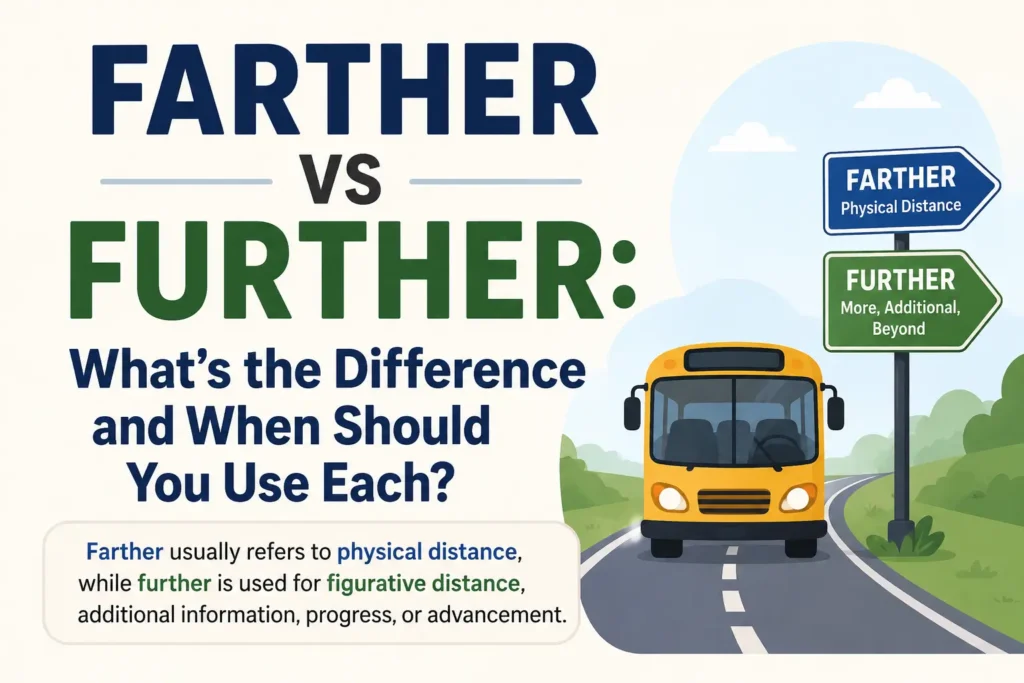
Farther vs Further is one of the most common grammar questions in American English because both words look alike and have similar meanings. The quick answer is simple: farther usually refers to physical distance, while further is used for figurative distance, additional information, progress, or advancement. Knowing this difference helps you choose the right word in school assignments, workplace emails, blog posts, and everyday conversations. If you’ve ever wondered which word is correct, this guide will make the answer easy to understand.
Although many people use farther and further interchangeably, they are not always the same. Understanding their grammar rules, word usage, literal distance, figurative meaning, and parts of speech will improve your writing and help you avoid common mistakes. You’ll also learn practical examples, memory tricks, comparison tables, and real-life usage so you can confidently use the correct word every time.
Quick Answer
If you’re in a hurry, here’s the short answer:
| Word | Best Used For | Example |
| Farther | Physical or measurable distance | We walked farther than yesterday. |
| Further | Figurative distance, additional information, progress, or advancement | Please contact me for further information. |
The easiest rule to remember
- Farther = Far in physical distance
- Further = More, additional, or beyond
Although many dictionaries now recognize that further is often used for physical distance, many editors and grammar experts still recommend using farther whenever you’re talking about measurable distance.
What Does “Farther” Mean?
Definition
Farther means at a greater physical distance. It describes something that is farther away in space or location.
It answers questions like:
- How far?
- Which location is more distant?
- Which place requires more travel?
Because farther relates to measurable distance, it’s commonly used when discussing walking, driving, flying, running, hiking, or comparing two physical locations.
Part of Speech
Farther can be used as:
- An adjective
- An adverb
Unlike further, it is not commonly used as a verb.
When to Use “Farther”
Use farther whenever you’re talking about a real, physical distance that someone could measure.
Examples include:
- Roads
- Cities
- Buildings
- Parks
- Hiking trails
- Running distances
- Flights
- Maps
Examples
✅ My office is farther from home than my previous job.
Why it’s correct:
The sentence compares two measurable locations.
✅ We walked farther than we planned.
Why it’s correct:
Walking distance can be measured.
✅ The grocery store is farther down the street.
Why it’s correct:
The location exists physically.
✅ Our hotel is farther from the beach.
Why it’s correct:
The sentence compares actual places.
Everyday American English Examples
At school
“The science building is farther than the library.”
While traveling
“We drove farther than expected because of traffic.”
During exercise
“She ran farther this week than last week.”
At home
“Can you move the chair farther from the wall?”
Common Physical Distance Words Used with “Farther”
You’ll often see farther with words like:
- away
- north
- south
- east
- west
- down the road
- across town
- beyond
- from home
- from school
Examples:
- The campsite is farther north.
- Their house is farther away.
- The river is farther down the trail.
Why “Farther” Is Easy to Remember
A helpful trick is to notice that farther begins with the word far.
Think about it this way:
Far = Physical distance
If you can measure it with a ruler, map, GPS, or odometer, farther is usually the better choice.
What Does “Further” Mean?
Definition
Further usually means:
- More
- Additional
- Beyond
- To a greater degree
- To advance something
Instead of talking about physical distance, further usually refers to ideas, progress, time, learning, discussion, or extra information.
You’ll also notice that further appears in many common expressions used every day in American English.
Parts of Speech
One reason further is more common than farther is that it has more grammatical uses.
It can be:
- Adverb
- Adjective
- Verb
Further as an Adverb
It describes how something continues or develops.
Examples:
- Let’s discuss this further.
- I can’t explain it any further.
- We need to investigate further.
Further as an Adjective
It describes additional or extra things.
Examples:
- Further questions
- Further information
- Further instructions
- Further discussion
- Further research
Further as a Verb
This is something farther cannot do.
As a verb, further means:
- to help advance
- to promote
- to support progress
Examples:
- The new policy will further economic growth.
- Education helps further your career.
- Volunteers worked to further the organization’s mission.
When to Use “Further”
Choose further whenever you’re talking about things that cannot be physically measured.
These include:
- ideas
- knowledge
- education
- business
- progress
- discussions
- research
- relationships
- careers
- plans
Examples
✅ Please send me further details.
Why it’s correct:
Details are additional information, not physical distance.
✅ We’ll discuss this further tomorrow.
Why it’s correct:
The discussion continues rather than moves farther in space.
✅ She wants to further her education.
Why it’s correct:
Here, further is a verb meaning “advance.”
✅ The company needs further research before launching the product.
Why it’s correct:
Research is an abstract activity.
Real-Life Examples
At work
Please contact HR for further assistance.
In emails
If you have further questions, let me know.
In college
She continued her studies to further her career.
On social media
I’ll explain that further in another post.
In business
The meeting was postponed until further notice.
Common Expressions with “Further”
Many fixed expressions always use further.
These include:
- Further information
- Further details
- Further notice
- Further research
- Further education
- Further discussion
- Further assistance
- Further action
- Further review
- Further development
These expressions sound natural because they refer to additional information or continued progress rather than physical distance.
Farther vs Further: Side-by-Side Comparison
| Feature | Farther | Further |
| Primary Meaning | Physical distance | Additional amount or figurative distance |
| Physical Distance | ✅ Yes | ✅ Sometimes |
| Ideas or Progress | ❌ No | ✅ Yes |
| Additional Information | ❌ No | ✅ Yes |
| Can Be a Verb | ❌ No | ✅ Yes |
| Common in Emails | Rare | Very common |
| Common in Academic Writing | Sometimes | Very common |
| Fixed Expressions | Few | Many |
| Traditional Grammar Preference | Physical distance | Figurative distance |
The Simple Rule Most Writers Follow
If you remember only one rule, make it this one.
Use farther for measurable physical distance.
Examples:
- We hiked farther than expected.
- The airport is farther from downtown.
- She threw the ball farther than anyone else.
Use further for ideas, progress, time, or additional information.
Examples:
- We need further discussion.
- Please provide further evidence.
- His training helped further his career.
Why This Rule Works
This traditional distinction makes your writing more precise. Even though many modern dictionaries accept further for physical distance, many editors, teachers, and style guides still recommend reserving farther for measurable distance whenever possible.
As a result, following this simple guideline will help your writing sound natural, professional, and grammatically accurate in most American English contexts.
Can Further Replace Farther?
This is one of the most common questions about farther vs further.
The short answer is yes, sometimes. However, the best choice depends on your audience and writing style.
In modern American English, many people use further for both physical and figurative distance. You’ll hear native speakers say things like:
- “The gas station is further down the road.”
- “We drove further than expected.”
Most readers understand these sentences without any confusion.
However, many grammar teachers, editors, and professional writers still follow the traditional rule:
- Farther = physical distance
- Further = figurative distance or additional information
If you’re writing for school, business, publishing, or a professional website, it’s usually safer to keep this distinction.
Traditional vs. Modern Usage
| Situation | Best Choice | Also Accepted? |
| Physical distance | Farther | Further is often accepted |
| Additional information | Further | No |
| Continuing a discussion | Further | No |
| Advancing a goal | Further | No |
| As a verb | Further | Farther cannot be used |
Which Word Sounds More Natural?
Compare these examples:
✅ We walked farther than yesterday.
✅ We walked further than yesterday.
Both sentences are widely understood. However, the first one follows the traditional grammar rule because it refers to measurable distance.
Now compare these:
✅ Please provide further information.
❌ Please provide farther information.
Only further is correct because you’re talking about additional information, not physical distance.
When Both Words Are Correct
English is a living language, so not every grammar rule is absolute.
There are situations where farther and further are both acceptable, especially when referring to distance.
Example 1
- We drove farther than planned.
- We drove further than planned.
Both versions are acceptable in modern English.
Example 2
- The trail continues farther into the forest.
- The trail continues further into the forest.
Again, both are understood. However, farther better emphasizes measurable distance.
Why Context Matters
Ask yourself one simple question:
Can I measure the distance?
If the answer is yes, choose farther.
If the answer is no, choose further.
For example:
- Farther from the city ✔️
- Further into the conversation ✔️
- Further investigation ✔️
- Farther down the highway ✔️
This simple check works in most situations.
Common Expressions That Use Further
Some phrases are fixed expressions in American English. They almost always use further, even if no physical distance is involved.
Here are some of the most common ones.
| Expression | Meaning |
| Further information | More information |
| Further details | Additional details |
| Further research | More research |
| Further discussion | Continued discussion |
| Further education | Education after high school or college |
| Further action | Additional steps |
| Until further notice | Until another announcement is made |
| Further assistance | More help |
| Without further delay | Immediately |
| Further review | Additional examination |
Examples
✅ Please contact customer service for further assistance.
✅ The report requires further review.
✅ We’ll continue this topic after further discussion.
✅ The event has been postponed until further notice.
Notice that replacing further with farther would sound unnatural or incorrect.
Common Expressions That Use Farther
Unlike further, farther appears mostly in expressions about location or movement.
Some common examples include:
- Farther away
- Farther down the road
- Farther north
- Farther south
- Farther from home
- Farther than expected
- Farther into the desert
- Farther along the trail
Examples
✅ The restaurant is farther away than I remembered.
✅ We traveled farther north this summer.
✅ The cabin sits farther from the highway.
These phrases describe actual physical locations.
Common Mistakes People Make
Even experienced writers occasionally confuse these two words. Fortunately, the mistakes are easy to avoid once you know the rule.
Using Further for Measurable Distance in Formal Writing
❌ The finish line is further than it looks.
✅ The finish line is farther than it looks.
Why?
The finish line has a measurable location.
Using Farther for Additional Information
❌ Please send me farther details.
✅ Please send me further details.
Why?
Details are not physical objects you can measure.
Using Farther as a Verb
❌ Education helps farther your career.
✅ Education helps further your career.
Why?
Only further works as a verb meaning to advance or promote.
Mixing the Two Meanings
Consider this sentence:
We traveled farther to further our research.
This sentence is completely correct because each word has a different job.
- Farther = greater physical distance.
- Further = advance the research.
Although the two words look similar, they serve different purposes.
Real-Life Examples in American English
Understanding grammar is easier when you see how native speakers use it in everyday situations.
Everyday Conversation
Farther
- Can we park farther from the entrance?
- My grandparents live farther west now.
- We didn’t realize the beach was farther away.
Further
- Let’s talk about this further later.
- Do you have any further questions?
- I’d like further clarification.
School
Teachers often write:
- Please complete the reading before further discussion.
- Students who wish to further their studies may apply for scholarships.
For field trips, however, they might say:
- The museum is farther than the zoo.
Workplace Emails
Professional communication almost always uses further.
Examples:
- Please let me know if you need further assistance.
- We appreciate your patience while we conduct further review.
- No further action is required.
These phrases are standard in business English.
Text Messages
Friends often use both words naturally.
Examples:
- I can’t walk any farther 😂
- Tell me more.
- Explain it further.
Notice how further often means “explain more.”
News and Professional Writing
Journalists frequently write:
- Police are conducting further investigations.
- Scientists need further research.
- Officials released further information.
Travel articles, on the other hand, often use farther:
- Visitors can hike farther into the canyon.
- The road extends farther along the coast.
Farther vs Further in American and British English
American and British English share the same traditional distinction, but actual usage varies.
American English
Many American writers follow the classic guideline:
- Farther for physical distance.
- Further for figurative meanings.
However, using further for distance is becoming more common in everyday speech.
British English
British English tends to use further more frequently, even when discussing physical distance.
For example:
- The village is further along the road.
This usage is widely accepted in the UK.
Which Form Should You Use?
If you’re writing for a U.S. audience, following the traditional distinction is the clearest choice:
- Choose farther for measurable distance.
- Choose further for everything else, including additional information, progress, and advancement.
Doing so keeps your writing consistent and aligns with the expectations of many teachers, editors, and readers.
Grammar Notes
Pronunciation
The pronunciation of both words is very similar.
- Farther: /FAR-thur/
- Further: /FUR-thur/
The first syllable is the main difference.
Spelling
Notice the clue:
- Far appears inside farther.
- Further does not.
This spelling difference can help you remember which word relates to physical distance.
Parts of Speech
| Word | Adjective | Adverb | Verb |
| Farther | ✔️ | ✔️ | ❌ |
| Further | ✔️ | ✔️ | ✔️ |
This is another reason further appears more often in English. It simply has more grammatical uses.
Easy Memory Tricks to Remember the Difference
If you often mix up farther and further, don’t worry. A few simple memory tricks can help you choose the right word every time.
Think of the Word “Far” Inside Farther
The easiest trick is to look at the spelling.
- Far is part of farther.
- Far reminds you of physical distance.
If you’re talking about something you can measure on a map, with a ruler, or by miles, farther is usually the correct choice.
Examples:
- We drove farther than planned.
- The school is farther from my house.
- She threw the ball farther than anyone else.
Think of Further as “More”
When further means additional, more, or to a greater degree, imagine you’re adding something instead of measuring it.
Examples:
- We need further information.
- Let’s discuss it further.
- She wants to further her education.
Nothing in these examples has a measurable physical distance.
Ask Yourself One Question
Before choosing the word, ask:
Can I measure it?
- Yes → Use farther.
- No → Use further.
This simple question works in almost every situation.
Practice Quiz
Test your understanding with these sentences. Try answering before checking the solutions.
Choose the Correct Word
- We walked ________ than we expected.
- Please contact us for ________ information.
- She wants to ________ her career.
- The nearest gas station is much ________ away.
- We’ll discuss the proposal ________ tomorrow.
- The hikers traveled ________ into the mountains.
- No ________ action is needed.
- His comments only ________ confused everyone.
Answers and Explanations
1. Farther ✅
The sentence refers to measurable walking distance.
2. Further ✅
Information is additional, not physical.
3. Further ✅
Here, further is a verb meaning advance.
4. Farther ✅
The sentence compares physical locations.
5. Further ✅
The discussion continues rather than moves through space.
6. Farther ✅
The hikers traveled a greater physical distance.
7. Further ✅
“Further action” is a common expression.
8. Further ✅
The verb means “made worse” or “advanced.”
Quick Recap
Here are the most important points to remember about farther vs further.
- Farther usually refers to physical or measurable distance.
- Further usually refers to additional information, time, progress, or ideas.
- Further can also be used as a verb, but farther cannot.
- Many modern writers use further for physical distance, but farther remains the traditional choice.
- Fixed expressions such as further information, further research, and until further notice always use further.
- When writing for school, work, or professional publications, following the traditional distinction makes your writing clearer.
Synonyms and Related Words
Choosing the right synonym depends on the context.
Synonyms for Farther
When talking about physical distance, you may also use:
- More distant
- More remote
- Beyond
- At a greater distance
- Far away
Example:
The campground is more distant than the picnic area.
Synonyms for Further
When talking about ideas or progress, these alternatives may fit:
- Additional
- More
- Extra
- Continued
- Advanced
- Extended
- Promote (verb)
- Advance (verb)
- Develop (verb)
Examples:
- We need additional evidence.
- The course helped advance her career.
- Please provide more details.
Conclusion
Choosing between farther and further becomes much easier once you understand their traditional meanings. In most cases, farther is the right choice when you’re talking about physical or measurable distance, while further is used for figurative distance, additional information, continued discussion, progress, and as a verb meaning “to advance.”
Although modern American English often accepts further for physical distance, following the traditional rule makes your writing clearer and more professional. When you’re unsure, ask yourself one simple question: Can I measure it? If the answer is yes, choose farther. If the answer is no, further is usually the better option.
With regular practice and by paying attention to context, you’ll quickly build confidence in using both words correctly. Whether you’re writing an email, an academic paper, or a social media post, understanding farther vs further will help you communicate more accurately and naturally.
FAQs
Q1. What is the difference between farther and further?
The main difference is that farther usually refers to physical distance, while further refers to figurative distance, additional information, progress, or advancement.
Q2. Can farther and further be used interchangeably?
Sometimes, yes. Many native English speakers use further for physical distance. However, in formal American English, it’s still recommended to use farther for measurable distance and further for abstract meanings.
Q3. When should I use farther?
Use farther when talking about something you can physically measure, such as miles, roads, buildings, or travel distances.
Example:
We walked farther than we expected.
Q4. When should I use further?
Use further when referring to ideas, discussions, education, research, additional information, or progress.
Example:
Please contact us for further information.
Q5. Is further a verb?
Yes. Further can be used as a verb meaning to advance, promote, or help develop something.
Example:
She wants to further her career through higher education.
Q6. Is farther a verb?
No. Farther is only used as an adjective or an adverb. It cannot be used as a verb.
Q7. Which word is preferred in American English?
In American English, the traditional preference is to use farther for physical distance and further for figurative meanings. This distinction is still common in professional and academic writing.
Q8. How can I remember the difference easily?
A simple memory trick is:
- Far is inside farther, so think of physical distance.
- Think of further as meaning more, additional, or beyond.
Q9. Is it farther away or further away?
Both expressions are used today. However, farther away is traditionally considered more accurate when referring to physical distance.
Q10. Why do many people confuse farther and further?
These words have similar spellings, pronunciations, and historical usage. Over time, their meanings have overlapped, so many people use them interchangeably in everyday conversation. Learning the traditional rule helps you use each word more accurately, especially in formal writing.
