
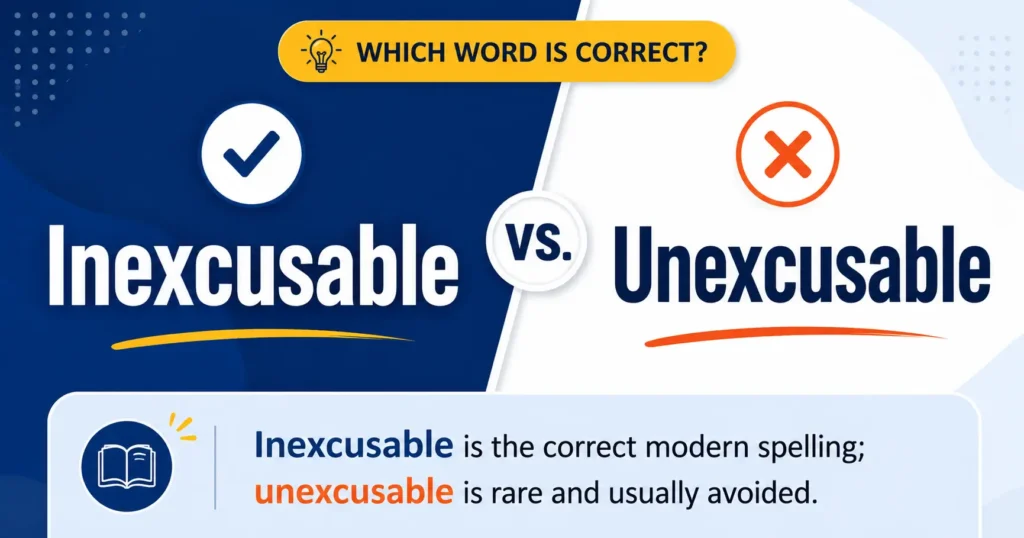
Inexcusable vs. Unexcusable explains which spelling fits modern English and why one form gives readers clearer, more reliable meaning today.
These two words seem to have the same meaning and implied meaning: an act no one can excuse, justify, overlook, or pardon, with no allowance for the offense. Serious behavior may be called unjustifiable behavior, unacceptable behavior, or unforgivable, while a minor mistake may be excusable conduct, forgivable, or simply excusable. This opposite contrast makes the two terms less confusing.
In modern English, inexcusable is the correct, commonly used, accepted spelling, standard form, and preferred word. Unexcusable is a less common variant and alternative, recognized in some records, yet many readers treat it as a misspelling or nonstandard form. In practical editing, careful English spelling, formal word usage, word choice, spelling choice, correctness, clarity, and the usage difference matter in professional writing, academic writing, and everyday writing.
Quick Answer: Inexcusable or Unexcusable?
Inexcusable is the correct and preferred word.
It means impossible to excuse, justify, or defend.
Correct: Ignoring the safety warning was inexcusable.
Avoid: Ignoring the safety warning was unexcusable.
Although unexcusable follows a pattern that seems logical, standard English strongly favors inexcusable. Most editors, teachers, and professional writers would replace unexcusable with inexcusable.
Here is the basic rule:
When you mean “too wrong or serious to excuse,” use inexcusable.
Inexcusable vs. Unexcusable at a Glance
| Feature | Inexcusable | Unexcusable |
| Basic meaning | Impossible to excuse or justify | Intended to mean impossible to excuse |
| Part of speech | Adjective | Adjective |
| Standard in modern English | Yes | Generally no |
| Common in American English | Yes | Extremely rare |
| Suitable for formal writing | Yes | Best avoided |
| Recommended choice | Yes | No |
| Example | The error was inexcusable. | Replace with inexcusable. |
The words may look similar, but they don’t have equal status in modern usage. Inexcusable is established, familiar, and natural. In contrast, unexcusable may distract readers or appear to be a spelling mistake.
What Does Inexcusable Mean?
Inexcusable is an adjective meaning too wrong, serious, careless, or harmful to be excused.
You use it when you believe that no reasonable explanation can justify what happened.
For example:
- Inexcusable behavior
- An inexcusable mistake
- Inexcusable negligence
- An inexcusable delay
- Inexcusable treatment of employees
The word expresses strong disapproval. Therefore, it usually describes more than a small inconvenience or harmless error.
Compare these sentences:
The delay was inconvenient.
This sentence means the delay caused a problem.
The delay was inexcusable.
This version is much stronger. It suggests that the delay was unacceptable and that no reasonable defense exists.
Inexcusable as an Adjective
The word inexcusable is an adjective, which means it describes a noun or gives more information about a subject.
It can appear before a noun:
- That was an inexcusable mistake.
- The company showed inexcusable carelessness.
- Her inexcusable conduct damaged the team’s reputation.
It can also follow a linking verb such as is, was, seems, became, or remains:
- His behavior was inexcusable.
- The lack of preparation seems inexcusable.
- Their repeated dishonesty became inexcusable.
- The failure remains inexcusable.
In each sentence, the adjective describes the behavior, failure, carelessness, or mistake.
Read this also: Comment vs. Coment: Which Spelling Is Correct?
How Strong Is the Word Inexcusable?
Inexcusable is a strong word. It doesn’t simply mean that something was wrong.
Instead, it suggests that the action was so unreasonable, careless, or harmful that no acceptable explanation can defend it.
Consider the difference:
- Unfortunate: The meeting started ten minutes late.
- Unacceptable: The manager repeatedly ignored customer complaints.
- Inexcusable: The company knowingly hid a serious safety risk.
The correct word depends on the seriousness of the situation. Therefore, don’t use inexcusable for every minor annoyance unless you’re being deliberately dramatic or humorous.
Is Unexcusable a Real Word?
The most accurate answer is that unexcusable has been recorded in English, but it is rare and not the normal choice in modern edited writing.
Some older or less common sources may use it as a synonym for inexcusable. However, dictionary recognition does not always mean a word is common, preferred, or suitable in every context.
Modern readers strongly expect inexcusable.
For that reason, avoid unexcusable in:
- Academic papers
- Business communication
- News writing
- Professional reports
- School assignments
- Website content
- Formal complaints
- Job applications
- Edited publications
A reader may understand what unexcusable means. Still, the unusual form can make the sentence look careless.
Why Do People Write Unexcusable?
People often create unexcusable by following a familiar English pattern.
The prefix un- commonly changes a positive adjective into its negative form:
| Positive word | Negative word |
| acceptable | unacceptable |
| fair | unfair |
| certain | uncertain |
| forgivable | unforgivable |
| avoidable | unavoidable |
Because excusable is a real adjective, adding un- may seem natural:
- excusable → unexcusable
The logic is understandable. However, English does not always follow the most predictable pattern.
Standard usage developed around:
- excusable → inexcusable
Therefore, unexcusable may be logically formed, but inexcusable is the established word.
Is Unexcusable Grammatically Wrong?
Calling unexcusable completely imaginary would be inaccurate. The word has appeared in English.
Still, it is better described as:
- Rare
- Nonpreferred
- Unusual
- Often treated as an error
- Unsuitable for most modern formal writing
In practical terms, you should correct it.
Nonpreferred: Her actions were unexcusable.
Standard: Her actions were inexcusable.
The second sentence sounds natural and professional.
Why Is Inexcusable the Standard Form?
The word inexcusable contains three meaningful parts:
- in-: not
- excuse: a reason or justification
- -able: capable of being
Therefore, inexcusable literally means not capable of being excused.
The base word is excuse. From it, English forms several related words:
| Word | Part of speech | Meaning |
| Excuse | Noun | A reason offered to explain a fault |
| Excuse | Verb | To forgive or overlook a fault |
| Excusable | Adjective | Able to be forgiven or justified |
| Inexcusable | Adjective | Unable to be forgiven or justified |
| Inexcusably | Adverb | In a way that cannot be excused |
The negative prefix in- also appears in many common words:
- Inaccurate
- Incomplete
- Indefensible
- Inappropriate
- Inadequate
- Intolerable
In each case, the prefix creates a negative meaning.
Why Negative Prefixes Change Form
English uses several related negative prefixes, including in-, im-, il-, and ir-.
The form often changes to make pronunciation easier:
| Prefix form | Example |
| in- | inaccurate |
| im- | impossible |
| il- | illegal |
| ir- | irregular |
The word inexcusable keeps the form in- because that is the established spelling.
You should not write:
- imexcusable
- ilexcusable
- irexcusable
Only inexcusable is standard.
How to Pronounce Inexcusable
In American English, inexcusable is commonly pronounced:
in-ik-SKYOO-zuh-buhl
The main stress falls on SKYOO.
A simple syllable division is:
in-ex-cus-a-ble
The word has five syllables:
- in
- ex
- cus
- a
- ble
The pronunciation includes a z sound in the middle. Therefore, the stressed part sounds closer to skyooz than skyoos.
This follows the pronunciation of the verb excuse:
- Noun: an excuse often uses an s sound.
- Verb: Please excuse me uses a z sound.
- Adjective: inexcusable also uses the z sound.
How to Use Inexcusable in a Sentence
You can use inexcusable in several common sentence patterns. The word works in formal writing, everyday conversation, workplace communication, and public statements.
However, its strong tone makes context important.
Inexcusable Before a Noun
Place inexcusable before a noun when you want to describe that noun directly.
Examples:
- The accountant made an inexcusable error.
- Cheating was an inexcusable decision.
- The coach criticized the player’s inexcusable conduct.
- The hospital investigated the inexcusable delay.
- The report revealed inexcusable negligence.
In each example, the adjective comes immediately before the noun it describes.
Notice the use of an:
It was an inexcusable mistake.
Use an, not a, because inexcusable begins with a vowel sound.
Inexcusable After a Linking Verb
You can also place inexcusable after a linking verb.
Examples:
- The mistake was inexcusable.
- His response seemed inexcusable.
- The repeated failures became inexcusable.
- Their conduct remains inexcusable.
- Such carelessness is inexcusable.
The adjective describes the subject rather than an immediately following noun.
“It Is Inexcusable to” Structure
Use it is inexcusable to + verb when criticizing an action.
Examples:
- It’s inexcusable to ignore a serious warning.
- It was inexcusable to leave the children unattended.
- It would be inexcusable to publish false information.
- It is inexcusable to treat customers that way.
This structure focuses on the action itself.
“It Is Inexcusable That” Structure
Use it is inexcusable that + clause when commenting on a complete situation.
Examples:
- It’s inexcusable that no one called the customer.
- It was inexcusable that the records were never checked.
- It is inexcusable that employees lacked basic safety equipment.
This form works well when the action involves a clear subject and verb.
Common Prepositions With Inexcusable
No single preposition always follows inexcusable. The correct choice depends on the sentence.
Common patterns include:
- Inexcusable for someone to do something
- Inexcusable in a certain setting
- Inexcusable under certain conditions
- Inexcusable on someone’s part
Examples:
- It was inexcusable for the manager to ignore the complaint.
- That language is inexcusable in a professional setting.
- The delay was inexcusable under the circumstances.
- The dishonesty was inexcusable on his part.
Choose the preposition based on the meaning you need.
Correct and Incorrect Examples
Seeing mistakes beside corrected versions makes the difference easier to remember.
Standard Word Choice
Incorrect or nonpreferred: The company’s actions were unexcusable.
Correct: The company’s actions were inexcusable.
Why: Modern standard English prefers inexcusable.
Adjective Versus Adverb
Incorrect: The supervisor spoke inexcusable to the employee.
Correct: The supervisor spoke inexcusably to the employee.
Why: The sentence describes how the supervisor spoke. Therefore, it needs the adverb inexcusably, not the adjective inexcusable.
Natural Sentence Structure
Awkward: It was inexcusable of the delay.
Correct: The delay was inexcusable.
Correct: It was inexcusable for them to delay the response.
Why: The phrase inexcusable of the delay does not form a natural relationship. Instead, make the delay the subject or identify the person responsible.
Correct Article Choice
Incorrect: It was a inexcusable mistake.
Correct: It was an inexcusable mistake.
Why: Use an before a word that begins with a vowel sound.
Appropriate Strength
Overstated: My coffee arrived two minutes late, which was inexcusable.
More natural: My coffee arrived two minutes late, which was annoying.
Why: The original sentence is grammatically correct, but the word may sound too strong for a minor delay.
Of course, speakers sometimes exaggerate for humor:
Forgetting the snacks on movie night is inexcusable.
Here, the dramatic word choice is playful rather than literal.
Inexcusable, Unexcused, and Without Excuse
These expressions are related, but they are not interchangeable.
| Term | Meaning | Common context | Example |
| Inexcusable | Too wrong or serious to justify | Conduct, mistakes, failures | His behavior was inexcusable. |
| Unexcused | Not officially approved or accepted | School or workplace attendance | She had an unexcused absence. |
| Without excuse | Lacking a valid explanation or defense | Formal or moral judgment | They were without excuse. |
Inexcusable
Inexcusable makes a judgment about the seriousness of an action.
Falsifying the documents was inexcusable.
The sentence means the action cannot reasonably be defended.
Unexcused
Unexcused usually means something was not officially permitted.
The student received an unexcused absence.
The absence may have had a reason. However, the school did not formally accept that reason.
An unexcused absence is not necessarily an inexcusable absence. Those phrases express different ideas.
Without Excuse
Without excuse means that a person lacks a valid justification.
After receiving three warnings, the employee was without excuse.
This phrase can sound formal, moral, or legal depending on the context.
Related Forms of Inexcusable
Understanding related forms helps you choose the correct word for each sentence.
Inexcusably
Inexcusably is the adverb form. It describes how an action happened or adds force to another adjective.
Examples:
- The report was inexcusably late.
- The driver behaved inexcusably.
- The company was inexcusably careless with customer data.
- He spoke inexcusably rudely to the receptionist.
Use inexcusably when the word modifies a verb, adjective, or adverb.
Compare:
- Her behavior was inexcusable.
- She behaved inexcusably.
The first sentence needs an adjective. The second needs an adverb.
Inexcusability and Inexcusableness
Inexcusability and inexcusableness are possible noun forms. However, both are rare and may sound awkward.
Instead of writing:
The inexcusability of the conduct was obvious.
You could write:
The conduct clearly had no justification.
Or:
The seriousness of the conduct was obvious.
Clear rewriting usually sounds more natural than forcing an uncommon noun form.
Excusable
Excusable means capable of being forgiven, overlooked, or justified.
Examples:
- The beginner’s small mistake was excusable.
- Her absence was excusable because of the emergency.
- A minor formatting error may be excusable.
Compare:
The error was excusable because the instructions were unclear.
The error was inexcusable because the employee ignored repeated warnings.
The added prefix completely changes the judgment.
Common Misspellings of Inexcusable
Because inexcusable is a long word, writers often misspell it.
Common errors include:
- Unexcusable
- Inexcusible
- Inexcuseable
- Inexusable
- Inexcusable
- In-excusable
The correct spelling is:
inexcusable
A Simple Spelling Trick
Start with the word excusable:
e-x-c-u-s-a-b-l-e
Then add in-:
in + excusable = inexcusable
Do not remove letters. Also, don’t add a hyphen.
Correct: inexcusable
Incorrect: in-excusable
Another memory trick is to connect it with inexcuse:
Something inexcusable leaves you with no excuse.
The phrase isn’t a spelling rule, but it can help you remember the meaning.
Synonyms for Inexcusable
Several words have meanings close to inexcusable. However, each one carries a slightly different tone.
| Synonym | Main meaning | Best use |
| Unforgivable | Too serious to forgive | Personal betrayal or moral wrongdoing |
| Unjustifiable | Impossible to support with a good reason | Decisions, costs, or policies |
| Indefensible | Impossible to defend | Arguments, conduct, or public positions |
| Unacceptable | Below an acceptable standard | Workplace and general professional use |
| Outrageous | Shockingly unreasonable or offensive | Emotional criticism |
| Unpardonable | Impossible to pardon | Formal or literary writing |
| Intolerable | Too severe to continue accepting | Conditions, pain, or treatment |
| Inexcusable | Impossible to excuse or justify | Strong criticism of conduct or failure |
Inexcusable vs. Unacceptable
These words overlap, but they are not identical.
Unacceptable means that something fails to meet a required standard.
Inexcusable goes further. It suggests that no valid explanation can justify the failure.
Compare:
The formatting errors are unacceptable and must be corrected.
This statement sets a standard and asks for improvement.
Knowingly publishing false data is inexcusable.
This sentence makes a stronger moral or professional judgment.
In workplace communication, unacceptable is often more diplomatic. Meanwhile, inexcusable can sound personal or accusatory.
Inexcusable vs. Unforgivable
Unforgivable often focuses on emotional or moral forgiveness.
Inexcusable focuses on the lack of a valid reason.
Compare:
- Betraying a close friend may feel unforgivable.
- Ignoring a clear safety procedure may be inexcusable.
An action can be inexcusable but eventually forgiven. Therefore, the two words are related but not identical.
Antonyms of Inexcusable
Useful opposites include:
- Excusable
- Forgivable
- Understandable
- Justifiable
- Defensible
- Acceptable
- Reasonable
- Pardonable
However, these aren’t perfect opposites in every sentence.
For example:
Her reaction was understandable.
This means people can see why she reacted that way. It does not necessarily mean the reaction was completely correct.
Similarly:
The error was excusable.
This suggests the mistake can be forgiven, perhaps because the circumstances explain it.
Formal, Professional, and Casual Usage
Inexcusable is correct in both formal and informal English. Still, the tone changes depending on the setting.
Formal and Academic Writing
In formal writing, use the word when evidence supports a strong judgment.
Example:
The researchers described the failure to disclose the conflict of interest as inexcusable.
The word fits because the sentence refers to a serious ethical failure.
However, academic writing often favors more precise language. Instead of simply calling something inexcusable, explain why:
The failure was inexcusable because the authors had received three written requests to correct the data.
The added reason strengthens the claim.
Professional Communication
Be careful when using inexcusable in emails, evaluations, or complaints. It can sound harsh.
Direct version:
The failure to notify the client was inexcusable.
More diplomatic version:
The failure to notify the client was a serious communication breakdown that must not happen again.
Both versions express concern. However, the second focuses more on the problem and solution.
Use the stronger word when the seriousness of the conduct truly justifies it.
Casual Conversation
In everyday conversation, inexcusable may be serious or humorous.
Serious:
The way he treated the waiter was inexcusable.
Humorous:
You watched the season finale without me? That’s inexcusable.
Context and tone tell the listener whether the speaker is being literal.
Real-Life Usage Examples
The following examples show how the word works in common American settings.
At School
Copying another student’s essay was inexcusable.
The word expresses a strong judgment about academic dishonesty.
At Work
Failing to back up the company’s financial records was inexcusable.
The action involved a clear professional responsibility.
In Customer Service
The six-week delay without any explanation was inexcusable.
The sentence criticizes both the delay and the lack of communication.
In an Email
While mistakes happen, ignoring three follow-up messages was inexcusable.
The contrast makes the criticism more precise. It recognizes that ordinary mistakes are possible but identifies repeated neglect as the real problem.
On Social Media
Disagreeing is normal. Harassing someone over a different opinion is inexcusable.
The word marks a clear boundary between acceptable disagreement and harmful conduct.
In Parenting
Forgetting a chore is understandable, but deliberately lying about it is inexcusable.
This example separates a minor mistake from intentional dishonesty.
Mini Case Studies: Choosing the Right Word
Case Study: A Late Assignment
A student submits an assignment one hour late because the school’s website stopped working.
Calling the delay inexcusable may be unfair because the student had a reasonable explanation.
Better wording:
The delay was understandable because of the technical problem.
However, suppose the student ignored the deadline for three weeks and offered no explanation.
Then this sentence may fit:
The repeated failure to submit the work was inexcusable.
The key issue is whether a reasonable justification exists.
Case Study: A Workplace Error
An employee enters one incorrect number during their first week.
The mistake may be excusable, especially if training was incomplete.
Now imagine that an experienced manager knowingly approves false financial information.
That conduct may be inexcusable because the person understood the rules and ignored them.
Case Study: A Customer Complaint
A restaurant delivers the wrong side dish during a busy evening.
Calling the mistake inexcusable would probably be excessive.
However, refusing to help a customer with a severe allergy may justify stronger language:
Ignoring the customer’s allergy warning was inexcusable.
The word should match the seriousness of the risk.
Common Mistakes to Avoid
Using Unexcusable Because It Sounds Logical
English patterns can be misleading. Although un- + excusable seems reasonable, modern standard usage prefers inexcusable.
Confusing Inexcusable With Unexcused
An unexcused absence lacks official approval. An inexcusable action lacks a valid moral or practical defense.
Using the Adjective Instead of the Adverb
Use inexcusable to describe a noun.
Use inexcusably to describe an action or another quality.
The behavior was inexcusable.
He behaved inexcusably.
Overusing the Word
Strong words lose impact when used for minor problems.
Instead of calling every error inexcusable, consider:
- Careless
- Disappointing
- Inconvenient
- Unprofessional
- Unacceptable
- Avoidable
Criticizing a Person Instead of the Behavior
Usually, it is clearer to describe the action rather than label the person.
Less natural:
He is inexcusable.
Clearer:
His behavior is inexcusable.
The second sentence identifies exactly what deserves criticism.
Memory Tricks for Inexcusable
Use these simple reminders:
- Inexcusable begins with “in,” not “un.”
- Something inexcusable offers no valid excuse.
- Start with excusable, then add in-.
- Use inexcusably when describing how someone acts.
- Use unexcused for attendance or official permission.
A compact reminder is:
No excuse = inexcusable. No permission = unexcused.
Grammar Tips for Using Inexcusable Correctly
Keep these rules in mind:
- Use inexcusable as an adjective.
- Use inexcusably as an adverb.
- Write an inexcusable, not a inexcusable.
- Don’t add a hyphen.
- Prefer inexcusable over unexcusable.
- Describe behavior, conduct, errors, failures, or decisions.
- Use the word only when the situation deserves strong criticism.
- Support serious judgments with a clear reason in professional or academic writing.
Frequently Asked Questions
Q1.Is unexcusable a correct word?
Unexcusable has been recorded in English, but it is rare and not preferred in modern usage. In most situations, you should use inexcusable instead.
Q2.What does inexcusable mean?
Inexcusable means impossible to excuse, forgive, defend, or justify. It usually describes serious mistakes, harmful actions, or unacceptable behavior.
Q3.Is inexcusable an adjective?
Yes. Inexcusable is an adjective because it describes a noun or subject.
Example: “The manager made an inexcusable mistake.”
Q4.What is the difference between inexcusable and unexcused?
Inexcusable means an action cannot be justified. Unexcused means something, such as an absence, was not officially approved.
Q5.How do you use inexcusable in a sentence?
You can write, “Ignoring the safety warning was inexcusable.” The word shows that the action was too serious to defend.
Conclusion
The difference between Inexcusable vs. Unexcusable is mainly about standard usage. Inexcusable is the correct, widely accepted, and preferred word in modern American English. It describes an action, mistake, or type of behavior that cannot be reasonably excused, defended, or justified.
Although unexcusable has appeared in older or rare usage, most readers view it as unusual or incorrect. Therefore, use inexcusable in academic work, professional emails, articles, reports, and everyday writing. Also, use inexcusably when you need an adverb, as in, “The report was inexcusably late.”
