
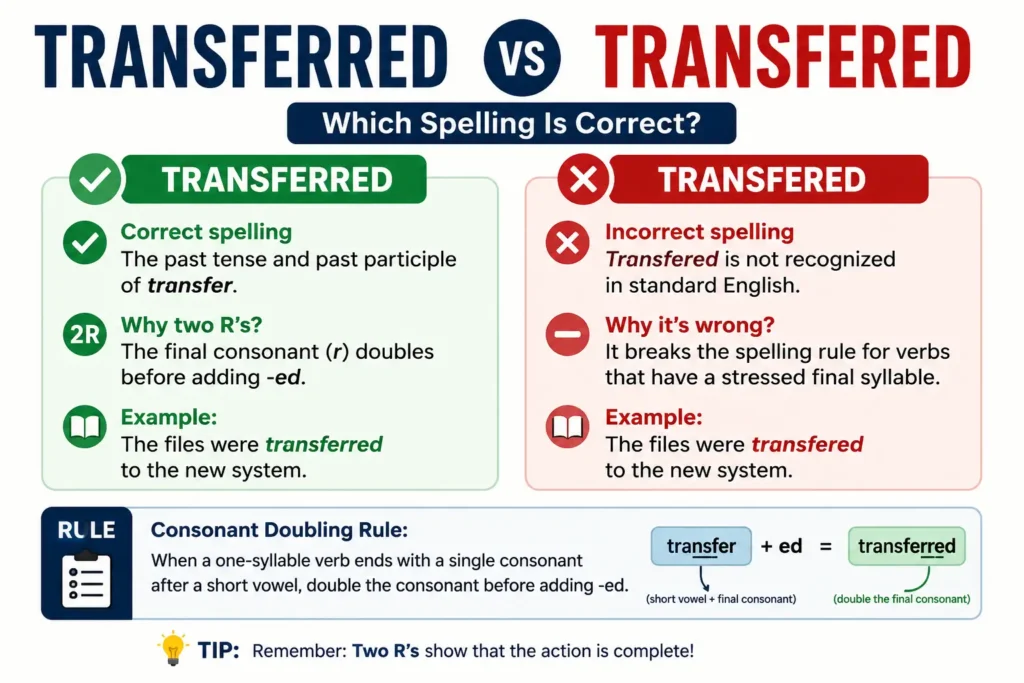
Transferred vs transfered is easy to settle: transferred is the correct spelling, while transfered is an unrecognized spelling in standard English.
The short answer follows a clear spelling rule: the base verb transfer forms its past tense and past participle with suffix -ed. Because the final syllable carries stress and ends in a final consonant, consonant doubling creates a double consonant and two r’s. This spelling pattern, part of English spelling rules, explains the spelling difference, suffix addition, suffixes, word formation, verb forms, word form, related forms, and the full spelling explanation.
In American English and British English, the same pronunciation can mislead native speakers, English learners, students, and professionals. A spelling checker may show a red spelling underline in a professional email, bank form, work report, or document. For better overall writing accuracy, avoid guessing: use sentence examples, practical tips, and one memorable trick—transfer gains another r before -ed. This builds clarity and confidence.
Quick Answer: Is It Transferred or Transfered?
Use transferred with two r’s.
Correct: The bank transferred the money this morning.
Incorrect: The bank transfered the money this morning.
The final r in transfer doubles before the ending -ed. Therefore, the correct formula is:
transfer + r + ed = transferred
The spelling transfered isn’t an accepted variation. It’s incorrect in formal, informal, academic, and professional writing.
Read this also: Unaffected vs Uneffected: Which Spelling Is Correct?
Transferred vs. Transfered at a Glance
| Word | Correct? | Meaning | Example |
| Transferred | Yes | Moved, sent, reassigned, or passed to another place or person | She transferred the files to a new folder. |
| Transfered | No | Misspelling of transferred | She transfered the files to a new folder. |
Both US English and UK English use transferred. This word doesn’t have separate regional spellings.
Why Does Transferred Have Two R’s?
Transferred has two r’s because the final consonant in transfer doubles before -ed.
This change follows a spelling pattern used with many verbs. However, three conditions usually matter:
- The word ends in a single consonant.
- A single vowel comes before that consonant.
- The final syllable receives the main stress.
The verb transfer ends in -fer. The final syllable is stressed when you use the word as a verb:
trans-FER
Because the stressed syllable ends in a vowel followed by one consonant, the final r doubles before -ed.
- transfer → transferred
- transfer → transferring
The second r protects the spelling pattern when the suffix is added.
How the Consonant-Doubling Rule Works
The consonant-doubling rule often applies when a verb ends in a consonant-vowel-consonant pattern. Grammar books sometimes call this a CVC pattern.
For example:
- admit
- prefer
- occur
- transfer
Each word has a stressed final syllable. As a result, the last consonant doubles before endings such as -ed and -ing.
| Base verb | Past tense | Present participle |
| admit | admitted | admitting |
| occur | occurred | occurring |
| prefer | preferred | preferring |
| refer | referred | referring |
| transfer | transferred | transferring |
The pattern is useful, but you shouldn’t apply it blindly. Word stress plays an important role.
Why Word Stress Matters
A final consonant usually doubles when the last syllable carries the stress.
Compare prefer and offer:
- pre-FER → preferred
- OF-fer → offered
The final syllable in prefer is stressed. Therefore, the final r doubles.
In contrast, the first syllable in offer is stressed. The last syllable is weak, so the final r doesn’t double.
Here are more comparisons:
| Final syllable stressed | Correct form | Final syllable not stressed | Correct form |
| prefer | preferred | offer | offered |
| occur | occurred | visit | visited |
| admit | admitted | open | opened |
| refer | referred | happen | happened |
This stress rule explains why transferred needs two r’s. The verb is pronounced trans-FER, not TRANS-fer.
The Correct Spelling Formula
You can build the word in three simple steps:
- Start with transfer.
- Double the final r.
- Add -ed.
The result is transferred.
Transfer + r + ed = transferred
Simply adding -ed creates transfered, which breaks the standard spelling pattern.
However, consonant doubling doesn’t happen with every suffix. Related forms can follow different conventions, as you’ll see with transferable.
What Does Transferred Mean?
Transferred means moved, sent, passed, or reassigned from one person, place, position, system, or account to another.
The exact meaning depends on the context.
You can transfer:
- Money between bank accounts
- Files between computers
- Employees between offices
- Students between schools
- Patients between hospitals
- Calls between departments
- Property between owners
- Responsibilities between team members
- Points between loyalty programs
- Data between devices
In each case, something leaves one position or holder and goes to another.
Transferred as the Simple Past Tense
Use transferred as the simple past tense when the action happened and finished in the past.
Maya transferred the payment yesterday.
The action is complete. Maya moved the payment at a specific past time.
More examples include:
- The company transferred Daniel to its Chicago office.
- I transferred the photos to my laptop last night.
- The school transferred the student to another class.
- Our receptionist transferred the call to customer support.
- The owner transferred the property to a family trust.
In these sentences, transferred follows the person or organization performing the action.
Transferred as a Past Participle
Transferred also works as a past participle. In that role, it appears with helping verbs such as has, have, and had.
The funds have transferred successfully.
This sentence describes a completed action with a connection to the present.
However, speakers often use the passive form when discussing money or data:
The funds have been transferred successfully.
Other examples include:
- She has transferred to a different university.
- We have transferred all customer records.
- They had transferred the balance before the deadline.
- The IT team has transferred the website to a new server.
The helping verb shows the tense. Meanwhile, transferred remains unchanged.
Transferred in Passive Sentences
The passive voice focuses on the person or thing receiving the action.
The patient was transferred to another hospital.
This sentence emphasizes the patient, not the person who arranged the move.
Common passive structures include:
- was transferred
- were transferred
- has been transferred
- have been transferred
- had been transferred
- will be transferred
Examples:
- Your call was transferred to the billing department.
- The files were transferred securely.
- Ownership has been transferred to the buyer.
- The employees will be transferred next month.
Passive sentences are common in banking, healthcare, technology, and workplace communication. In those settings, the result often matters more than the person performing the action.
Transferred as an Adjective
Sometimes transferred works like an adjective. More precisely, it’s a participle describing a noun.
The transferred employee begins work on Monday.
Here, transferred describes the employee.
Other examples include:
- transferred funds
- transferred data
- transferred ownership
- transferred assets
- transferred students
Although this use is grammatically correct, some phrases may sound stiff. For clearer writing, you can often rewrite the sentence.
The transferred data was corrupted.
The data that we transferred was corrupted.
The second version may sound more natural because it clearly shows the action.
How to Use Transferred in a Sentence
The verb transfer appears in several common sentence patterns. Choosing the right structure makes your meaning clearer.
Transfer Something to Someone or Somewhere
Use to when you name the destination or recipient.
- I transferred the money to my savings account.
- She transferred the call to her manager.
- We transferred the documents to the new system.
The word after to receives the person or thing.
Transfer Something From One Place to Another
Use from and to when both the starting point and destination matter.
- He transferred the funds from checking to savings.
- The nurse transferred the patient from the clinic to the hospital.
- I transferred the photos from my phone to my computer.
This pattern gives the reader a complete movement path.
Transfer Someone to a Department or Location
People can also be reassigned.
- The company transferred her to the legal department.
- His manager transferred him to the Denver office.
- The school transferred the student to another classroom.
In these examples, the person changes roles, locations, or groups.
Be Transferred To
Use be transferred to in passive sentences.
- I was transferred to customer service.
- The patient was transferred to intensive care.
- The case was transferred to another judge.
This structure is especially common when the person who made the decision isn’t important or isn’t known.
Have Something Transferred
Use have something transferred when you arrange for another person or system to move it.
- I had the balance transferred to my new account.
- She had her medical records transferred to the specialist.
- We had the domain transferred to another provider.
The subject causes the transfer but may not perform it personally.
Correct Examples of Transferred
The following sentences show transferred in everyday American English.
Workplace Example
The director transferred Leah to the marketing team.
Transferred is the simple past tense. The director completed the action, and Leah moved to another team.
Banking Example
I transferred $300 from checking to savings.
The sentence clearly identifies the amount, starting account, and destination account.
Technology Example
The software transferred the data automatically.
The software performed a completed action. Therefore, the simple past tense is correct.
Education Example
Marcus has transferred to a community college.
The phrase has transferred uses the present perfect tense. His move happened before now and remains relevant.
Healthcare Example
The patient was transferred to a larger medical center.
The passive form emphasizes the patient and destination. It doesn’t identify who ordered or completed the transfer.
Customer Service Example
Please hold while your call is transferred.
The present passive form describes an action happening as the speaker talks.
Incorrect Examples and Corrections
The most common mistake is leaving out the second r.
Incorrect: The payment was transfered yesterday.
Correct: The payment was transferred yesterday.
The final r must double before -ed.
Incorrect: She transfered to another college.
Correct: She transferred to another college.
Again, the verb has final-syllable stress. Therefore, you need two r’s.
Incorrect: We have transfered your account.
Correct: We have transferred your account.
The spelling doesn’t change in the past participle form. It remains transferred.
Incorrect: The files are being transfered.
Correct: The files are being transferred.
Although the sentence includes being, it still needs the past participle transferred.
Other Common Errors With Transfer
Writers sometimes avoid transfered but make a different mistake.
Transfering Instead of Transferring
Incorrect: The system is transfering the files.
Correct: The system is transferring the files.
The final r doubles before -ing, just as it does before -ed.
Transferrred With Three R’s
Incorrect: The money was transferrred.
Correct: The money was transferred.
The base word already ends in one r. You add one more, not two more.
Transferred Instead of Transfers
Incorrect: She transferred money every Friday.
Correct: She transfers money every Friday.
The first sentence can be correct when discussing a past routine. However, a current weekly habit needs the present-tense form transfers.
Transferred Instead of Transferring
Incorrect: We are transferred the records now.
Correct: We are transferring the records now.
After are, use transferring for an active ongoing action.
The passive version would be:
The records are being transferred now.
Transfer Verb Forms
Understanding the full verb family can prevent several spelling and tense errors.
| Form | Spelling | Example |
| Base form | transfer | Please transfer the call. |
| Third-person singular | transfers | She transfers the reports every Friday. |
| Simple past | transferred | She transferred the report yesterday. |
| Past participle | transferred | She has transferred the report. |
| Present participle | transferring | She is transferring the report now. |
| Gerund | transferring | Transferring files may take several minutes. |
The two forms that double the r are transferred and transferring.
Transferred vs. Transferring
Although both words come from transfer, they serve different purposes.
Transferred usually describes a completed action:
We transferred the data last night.
Transferring usually describes an action in progress:
We are transferring the data now.
It can also act as a noun-like gerund:
Transferring large files takes time.
| Word | Main use | Example |
| Transferred | Completed action or past participle | The money was transferred. |
| Transferring | Ongoing action or gerund | We are transferring the money. |
A simple time test can help. Use transferred for something completed. Use transferring for something happening or treated as an activity.
Why Transferable Has Only One R
The correct spelling is transferable, not transferrable in most modern standard usage.
This difference often confuses writers because transferred and transferring use two r’s.
| Related word | Correct spelling |
| Past tense | transferred |
| Present participle | transferring |
| Adjective | transferable |
| Noun | transfer |
| Person receiving property | transferee |
| Person making a legal transfer | transferor |
The endings -ed and -ing trigger the usual consonant-doubling pattern in transfer. However, transferable follows its established dictionary spelling with one final r before -able.
Therefore, don’t assume every related suffix follows the same rule. Treat transferable as a standard related form that you should learn separately.
Remember: Funds are transferred, a transaction is transferring, and a ticket may be transferable.
Is Transferred American or British English?
Both American English and British English spell the word transferred with two r’s.
| Variety of English | Correct spelling |
| American English | transferred |
| British English | transferred |
| Canadian English | transferred |
| Australian English | transferred |
There’s no regional difference because the final syllable of the verb transfer receives the stress.
This consistency differs from words such as traveled and travelled:
- American English: traveled
- British English: travelled
However, transfered isn’t the American version of transferred. It’s simply incorrect.
How to Pronounce Transferred
In American English, transferred sounds like:
trans-FERD
The main stress falls on FERD. The ending -ed doesn’t create an extra syllable.
You don’t normally pronounce it as:
trans-FER-ed
Instead, transferred usually has two syllables:
- trans
- ferred
The doubled r also doesn’t create two separate r sounds. It’s a spelling feature, not an instruction to repeat the sound.
Why People Write Transfered
The misspelling transfered usually comes from a reasonable but incomplete assumption.
Many regular verbs form the past tense by adding -ed:
- work → worked
- clean → cleaned
- open → opened
A writer may apply that simple pattern to transfer:
- transfer + ed → transfered
However, that approach ignores consonant doubling and word stress.
Other causes include:
- Typing too quickly
- Missing the error during proofreading
- Relying too heavily on autocorrect
- Confusing transferred with transferable
- Assuming the one-r form is an American spelling
- Learning English from speech without seeing the written form
The best solution isn’t merely memorizing one word. Instead, learn why the r doubles.
An Easy Way to Remember Transferred
A strong memory trick connects transferred with transferring.
Both forms describe movement, and both use a double r:
- transferred
- transferring
You can also use this short reminder:
When a transfer has occurred, remember the extra r.
Another option is to picture the two r’s as two locations:
One r for where it started, and one r for where it went.
That isn’t the formal grammar rule. However, it’s an effective spelling reminder.
Similar Words That Double the Final Consonant
Several verbs follow the same basic pattern as transfer.
| Base verb | Past tense | Present participle |
| admit | admitted | admitting |
| begin | began | beginning |
| commit | committed | committing |
| occur | occurred | occurring |
| permit | permitted | permitting |
| prefer | preferred | preferring |
| refer | referred | referring |
| regret | regretted | regretting |
In these examples, the final syllable receives stress before the suffix is added.
By contrast, these verbs don’t double the final consonant:
| Base verb | Past tense | Reason |
| offer | offered | Stress falls on the first syllable |
| open | opened | Stress falls on the first syllable |
| visit | visited | Stress falls on the first syllable |
| happen | happened | Stress falls on the first syllable |
| listen | listened | Stress falls on the first syllable |
These comparisons show why pronunciation and stress matter.
Useful Prepositions With Transferred
Choosing the correct spelling is only part of the task. You also need the right preposition.
Transferred To
Use to for a destination, recipient, group, or position.
- The money was transferred to my account.
- She was transferred to another department.
- Your call has been transferred to an agent.
Transferred From
Use from for the starting point.
- The data was transferred from an older computer.
- He transferred from a private college.
- The funds were transferred from the business account.
Transferred Between
Use between when something moves across two known places, systems, or parties.
- Files can be transferred between devices.
- The balance was transferred between two accounts.
- Employees may be transferred between regional offices.
Transferred Into
Use into when emphasizing movement inside a system, account, file, or category.
- The data was transferred into the new database.
- The money was transferred into a trust.
- Her credits were transferred into the degree program.
Transferred Out Of
Use out of when emphasizing removal from the original place.
- He was transferred out of the department.
- The patient was transferred out of intensive care.
- Funds were transferred out of the account.
Transferred in Real-Life Contexts
The meaning of transferred changes slightly across industries.
| Context | What is moved? | Example |
| Banking | Money or account balances | The funds were transferred electronically. |
| Employment | Employees or responsibilities | She transferred to the Seattle office. |
| Education | Students or academic credits | His credits transferred successfully. |
| Technology | Files, data, or domains | We transferred the website to a new server. |
| Healthcare | Patients or medical records | The patient was transferred for specialist care. |
| Customer service | Phone calls or cases | The agent transferred my call. |
| Law | Rights, property, or ownership | Ownership was transferred to the buyer. |
| Transportation | Passengers or cargo | The cargo was transferred to another truck. |
The central idea remains the same: something moves from one place, holder, or condition to another.
Illustrative Case Study: A Costly Email Error
Consider an employee who writes this sentence in a payroll email:
Your salary was transfered to the new account.
The recipient can still understand the message. However, the misspelling makes the email look careless, especially because it concerns money.
A stronger version is:
Your salary was transferred to the new account on Friday.
The corrected sentence does more than fix the spelling. It also adds a useful date, which makes the message clearer and more professional.
This example highlights an important point. A spelling mistake may not destroy the meaning, but it can weaken trust. That matters in financial, legal, academic, and workplace communication.
Synonyms for Transferred
The best synonym depends on what moved and how it moved.
| Synonym | Best used for | Example |
| moved | General physical or digital movement | We moved the files. |
| relocated | People, offices, or equipment | The company relocated the team. |
| reassigned | Jobs, duties, or cases | The manager reassigned the project. |
| forwarded | Emails, calls, or documents | She forwarded the message. |
| transmitted | Signals, information, or data | The device transmitted the results. |
| deposited | Money placed into an account | The employer deposited the payment. |
| conveyed | Information, rights, or meaning | The agreement conveyed ownership. |
| delivered | Items, messages, or files | The courier delivered the package. |
| shifted | Positions, resources, or attention | They shifted funds to another project. |
These words aren’t always interchangeable.
For example, deposited describes placing money into an account. However, transferred usually suggests movement from one account or owner to another.
Likewise, reassigned works well for employees or duties. It doesn’t usually describe data or money.
Grammar Tips for Clearer Writing
Name What Was Transferred
Avoid vague sentences when the object matters.
Vague: It was transferred yesterday.
Clear: The payment was transferred yesterday.
The second version tells the reader what moved.
Include the Destination When Needed
A transfer often raises an obvious question: Where did it go?
The records were transferred.
This sentence is correct but incomplete in many professional contexts.
The records were transferred to the compliance department.
The destination makes the message useful.
Use Active Voice When the Actor Matters
Passive: The request was transferred to another team.
Active: Customer support transferred the request to another team.
The active version identifies who performed the action.
However, passive voice isn’t always wrong. Use it when the result matters more than the actor.
Check the Tense
Time words can help you choose the correct form.
- Yesterday, we transferred the data.
- Right now, we’re transferring the data.
- Every week, the system transfers the data.
- By noon, we’ll have transferred the data.
Quick Practice: Transferred or Transfered?
Choose the correct spelling in each sentence.
- The bank transferred / transfered the payment.
- My supervisor transferred / transfered me to another team.
- The files were transferred / transfered successfully.
- She has transferred / transfered to a new school.
- Ownership was transferred / transfered last month.
The correct answer is transferred in every sentence.
Now correct these related errors:
- We are transfering the customer data.
- He transferrred the call to billing.
- The account has been transfered.
- She is transferred the files right now.
Answers
- We are transferring the customer data.
- He transferred the call to billing.
- The account has been transferred.
- She is transferring the files right now.
The final sentence needs transferring because it describes an active action in progress.
See must: Encorporate vs Incorporate: Which Spelling Is Correct?
Frequently Asked Questions
Is Transfered Ever Correct?
No. Transfered is not correct in standard American English or British English. The correct past-tense and past-participle form is always transferred.
Correct: The money was transferred yesterday.
Incorrect: The money was transfered yesterday.
Why Does Transferred Have Two R’s?
Transferred has two r’s because the final syllable of transfer is stressed. When -ed is added, the final r doubles.
The pattern is:
transfer + r + ed = transferred
The same rule applies to transferring.
What Is the Correct Past Tense of Transfer?
The correct past tense of transfer is transferred.
She transferred to another school last year.
The past participle is also transferred:
She has transferred to another school.
Is Transferred Spelled the Same in American and British English?
Yes. Both American English and British English use transferred with two r’s. Unlike words such as traveled and travelled, this word has no regional spelling difference.
What Is the Difference Between Transferred and Transferring?
Transferred describes a completed action:
We transferred the files yesterday.
Transferring describes an action that is happening now or an activity in general:
We are transferring the files now.
Both words double the final r.
Conclusion
The choice between transferred vs transfered is straightforward. Transferred is the only correct spelling, while transfered is always a spelling error.
The final r doubles because transfer ends in a stressed syllable. Therefore, the correct related forms are transferred and transferring. However, the adjective transferable normally uses one r.
Remember this simple pattern:
transfer → transferred → transferring
Using the right spelling will improve your writing accuracy, clarity, and professional communication in emails, documents, academic work, banking, and everyday English.
