
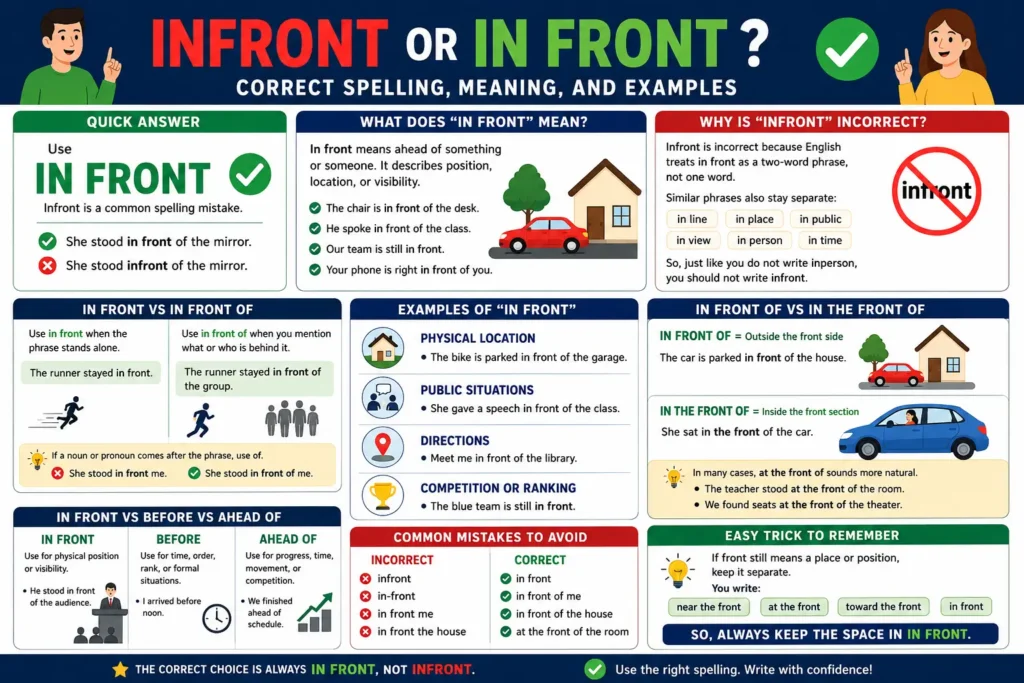
Many writers feel confused about infront or in front because both forms look similar when typed quickly. However, the correct spelling is in front as two separate words, while infront is a common misspelling.
This phrase is used to show position, location, or something placed ahead of another person, object, or place. For example, “The car is in front of the house” clearly explains where the car is. Understanding the difference improves English grammar, spelling accuracy, and overall writing clarity.
It also helps students, bloggers, professionals, and English learners avoid a small but noticeable grammar mistake. In standard English, including both American and British English, in front is always the correct form. This guide explains the meaning, usage, examples, and common mistakes so you can use the phrase confidently in daily writing. .
Quick Answer: Use “In Front”
The correct form is in front.
Infront is a common spelling mistake. It may appear in casual typing, but it is not accepted in formal, professional, or academic writing.
Correct:
- She stood in front of the mirror.
Incorrect:
- She stood infront of the mirror.
What Does “In Front” Mean?
In front means ahead of something or someone. It describes position, location, or visibility.
Examples:
- The chair is in front of the desk.
- He spoke in front of the class.
- Our team is still in front.
- Your phone is right in front of you.
Most of the time, in front refers to physical position. It can also describe public visibility, competition, or priority.
Read this also: Smooth vs Smoothe: Correct Spelling, Meaning, and Easy Examples
Why Is “Infront” Incorrect?
Infront is incorrect because English treats in front as a two-word phrase, not one word.
The word in shows position. The word front means the forward side of something. Together, they form a phrase that shows where something is.
Similar phrases also stay separate:
- in line
- in place
- in public
- in view
- in person
So, just like you do not write inperson, you should not write infront.
In Front vs In Front Of
Use in front when the phrase stands alone.
Example:
- The runner stayed in front.
Use in front of when you mention the person, place, or thing behind it.
Example:
- The runner stayed in front of the group.
More examples:
- She stood in front.
- She stood in front of the door.
- He sat in front.
- He sat in front of me.
If a noun or pronoun comes after the phrase, use of.
Incorrect:
- She stood in front me.
Correct:
- She stood in front of me.
Correct Examples of “In Front”
Here are natural examples of in front in everyday English.
Physical Location
- The bike is parked in front of the garage.
- A small table sits in front of the sofa.
- The cat slept in front of the window.
- A tree grows in front of our house.
Public Situations
- She gave a speech in front of the class.
- He apologized in front of everyone.
- Don’t argue in front of customers.
- The singer performed in front of a large crowd.
Directions
- Meet me in front of the library.
- Park in front of the main gate.
- Wait in front of the ticket counter.
- The bus stop is in front of the mall.
Competition or Ranking
- The blue team is still in front.
- She stayed in front during the race.
- Our company finished in front of its competitors.
- He remained in front until the final round.
Common Incorrect Examples
Incorrect:
- She stood infront of the mirror.
- He parked infront of the school.
- The dog slept infront of the sofa.
- They waited infront of the office.
Correct:
- She stood in front of the mirror.
- He parked in front of the school.
- The dog slept in front of the sofa.
- They waited in front of the office.
The fix is always the same: add a space.
In Front Of vs In the Front Of
These phrases look similar, but they can mean different things.
Use in front of when something is ahead of or outside the front side of another thing.
Example:
- The car is parked in front of the house.
This usually means the car is outside the house, near the front side.
Use in the front of when something is inside the front section of a place or object.
Example:
- She sat in the front of the car.
This means she sat inside the car, in the front section.
In many cases, at the front of sounds more natural.
Examples:
- The teacher stood at the front of the room.
- We found seats at the front of the theater.
In Front vs Before
Before and in front are sometimes similar, but they are not always the same.
Use before for time, order, rank, or formal situations.
Examples:
- I arrived before noon.
- Her name comes before mine on the list.
- He appeared before the judge.
Use in front for physical position or visibility.
Examples:
- I stood in front of the door.
- Her bag was in front of mine.
- He spoke in front of the judge.
In Front vs Ahead Of
Use ahead of for progress, time, movement, or competition.
Examples:
- We finished ahead of schedule.
- She is ahead of her classmates.
- The company is ahead of its rivals.
Use in front of for physical position or visibility.
Examples:
- The table is in front of the sofa.
- He stood in front of the audience.
- The sign is in front of the building.
Both phrases can work in some cases, but in front of is usually better for location.
Is “Infront” Correct in American or British English?

No. Infront is not correct in American English or British English.
Both forms use the same spelling:
- American English: in front
- British English: in front
So, do not treat infront as a regional spelling. It is simply a misspelling.
Why Do People Write “Infront”?
People often write infront because the phrase sounds like one word when spoken quickly. English also has words like inside, into, and outside, which can make the mistake feel natural.
However, in front has not become a standard compound word. It should stay as two words.
Read this also: Shined vs Shone: Difference, Meaning, and Correct Usage
Common Mistakes to Avoid
Avoid these forms:
- infront
- in-front
- in front me
- in front the house
Use these instead:
- in front
- in front of me
- in front of the house
- at the front of the room
Easy Trick to Remember
Here is a simple trick:
If front still means a place or position, keep it separate.
You write:
- near the front
- at the front
- toward the front
- in front
So, always keep the space in in front.
FAQs About Infront or In Front
The correct spelling is in front as two words.
Infront is incorrect in standard English.
No, infront is not a standard English word.
It is a common misspelling of in front.
Use in front of when you mention what something is ahead of.
Example: She stood in front of the mirror.
No, in-front with a hyphen is incorrect.
Always write in front as two separate words.
Yes, both American and British English use in front.
There is no spelling difference.
Conclusion
The correct choice is always in front, not infront. This two-word phrase is used to describe position, location, direction, or something placed ahead of another thing. Whether you are writing an email, school assignment, blog post, or professional message, using the correct spelling improves grammar accuracy, spelling accuracy, and writing clarity. Remember that in front of is used when you mention the person, place, or object behind it, such as “in front of me” or “in front of the house.” Avoid incorrect forms like infront, in-front, and “in front me.” The rule is simple: keep the space between the words. Once you remember that front stays separate, this common English mistake becomes easy to avoid.

3 thoughts on “Infront or In Front: Correct Spelling, Meaning, and Examples”