
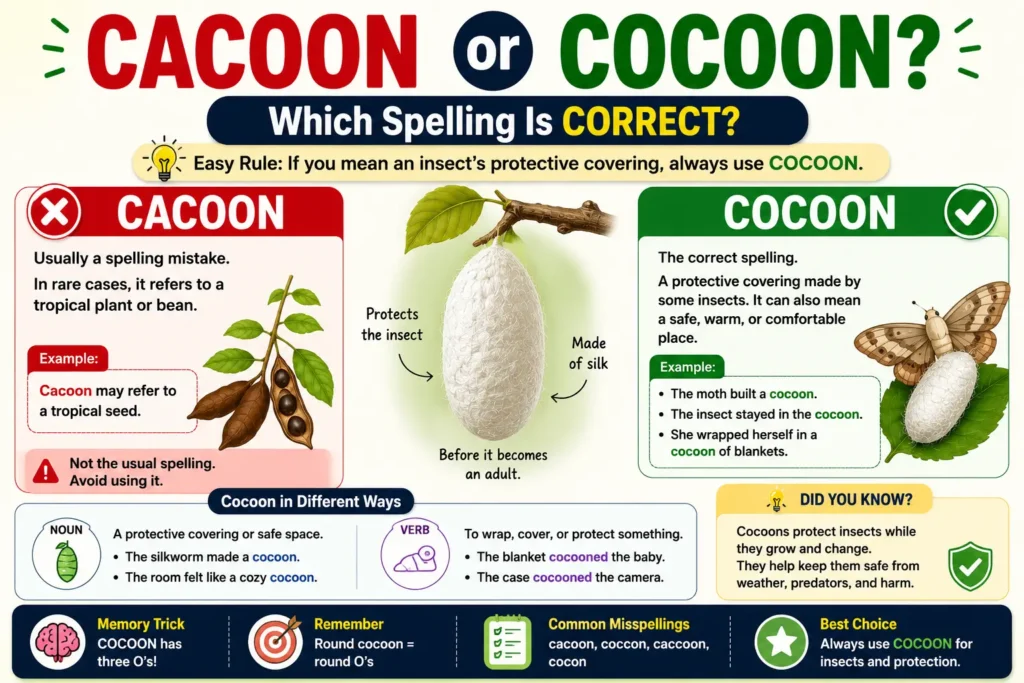
Have you ever wondered whether cacoon or cocoon is the correct spelling? Many people get confused because both words look similar. However, only one spelling is correct in everyday English. If you are searching for the correct spelling, learning English, or trying to avoid common spelling mistakes, this guide will help you quickly understand the difference.
The word cocoon is commonly used to describe the protective covering made by certain insects before they become adults. On the other hand, cacoon is usually a misspelling that appears because of typing errors or confusion. Knowing the correct cocoon spelling can improve your writing and help you communicate more clearly.
In this article, you will learn the difference between cacoon or cocoon, understand the cocoon meaning, see simple examples, discover useful memory tricks, and avoid one of the most common English spelling mistakes. By the end, you will know exactly which spelling to use and why.
Quick Answer: Cocoon or Cacoon?
Here is the simple rule:
- ✅ Cocoon — the correct word for an insect’s covering or a safe space
- ⚠️ Cacoon — almost always a spelling mistake
| Word | Correct? | Meaning |
|---|---|---|
| Cocoon | ✅ Yes | A protective covering |
| Cacoon | ⚠️ Rare | A rare tropical plant |
The safest rule: if you mean the silky case around an insect, always write cocoon.
Read this also: Someday vs Some Day: Meaning, Difference, Examples, and Easy Rules
What Does Cocoon Mean?
A cocoon is a protective case. In science, it is the silky case that some insects make before they grow into adults.
Many moth babies, called larvae, spin cocoons. The cocoon keeps the insect safe while its body changes inside.
But cocoon is not only a science word. People use it every day too:
- A warm bed can feel like a cocoon.
- A quiet room can become a cocoon after a busy day.
- Soft packaging can cocoon a fragile gift.
In every example, the idea stays the same. A cocoon protects something from the outside world.
Cocoon as a Naming Word (Noun)
Most people first learn cocoon as a naming word.
Here are some simple examples:
- “The moth came out of its cocoon.”
- “The silkworm made a silk cocoon.”
- “She curled up in a cocoon of blankets.”
The first two examples are about science. The third one is about comfort. But they all share one idea — protection.
Cocoon as an Action Word (Verb)
Cocoon can also be an action word.
When you cocoon something, you wrap it or protect it. Look at these forms:
| Form | Example |
|---|---|
| cocoon | I like to cocoon myself in blankets. |
| cocoons | The soft case cocoons the camera. |
| cocooned | She cocooned herself in a blanket. |
| cocooning | Cocooning at home helps people relax. |
For example: “The padded bag cocoons the laptop.”
What Does Cacoon Mean?
Cacoon is usually just a spelling mistake for cocoon.
People write it this way because both spellings look possible. But the correct spelling for an insect’s covering is always cocoon, never cacoon.
Cacoon does exist as a rare word. It can mean a tropical plant or bean. This meaning is very uncommon. Most readers will think it is a typo if they see it.
So remember this simple rule: use cacoon only for the rare plant. Use cocoon for everything else.
Why Do People Mix Up Cocoon and Cacoon?
This mix-up makes sense. English spelling is not always easy.
The word cocoon has three letter O’s. That looks a little strange at first. Here are the main reasons people get it wrong.
The Sound Trick
When people say cocoon fast, the first sound can feel soft. So some people guess “a” instead of “o.” That creates the wrong spelling, cacoon.
Fast Typing
Sometimes it is just a typo. The letters “a” and “o” sit close together on a keyboard. A fast typer may type cacoon without noticing.
How to Spell Cocoon Correctly
The correct spelling is: C-O-C-O-O-N
Here is an easy trick:
co + coon = cocoon
Another trick: a cocoon looks round, and the word cocoon has three round O’s in it.
Avoid these wrong spellings:
- ❌ cacoon
- ❌ cocon
- ❌ coccoon
The plural is simple too: one cocoon, two cocoons.
Cocoon in Science
In science, a cocoon protects an insect during a big change. This change is called metamorphosis.
Here are the four stages many moths go through:
| Stage | What Happens |
|---|---|
| Egg | The insect begins life. |
| Larva | The young insect eats and grows. |
| Pupa | The insect changes inside a safe stage. |
| Adult | The grown-up insect comes out. |
A cocoon protects the pupa stage. The larva builds the cocoon first. Then the insect changes inside, safe and hidden.
What Is a Cocoon Made Of?
Most cocoons are made of silk. An insect makes silk from special glands inside its body. Then it spins that silk around itself.
Not every cocoon looks the same. Some cocoons are:
- Soft and silky
- Hidden inside leaves
- Covered with soil
- Attached to twigs
The material depends on the type of insect. But the goal is always the same — keep the insect safe.
Cocoon vs Chrysalis
A cocoon and a chrysalis are not the same thing. This is one of the most common mistakes people make.
Many people think butterflies come from cocoons. Actually, that is usually wrong. Most butterflies form a chrysalis. Most moths form a cocoon.
| Word | Meaning |
|---|---|
| Cocoon | A covering, often made of silk |
| Chrysalis | A butterfly’s pupa stage |
Easy way to remember:
- Cocoon = the covering
- Chrysalis = a butterfly’s stage
So say: “The moth came out of its cocoon” and “The butterfly came out of its chrysalis.”
Do Butterflies Make Cocoons?
Most butterflies do not make cocoons. They form chrysalises instead.
Many kids learn the phrase “butterfly cocoon.” It sounds familiar, but it is usually wrong in real science.
| Insect | Usually Forms |
|---|---|
| Moth | Cocoon |
| Butterfly | Chrysalis |
If you want to be accurate, avoid saying “butterfly cocoon.” Say chrysalis instead.
Types of Cocoons in Nature
Cocoons do not all look the same. Nature has different designs for different insects.
Silk Cocoons
Silkworms make silk cocoons. People use those silk threads to make fabric. This is how silk cloth is made.
Moth Cocoons
Many baby moths spin cocoons before they grow up. These cocoons can be on leaves, branches, or tree bark.
Underground Cocoons
Some insects build cocoons underground. The soil keeps them safe from birds and bad weather.
Cocoon in Everyday Talk
The word cocoon works outside of science too. People use it to talk about comfort and safety.
Here are some common phrases:
- a cocoon of blankets
- a cocoon of warmth
- a quiet cocoon
- a cozy cocoon
For example: “After a long day, she curled up in a cocoon of blankets.” This feels natural because the picture is so clear. A cocoon wraps. It protects. It feels cozy.
Read this also: Frances vs Francis: Meaning, Spelling, and Correct Use
Cocoon as a Symbol of Change
A cocoon often stands for big change.
This idea comes from nature. A small insect goes into a hidden stage and comes out as something totally different. People connect this with growing, healing, and changing.
A cocoon can mean:
- Healing after sadness
- Rest before growing
- A quiet time to get ready
But there are two sides to this idea. A cocoon can help you grow. But it can also become a hiding place if you stay inside too long.
A cocoon can protect you while you heal. But it can trap you if you never come out.
Cocoon in Home Writing
In home and lifestyle writing, cocoon usually means comfort. A soft bedroom can feel like a cocoon. A warm blanket can cocoon your body.
For example: “Turn your bedroom into a peaceful cocoon.” This works because everyone wants comfort after a long day.
Cocoon in Product Design
Designers use the word cocoon when something wraps and protects gently.
| Product | How It Cocoons |
|---|---|
| Baby wrap | Holds the baby snugly |
| Laptop sleeve | Protects the laptop |
| Travel pillow | Wraps around your neck |
The word feels gentle. It does not just mean “protected.” It means “protected with care.”
Real Examples of Cocoon in Sentences
Science Examples
- “The moth larva spun a cocoon.”
- “A silkworm cocoon has fine silk threads.”
- “The adult moth came out of the cocoon.”
Everyday Examples
- “She wrapped herself in a cocoon of blankets.”
- “The room felt like a warm cocoon during the storm.”
Design Examples
- “The foam wrap cocooned the glass bottle.”
- “The case cocoons the camera during travel.”
Common Mistakes to Avoid
Mistake 1 — Writing Cacoon for Insects
- ❌ “The moth made a cacoon.”
- ✅ “The moth made a cocoon.”
Mistake 2 — Calling Every Stage a Cocoon
- ❌ “The butterfly came out of its cocoon.”
- ✅ “The butterfly came out of its chrysalis.”
Mistake 3 — Saying the Cocoon Becomes a Moth
- ❌ “The cocoon turned into a moth.”
- ✅ “The moth grew inside the cocoon.”
Cocoon and the Silk Industry
Silkworm cocoons are very important in real life.
A silkworm makes a silk cocoon before it becomes a moth. People collect these cocoons and turn the silk into thread. That thread becomes fabric.
Silk has shaped clothes and trade for thousands of years. One tiny insect helped build a huge industry. That shows how powerful one small word can be.
British English vs American English
There is no difference here. Both British and American English use cocoon.
Cacoon is not a British spelling. It is not an American spelling either. It is almost always just a mistake.
Some words really do change between American and British English, like color and colour. But cocoon stays exactly the same everywhere.
Read this also:Smooth vs Smoothe: Correct Spelling, Meaning, and Easy Examples
Words Similar to Cocoon
For science writing, you can sometimes use:
- covering
- case
- shell
For comfort or feeling-based writing, you can use:
- shelter
- haven
- safe space
Use cocoon when you want a soft, natural feeling. Use covering or case when you want a more technical word.
How to Choose the Right Word

| If You Mean… | Use This Word |
|---|---|
| A moth’s silk case | Cocoon |
| A safe, cozy space | Cocoon |
| To wrap or protect | Cocoon |
| A butterfly’s stage | Chrysalis |
| A rare tropical plant | Cacoon |
Practice: Choose the Correct Word
Try these on your own. Answers are below.
- The silkworm spun a soft _____.
- The butterfly formed a _____.
- She wrapped herself in a _____ of blankets.
Answers: 1. cocoon, 2. chrysalis, 3. cocoon
Why Correct Spelling Matters
Correct spelling builds trust. A spelling mistake may seem small, but readers notice it right away.
A reader may forgive one small typo. But too many mistakes can make a whole page feel careless. That is even more true when the mistake is in the main word of the article.
Use cocoon correctly, and your writing instantly looks cleaner and more trustworthy.
Frequently Asked Questions
Cocoon is the correct spelling. A cocoon is the protective covering made by certain insects, such as moths, during development. The word can also describe a safe, comfortable, or sheltered environment. Cacoon is usually a spelling mistake and is not the standard English word.
Yes, cacoon is technically a real word, but it is very rare. It refers to a tropical climbing plant and its bean-like seeds. In everyday English, people who write “cacoon” are almost always intending to write cocoon instead.
The correct spelling is C-O-C-O-O-N (cocoon). It contains three letter “O”s and is the standard spelling in both American and British English. If you are referring to an insect’s protective covering or a cozy shelter, always use cocoon.
A cocoon is a silk covering spun by many moth larvae, while a chrysalis is the hard pupal stage of a butterfly. They are different biological structures. Most moths create cocoons, whereas most butterflies develop inside a chrysalis.
No, most butterflies do not make cocoons. Instead, they form a chrysalis, which is the butterfly’s pupal stage. Cocoons are typically associated with moths, which spin silk around themselves for protection during transformation into adults.
Conclusion
In conclusion, when choosing between cacoon or cocoon, the correct spelling is cocoon. It is the standard word used in English for an insect’s protective covering and is the spelling you should use in everyday writing. Learning the correct spelling helps you avoid common spelling mistakes and improves your communication.
Although cacoon exists as a rare botanical term, most people searching for cocoon meaning actually need the standard cocoon spelling. Understanding this difference can make your writing more accurate and professional.
Remember this simple rule: if you are talking about insects, protection, or a safe covering, always use cocoon. This easy tip will help you avoid English spelling mistakes and use the right word with confidence every time.e.

3 thoughts on “Cacoon or Cocoon: Correct Spelling and Easy Examples”