
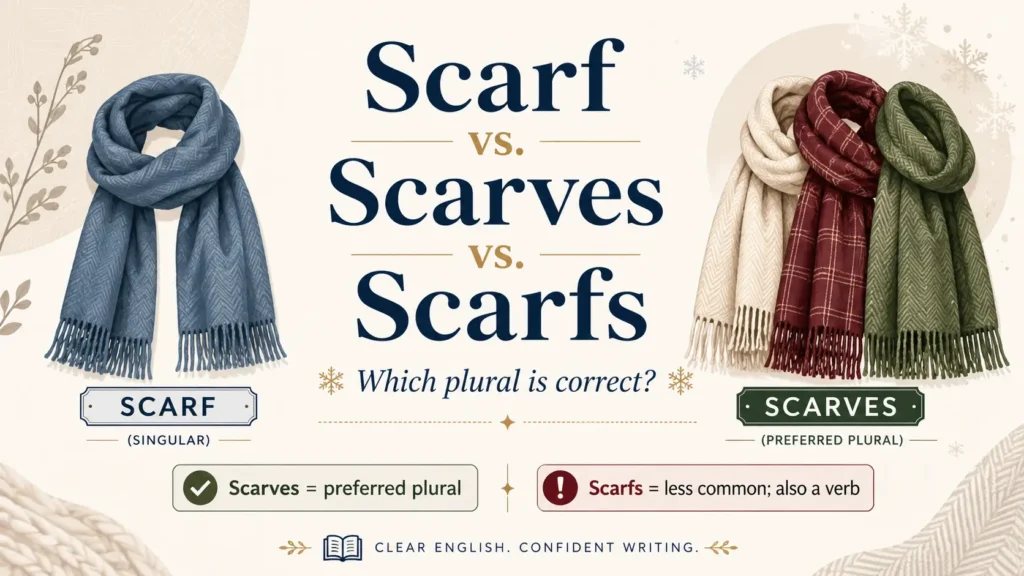
Choosing between scarf, scarves, and scarfs can confuse many writers because these words look similar but do not always function the same way in modern English. The basic rule is simple:
scarves is the standard plural of scarf and the most natural choice for formal, professional, academic, and fashion-related writing. The spelling scarfs can also work as a less common plural noun, but it may sound informal or unusual to some readers. In many cases, scarfs is more familiar as a verb form, as in “he scarfs down his lunch,” which means he eats quickly.
Understanding this difference helps you choose the correct plural, avoid the nonstandard word “scarve,” and follow basic English grammar rules with confidence. This guide explains the meaning, usage, examples, and common mistakes so you can use each form clearly in blog posts, product descriptions, schoolwork, and everyday communication. It also gives readers a practical answer before moving into detailed comparisons.
What Does “Scarf” Mean?
A scarf is a long piece of fabric worn around the neck, head, or shoulders. People wear scarves for warmth, fashion, religious reasons, cultural expression, or personal style.
Examples:
- She wore a wool scarf in winter.
- He bought a silk scarf as a gift.
- The children wrapped scarves around their necks before going outside.
As a noun, scarf refers to the clothing accessory. As a verb, scarf has a different meaning. In informal American English, it means to eat quickly or greedily.
Example:
- He scarfs his breakfast before leaving for work.
This difference matters because scarfs can be either a plural noun or a verb depending on the sentence.
Scarves: The Preferred Plural Form
Scarves is the standard plural form of scarf. It is the form most readers expect, especially in formal, educational, professional, and international writing.
Examples:
- She owns several scarves.
- The store sells wool scarves and silk scarves.
- We packed gloves, coats, and scarves for the trip.
- The fashion collection included brightly colored scarves.
Use scarves when you are talking about more than one scarf. It sounds natural, polished, and correct in almost every context.
Why Does “Scarf” Become “Scarves”?
Many English nouns ending in f or fe change to ves in the plural.
Examples:
| Singular | Plural |
| leaf | leaves |
| knife | knives |
| shelf | shelves |
| wolf | wolves |
| loaf | loaves |
| scarf | scarves |
This is why scarves sounds natural to most English speakers. It follows the same pattern as words like shelf/shelves and wolf/wolves.
However, English does not apply this rule to every word ending in f. For example, we say roofs, not usually rooves, and beliefs, not believes. That is why some words have more than one accepted plural form.
Is “Scarfs” Correct?
Yes, scarfs can be correct as a plural noun, but it is much less common than scarves.
Examples:
- The shop displayed colorful scarfs in the window.
- She packed two scarfs for the trip.
These sentences are understandable, and some dictionaries recognize scarfs as an alternative plural. However, many readers may see scarfs as unusual or informal. Some may even assume it is a spelling mistake.
For that reason, scarves is the better choice in most situations.
Scarves vs. Scarfs: Main Difference
The main difference is usage.
| Word | Meaning | Best Use |
| scarf | Singular noun | One clothing accessory |
| scarves | Plural noun | Preferred form for more than one scarf |
| scarfs | Plural noun or verb | Less common plural; common verb |
| scarve | Incorrect | Do not use |
In professional writing, use scarves as the plural noun. Use scarfs only when it functions as a verb or when you intentionally want the less common plural form.
“Scarfs” as a Verb
The word scarfs is often used as a verb in informal American English. It means to eat quickly.
Examples:
- He scarfs down his lunch every day.
- The dog scarfs its food too fast.
- She scarfs a sandwich between meetings.
In these examples, scarfs is not the plural of scarf. It is the third-person singular form of the verb scarf.
The verb forms are:
| Verb Form | Example |
| scarf | I scarf my food when I am late. |
| scarfs | He scarfs his lunch quickly. |
| scarfed | She scarfed the pizza. |
| scarfing | They were scarfing snacks during the movie. |
Do not use scarves as a verb. A sentence like “He scarves his food” is incorrect.
When Should You Use “Scarves”?
Use scarves when you want the safest, clearest, and most accepted plural form.
Use scarves in:
- formal writing
- academic writing
- product descriptions
- fashion content
- business writing
- blog posts
- British English
- international English
Examples:
- Our winter collection includes wool scarves, gloves, and hats.
- She donated handmade scarves to the shelter.
- The boutique sells designer scarves from Italy.
If you are unsure which form to use, choose scarves.
When Can You Use “Scarfs”?
Use scarfs mainly when it is a verb.
Examples:
- He scarfs down breakfast before school.
- The puppy scarfs its food too quickly.
You may also use scarfs as a plural noun, but it is less common and may look informal.
Example:
- The market sells handmade scarfs and shawls.
This is not necessarily wrong, but scarves would sound more natural and professional:
- The market sells handmade scarves and shawls.
Common Mistakes to Avoid
1. Using “scarve” as the singular form
The singular form is always scarf, not scarve.
Incorrect:
- I bought a new scarve.
Correct:
- I bought a new scarf.
2. Using “scarves” as a verb
Scarves is a plural noun, not a verb.
Incorrect:
- He scarves his lunch quickly.
Correct:
- He scarfs his lunch quickly.
3. Mixing “scarves” and “scarfs” in the same article
Even though both plural forms can be accepted, switching between them can look inconsistent.
Less professional:
- The store sells scarves in winter. These scarfs are handmade.
Better:
- The store sells scarves in winter. These scarves are handmade.
Choose one plural form and use it consistently. In most cases, choose scarves.
4. Assuming “scarfs” is always wrong
Scarfs is not always wrong. It can be a valid plural noun, and it is also correct as a verb. The problem is that it is less common as a plural, so readers may find it awkward in formal writing.
Examples of “Scarf,” “Scarves,” and “Scarfs”
Scarf as a singular noun
- She wore a red scarf.
- I lost my favorite scarf.
- This scarf is made of cashmere.
Scarves as a plural noun
- She owns several silk scarves.
- The children wore scarves in the snow.
- The shop sells scarves in many colors.
Scarfs as a verb
- He scarfs his food when he is in a hurry.
- The dog scarfs everything in its bowl.
- She scarfs down a snack before practice.
Scarfs as a less common plural noun
- The vendor displayed colorful scarfs.
- He packed two scarfs for the cold weather.
These examples show why context matters. Scarves usually refers to more than one clothing accessory. Scarfs can refer to multiple scarves, but it often works as a verb meaning “eats quickly.”
FAQ: Scarf, Scarves, and Scarfs
1. What is the correct plural of scarf?
The most common and preferred plural of scarf is scarves. It is the safest choice for formal writing, product descriptions, articles, and everyday English.
2. Is scarfs a correct word?
Yes, scarfs can be correct, but it has two uses. It can be a less common plural noun, and it can also be a verb form meaning to eat quickly.
3. Should I use scarves or scarfs in professional writing?
Use scarves in professional writing. It is the standard correct plural and is more widely accepted by readers in both British and American English.
4. Is scarve a word?
No, “scarve” is not a standard English word. The singular form is scarf, and the preferred plural form is scarves.
5. What does scarfs mean as a verb?
As a verb, scarfs means eats quickly or greedily. For example, “He scarfs down his lunch” means he eats his lunch very fast.
Final Answer
The easiest rule to remember is this: use scarves when you are talking about more than one scarf. It is the preferred plural of scarf and the safest option for professional, formal, and international writing. The spelling scarfs is not always wrong, but it is less common as a plural noun and may look awkward to some readers. However, scarfs is correct as a verb form when it means to eat quickly, as in “she scarfs her food.” To avoid confusion, choose scarves for clothing, use scarfs mainly as a verb, and never use “scarve.” By following this simple English grammar rule, you can select the correct plural naturally and keep your writing clear, polished, reader-friendly, and consistent from beginning to end.

1 thought on “Scarf vs. Scarves vs. Scarfs: Which Plural Is Correct?”