
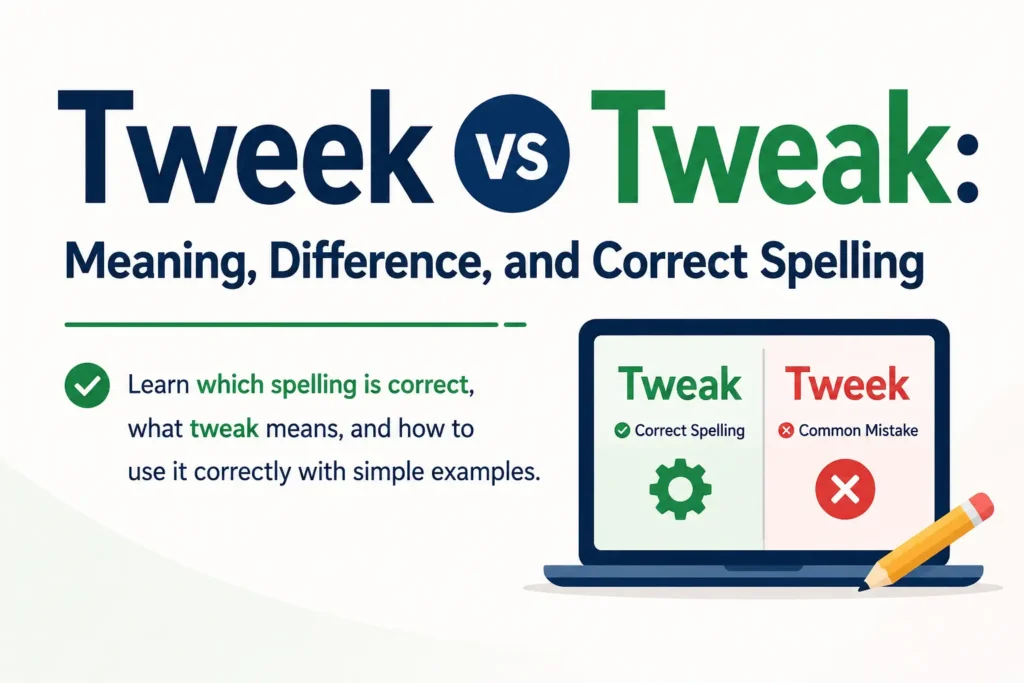
Tweek vs tweak is a common spelling question, but the rule is simple: use tweak for a small change, adjustment, or improvement in standard English.
People often write tweek because tweak has the same long e sound as week and seek. However, pronunciation doesn’t control spelling. In emails, essays, reports, software documentation, and social media posts, tweak is the accepted form. Tweek should appear only when it is an official name, title, username, or brand.
You can use tweak as a verb or noun. “Please tweak the settings” shows an action, while “The design needs one tweak” names the change. Its correct forms are tweaks, tweaked, and tweaking. A useful memory trick connects tweak with weak because both end in -eak. This correct spelling keeps school writing, business writing, and online writing clear, accurate, and professional.
Tweek vs Tweak: Quick Answer
Tweak is a standard English word. It can work as either a verb or a noun.
As a verb, it usually means to make a small change:
We need to tweak the schedule before sending it.
As a noun, it means a small adjustment:
The design needs one final tweak.
Tweek, by contrast, is not the accepted spelling when you mean “adjust” or “make a small change.” It may appear as a name, brand, username, title, or creative spelling.
| Word | Standard English word? | Main use |
| Tweak | Yes | A small change, adjustment, pull, or improvement |
| Tweek | Usually no | A proper name, creative spelling, or misspelling |
When you’re describing an ordinary action or adjustment, choose tweak.
What Does “Tweak” Mean?
The word tweak has several meanings. Most relate to making a small movement or change.
Today, people often use it when discussing writing, technology, design, business plans, or personal routines. However, the word also has older physical meanings and newer slang uses.
Tweak as a Verb
As a verb, tweak can mean to make a small change that improves how something works or looks.
Examples:
- “The editor tweaked the title.”
- “You can tweak the brightness in your phone settings.”
- “We should tweak the budget before the meeting.”
- “She tweaked the recipe by adding less sugar.”
In each sentence, the change is limited. The person isn’t replacing the entire title, system, budget, or recipe.
A tweak is usually smaller than a full rewrite, redesign, or overhaul.
The verb can also mean to pinch, pull, or twist something sharply.
- “The child playfully tweaked his brother’s ear.”
- “She tweaked the corner of the fabric.”
- “He felt pain after he tweaked a muscle.”
In the last example, tweaked a muscle means slightly injured or strained it.
Tweak as a Noun
As a noun, tweak means a small change, correction, or adjustment.
- “The website only needs a minor tweak.”
- “A few tweaks made the paragraph easier to read.”
- “That final tweak improved the logo.”
- “The app update includes several performance tweaks.”
Because tweak is a countable noun, you can use it with numbers and articles:
- a tweak
- one tweak
- two tweaks
- several tweaks
- a few tweaks
Incorrect:
The design needs tweak.
Correct:
The design needs a tweak.
The singular countable noun normally needs an article such as a or the.
Is “Tweek” a Real English Word?
Tweek is not the standard spelling of the English word tweak. If you use it to mean “adjust,” most editors, teachers, and readers will treat it as a spelling error.
For example:
Incorrect:
Please tweek the report before submitting it.
Correct:
Please tweak the report before submitting it.
Still, Tweek can be correct in limited situations. English allows people, businesses, fictional characters, and products to use unusual spellings as proper names.
When “Tweek” May Be Correct
Use Tweek when it is the official spelling of:
- A person’s name
- A fictional character
- A company or brand
- A product
- A social media username
- A song, game, book, or creative title
Proper names don’t always follow standard dictionary spelling.
For instance, Tweek Tweak is a character in the animated television series South Park. His first name is intentionally spelled Tweek. That spelling doesn’t make tweek an accepted alternative for the verb tweak.
Compare these examples:
- “I need to tweak my presentation.” — Correct standard word
- “Tweek appears in the episode.” — Correct proper name
- “Please tweek the presentation.” — Incorrect spelling
The intended meaning decides which spelling you need.
Tweek vs Tweak Comparison Table
The following table shows the main differences between the two forms.
| Feature | Tweak | Tweek |
| Correct standard spelling | Yes | Usually no |
| Dictionary word | Yes | Not normally as a general word |
| Part of speech | Verb and noun | Usually a proper noun |
| Main meaning | A small change, adjustment, pinch, or pull | Depends on the name or title |
| Suitable for school writing | Yes | Only when it is an official name |
| Suitable for business writing | Yes | Only as a proper name |
| Past-tense form | Tweaked | Not applicable as a standard verb |
| Present participle | Tweaking | Not “tweeking” |
| Example | “Tweak the settings.” | “Tweek is a character’s name.” |
The safest rule is clear:
Use tweak for the ordinary English word. Use Tweek only when you are preserving an official name.
How Do You Pronounce “Tweak”?
In American English, tweak is pronounced like tweek.
Its pronunciation is:
/twiːk/
A simple sound guide is:
TWEEK
The word rhymes with:
- Beak
- Leak
- Peak
- Seek
- Speak
- Week
- Weak
This pronunciation explains why people often misspell the word. The long ee sound may suggest the spelling tweek. However, English vowel sounds can have several spellings.
The correct form uses ea, not ee.
Why the Sound Causes Confusion
Many long e words use ee:
- Week
- Seek
- Green
- Sleep
- Feel
However, many others use ea:
- Speak
- Weak
- Leak
- Peak
- Clean
Because both patterns can create the same sound, you can’t always spell a word correctly by listening alone. You need to remember its established spelling.
A useful memory sentence is:
A weak sentence may need a tweak.
Both weak and tweak end in -eak.
The Grammar of “Tweak”
The word tweak can play two main roles in a sentence. It can be a verb, which names an action, or a noun, which names the adjustment itself.
Understanding these roles will help you choose the correct word form.
Forms of the Verb “Tweak”
The verb is regular, so its past forms follow the normal -ed pattern.
| Grammar form | Word |
| Base form | tweak |
| Third-person singular | tweaks |
| Simple past | tweaked |
| Past participle | tweaked |
| Present participle | tweaking |
Examples:
- “I usually tweak the settings.”
- “She tweaks the schedule every Monday.”
- “We tweaked the design yesterday.”
- “They have tweaked the software.”
- “He is tweaking the final paragraph.”
Notice that the e remains before -d in tweaked, but it disappears before -ing in tweaking.
Correct:
- tweak
- tweaked
- tweaking
Incorrect:
- tweek
- tweeked
- tweeking
- tweakking
Using “Tweak” as a Countable Noun
As a noun, tweak can be singular or plural.
Singular:
- “The plan needs a tweak.”
- “That was the final tweak.”
Plural:
- “We made three tweaks.”
- “The editor suggested several tweaks.”
Common adjectives used with tweak include:
- Small tweak
- Minor tweak
- Quick tweak
- Final tweak
- Necessary tweak
- Simple tweak
- Technical tweak
- Slight tweak
For example:
A minor tweak to the introduction made the article much clearer.
Correct Examples of “Tweak” in Sentences
The meaning of tweak becomes easier to understand when you see it in real situations.
Everyday Conversation
- “Let me tweak the recipe before dinner.”
- “The room looks better after a few small tweaks.”
- “I need to tweak my morning routine.”
- “She tweaked her back while moving the sofa.”
- “We can tweak the plan if the weather changes.”
These examples sound natural in casual American English.
School and Academic Writing
- “The student tweaked the thesis statement for clarity.”
- “A few wording tweaks improved the essay.”
- “The professor asked him to tweak the research question.”
- “The conclusion needs a slight tweak.”
- “She tweaked the chart labels before submitting the report.”
In formal academic work, tweak is acceptable. However, more specific words may sometimes sound stronger.
For example:
- Revise the thesis statement
- Modify the research method
- Clarify the conclusion
- Adjust the chart labels
Use the word that describes the action most accurately.
Work and Professional Communication
- “We need to tweak the budget before Friday.”
- “Please tweak the email so the request sounds more direct.”
- “The manager suggested a small tweak to the timeline.”
- “We’ve tweaked the proposal based on your feedback.”
- “A few pricing tweaks may improve sales.”
The word is common in offices because it suggests that the main idea is already sound. Only a limited adjustment is needed.
Technology and Software
- “You can tweak the privacy settings.”
- “The developer tweaked the code to improve speed.”
- “A small interface tweak made the app easier to use.”
- “Try tweaking the display settings.”
- “The update includes security and performance tweaks.”
In technology, a tweak is often smaller than a complete update or system change.
Social Media and Content Creation
- “She tweaked the caption before posting it.”
- “Try tweaking the headline to make it clearer.”
- “The video needs a few audio tweaks.”
- “I made one final tweak to the thumbnail.”
- “The creator tweaked the opening to keep viewers interested.”
These examples show why the word is popular among writers, designers, marketers, and creators.
Common Tweek vs Tweak Mistakes
Most errors happen because writers spell the word as it sounds or use the wrong grammar form.
Writing “Tweek” Instead of “Tweak”
Incorrect:
We need to tweek the layout.
Correct:
We need to tweak the layout.
Why it is wrong: The standard verb is spelled tweak, even though it sounds like tweek.
Writing “Tweeking” Instead of “Tweaking”
Incorrect:
She is tweeking the settings.
Correct:
She is tweaking the settings.
Why it is wrong: The base word is tweak. When adding -ing, remove the final silent e.
Using the Base Form After “Is”
Incorrect:
He is tweak the design.
Correct:
He is tweaking the design.
Why it is wrong: The present continuous tense uses is + verb-ing.
Forgetting the Past-Tense Ending
Incorrect:
We tweak the schedule yesterday.
Correct:
We tweaked the schedule yesterday.
Why it is wrong: The word yesterday shows that the action happened in the past. Therefore, you need tweaked.
Using “Tweak” Without an Article
Incorrect:
The document needs tweak.
Correct:
The document needs a tweak.
Why it is wrong: A single countable noun usually requires an article.
Using “Tweak” for a Major Change
Unclear:
The company tweaked its entire business model.
Better:
The company overhauled its entire business model.
Why the second sentence is better: Tweak usually suggests a small change. An entire business model requires a larger word, such as overhaul, restructure, or transform.
Why Do People Confuse Tweek and Tweak?
The error is understandable. English spelling often uses different letter combinations for the same sound.
The Long “E” Sound
The main reason is pronunciation. Tweak has the same long e sound found in week and seek.
As a result, a writer may assume that ee is the correct vowel pair.
However, the correct spelling follows the ea pattern used in speak, weak, and leak.
Familiar “EE” Spellings
People see common ee words every day:
- See
- Feel
- Need
- Week
- Keep
- Green
That familiar pattern can influence spelling, especially when someone has heard tweak but hasn’t seen it written often.
Proper Names and Online Content
A search for tweek may show usernames, fictional characters, brands, and fan pages. Therefore, the spelling can look more common or acceptable than it really is.
Still, search results don’t determine standard grammar. A creative name can use any spelling its owner chooses.
Autocorrect and Spell-Check Limits
Spell-check tools may recognize Tweek as a name. As a result, they may not underline it.
That doesn’t mean the spelling is correct in your sentence.
Always check the meaning:
- Are you naming a person, character, or brand? Tweek may be right.
- Are you describing a small change? Use tweak.
What Does “Tweak” Mean in Slang?
In slang, tweak and tweaking can have meanings that differ from “make a small adjustment.”
Because these meanings may sound negative, you should consider the context carefully.
“Tweaking” as Overreacting
In casual speech and social media, tweaking may mean acting irrationally, panicking, overreacting, or behaving strangely.
Example:
“You’re tweaking if you think I’m paying $500 for that.”
Here, the speaker means:
- You’re being unreasonable.
- You’re not thinking clearly.
- Your idea sounds extreme.
Another example:
“Why are you tweaking over one small mistake?”
In this case, it means “Why are you reacting so strongly?”
This use is highly informal. Avoid it in academic papers, professional reports, or formal emails.
“Tweaking” as Nervous or Agitated Behavior
The word may also describe someone who seems unusually restless, anxious, or agitated.
“He looked like he was tweaking during the conversation.”
Be careful with this use. It may sound insulting, judgmental, or connected to drug use.
Drug-Related Slang
In some American slang, tweaking refers to agitated, repetitive, or unusual behavior associated with stimulant use.
Because this meaning is sensitive, don’t use the term casually when describing a real person. A more neutral description may be clearer and less harmful.
For example, instead of writing:
“He was tweaking.”
You could write:
“He appeared extremely restless and agitated.”
The second version describes observable behavior without making an unsupported claim.
Tweak in Formal and Informal American English
Tweak is widely used in modern American English. However, its tone changes slightly based on context.
Casual Usage
In everyday speech, tweak sounds natural and friendly.
- “I’ll tweak it later.”
- “Can we tweak the plan?”
- “The recipe needs a small tweak.”
The word communicates that the problem isn’t serious.
Professional Usage
In business, design, technology, and marketing, tweak is common.
- “We tweaked the campaign.”
- “The software needs a few performance tweaks.”
- “Let’s tweak the presentation before the client meeting.”
However, it may sound too casual in legal, scientific, or highly formal documents.
Academic and Formal Alternatives
Depending on the context, choose a more precise word:
| Instead of “tweak” | Use when you mean |
| Adjust | Change a setting, amount, position, or balance |
| Revise | Reconsider and change written content |
| Modify | Change part of a method, object, or plan |
| Refine | Improve details or quality |
| Correct | Fix an error |
| Amend | Make an official change to a formal document |
| Calibrate | Adjust an instrument for accuracy |
For example:
Casual:
We tweaked the research method.
More precise:
We modified the research method.
Both may be grammatically correct. However, modified gives the reader a clearer idea of the action.
Tweak in Technology, Design, Business, and Writing
The word tweak appears often in fields where small adjustments can produce noticeable results.
Technology and Software
A technology tweak may involve:
- Changing privacy settings
- Improving loading speed
- Adjusting screen brightness
- Editing a small section of code
- Changing notification preferences
- Improving a user interface
A tweak doesn’t usually replace the whole system.
Mini case: A website takes five seconds to load. A developer compresses several images, reducing the loading time. That is a performance tweak. Rebuilding the entire website would be an overhaul.
Graphic and Product Design
Designers may tweak:
- Font size
- Spacing
- Color balance
- Image placement
- Button shape
- Border thickness
- Product dimensions
Mini case: A designer moves a logo slightly higher and increases the space around it. Those are small design tweaks, not a full redesign.
Business and Project Planning
In business, teams may tweak:
- Budgets
- Deadlines
- Prices
- Marketing messages
- Workflows
- Meeting schedules
- Sales targets
Mini case: A team moves a product launch from Monday to Wednesday. It also reduces the advertising budget by 5%. These are planning tweaks. Canceling the launch would be a major strategic change.
Writing and Editing
Writers often tweak:
- Headlines
- Introductions
- Sentence order
- Word choice
- Tone
- Calls to action
- Paragraph length
Mini case: An editor replaces a vague verb with a stronger one and shortens a sentence. That is a wording tweak. Replacing several sections would be a revision or rewrite.
Tweak Compared with Similar Words
Several words can describe change, but they don’t all suggest the same level of effort.
| Word | Meaning | Usual size of change | Example |
| Tweak | Make a small adjustment | Small | “Tweak the headline.” |
| Adjust | Change for better fit or function | Small to moderate | “Adjust the chair.” |
| Edit | Correct or improve content | Varies | “Edit the report.” |
| Modify | Change part of something | Moderate | “Modify the agreement.” |
| Refine | Improve details or quality | Small and careful | “Refine the argument.” |
| Revise | Reconsider and change | Moderate to large | “Revise the essay.” |
| Overhaul | Change something extensively | Large | “Overhaul the system.” |
Tweak vs Adjust
These words often overlap.
- Tweak usually sounds informal and suggests a small improvement.
- Adjust often relates to position, settings, amount, or function.
Examples:
- “Tweak the headline.” — Improve it slightly.
- “Adjust the seat.” — Change its position.
- “Adjust the volume.” — Raise or lower the sound.
Tweak vs Edit
Edit is broader. It may involve correcting, removing, reorganizing, or rewriting content.
A tweak is often one small part of editing.
- “I edited the article.” — I made various changes.
- “I tweaked the title.” — I made a small change to the title.
Tweak vs Revise
Revise suggests that you reviewed the content and made meaningful changes.
Tweak suggests a lighter adjustment.
- “Tweak the final sentence.” — Make a minor change.
- “Revise the final section.” — Review and change it more fully.
Tweak vs Overhaul
These words describe very different levels of change.
- A tweak changes one detail.
- An overhaul changes much or all of something.
Examples:
- “The app needs a color tweak.”
- “The outdated app needs a complete overhaul.”
Synonyms for “Tweak”
The best synonym depends on the meaning of tweak in the sentence.
Synonyms for a Small Improvement
- Adjust
- Refine
- Fine-tune
- Polish
- Improve
- Correct
Example:
We need to refine the introduction.
This sounds slightly more formal than “tweak the introduction.”
Synonyms for Changing Something
- Modify
- Alter
- Revise
- Edit
- Adapt
- Rework
Example:
The company modified its return policy.
Here, modified may be clearer because a policy change can be more than a small tweak.
Synonyms for Pulling or Twisting
- Pinch
- Pull
- Twist
- Tug
- Yank
However, these words aren’t always interchangeable.
For example:
She tweaked his ear.
You could replace tweaked with pinched or pulled, depending on the exact action. You couldn’t replace it with refined or modified.
Context always controls the best synonym.
Related Words and Word Forms
The following forms all come from tweak:
- Tweak — base verb or singular noun
- Tweaks — third-person verb or plural noun
- Tweaked — past tense or past participle
- Tweaking — present participle or gerund
- Tweaker — informal noun with several possible meanings
Be cautious with tweaker. It may describe someone who repeatedly adjusts or experiments with things. However, in slang, it can also refer negatively to a person using stimulants.
Therefore, don’t use it to describe someone unless the intended meaning is clear and appropriate.
Memory Tricks for Spelling “Tweak”
You can remember the correct spelling with a few simple methods.
Connect It with “Weak”
Both words end in -eak:
- Weak
- Tweak
Memory sentence:
A weak draft may need a tweak.
Remember the “EA” Family
Think of these words:
- Beak
- Leak
- Peak
- Speak
- Weak
- Tweak
They all contain ea and have a long e sound.
Use the Meaning Test
Ask yourself:
Am I talking about a small change?
When the answer is yes, use tweak.
Check for a Proper Name
If you see Tweek, check whether it is an official name.
- Tweek Tweak — Proper name
- “Tweak the settings” — Standard verb
- “A small tweak” — Standard noun
This quick check prevents most errors.
Why Correct Spelling Matters
A single spelling mistake may not destroy your message. However, it can affect clarity and credibility.
School and Academic Work
Teachers may mark tweek as incorrect because the standard form is tweak.
Correct spelling also shows that you reviewed your work carefully.
Business Emails and Reports
In professional writing, tweek may look careless.
Incorrect:
Please tweek the attached proposal.
Correct:
Please tweak the attached proposal.
The corrected version looks more polished and professional.
Websites and Published Content
Spelling consistency improves the reading experience. It also helps editors, customers, and readers understand your meaning quickly.
However, never “correct” a proper name simply because it uses an unusual spelling. Brand names and character names should keep their official form.
Resumes and Client Communication
Documents such as resumes, cover letters, proposals, and client emails require careful proofreading.
A spelling mistake in a short document is more noticeable because readers have less text to evaluate.
Conclusion
The difference between tweek vs tweak is easy to remember. Tweak is the correct standard English spelling when you mean a small change, adjustment, or improvement. You can use it as a verb, as in “tweak the settings,” or as a noun, as in “make a small tweak.”
Tweek is usually a spelling mistake unless it is part of an official name, username, brand, or fictional character’s name. For clear school, business, and online writing, always use tweak when you mean to change something slightly.
Frequently Asked Questions
Q1: Is it spelled tweek or tweak?
The correct spelling is tweak. Use it when you mean to make a small adjustment or improvement.
Q2: Is tweek a real English word?
Tweek is not the standard spelling of the English word tweak. However, it may appear as a proper name, brand name, or username.
Q3:What does tweak mean?
Tweak means to make a small change to improve something. It can also mean a slight adjustment.
Q4: What is the past tense of tweak?
The past tense of tweak is tweaked.
Example: “We tweaked the design yesterday.”
Q5: What does tweaking mean?
Tweaking means making small changes or adjustments. In informal slang, it may also describe someone who is overreacting or acting unusually.
