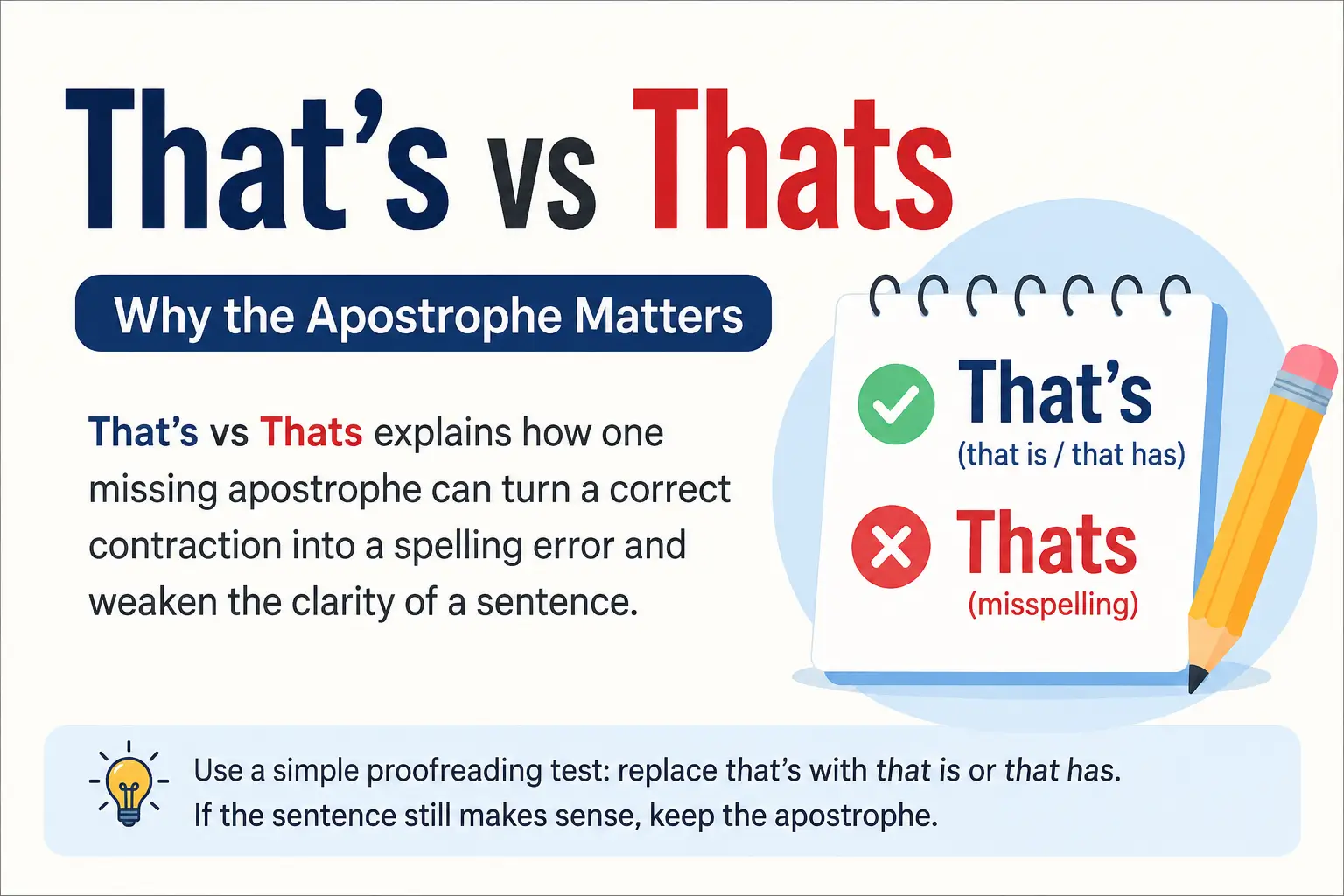
That’s vs Thats explains how one missing apostrophe can turn a correct contraction into a spelling error and weaken the clarity of a sentence. That’s combines that is or that has, while thats is normally a nonword in standard English.
The apostrophe marks missing letters and keeps the meaning clear. For example, that’s a good point means that is a good point. Without the mark, the sentence uses the wrong form and may look like careless writing. This small error can also reduce writing accuracy in school or work.
Use a simple proofreading test: replace that’s with that is or that has. If the sentence still makes sense, keep the apostrophe. This check helps in emails, blog posts, texts, social media, and professional writing, especially when fast typing or autocorrect causes errors. It also helps English learners choose the correct spelling every time.
Quick Answer: Is It That’s or Thats?
That’s is the correct spelling when you mean that is or that has.
- That’s my new laptop.
Meaning: That is my new laptop. - That’s been a difficult week.
Meaning: That has been a difficult week.
The spelling thats is not a standard contraction because it doesn’t contain the required apostrophe.
Quick rule: If you can replace the word with that is or that has, write that’s with an apostrophe.
That’s vs. Thats at a Glance
The following table shows the basic difference.
| Form | Meaning | Standard English? | Example |
| that’s | That is | Yes | That’s the correct answer. |
| that’s | That has | Yes | That’s caused a serious delay. |
| thats | Usually a misspelling of that’s | No | Thats the correct answer. |
| that is | Full form of that’s | Yes | That is the correct answer. |
| that has | Full form of that’s in some sentences | Yes | That has caused a delay. |
In most cases, the choice is not between two accepted spellings. That’s is correct, while thats is an error.
What Does That’s Mean?
That’s is a contraction. A contraction combines two words into a shorter form. An apostrophe marks the place where one or more letters have been removed.
The word that’s can represent two different expressions:
- that is
- that has
The surrounding sentence tells you which meaning applies.
That’s Meaning “That Is”
Most often, that’s means that is.
You can use it to identify something, describe a situation, express an opinion, or explain a fact.
Examples
- That’s my seat.
Expanded: That is my seat. - That’s an unusual question.
Expanded: That is an unusual question. - That’s where the meeting will take place.
Expanded: That is where the meeting will take place. - That’s not what I ordered.
Expanded: That is not what I ordered. - That’s why we left early.
Expanded: That is why we left early.
In each example, replacing that’s with that is produces a complete and natural sentence.
That’s Meaning “That Has”
The contraction that’s can also mean that has. In this structure, has usually works as a helping verb.
A helping verb supports the main verb. When that’s means that has, it is commonly followed by a past participle such as:
- been
- changed
- happened
- caused
- created
- finished
- improved
Examples
- That’s been helpful.
Expanded: That has been helpful. - That’s changed the way I work.
Expanded: That has changed the way I work. - That’s caused several problems.
Expanded: That has caused several problems. - That’s happened before.
Expanded: That has happened before. - That’s improved since last year.
Expanded: That has improved since last year.
The word following that’s often helps you recognize this meaning. For example, been strongly suggests that the contraction means that has.
When “That Has” Should Not Become “That’s”
In standard American English, has is usually contracted after that when it serves as a helping verb. It is not normally contracted when it is the main verb showing ownership or possession.
Consider this sentence:
- That has a broken handle.
Here, has means “possesses” or “contains.” Writing that’s would create a different meaning:
- That’s a broken handle.
This sentence means:
- That is a broken handle.
Therefore, the following two sentences are not interchangeable:
| Sentence | Meaning |
| That has a red cover. | The object possesses or includes a red cover. |
| That’s a red cover. | The object being identified is a red cover. |
When has expresses possession, keep the full form unless you use a structure such as that’s got, which is common in informal speech.
- That’s got a red cover.
- That has got a red cover.
However, in clear professional writing, that has a red cover is often more direct.
Why Does That’s Need an Apostrophe?
The apostrophe in that’s shows that letters have been left out.
Here is how the contraction forms:
- that is → that’s
- that has → that’s
In that is, the apostrophe replaces the letter i.
In that has, it replaces the letters ha.
Without the apostrophe, the reader cannot see that two words have been combined. Therefore, thats is not the standard written form of either expression.
The Apostrophe Is Not Optional
Some people leave out apostrophes in text messages, social media posts, or quick online comments. Although the meaning may still be understood, the spelling remains nonstandard.
For example:
- Informal but incorrect: Thats so funny.
- Standard: That’s so funny.
- Informal but incorrect: Thats what I meant.
- Standard: That’s what I meant.
Typing quickly does not change the spelling rule. In schoolwork, emails, articles, applications, reports, and professional messages, always include the apostrophe.
Why Is “Thats” Usually Incorrect?
The spelling thats is usually created when someone removes the apostrophe from that’s. However, an apostrophe is a meaningful punctuation mark, not a decorative symbol.
Writers commonly make this error for several reasons:
- They type too quickly.
- Their keyboard makes apostrophes inconvenient.
- They copy informal texting habits into formal writing.
- Autocorrect fails to detect the mistake.
- They confuse contractions with possessive forms.
- They assume punctuation doesn’t matter online.
Even when readers understand thats, the missing apostrophe can make writing look careless or unedited.
Can “Thats” Ever Be Correct?
In ordinary sentences, thats is not the correct spelling of that’s.
However, it may appear intentionally in limited situations, including:
- A registered brand name
- A website name
- A social media username
- A song, book, or creative title
- Stylized advertising language
- A quoted spelling error
For example, a business might deliberately use Thats in its official name. In that case, you should preserve the brand’s chosen spelling when referring to it.
There is also a rare technical situation in which writers discuss multiple uses of the word that. They might informally write thats, just as someone might discuss several “ifs” or “buts.” Still, clearer wording is usually better:
- Less clear: The paragraph contains too many thats.
- Clearer: The paragraph contains too many uses of the word “that.”
These unusual cases do not make thats acceptable as a replacement for that’s in normal writing.
How to Tell Whether That’s Means “That Is” or “That Has”
Because that’s has two possible meanings, you need to examine the sentence.
Fortunately, three simple tests can help.
Use the Replacement Test
First, replace that’s with that is.
- That’s a good plan.
- That is a good plan.
The sentence still makes sense, so that’s means that is.
Now consider another example:
- That’s caused confusion.
- That is caused confusion.
The expanded sentence is incorrect. Therefore, try that has:
- That has caused confusion.
This version works, so that’s means that has.
Look at the Word That Follows
The next word often gives you a useful clue.
When that’s means that is, it may be followed by:
- A noun: That’s my car.
- An adjective: That’s strange.
- An adverbial phrase: That’s over there.
- A question word: That’s why I called.
- A pronoun: That’s what we need.
- A verb ending in -ing: That’s getting expensive.
When that’s means that has, it is often followed by a past participle:
- That’s been
- That’s changed
- That’s happened
- That’s caused
- That’s improved
However, context still matters because some words can appear in more than one grammatical structure.
Check the Meaning of the Whole Sentence
A single word may not always reveal the intended expansion. Therefore, read the entire sentence.
Compare these examples:
- That’s finished.
- That’s finished the project.
The first sentence usually means:
- That is finished.
Here, finished describes the condition of something.
The second sentence means:
- That has finished the project.
Here, finished is part of an action.
The sentence structure and meaning determine the correct interpretation.
Correct Examples of That’s in Sentences
The contraction that’s appears frequently in spoken and written American English.
Everyday Conversation
- That’s my brother at the door.
- That’s a little expensive.
- That’s not what she said.
- That’s where I left my keys.
- That’s exactly what I was thinking.
- That’s been bothering me all day.
These examples sound natural in face-to-face conversation because contractions make speech smoother.
Text Messages and Social Media
- That’s hilarious!
- That’s why I didn’t reply.
- That’s the best photo you posted.
- That’s been happening to me too.
- That’s all I needed to know.
Although online writing is often casual, standard spelling still uses the apostrophe.
School and Academic Writing
Contractions may be acceptable in many school assignments, especially reflective essays, informal responses, and explanatory writing.
For example:
- That’s one reason the character changes during the story.
However, an instructor may prefer the full form in formal academic work:
- That is one reason the character changes during the story.
Both versions are grammatically correct. The difference is mainly tone and formality.
Emails and Professional Writing
That’s is acceptable in most workplace emails, especially when the message is friendly and conversational.
- That’s the file I mentioned yesterday.
- That’s been added to the agenda.
- That’s a useful suggestion.
- That’s why the deadline was extended.
In a highly formal report, contract, policy, or legal document, the full form may be clearer:
- Conversational: That’s the main concern.
- More formal: That is the main concern.
Using that is can also add emphasis.
Incorrect Examples and How to Fix Them
Understanding why an example is wrong can help you avoid repeating the mistake.
Missing the Apostrophe
Incorrect:
Thats the correct answer.
Correct:
That’s the correct answer.
The sentence means that is the correct answer, so the contraction needs an apostrophe.
Incorrect:
Thats been a major problem.
Correct:
That’s been a major problem.
Here, that’s means that has.
Incorrect:
I think thats enough.
Correct:
I think that’s enough.
The correct expansion is I think that is enough.
Using That’s When “Has” Expresses Possession
Incorrect for the intended meaning:
That’s a cracked screen.
Suppose you mean the device possesses a cracked screen. In that case, write:
Correct:
That has a cracked screen.
The sentence That’s a cracked screen means the object being identified is itself a cracked screen.
Adding an Apostrophe Without a Contraction
Some writers add apostrophes before every final s. However, an apostrophe should have a clear job.
That’s is correct only when it can expand to:
- that is
- that has
Do not use an apostrophe merely because the word ends in s.
Using That’s When “That Is” Needs Emphasis
A contraction is grammatically correct, but it may weaken emphasis.
Compare:
- That’s the problem.
- That is the problem.
The second version places stronger stress on is. A speaker might use it to correct someone or make a firm point.
For example:
That is exactly why the plan failed.
Here, the full form sounds more deliberate and forceful.
Common Phrases That Need That’s
Many everyday expressions use the contraction that’s. The apostrophe should remain in each phrase.
| Correct phrase | Example |
| that’s why | That’s why I emailed you. |
| that’s all | That’s all we need today. |
| that’s right | That’s right; the meeting starts at nine. |
| that’s okay | That’s okay. We can try again. |
| that’s it | That’s it! You found the answer. |
| that’s what | That’s what the instructions say. |
| that’s how | That’s how the machine works. |
| that’s because | That’s because the file was missing. |
| that’s enough | That’s enough information for now. |
| that’s been | That’s been our main concern. |
Therefore, write that’s why, not thats why. The same rule applies to every phrase in the table.
That’s in Formal, Informal, and Professional English
The contraction is grammatically correct in both speech and writing. However, the level of formality may affect whether you choose that’s or the full form.
Casual and Spoken English
In ordinary American conversation, that’s sounds natural.
- That’s great.
- That’s my phone.
- That’s what I heard.
- That’s been happening lately.
Using that is in every casual sentence can sound unusually stiff.
For example:
- Natural conversation: That’s a nice jacket.
- More deliberate: That is a nice jacket.
Both are correct, but the contraction is more common in relaxed speech.
Professional Communication
Contractions are widely accepted in modern professional communication. They often make emails and messages sound friendly rather than cold.
For example:
- That’s a good point.
- That’s been corrected in the latest version.
- That’s why the delivery date changed.
However, use the full form when you need extra clarity, contrast, or emphasis.
- That is the final approved version.
- That has already been reviewed by the legal team.
Academic and Highly Formal Writing
Some teachers, editors, and organizations discourage contractions in formal writing. Their preference is a style choice, not a grammar rule.
Compare:
- That’s an important limitation of the study.
- That is an important limitation of the study.
Both sentences are correct. The second simply has a more formal tone.
Always follow the required style guide for an assignment, journal, institution, or workplace.
Pronunciation and Grammar Role of That’s
In American English, that’s is commonly pronounced:
/ðæts/
It sounds like the word that followed immediately by an s sound.
The spelling thats would normally be pronounced the same way. Therefore, you cannot hear the apostrophe in speech. You must understand the grammar to spell the word correctly.
In many sentences, that acts as a demonstrative pronoun. A demonstrative pronoun points to a person, object, idea, event, or situation.
For example:
- That’s mine.
- That’s surprising.
- That’s what happened.
In each example, that points to something already visible, known, or mentioned.
That’s Compared With Related Words and Forms
Writers sometimes confuse that’s with other short words that look or sound similar.
That’s vs. That Is
That’s and that is can have the same basic meaning.
- That’s my car.
- That is my car.
The contraction sounds more natural in conversation. In contrast, the full form may sound more formal or emphatic.
Use that is when:
- You want to stress the verb is.
- You are writing in a highly formal style.
- A contraction could create ambiguity.
- A teacher or style guide requires full forms.
That’s vs. That Has
When has is a helping verb, that’s may replace that has.
- That’s happened before.
- That has happened before.
Again, the full form sounds more deliberate.
However, do not automatically contract that has when has expresses possession.
- That has three buttons.
- Not normally: That’s three buttons.
The second sentence means that is three buttons, which changes the idea.
That’s vs. Those
Those is the plural demonstrative form related to that.
- Singular: That book is mine.
- Plural: Those books are mine.
The spelling thats is not the normal plural of that.
Compare:
- Correct: That’s my book.
- Correct: Those are my books.
- Incorrect: Thats are my books.
That’s vs. Its
These words perform different jobs.
- That’s means that is or that has.
- Its shows possession.
Examples:
- That’s a large dog.
- The dog wagged its tail.
A useful test is to expand that’s:
- That is a large dog.
You cannot expand its in the same way.
That’s vs. Whats, Its, and Lets
The missing-apostrophe error also occurs in other contractions.
| Incorrect | Correct | Expanded form |
| thats | that’s | that is / that has |
| whats | what’s | what is / what has |
| its when “it is” is intended | it’s | it is / it has |
| lets when “let us” is intended | let’s | let us |
Be careful, though. Its and lets can also be correct words in other contexts.
- The company changed its policy.
- The teacher lets us leave early.
Grammar depends on meaning, not appearance alone.
Synonyms and Alternatives for That’s
Because that’s is a contraction, it does not have exact synonyms in every sentence. Still, you can often rewrite the sentence using a full form or a more specific expression.
Alternatives for “That’s” Meaning “That Is”
- That is
- It is
- This is
- The reason is
- The fact is
- What you see is
Examples:
- That’s the reason we left.
- That is the reason we left.
- The reason we left is the weather.
The best alternative depends on what that refers to.
Alternatives for “That’s” Meaning “That Has”
- That has
- It has
- This has
- A specific noun phrase
Examples:
- That’s caused a delay.
- That has caused a delay.
- The software error has caused a delay.
Replacing vague words such as that with a specific noun can improve clarity.
Real-Life Examples of That’s vs. Thats
These examples show how the rule applies in common situations.
At School
Incorrect:
Thats the chapter we need to read.
Correct:
That’s the chapter we need to read.
The contraction means that is.
At Work
Incorrect:
Thats been added to the report.
Correct:
That’s been added to the report.
The contraction means that has.
In an Email
Incorrect:
Thats why I requested an extension.
Correct:
That’s why I requested an extension.
The phrase expands to that is why.
In a Text Message
Incorrect:
Thats amazing!
Correct:
That’s amazing!
Casual writing still uses the standard contraction.
On Social Media
Incorrect:
Thats the best video I’ve seen today.
Correct:
That’s the best video I’ve seen today.
The apostrophe makes the sentence properly edited and easier to trust.
In a Formal Report
Conversational:
- That’s the main reason sales increased.
More formal:
- That is the main reason sales increased.
Both are grammatically correct. The second version may better match a formal report.
Common Mistakes With That’s
Several errors appear repeatedly in American English writing.
Treating the Apostrophe as Optional
Wrong:
Thats what happened.
Right:
That’s what happened.
The apostrophe is part of the contraction’s spelling.
Assuming Every Final S Shows a Plural
The s in that’s does not make that plural. Instead, it belongs to the contracted verb is or has.
- That’s correct. = That is correct.
- That’s happened. = That has happened.
For a plural demonstrative, use those.
Confusing Contractions With Possession
Apostrophes often show possession in nouns:
- Maria’s notebook
- the company’s policy
- the teacher’s desk
However, the apostrophe in that’s shows omitted letters, not ownership.
Trusting Autocorrect Too Much
Some spelling tools may overlook thats, especially in informal messages or names. Therefore, do not assume that a lack of correction means the spelling is acceptable.
Use the expansion test yourself.
Using That’s in an Unclear Sentence
Sometimes that has no obvious reference.
Unclear:
- That’s why it failed.
Clearer:
- The missing data is why the analysis failed.
The first sentence is grammatically correct, but readers may not know what that refers to. Good writing requires both correct grammar and clear meaning.
Easy Memory Tricks for That’s
A simple memory method can prevent the mistake.
Expand Before You Write
Read the sentence with that is or that has.
- That is useful. → That’s useful.
- That has worked well. → That’s worked well.
If neither expansion makes sense, reconsider the sentence.
Remember What the Apostrophe Replaces
The apostrophe signals missing letters.
Two words became one, so the apostrophe shows what is gone.
This rule also works for:
- it is → it’s
- what is → what’s
- who is → who’s
- there is → there’s
Check Common Phrases
Certain expressions nearly always use that’s:
- that’s why
- that’s all
- that’s right
- that’s what
- that’s it
Learning these as complete phrases can improve your spelling automatically.
Say the Full Form Silently
Before submitting an email or assignment, read that’s as that is or that has.
For example:
- That’s the final version.
- That is the final version.
Because the expansion works, the contraction is correct.
Grammar Tips for Using That’s Clearly
Correct spelling is important, but clear usage matters too.
Make Sure “That” Has a Clear Reference
The reader should understand what that points to.
Vague:
- That’s a problem.
Clearer:
- The missing signature is a problem.
The first version works when the context is obvious. Otherwise, name the issue directly.
Use the Full Form for Emphasis
A contraction reduces stress. Therefore, use that is when you want a stronger tone.
- That’s not the point.
- That is not the point.
The second sentence sounds firmer.
Avoid Too Many Vague Demonstratives
A paragraph filled with that, this, it, and those may become hard to follow.
Instead of writing:
- That’s why that caused that problem.
Write:
- The incorrect setting caused the system failure.
Specific nouns improve both authority and readability.
Match the Level of Formality
Use that’s freely in:
- Conversations
- Text messages
- Blog posts
- Friendly emails
- Social media captions
- Informal explanations
Consider that is or that has in:
- Legal documents
- Formal research papers
- Policies
- Contracts
- Ceremonial speeches
- Writing that requires strong emphasis
Quick Editing Checklist
Before you publish or submit your writing, ask these questions:
- Can that’s be replaced with that is?
- Can it be replaced with auxiliary that has?
- Did you include the apostrophe?
- Does has show possession instead?
- Is the reference of that clear?
- Would the full form improve emphasis?
- Does the sentence match the required level of formality?
- Is Thats part of an official name rather than a normal sentence?
If the word means that is or that has, the correct spelling is usually that’s.
Conclusion
The difference between that’s vs thats is simple but important. That’s is the correct contraction of that is or that has, while thats is usually a spelling mistake. The apostrophe shows that letters have been removed, so it should never be left out in standard English.
Whenever you’re unsure, replace that’s with that is or that has. If the sentence still makes sense, use that’s with the apostrophe. This quick test can help you avoid mistakes in emails, schoolwork, social media posts, and professional writing.
Frequently Asked Questions
Q1: Is “thats” ever correct?
In normal English sentences, thats is not correct. It may appear in a brand name, username, or creative title, but the standard contraction always needs an apostrophe.
Q2: What does “that’s” mean?
That’s can mean that is or that has.
- That’s my book. = That is my book.
- That’s been helpful. = That has been helpful.
Q3: Why does “that’s” need an apostrophe?
The apostrophe replaces missing letters when two words are shortened. It turns that is or that has into that’s.
Q4:Is it “that’s why” or “thats why”?
The correct phrase is that’s why. It expands to that is why, so the apostrophe is required.
Q5:Can I use “that’s” in formal writing?
Yes, that’s is grammatically correct in formal writing. However, that is may sound more formal or emphatic in academic, legal, or professional documents.Meta Title
That’s vs Thats: Meaning, Difference, and Correct Usage