
The skiid vs skied confusion often appears in captions, school essays, travel blogs, and everyday writing, even among confident English users.
At first sight, both spellings may look believable, so students, learners, writers, and native speakers often pause and question which version is correct. This small grammar trap can appear while writing about winter sports, a mountain trip, a day on the slopes, or a social media post. English spelling patterns are not always simple, especially when a verb ends in a vowel sound.
This guide gives a clear and quick answer without unnecessary detail. You will learn the correct spelling, understand why the wrong form appears online, and see how the word is used in real sentences, captions, emails, formal writing, and informal writing. It also explains British and American usage, pronunciation, common mistakes, and practical examples, so you can write with confidence and avoid hesitation, confusion, and second-guessing in future writing.
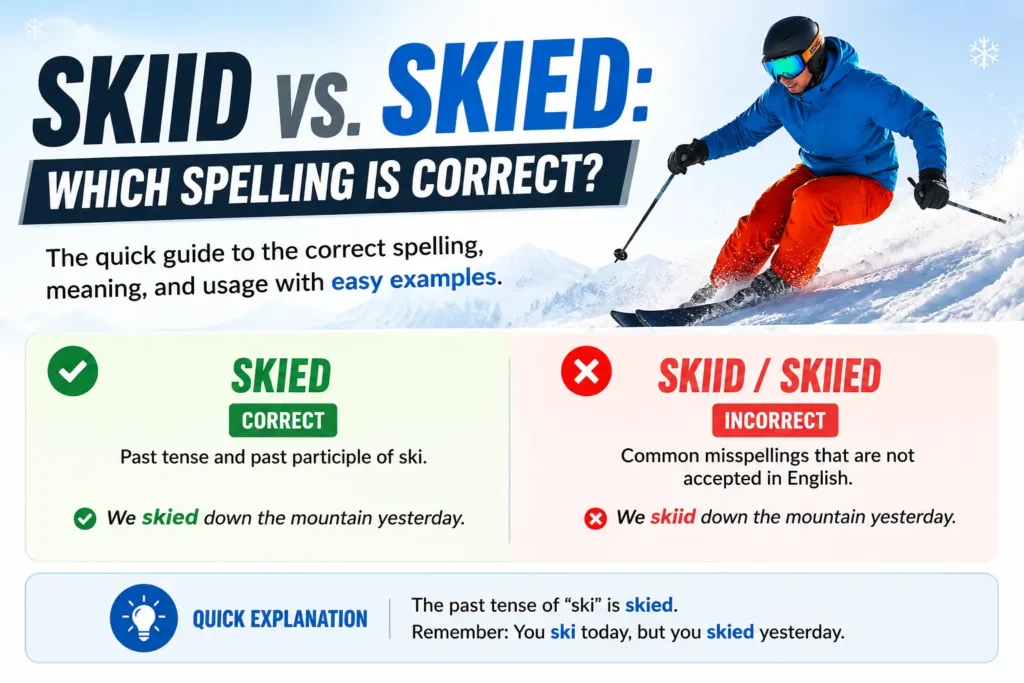
Quick Answer: Is It Skiid or Skied?
Skied is the correct spelling.
It is the simple past tense and past participle of ski.
Correct: We skied down the mountain yesterday.
Incorrect: We skiid down the mountain yesterday.
Incorrect: We skiied down the mountain yesterday.
Use skied in formal writing, casual conversation, emails, school assignments, travel blogs, and social media.
A simple way to remember it is:
You ski today, but you skied yesterday.
Skiid vs. Skied at a Glance
| Form | Correct or Incorrect? | Meaning or Use |
| Skied | Correct | Past tense and past participle of ski |
| Skiid | Incorrect | A misspelling of skied |
| Skiied | Incorrect | Another common misspelling |
| Skiing | Correct | The activity or ongoing action |
| Ski | Correct | Base form of the verb |
The key difference is simple. Skied belongs to standard English, while skiid does not.
What Does Skied Mean?
Skied means traveled, moved, competed, or went over snow or water using skis.
It is the past form of the verb ski.
Examples:
- We skied in Utah during winter break.
- She skied down the beginner slope.
- They skied across the frozen valley.
- He skied behind a boat last summer.
- The athlete skied the final course in record time.
The exact meaning depends on context. In most cases, skied refers to snow skiing. However, it can also describe water skiing.
Skied as a Simple Past-Tense Verb
The simple past describes an action that started and finished in the past.
We skied all morning.
The action is complete. The sentence may refer to yesterday, last week, last winter, or another finished time.
More examples:
- I skied for the first time in January.
- Maria skied with her family last weekend.
- The students skied during their school trip.
- We skied until the resort closed.
- He skied every day during the vacation.
Time words often appear with the simple past:
- yesterday
- last weekend
- last winter
- in 2025
- two days ago
- during our vacation
However, a past-time expression isn’t always necessary when the context already makes the timing clear.
I tried the blue trail first. Then I skied down the harder slope.
Skied as a Past Participle
Skied is also the past participle of ski. A past participle often appears after has, have, or had.
Examples:
- I have skied there before.
- She has skied in several states.
- We had never skied on fresh powder.
- They have skied together for years.
- He had skied that trail before the storm arrived.
The spelling stays the same in the simple past and past participle.
| Tense | Example |
| Simple past | We skied yesterday. |
| Present perfect | We have skied there before. |
| Past perfect | We had skied before lunch. |
| Future perfect | We will have skied every trail by Friday. |
Correct Forms of the Verb Ski
The verb ski changes depending on the tense and subject.
| Grammar Form | Correct Form | Example |
| Base form | ski | I want to ski. |
| Simple present | ski | We ski every winter. |
| Third-person singular | skis | She skis on Saturdays. |
| Present participle | skiing | They are skiing now. |
| Gerund | skiing | Skiing is good exercise. |
| Simple past | skied | We skied yesterday. |
| Past participle | skied | He has skied before. |
Although ski is a regular verb, its spelling changes slightly when forming skied.
The correct principal forms are:
ski, skis, skiing, skied
Neither skiid nor skiied belongs in this verb pattern.
Read this also: Accross vs Across: Which Spelling Is Correct? Meaning, Usage, Grammar, and Examples
Why Skied Is the Correct Spelling
The accepted past form of ski is skied.
You can think of the spelling process this way:
- Start with ski.
- Change the ending to skie-.
- Add -d.
- The result is skied.
This pattern prevents the incorrect double-i spelling skiied.
Compare these forms:
- ski → skied
- tie → tied
- die → died
- lie → lied
- vie → vied
These words all end in -ied in the past tense.
However, don’t turn this into an overly broad rule for every verb ending in a vowel. English spelling contains many patterns and exceptions. For this word, the reliable rule is simply that the past tense of ski is skied.
Why You Don’t Write Skiied
Some writers assume they should add -ed directly to ski:
ski + ed = skiied
That result looks logical, but it is not the standard spelling.
English removes the extra i and uses skied instead.
Incorrect: We skiied all afternoon.
Correct: We skied all afternoon.
The extra i is unnecessary because the accepted spelling already represents the correct pronunciation.
Why Skiid Is Also Wrong
The form skiid may come from trying to spell the long ee sound.
Because ski sounds like “skee,” some writers add another i before d. However, English spelling does not form the past tense that way.
Incorrect: They skiid down the hill.
Correct: They skied down the hill.
Pronunciation alone cannot always tell you how an English word is spelled. You must also know the accepted written form.
Why Skiing Has Two I’s but Skied Does Not
The spelling skiing is correct, even though it contains two i’s together.
That happens because:
ski + ing = skiing
The first i belongs to the base word ski. The second i belongs to the ending -ing.
By contrast, the past form is:
ski → skied
English does not use skiied.
| Word | Status | Explanation |
| Skiing | Correct | The final i in ski meets the i in -ing |
| Skied | Correct | Standard past-tense spelling |
| Skiied | Incorrect | Contains an unnecessary extra i |
| Skiid | Incorrect | Does not follow the accepted past form |
This difference causes much of the confusion. Writers see skiing and assume the past form must also keep two i’s. It doesn’t.
How to Pronounce Skied
Skied is pronounced like skeed.
It has one syllable.
The ending -ed does not create an extra syllable.
skied = skeed
You do not pronounce it as:
- “skee-ed”
- “sky-ed”
- “skee-id”
The final sound is a clear d sound.
Examples in natural speech:
- We skied all day.
- Have you ever skied before?
- She skied down quickly.
Do Skiid and Skied Sound Different?
Skiid is not a standard word, so it has no official pronunciation.
People who write it usually intend to pronounce it exactly like skied. However, the intended sound does not make the spelling correct.
This is similar to many spelling errors in English. A misspelled word may still be understandable, but it remains unsuitable for careful writing.
How to Use Skied in a Sentence
You can use skied with locations, time expressions, distances, trails, conditions, and helping verbs.
Skied With a Location
Use skied with in, at, on, through, or down when describing a place.
- We skied in Colorado last December.
- She skied at a resort near Denver.
- They skied on fresh snow.
- I skied through the forest.
- He skied down the steepest trail.
Each preposition adds a different detail.
In often names a city, state, country, or general area.
We skied in Vermont.
At often identifies a resort or specific site.
We skied at Snowbird.
Down shows direction.
We skied down the mountain.
Skied With a Time Expression
You can show when the action happened.
- We skied yesterday.
- She skied last weekend.
- I skied during winter break.
- They skied for three hours.
- He skied until sunset.
Use the simple past when the time period is finished.
We skied last Saturday.
Use the present perfect when the exact time is not important.
We have skied there before.
Skied With Helping Verbs
Use skied after has, have, and had.
- She has skied in Canada.
- We have skied that route twice.
- He had never skied before the trip.
- They had skied for an hour before it began snowing.
Do not use the base form after these helping verbs when you need a perfect tense.
Incorrect: She has ski there.
Correct: She has skied there.
Questions With Skied
Use skied in questions with has, have, or had.
- Have you ever skied?
- Has she skied this trail before?
- Had they skied together before the race?
However, after did, use the base form ski.
Correct: Did you ski yesterday?
Incorrect: Did you skied yesterday?
The helping verb did already carries the past tense. Therefore, the main verb returns to its base form.
Negative Sentences
The same rule applies in negative sentences.
With did not, use ski:
- We did not ski yesterday.
- She didn’t ski because she was sick.
- They didn’t ski after the storm.
With has not, have not, or had not, use skied:
- I haven’t skied this season.
- He hasn’t skied in years.
- We hadn’t skied there before.
Correct and Incorrect Examples
The following examples show the most common errors.
Skiid Instead of Skied
Incorrect: We skiid for four hours.
Correct: We skied for four hours.
Why: Skied is the standard past form of ski.
Skiied Instead of Skied
Incorrect: She skiied down the hill.
Correct: She skied down the hill.
Why: The past form does not keep two i’s.
Skied After Did
Incorrect: Did you skied last weekend?
Correct: Did you ski last weekend?
Why: The auxiliary verb did already shows past tense.
Ski After Have
Incorrect: I have ski there before.
Correct: I have skied there before.
Why: The present perfect requires the past participle.
Skiing for a Completed Past Action
Incorrect: We skiing yesterday.
Correct: We skied yesterday.
Why: Skiing needs a form of be when it functions as part of a continuous tense.
You could also write:
We were skiing yesterday.
This sentence focuses on the activity in progress. By contrast, “We skied yesterday” treats the trip as a completed event.
Was Skied Instead of Was Skiing
Incorrect: I was skied when you called.
Correct: I was skiing when you called.
Why: Use was skiing for an action that was in progress.
The phrase was skied is passive and would require a different meaning. For example, a trail might be described as “heavily skied,” meaning many people had used it.
Skied in Everyday American English
Skied appears naturally in conversation, travel writing, schoolwork, sports coverage, and online posts.
Conversation
“Have you ever skied before?”
“Yes, I skied a few times in high school.”
This exchange uses skied first as a past participle and then as a simple past verb.
We skied on Saturday and drove home Sunday morning.
This sentence works in a casual email because it gives a clear timeline.
A more professional travel update might say:
Our team skied during the morning session and attended the conference that afternoon.
Social Media
We skied all morning, drank hot chocolate, and watched the snow fall.
The same spelling applies in informal writing. Casual style does not change the verb form.
Travel Blogs
We skied several beginner trails before trying the intermediate course.
Travel writing often combines skied with trail names, weather conditions, and personal experiences.
News and Sports Writing
The athlete skied the final section in less than two minutes.
In sports reporting, skied can describe movement through a racecourse or a completed section of an event.
School Writing
During our family vacation, we skied in the Rocky Mountains.
Teachers expect the standard form skied, not skiid or skiied.
Formal, Academic, and Professional Usage
Skied is correct at every level of formality.
Use it in:
- Academic assignments
- Business emails
- Travel reports
- News articles
- Professional biographies
- Sports coverage
- Personal essays
- Social media captions
- Text messages
The spelling never changes because of tone.
Formal: The participants skied along the marked route.
Casual: We skied all day and had a great time.
Both sentences use the same verb form.
American English vs. British English
There is no major regional difference here.
Both American English and British English use:
- ski
- skis
- skiing
- skied
Neither variety accepts skiid as the normal past form.
Likewise, skiied is not a standard British spelling.
| English Variety | Correct Past Form |
| American English | skied |
| British English | skied |
| Canadian English | skied |
| Australian English | skied |
Therefore, you do not need to change the spelling for an international audience.
Similar Words That Use -ied
Several common verbs form the past tense with -ied.
| Base Verb | Past Tense | Example |
| die | died | The plant died. |
| lie | lied | He lied about the result. |
| tie | tied | She tied her shoes. |
| vie | vied | Two teams vied for first place. |
| ski | skied | We skied yesterday. |
These words can help you remember the visual pattern.
However, they do not all follow exactly the same grammatical history. The useful point is their modern spelling: each past form ends in -ied.
Skied and Related Ski Words
Understanding the full word family can prevent spelling and grammar mistakes.
| Word | Part of Speech | Meaning |
| Ski | Noun | One long runner worn on the foot |
| Ski | Verb | To move using skis |
| Skis | Plural noun | More than one ski |
| Skis | Verb | Present-tense form used with he, she, or it |
| Skier | Noun | A person who skis |
| Skiing | Noun or verb form | The activity or ongoing action |
| Skied | Verb | Past tense or past participle |
| Skiable | Adjective | Suitable or safe for skiing |
Ski vs. Skis
As a noun:
- I bought one ski.
- I bought two skis.
As a verb:
- I ski every winter.
- She skis every winter.
The -s in skis may mark either a plural noun or a third-person singular verb. The sentence context tells you which meaning applies.
Skier vs. Skiing
A skier is a person.
The skier reached the bottom safely.
Skiing names the activity or describes an ongoing action.
Skiing takes practice.
The athlete is skiing quickly.
Skied vs. Skiing
Use skied for a completed action.
We skied yesterday.
Use skiing for an ongoing action or the activity itself.
We are skiing now.
Skiing is popular in the region.
Common Spelling and Grammar Mistakes
Several errors appear around the verb ski.
Writing Skiid
Wrong: He skiid yesterday.
Right: He skied yesterday.
This error often comes from spelling the long vowel sound by ear.
Writing Skiied
Wrong: We skiied in Utah.
Right: We skied in Utah.
Writers sometimes copy the double-i pattern from skiing. However, that pattern does not apply to the past tense.
Writing Skyed
Wrong: They skyed down the mountain.
Right: They skied down the mountain.
Skyed may appear as a rare form connected with the verb sky, but it is not the past tense of ski.
Writing Did Skied
Wrong: Did she skied yesterday?
Right: Did she ski yesterday?
After did, use the base form.
Writing Have Ski
Wrong: They have ski here before.
Right: They have skied here before.
After have, use the past participle.
Adding an Apostrophe
Wrong: We ski’d all day.
Right: We skied all day.
An apostrophe is not needed. Skied is a normal verb form, not a contraction.
Confusing Skis and Ski’s
Skis can be a plural noun or a present-tense verb.
The skis are in the garage.
She skis every weekend.
Ski’s is possessive or a contraction in rare contexts.
The ski’s edge is damaged.
Do not use ski’s as a plural.
Context-Based Alternatives to Skied
There is no perfect synonym that works in every sentence. However, you can sometimes replace skied with a phrase that gives more detail.
| Alternative | Best Context |
| Went skiing | General conversation |
| Traveled on skis | Clear physical description |
| Descended on skis | Downhill movement |
| Raced on skis | Competition |
| Cross-country skied | Cross-country skiing |
| Water-skied | Skiing behind a boat |
| Glided over the snow | Descriptive writing |
Compare:
We skied all afternoon.
We went skiing all afternoon.
Both sentences are correct. The first is more direct, while the second sounds especially natural in casual conversation.
For precise writing, choose the phrase that matches the activity.
She raced on skis in a regional event.
This version gives more information than simply saying she skied.
Real-Life Case Studies
A Past Vacation
A student writes:
My family skiid in Colorado last year.
The meaning is understandable, but skiid is misspelled.
The corrected sentence is:
My family skied in Colorado last year.
The phrase last year signals a completed past action, so skied is the right form.
A Question About Experience
Someone asks:
Did you skied before?
This sentence contains the right idea but the wrong verb form.
The correct version is:
Did you ski before?
A more natural question is:
Have you ever skied before?
The first question asks about a past time. The second asks about life experience.
An Ongoing Activity
A traveler texts:
We skied right now.
The phrase right now usually requires a continuous tense.
A better sentence is:
We are skiing right now.
However, after the activity ends, the traveler can say:
We skied all morning.
A Professional Biography
A biography says:
She has skiied competitively since college.
The correct version is:
She has skied competitively since college.
Because the sentence uses has, it needs the past participle skied.
Memory Tricks for Skied
A useful memory trick should be simple enough to recall while writing.
Try this sentence:
Today I ski. Yesterday I skied.
You can also connect skied with these familiar words:
- tied
- died
- lied
- vied
They all end in -ied.
Another reminder is:
Skiing has two i’s, but skied has one.
Finally, remember that skiid looks like an attempt to spell the sound. Standard spelling, however, is skied.
Quick Grammar Check
Before choosing a form, ask what the sentence is doing.
| Situation | Correct Form |
| General or future action | ski |
| He, she, or it in simple present | skis |
| Action happening now | skiing |
| Finished past action | skied |
| After has, have, or had | skied |
| After did or didn’t | ski |
Use this checklist:
- Are you describing a completed action? Use skied.
- Is the action happening now? Use skiing.
- Does the sentence contain did? Use ski.
- Does it contain has, have, or had? Use skied.
- Are you tempted to write skiid or skiied? Replace it with skied.
Practice: Choose the Correct Form
Choose ski, skis, skiing, or skied.
Fill in the Blanks
- We ______ at the resort last Saturday.
- She ______ every winter.
- They are ______ on the beginner trail.
- Have you ever ______ in deep snow?
- Did he ______ during the school trip?
- I want to ______ in Vermont next year.
- Our family has ______ there several times.
- He was ______ when the storm began.
Correct the Mistakes
- We skiid for three hours.
- She skiied down the slope.
- Did they skied yesterday?
- I have ski in Colorado.
- He is skied right now.
Answer Key
- We skied at the resort last Saturday.
The sentence describes a completed past action. - She skis every winter.
Use skis with the third-person singular subject she. - They are skiing on the beginner trail.
The action is happening now. - Have you ever skied in deep snow?
Use the past participle after have. - Did he ski during the school trip?
Use the base form after did. - I want to ski in Vermont next year.
Use the base form after to. - Our family has skied there several times.
Use the past participle after has. - He was skiing when the storm began.
The past continuous describes an action in progress.
Corrected sentences:
- We skied for three hours.
- She skied down the slope.
- Did they ski yesterday?
- I have skied in Colorado.
- He is skiing right now.
Frequently Asked Questions
Q1. Is skiid a correct word?
No, skiid is not a correct English word. It is a common misspelling of skied.
Q2. What is the past tense of ski?
The correct past tense of ski is skied. For example: “They skied on the slopes last weekend.”
Q3. Is skiied an acceptable spelling?
No, skiied is also incorrect. You only add -ed to ski, which gives you skied.
Q4. How do you pronounce skied?
Skied is pronounced like “skeed.” It has one smooth syllable.
Q5. Should I say “Did you skied?” or “Did you ski?”
The correct question is “Did you ski?” After did, always use the base form of the verb, not the past-tense form.
Conclusion
The difference between skiid vs skied is simple: skied is the correct past-tense form of ski, while skiid is a spelling mistake. This rule is the same in both British and American English. Use skied when talking about a completed action, such as, “We skied down the mountain yesterday.” Remembering this spelling will help you write captions, essays, emails, and travel stories with confidence.
