
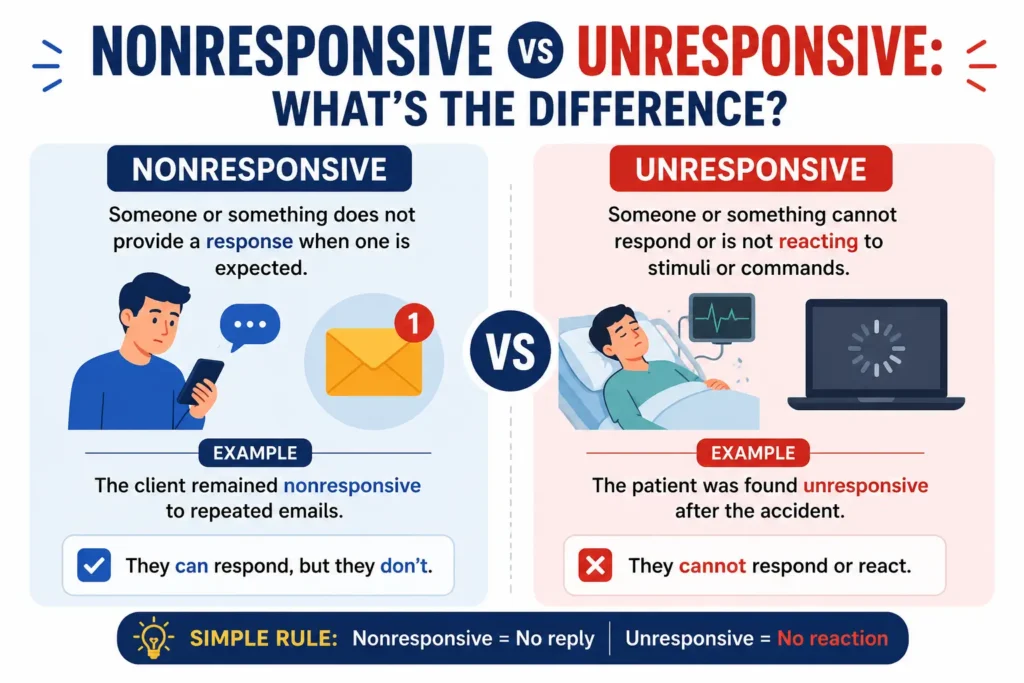
Nonresponsive vs Unresponsive may look similar at first glance, but these English words have different meaning, usage, and nuances depending on the context. Knowing the differences helps readers avoid confusion and improve writing with better clarity, precision, and accuracy. For example, Unresponsive often describes patients in medical situations, while Nonresponsive may describe people, computers, systems, or a client who does not reply.
While reviewing professional writing, I once stared at a frozen phone after sending an email and wondered which word was right. That real-life example helped me learn the distinction through practical tips instead of guessing. Once you stop using the terms interchangeably, the small shift becomes easier to understand and use correctly.
In the modern era, intelligent software suggests better wording and corrects spelling, yet you still need to choose the proper word. This is especially true in medical contexts, everyday communication, and other work where writers need clear, polished, and reliable language because every sentence and reaction matters.
Quick Answer
The simplest difference between nonresponsive and unresponsive is this:
- Nonresponsive usually means someone or something does not provide a response when one is expected.
- Unresponsive usually means someone or something cannot respond or is not reacting to stimuli, communication, or commands.
Quick Examples
✅ The client remained nonresponsive to repeated emails.
✅ The patient became unresponsive after the accident.
In the first sentence, the person could respond but didn’t.
In the second sentence, the person was physically unable to respond.
What Do “Nonresponsive” and “Unresponsive” Mean?
Although the words look similar, their usage differs depending on the context.
Meaning of Nonresponsive
Nonresponsive describes a person, organization, system, or process that fails to reply or react when a response is expected.
The word often appears in:
- Business communication
- Legal settings
- Customer service
- Government reports
- Surveys and research
Examples
- The vendor was nonresponsive during contract negotiations.
- Several participants were nonresponsive to the survey.
- The witness gave a nonresponsive answer.
In these examples, a response was expected but was not properly provided.
Meaning of Unresponsive
Unresponsive describes a person, machine, system, or object that does not react to stimuli, commands, or interaction.
The term frequently appears in:
- Healthcare
- Technology
- Everyday conversation
- Psychology
Examples
- The patient was found unresponsive.
- My phone became unresponsive after the update.
- The child appeared emotionally unresponsive.
Here, the focus is on an inability or failure to react.
Pronunciation
| Word | Pronunciation |
| Nonresponsive | non-ri-SPON-siv |
| Unresponsive | un-ri-SPON-siv |
Both words share the same root: responsive.
Parts of Speech and Word Forms
| Word | Part of Speech |
| Nonresponsive | Adjective |
| Unresponsive | Adjective |
| Responsive | Adjective |
| Responsiveness | Noun |
| Responsively | Adverb |
Nonresponsive vs Unresponsive: The Key Difference
The most important distinction involves the type of response being discussed.
| Aspect | Nonresponsive | Unresponsive |
| Main Meaning | Fails to provide a response | Fails to react or respond |
| Common Context | Communication | Physical, emotional, medical, technical |
| Implies Ability? | Usually yes | Often no |
| Medical Usage | Less common | Very common |
| Legal Usage | Very common | Rare |
| Technology Usage | Possible | Very common |
Simple Rule
Think of it this way:
- Nonresponsive = No reply
- Unresponsive = No reaction
That simple rule works in most situations.
Response vs Lack of Response
A nonresponsive person often chooses not to answer or fails to answer adequately.
An unresponsive person may be unable to answer because of physical, emotional, or technical reasons.
Example
Nonresponsive
“The customer was nonresponsive to our requests.”
The customer could reply but didn’t.
Unresponsive
“The customer became unresponsive during the medical emergency.”
The customer could not respond.
Why the Words Sometimes Overlap
In everyday conversation, people occasionally use the terms interchangeably.
For example:
- The employee was nonresponsive.
- The employee was unresponsive.
Both could mean the employee did not answer.
However, professional writing often prefers more precise wording.
Side-by-Side Comparison Table
| Feature | Nonresponsive | Unresponsive |
| Definition | Not providing a response | Not reacting or responding |
| Common Usage | Business, legal, communication | Medical, technology, behavior |
| Formality | Formal | Formal and general |
| Medical Context | Limited | Standard term |
| Legal Context | Common | Rare |
| Technology Context | Less common | Common |
| Emotional Context | Rare | Common |
| Interchangeable? | Sometimes | Sometimes |
| Preferred in Healthcare | No | Yes |
| Preferred in Court | Yes | No |
When to Use Nonresponsive
Use nonresponsive when discussing expected communication, answers, or cooperation.
Business and Workplace Communication
Businesses often describe people as nonresponsive when they fail to answer messages or requests.
Examples
- The supplier remained nonresponsive.
- Several stakeholders were nonresponsive.
- The client became nonresponsive after receiving the proposal.
Case Study
A company sends five follow-up emails regarding a contract.
The recipient reads the messages but never replies.
The correct description is:
“The client was nonresponsive.”
The person could respond but chose not to.
Email and Customer Service
Customer service teams frequently use the term.
Examples
- The customer was nonresponsive after our third contact attempt.
- The account was closed due to a nonresponsive customer.
Surveys and Research
Researchers often categorize participants as nonresponsive.
Examples
- Twenty respondents were classified as nonresponsive.
- The survey had a high rate of nonresponsive participants.
Legal and Court Proceedings
Legal professionals regularly use nonresponsive.
A witness gives a nonresponsive answer when the answer does not address the question asked.
Example
Attorney:
“Where were you on Friday?”
Witness:
“I always tell the truth.”
That answer is nonresponsive because it avoids the question.
Read this also: LYT Meaning in Text: What Does LYT Mean?
Administrative and Government Writing
Government agencies commonly describe individuals or organizations as nonresponsive when required information is not submitted.
When to Use Unresponsive
Use unresponsive when describing a lack of reaction.
Medical Situations
Healthcare professionals often use unresponsive to describe patients who do not react to verbal commands, touch, or other stimuli.
Examples
- The patient was unresponsive upon arrival.
- Emergency responders treated an unresponsive individual.
This is one of the most common uses of the word.
Technology and Software
Technology users frequently encounter unresponsive systems.
Examples
- The app became unresponsive.
- The computer was completely unresponsive.
- The touchscreen remained unresponsive.
Everyday Conversation
People also use the word casually.
Examples
- He seemed unresponsive during the discussion.
- The audience became unresponsive.
Emotional or Behavioral Descriptions
Psychologists and counselors may describe someone as emotionally unresponsive.
Examples
- The child appeared emotionally unresponsive.
- The patient remained unresponsive to therapy.
Nonresponsive vs Unresponsive in Medical English
Medical usage creates much of the confusion surrounding these words.
Which Term Healthcare Professionals Prefer
In healthcare settings, unresponsive is generally preferred.
Medical staff use it when patients fail to react to:
- Voice
- Touch
- Pain
- External stimuli
Example
“The patient was unresponsive but breathing.”
This wording is standard medical English.
Difference Between Unresponsive and Unconscious
These words are related but not identical.
| Term | Meaning |
| Unresponsive | Not reacting to stimuli |
| Unconscious | Not awake or aware |
A person may be unresponsive without being fully unconscious.
For example, certain medical conditions can prevent meaningful responses while consciousness remains partially intact.
Does Nonresponsive Mean the Same Thing in Medicine?
Sometimes medical documents use nonresponsive, but unresponsive is far more common and generally preferred.
Nonresponsive in Legal and Professional Writing
Legal English often uses nonresponsive in a specialized way.
Nonresponsive Witness or Answer
A nonresponsive answer fails to address the question.
Example
Question:
“Did you sign the agreement?”
Answer:
“I’ve worked with that company for years.”
The answer is nonresponsive.
Nonresponsive Client or Party
Law firms frequently describe clients or opposing parties as nonresponsive when communication stops.
Example
“The opposing party has remained nonresponsive.”
Why Lawyers Prefer Nonresponsive
The legal focus is on whether a response was provided.
Therefore, nonresponsive fits better than unresponsive.
Nonresponsive vs Unresponsive in Technology
Technology creates another area where the distinction matters.
Apps, Websites, and Software
Most technical writers prefer unresponsive.
Examples
- The website became unresponsive.
- The software remained unresponsive.
- The system was unresponsive after installation.
Devices and Electronics
Physical devices often become unresponsive when they stop reacting to input.
Examples
- The remote became unresponsive.
- The keyboard was unresponsive.
Which Word Sounds More Natural in Tech Writing?
Generally:
✅ Unresponsive software
✅ Unresponsive device
❌ Nonresponsive software (less common)
Everyday Examples of Both Words
Examples with Nonresponsive
- The manager was nonresponsive to employee concerns.
- The landlord became nonresponsive.
- Several participants were nonresponsive.
Examples with Unresponsive
- The patient was unresponsive.
- My tablet became unresponsive.
- The child appeared emotionally unresponsive.
Examples Where Either Word Could Work
- The employee was nonresponsive.
- The employee was unresponsive.
Both may be acceptable depending on whether you’re emphasizing communication or reaction.
Common Mistakes and How to Avoid Them
Using Nonresponsive for Medical Emergencies
Incorrect
“The patient was nonresponsive.”
Better
“The patient was unresponsive.”
Medical professionals generally prefer the second version.
Using Unresponsive for Legal Responses
Less Accurate
“The witness gave an unresponsive answer.”
Better
“The witness gave a nonresponsive answer.”
Assuming the Words Always Mean the Same Thing
Although they overlap, context matters.
Always consider whether you’re discussing:
- Communication
- Physical reactions
- Technology
- Healthcare
- Legal matters
Confusing Them with Irresponsive
Some writers mistakenly use irresponsive.
While the word exists, it is rare and generally avoided in modern American English.
Use:
- Nonresponsive
- Unresponsive
Instead.
Similar Words You Might Confuse
Unresponsive vs Unconscious
Unresponsive does not always mean unconscious.
Nonresponsive vs Irresponsive
Nonresponsive is much more common.
Nonresponsive vs Inactive
Inactive means not operating.
Nonresponsive means failing to respond.
Unresponsive vs Indifferent
Indifferent describes attitude.
Unresponsive describes reaction.
Nonresponsive vs Silent
Someone can be silent without being nonresponsive.
Which Word Should You Use? (Quick Decision Guide)
| Situation | Best Choice |
| Patient | Unresponsive |
| Medical report | Unresponsive |
| Email communication | Nonresponsive |
| Survey participant | Nonresponsive |
| Witness testimony | Nonresponsive |
| Computer problem | Unresponsive |
| Mobile app issue | Unresponsive |
| Emotional reaction | Unresponsive |
| Customer support issue | Nonresponsive |
Grammar and Style Notes
Are Both Words Standard English?
Yes.
Both are recognized standard English words.
American vs British English Usage
Both forms appear in American and British English.
However, usage patterns remain largely the same across both varieties.
Formal and Informal Usage
Both words work well in:
- Formal writing
- Professional communication
- Academic writing
Unresponsive also appears frequently in casual speech.
Dictionary Guidance
Most major dictionaries define:
- Nonresponsive as failing to respond.
- Unresponsive as not reacting or responding.
The distinction often depends on context rather than strict grammar rules.
Memory Trick to Remember the Difference
Try this simple shortcut:
Nonresponsive = No Reply
Unresponsive = No Reaction
If you’re talking about communication, choose nonresponsive.
If you’re talking about physical, emotional, or technical reactions, choose unresponsive.
Practice Exercises
Choose the Correct Word
- The patient remained _____ throughout the examination.
- The vendor became _____ after receiving the contract.
- My phone is completely _____.
- The witness gave a _____ answer.
Answers
- Unresponsive
- Nonresponsive
- Unresponsive
- Nonresponsive
Fill in the Blanks
- The customer was ______ to repeated emails.
- The computer became ______ after the update.
- The witness gave a ______ statement.
- The patient was found ______.
Answers
- Nonresponsive
- Unresponsive
- Nonresponsive
- Unresponsive
Correct the Sentence
Incorrect
“The witness provided an unresponsive answer.”
Better
“The witness provided a nonresponsive answer.”
Synonyms and Related Words
Synonyms of Nonresponsive
- Uncooperative
- Silent
- Ignoring
- Uncommunicative
- Unreceptive
Synonyms of Unresponsive
- Inactive
- Insensitive
- Unreactive
- Motionless
- Detached
Related Terms
- Responsive
- Response
- React
- Reaction
- Communication
- Feedback
- Interaction
- Stimulus
FAQs
Q1. What is the difference between nonresponsive and unresponsive?
Nonresponsive usually means someone does not reply, while unresponsive means someone or something does not react. The correct choice depends on the situation.
Q2. Can nonresponsive and unresponsive be used interchangeably?
Sometimes they can, but not in every context. Professional, medical, and legal writing often prefers one word over the other.
Q3. Which word is correct in medical situations?
Unresponsive is the standard medical term for a patient who does not react to voice, touch, or other stimuli. It is more common than nonresponsive in healthcare.
Q4. Is nonresponsive used in business communication?
Yes, nonresponsive is commonly used when a client, customer, or employee fails to answer emails, calls, or messages. It describes a lack of communication rather than a lack of reaction.
Q5. Why is unresponsive used for computers and apps?
A computer or app is unresponsive because it stops reacting to commands like clicks or taps. Since devices react instead of communicate, unresponsive is the more natural word.
Conclusion
Choosing between Nonresponsive vs Unresponsive is easier once you understand the context. Although both words describe a lack of response, they are not always interchangeable. Nonresponsive usually refers to someone or something that does not provide an expected reply, making it the better choice for business, legal, customer service, and communication situations. Unresponsive, on the other hand, is commonly used when a person, device, or system does not react, especially in medical and technology contexts.
A simple way to remember the difference is this: Nonresponsive = No Reply and Unresponsive = No Reaction. Keeping this rule in mind will help you choose the correct word in everyday conversations, professional writing, emails, reports, and technical documents. Using the right term makes your writing clearer, more accurate, and easier for readers to understand.
