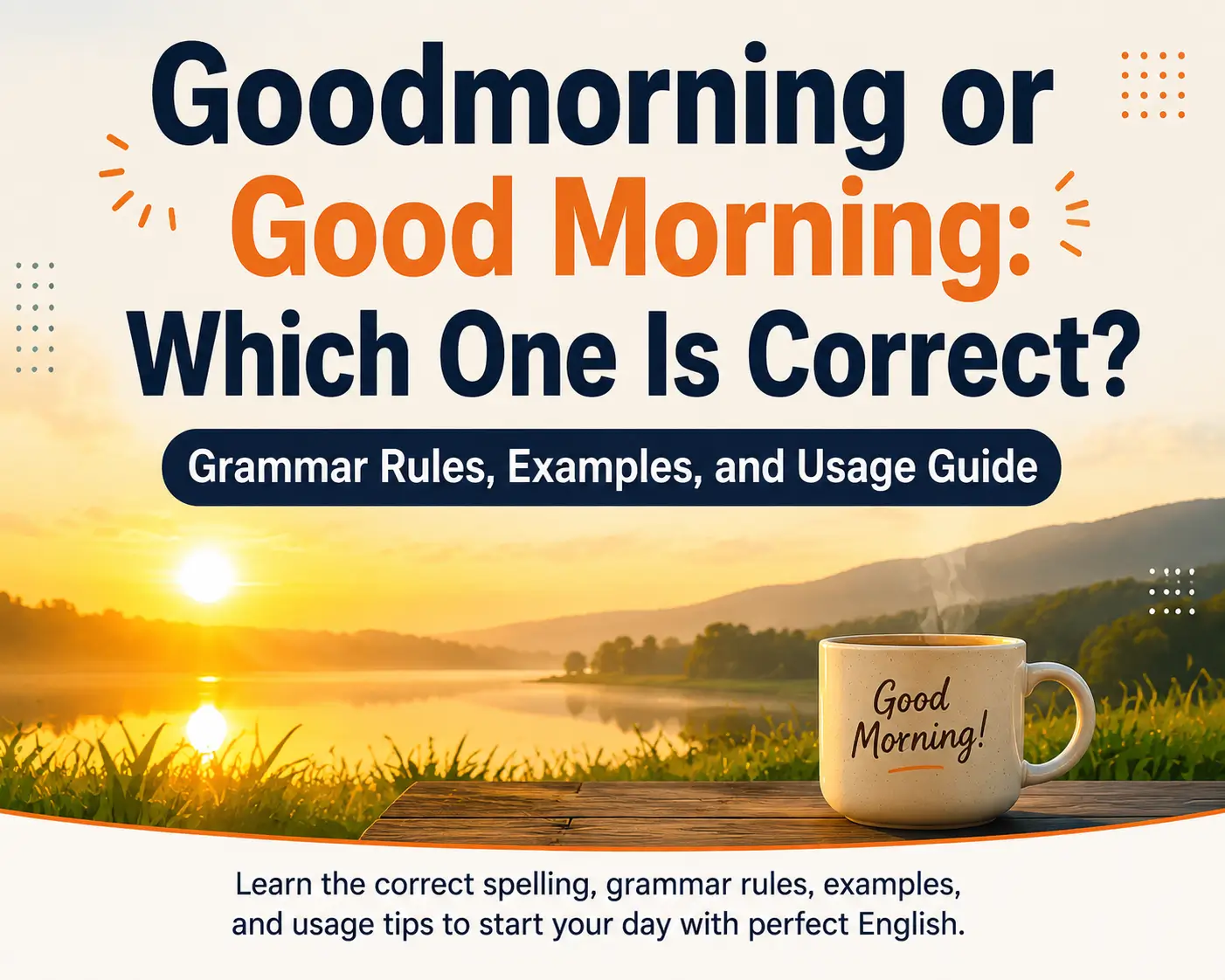
Goodmorning or Good Morning is a common grammar question, and the correct answer is simple: good morning is written as two words. Goodmorning is a spelling error in standard English. Whether you’re writing an email, sending a text message, greeting coworkers, or posting on social media, use good morning.
Knowing the correct English spelling, word spacing, and grammar rule helps you communicate clearly. The phrase is a familiar morning greeting that works in both formal writing and casual communication.
You should also know how to capitalize and punctuate it. For example, Good morning, Sarah. is correct because the name is a direct address. Once you understand these simple rules, you can use this correct expression confidently in everyday and professional communication.
Quick Answer: Goodmorning or Good Morning?
The correct spelling is good morning.
Good morning is a greeting made from two separate words:
- good — an adjective
- morning — a noun
Together, they form a familiar greeting used during the morning.
Correct:
Good morning! How are you?
Incorrect:
Goodmorning! How are you?
You may sometimes see goodmorning in usernames, hashtags, brand names, or casual online writing. However, that doesn’t make it the standard English spelling.
For normal writing, use good morning.
What Does Good Morning Mean?
Good morning is a greeting used when meeting, speaking to, or writing to someone during the morning.
It works much like:
- Good afternoon
- Good evening
- Hello
- Hi
For example:
Good morning, Sarah.
The speaker is greeting Sarah during the morning.
The phrase can also express a wish for someone to have a pleasant morning:
Good morning! I hope your day starts well.
In everyday American English, however, people usually treat it simply as a polite greeting rather than a literal wish.
How Good Morning Works in a Sentence
The phrase often stands alone:
Good morning!
It can also appear before a person’s name:
Good morning, David.
Or before a group:
Good morning, everyone.
You can also mention the greeting itself inside a sentence:
She gave us a cheerful good morning before the meeting.
Here, the phrase is being discussed rather than directly used as a greeting.
Why Is Good Morning Written as Two Words?
The spelling makes more sense when you look at the grammar.
In good morning, the word good describes morning. English commonly keeps this type of adjective-plus-noun combination as two words.
Compare:
- good morning
- good afternoon
- good evening
- beautiful morning
- busy morning
- cold morning
You wouldn’t normally write beautifulmorning or busymorning. In the same way, standard English keeps good morning separate.
Good Is an Adjective
An adjective describes a noun.
In the phrase:
good morning
Good describes the quality of the morning.
The structure is straightforward:
adjective + noun
That grammatical pattern is one reason the two words remain separate.
Good Morning Is Not a Standard Closed Compound
English has many compound words. A compound forms when two words work together as a single idea.
Some are written as one word:
- bedroom
- sunrise
- notebook
- weekend
Others remain open:
- high school
- post office
- living room
Still others use hyphens in certain roles:
- well-known author
- part-time job
English compound spelling isn’t always predictable. However, good morning has remained an open expression, meaning the words are written separately.
Goodmorning vs. Good Morning: Key Differences
The main difference is simple: one is standard English, and the other isn’t.
| Form | Standard English? | Meaning | Example |
| good morning | Yes | A morning greeting | Good morning, Maya. |
| goodmorning | No | Intended to mean the same greeting | Goodmorning, Maya. |
| Good morning | Yes | Greeting at the start of a sentence | Good morning! |
| Good Morning | Sometimes | Often used in titles or stylized text | Good Morning America |
| GM | Informal only | Abbreviation for good morning | GM! Hope you’re well. |
For ordinary sentences, emails, school assignments, and professional communication, choose good morning.
Why Do People Write Goodmorning as One Word?
The mistake is understandable because English contains many expressions that have gradually become single words.
However, goodmorning hasn’t become a standard closed compound.
Confusion With Other Compound Words
Writers may compare good morning with words such as:
- goodnight
- goodbye
- daytime
- nighttime
Because some familiar expressions are written as one word, goodmorning may look possible.
However, English doesn’t require similar phrases to follow identical spelling patterns.
Texting and Social Media Habits
Fast typing often leads people to remove spaces.
For example, someone might write:
goodmorninggg ☀️
in a casual social media comment.
That may be expressive and understandable, but it isn’t standard spelling.
Informal communication allows creativity. Formal writing usually doesn’t.
Hashtags Remove Spaces
Hashtags are another common reason people see the words joined:
#GoodMorning
Social platforms don’t allow spaces inside a single hashtag. Therefore, the combined form reflects hashtag formatting, not normal spelling.
You would still write:
Good morning, everyone! #GoodMorning
Usernames and Brand Names Follow Different Rules
A username may appear as:
@goodmorningdaily
That doesn’t mean goodmorning is a dictionary-standard spelling. Usernames often remove spaces because platforms require or encourage compact formatting.
Good Morning vs. Goodnight: Why Is One Two Words?
This comparison causes a lot of confusion.
Good morning is normally two words.
Goodnight is commonly one word when used as a farewell before sleeping or at the end of the day.
For example:
Good morning, Mom.
Goodnight, Mom.
English spelling develops through usage over time. Some common word combinations eventually become closed compounds, while others remain separate.
Good Night Can Also Be Two Words
The two-word form good night can still appear when good directly describes the noun night.
For example:
We had a good night at the concert.
Here, the meaning is literally that the night was enjoyable.
Compare:
Goodnight, everyone.
This is a farewell.
We had a good night.
This describes the night.
That distinction helps explain why you shouldn’t assume goodmorning must be one word just because goodnight can be.
How to Use Good Morning Correctly
Once you know the spelling, the next step is learning how the phrase works in real situations.
As a Standalone Greeting
You can use it by itself:
Good morning!
This is natural in both casual and professional settings.
Before a Person’s Name
Add a comma before the person’s name:
Good morning, Alex.
Alex is being directly addressed, so the comma separates the greeting from the name.
Before a Group
The same rule applies when addressing a group:
Good morning, everyone.
Good morning, team.
Good morning, class.
Within a Sentence
When you’re talking about the greeting instead of using it, lowercase is usually appropriate:
He said good morning and walked into the office.
The phrase isn’t beginning a sentence or functioning as a heading, so good and morning don’t need special capitalization.
Capitalization Rules for Good Morning
Many writers know the spacing rule but still wonder whether both words should be capitalized.
The answer depends on context.
At the Beginning of a Sentence
Capitalize only the first word under normal sentence capitalization:
Good morning, everyone.
You usually don’t need:
Good Morning, everyone.
unless you’re following a title-style format or intentional design choice.
In Email Greetings
Email greetings are sometimes treated like headings or salutations, so capitalization can vary by style.
A clean professional form is:
Good morning, Jennifer,
or:
Good morning, Jennifer.
Some people write:
Good Morning, Jennifer,
This capitalization is common in business communication, but it isn’t necessary under ordinary sentence-style capitalization.
The safest general choice is Good morning.
In Titles and Headings
Title case may capitalize both words:
Good Morning Messages for Your Team
Here, Good Morning appears as part of a title, so title capitalization rules apply.
In the Middle of a Sentence
Use lowercase when the phrase appears normally within a sentence:
I said good morning when I entered the room.
Punctuation With Good Morning
Correct spelling is only part of the issue. Punctuation matters too, especially when you address someone directly.
Good Morning, John
When a name follows the greeting, use a comma:
Good morning, John.
The comma is required because John is a direct address.
Compare:
Incorrect:
Good morning John.
Preferred:
Good morning, John.
The same pattern works with titles and group names:
Good morning, Dr. Lee.
Good morning, everyone.
Good morning, students.
Good Morning Everyone or Good Morning, Everyone?
The standard punctuation is:
Good morning, everyone.
The comma separates the greeting from the person or group being addressed.
In texts and social media posts, people often omit this comma. However, formal and edited writing should include it.
Exclamation Point or Period?
Both can work.
A period sounds calm and professional:
Good morning, Rachel.
An exclamation point sounds warmer or more enthusiastic:
Good morning, Rachel!
Choose punctuation based on tone.
Good Morning in Emails and Professional Writing
Good morning works well in professional emails because it’s polite, clear, and warmer than a very formal salutation.
For example:
Good morning, Ms. Carter,
I’m sending the updated report for your review.
This greeting feels professional without sounding stiff.
Greeting One Person
Use the person’s name when possible:
Good morning, Michael,
or:
Good morning, Michael.
Both styles appear in email. Your organization’s style or personal preference may determine which punctuation you use.
Greeting a Team
You can write:
Good morning, team.
Good morning, everyone.
Good morning, all.
Good morning, everyone often sounds the most natural and friendly.
Is Good Morning Too Formal?
Not usually.
It sits between very casual greetings and more formal salutations.
Compare:
| Greeting | Typical Tone |
| Hey | Very casual |
| Hi | Casual to professional |
| Hello | Neutral |
| Good morning | Polite and professional |
| Dear Ms. Wilson | More formal |
A workplace email can comfortably begin with Good morning.
Good Morning in Text Messages and Casual Conversation
Casual writing gives you more flexibility.
You might text:
Good morning! ☀️
Morning!
GM!
All three may work, depending on the relationship and situation.
Is Morning Correct by Itself?
Yes.
Morning! is a common shortened greeting in conversational English.
For example:
“Morning, Chris.”
It sounds more casual than Good morning but carries the same basic meaning.
Is GM Correct?
GM is a common abbreviation in texting, group chats, and social media.
For example:
GM everyone!
However, it isn’t ideal for formal emails, essays, business reports, or academic writing.
Use the full phrase when clarity and professionalism matter.
Good Morning on Social Media
Social media often mixes standard English with stylistic spelling.
A caption might say:
Good morning from New York!
That is standard spelling.
A hashtag might appear as:
#GoodMorning
That’s also fine because hashtags cannot contain regular spaces.
However, don’t use hashtag formatting as evidence that the phrase should normally be written as one word.
Correct regular sentence:
Good morning, friends!
Correct hashtag:
#GoodMorning
Incorrect standard spelling:
Goodmorning, friends!
When Should You Say Good Morning?
There isn’t a universal clock rule that determines exactly when good morning becomes incorrect.
In everyday American English, people generally use it from early morning until around noon.
For example:
- 7:00 a.m. — clearly good morning
- 9:30 a.m. — clearly good morning
- 11:45 a.m. — usually good morning
- 12:30 p.m. — good afternoon is more natural
Context matters.
A late-morning meeting at 11:50 a.m. may still begin with:
Good morning, everyone.
However, once you’re clearly into the afternoon, good afternoon is the better choice.
American vs. British English: Is There a Difference?
Both American English and British English normally write the greeting as good morning.
There isn’t a standard regional difference in the spelling.
Correct in American English:
Good morning.
Correct in British English:
Good morning.
So unlike pairs such as color/colour or center/centre, this phrase doesn’t change spelling between the two major varieties.
Common Mistakes With Good Morning
Most errors involve spacing, capitalization, or punctuation rather than meaning.
Writing Goodmorning
Incorrect:
Goodmorning, Emma.
Correct:
Good morning, Emma.
Always keep the two words separate in normal English.
Adding a Hyphen
Incorrect:
Good-morning, everyone.
Correct:
Good morning, everyone.
The greeting doesn’t require a hyphen.
Overcapitalizing the Phrase
Unnecessary in a normal sentence:
I wished everyone a Good Morning.
Better:
I wished everyone a good morning.
Capitalization depends on sentence position and context, not on the phrase itself.
Forgetting the Direct-Address Comma
Incorrect:
Good morning Sarah.
Correct:
Good morning, Sarah.
The comma tells the reader that Sarah is the person being addressed.
Correct and Incorrect Examples Explained
Seeing the rule in context makes it easier to remember.
| Example | Correct? | Why? |
| Good morning, James. | Yes | Two words and correct direct-address comma |
| Goodmorning, James. | No | The phrase shouldn’t be one word |
| Good-morning, James. | No | No hyphen is needed |
| Good morning everyone. | Not ideal | A comma should come before “everyone” |
| Good morning, everyone! | Yes | Correct spacing and punctuation |
| She said good morning to me. | Yes | Lowercase works inside a sentence |
| Morning, Anna! | Yes | Natural informal greeting |
| #GoodMorning | Yes | Acceptable hashtag formatting |
Real-Life Examples of Good Morning
The phrase appears in many everyday settings.
At Work
Good morning, team. The meeting will start at 9:30.
This sounds professional and welcoming.
At School
Good morning, class. Please open your books to page 25.
The comma marks direct address.
In an Email
Good morning, Daniel,
Thank you for sending the revised schedule.
This is appropriate for professional communication.
In a Text
Good morning! Hope you have a great day.
This sounds friendly and natural.
On Social Media
Good morning, everyone! What’s everyone working on today?
Again, the words stay separate even in casual online writing.
Good Morning vs. Similar Greetings
Choosing the right greeting often depends on time, tone, and formality.
Good Morning vs. Morning
Good morning sounds complete and polite.
Morning sounds shorter and more casual.
Good morning, Lisa.
Professional or neutral.
Morning, Lisa!
Friendly and informal.
Good Morning vs. Hello
Good morning refers to the time of day.
Hello works at any time.
You might use hello when you don’t know whether the recipient will read a message in the morning.
Good Morning vs. Good Afternoon
Use good morning before midday in most situations.
Use good afternoon after noon.
Both phrases stay as two words.
Good Morning vs. Good Evening
Good evening works later in the day, usually from late afternoon or early evening onward.
Again, it remains two words:
Good evening, everyone.
Good Morning vs. Goodnight
This pair follows different spelling conventions.
- good morning — two words
- goodnight — commonly one word as a farewell
Don’t use goodnight as proof that goodmorning should also be one word.
Other Ways to Say Good Morning
Sometimes another greeting fits the tone better.
Professional Alternatives
- Hello
- Hi
- Greetings
- Good day
- Welcome
For example:
Hello, Dr. Adams.
This works regardless of when the message is opened.
Casual Alternatives
- Morning!
- Hey!
- Hi!
- Rise and shine!
- Morning, everyone!
Rise and shine is cheerful but very informal, so it may not suit professional communication.
Easy Memory Tricks for Good Morning
A simple memory trick can prevent the spelling mistake.
Think of Good Afternoon
You already write:
good afternoon
as two words.
Use the same pattern for:
good morning
Replace Good With Another Adjective
Try replacing good:
- beautiful morning
- quiet morning
- cold morning
- busy morning
Since those phrases stay separate, good morning should look natural as two words too.
Remember That Hashtags Are Different
You may see:
#GoodMorning
because hashtags join words.
In a normal sentence, restore the space:
Good morning!
Quick Grammar Tips
Keep these rules in mind:
- Write good morning as two words.
- Don’t write goodmorning in standard English.
- Don’t hyphenate the phrase.
- Capitalize Good when the greeting begins a sentence.
- Usually lowercase morning unless title capitalization applies.
- Add a comma before a name or group being directly addressed.
- Use GM only in very informal communication.
- Treat #GoodMorning as hashtag formatting, not normal spelling.
Quick Practice: Goodmorning or Good Morning?
Choose the correct sentence:
A. Goodmorning, Claire.
B. Good morning, Claire.
Correct answer: B
The greeting must be written as two words.
Now fix this sentence:
Good morning everyone.
Correct version:
Good morning, everyone.
The space is correct, but the sentence needs a comma because everyone is being addressed directly.
Another example:
She wished me a Good Morning before work.
Better:
She wished me a good morning before work.
The phrase is part of the sentence, so it doesn’t need title-style capitalization.
Frequently Asked Questions
Q1: Is goodmorning or good morning correct?
Good morning is the correct spelling in standard English. It should always appear as two separate words in normal writing. Goodmorning is considered a spelling mistake.
Q2: Is good morning one word or two words?
Good morning is two words. The word good describes morning, so the expression stays separate in standard English usage.
Q3: Is goodmorning ever acceptable?
Goodmorning isn’t standard English. You may see it in usernames, hashtags, brand names, or very informal posts, but that doesn’t make it the correct spelling for regular writing.
Q4: Should both words in Good Morning be capitalized?
Usually, no. At the beginning of a sentence or greeting, write Good morning. Both words may be capitalized in titles, headlines, or intentional design styles.
Q5: Do you put a comma after good morning?
A comma is needed when you directly address someone:
Good morning, David.
However, a standalone greeting doesn’t need a comma:
Good morning!
Q6: Is “Good morning everyone” grammatically correct?
The wording is correct, but standard punctuation requires a comma before the person or group being addressed:
Good morning, everyone.
Q7: Can I use good morning in a professional email?
Yes. Good morning is a polite and natural professional email greeting. For example, Good morning, Ms. Taylor, works well when starting a workplace message.
Q8: Can I write GM instead of good morning?
GM is common in texting, chats, and social media, but it is highly informal. Use good morning in professional, academic, or other formal writing.
Q9: Why is goodnight one word but good morning is two words?
English compounds don’t always follow the same spelling pattern. Goodnight developed into an accepted one-word farewell, while good morning remains an open, two-word expression.
Q10: Is good morning formal or informal?
Good morning works in both formal and informal situations. You can use it with friends, teachers, customers, coworkers, managers, or anyone you meet during the morning.
Conclusion
When choosing between goodmorning or good morning, always use good morning in standard English. It is the correct form, correct spelling, and accepted morning greeting, while goodmorning is a spelling error.
Remember the main rule: keep the expression as two words. Also, use proper capitalization and add a comma when directly addressing someone, as in Good morning, Alex.
Whether you’re writing a professional email, sending a text message, speaking at work, or posting on social media, good morning is the clear and grammatically correct choice. Using the proper form improves clarity, grammar accuracy, and professional communication.