
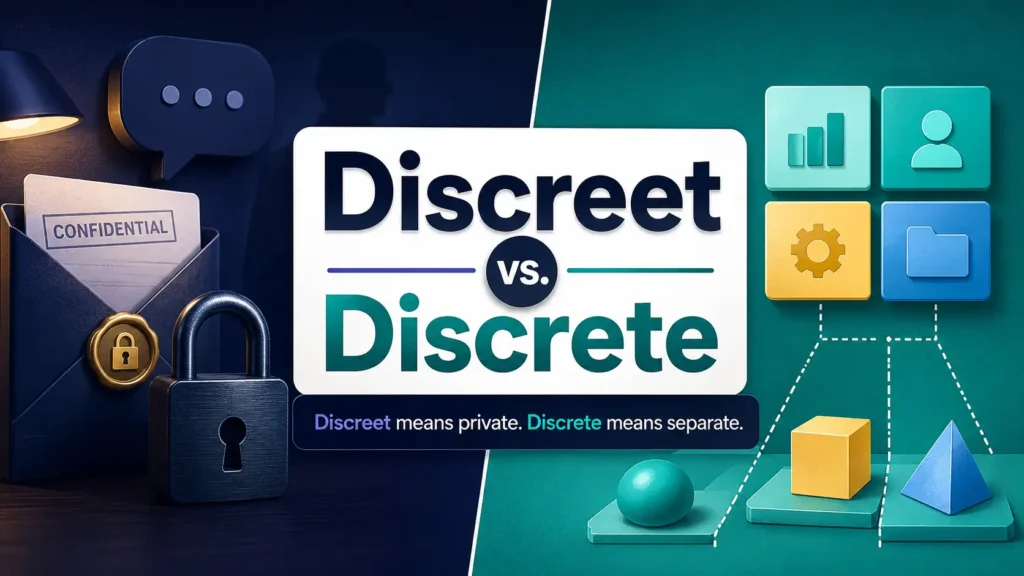
Discreet vs. discrete is a common word-choice problem because both words sound the same but have different meanings. Discreet means private, careful, tactful, or unlikely to attract attention. Discrete means separate, distinct, or divided into individual parts.
Choosing the wrong spelling can change your message. For example, a discreet conversation is private, while discrete conversations are separate discussions. Therefore, context matters more than pronunciation.
This guide explains the difference between discreet and discrete, their definitions, spelling, pronunciation, related word forms, and common mistakes. You’ll also learn simple grammar tips, real-life examples, and a memory trick that makes the correct choice easier.
Quick Answer: Discreet or Discrete?
Use discreet when you mean:
- Private
- Tactful
- Careful
- Subtle
- Unobtrusive
- Unlikely to reveal confidential information
Use discrete when you mean:
- Separate
- Distinct
- Individual
- Divided into parts
- Countable rather than continuous
Here’s the difference in two simple sentences:
- Please be discreet about the company’s hiring plans.
- The hiring process has four discrete stages.
In the first sentence, someone should keep information private. In the second, the stages are separate from one another.
Easy rule: Use discreet for privacy. Use discrete for separation.
Discreet vs. Discrete at a Glance
| Word | Part of speech | Main meaning | Common replacements | Example |
| Discreet | Adjective | Private, tactful, careful, or subtle | Private, careful, tactful, unobtrusive | She made a discreet inquiry. |
| Discrete | Adjective | Separate or distinct | Separate, individual, distinct | The plan has three discrete phases. |
Both words are adjectives, so they can describe nouns or appear after linking verbs.
- The discussion was discreet.
- The project stages were discrete.
Because their pronunciation and grammatical role are the same, you must use the sentence’s meaning to choose the correct spelling.
What Does Discreet Mean?
Discreet is an adjective that describes careful, private, tactful, or unobtrusive behavior. It often refers to people who protect confidential information or avoid causing embarrassment.
It can also describe actions, objects, services, or designs that don’t attract much attention.
Discreet Can Mean Careful About Privacy
A discreet person knows when not to share sensitive information. They may know a secret, but they don’t announce it or discuss it carelessly.
Consider these examples:
- Please be discreet about Maya’s medical leave.
- The attorney was discreet when discussing the case.
- You can trust Jordan to be discreet.
- The manager made a discreet inquiry about the complaint.
Each sentence involves privacy or careful judgment. The information may be personal, confidential, or potentially embarrassing.
A discreet person isn’t necessarily secretive in a dishonest way. Instead, the word usually suggests good judgment.
For example:
- A discreet employee protects a coworker’s private information.
- A secretive employee may hide information for unclear or suspicious reasons.
Therefore, discreet often has a positive meaning. It suggests tact, respect, and self-control.
Discreet Can Mean Unobtrusive
Discreet can also describe something designed not to attract attention.
For example:
- The hotel has a discreet entrance for private guests.
- She gave me a discreet signal during the meeting.
- The security officer watched from a discreet distance.
- The company uses discreet packaging.
- He wore a suit with a discreet pattern.
In these examples, the person or object stays in the background. It doesn’t look loud, obvious, or attention-grabbing.
Discreet packaging, for instance, usually means plain packaging that doesn’t reveal what’s inside. It doesn’t mean the package has separate parts.
Discreet Can Mean Tactful
Sometimes, discreet describes behavior that prevents embarrassment.
- She discreetly told him that his microphone was still on.
- The teacher gave the student a discreet reminder.
- He offered discreet assistance without drawing attention to the mistake.
In each case, the person handles an awkward situation carefully. They correct the problem without embarrassing anyone.
Common Phrases With Discreet
You’ll often see discreet in these combinations:
- discreet conversation
- discreet inquiry
- discreet manner
- discreet location
- discreet signal
- discreet service
- discreet entrance
- discreet packaging
- discreet design
- discreet reminder
- discreet distance
- discreet assistance
These phrases usually involve privacy, subtlety, or careful behavior.
What Does Discrete Mean?
Discrete is an adjective meaning separate, distinct, or individually identifiable. It describes things that can be treated as separate units, even when they belong to a larger group.
For example:
- The report contains five discrete sections.
- Each department performs a discrete function.
- The police investigated three discrete incidents.
- The course includes six discrete modules.
The sections, functions, incidents, and modules are connected to a larger subject. However, each one remains separate and identifiable.
Discrete Describes Separate Parts
Use discrete when something consists of individual components.
- The machine contains several discrete components.
- The project includes four discrete tasks.
- Researchers divided the answers into discrete categories.
- The software treats each request as a discrete event.
- The company operates through three discrete business units.
In each example, the parts can be separated or counted.
The word doesn’t mean that the items are far apart. Instead, it means that they have clear boundaries or identities.
For example, two departments may work closely together. Still, they can perform discrete functions if each has a separate responsibility.
Discrete in Mathematics and Statistics
In mathematics and statistics, discrete often contrasts with continuous.
Discrete data contains separate, countable values. Usually, you can list those values individually.
Examples include:
- The number of students in a classroom
- The number of cars in a parking lot
- The number of emails received today
- The number of goals scored in a game
You can have 20 or 21 students, but you can’t have 20.6 students. Therefore, the number of students is a discrete variable.
Continuous data, by contrast, can take any value within a range.
Examples include:
- Height
- Weight
- Temperature
- Distance
- Time
A person’s height might be 68 inches, 68.2 inches, or 68.25 inches. Because many possible measurements exist between two points, height is usually treated as continuous.
| Data type | Meaning | Example |
| Discrete data | Separate, countable values | Number of customers |
| Continuous data | Measurable values along a range | Customer wait time |
The distinction matters in research because discrete and continuous data often require different methods of analysis.
Discrete in Technology and Science
Discrete frequently appears in technical, scientific, and academic writing.
Common phrases include:
- discrete component
- discrete signal
- discrete event
- discrete system
- discrete mathematics
- discrete variable
- discrete value
- discrete category
- discrete probability distribution
For example, a discrete event happens at a specific point. A discrete system changes through separate steps or states.
Likewise, discrete mathematics studies countable structures, such as graphs, logical statements, and combinations. It differs from areas that focus heavily on continuous quantities.
In everyday conversation, discrete appears less often than discreet. However, it remains common in business, education, computing, engineering, statistics, and research.
How to Choose Between Discreet and Discrete
You don’t need to memorize a complicated grammar rule. Instead, focus on the meaning of the sentence.
Ask Whether Privacy or Tact Is Involved
Choose discreet when the sentence involves:
- Privacy
- Confidential information
- Careful behavior
- Good judgment
- Avoiding embarrassment
- Avoiding attention
- Subtle appearance
Example:
- We need a discreet place to discuss the merger.
The place should provide privacy and avoid attention. Therefore, discreet is correct.
Ask Whether Things Are Separate
Choose discrete when the sentence involves:
- Separate units
- Distinct categories
- Individual events
- Divided sections
- Countable values
- Independent parts
Example:
- The merger will occur in three discrete phases.
The phases are separate parts of the process. Therefore, discrete is correct.
Use the Replacement Test
Try replacing the confusing word with a simpler synonym.
Use discreet if one of these words fits:
- Private
- Tactful
- Careful
- Subtle
- Unobtrusive
Use discrete if one of these words fits:
- Separate
- Distinct
- Individual
- Independent
Consider this sentence:
- She asked a ___ question.
“She asked a tactful question” makes sense. Therefore, use discreet.
Now consider this example:
- The study examined four ___ groups.
“The study examined four separate groups” makes sense. Therefore, use discrete.
This replacement test works in most situations.
Key Differences Between Discreet and Discrete
Although the words look similar, they describe different ideas.
| Point of comparison | Discreet | Discrete |
| Core idea | Privacy or tact | Separation |
| Common context | Personal, social, professional | Technical, academic, organizational |
| Describes people? | Yes, commonly | Rarely and usually technically |
| Describes data? | Only when data collection is private | Yes, when values are countable |
| Common adverb | Discreetly | Discretely |
| Opposite ideas | Indiscreet, obvious | Continuous, connected |
| Example | A discreet warning | Three discrete warnings |
The easiest distinction is this:
- Discreet focuses on how something is handled.
- Discrete focuses on how something is divided.
Discreet vs. Discrete in Similar Sentences
Seeing both words in similar contexts makes the difference easier to understand.
A Discreet Request vs. Discrete Requests
- A discreet request is made carefully or privately.
- Discrete requests are separate requests.
Example:
- She made a discreet request to speak with the principal.
- The parents submitted three discrete requests.
The first sentence describes the manner of the request. The second describes the number and separation of the requests.
A Discreet Meeting vs. Discrete Meetings
- A discreet meeting is private or intentionally unnoticed.
- Discrete meetings are separate meetings.
Example:
- The executives arranged a discreet meeting after work.
- The committee held two discrete meetings on separate issues.
Discreet Packaging vs. Discrete Packages
- Discreet packaging hides or minimizes information about the contents.
- Discrete packages are separate packages.
Example:
- The pharmacy offers discreet packaging for home deliveries.
- The order arrived in three discrete packages.
A Discreet Design vs. Discrete Design Elements
- A discreet design is subtle and not flashy.
- Discrete design elements are distinct parts of a design.
Example:
- The office has a discreet design with neutral furniture.
- The logo contains three discrete design elements.
Discreet Events vs. Discrete Events
A discreet event would be private, quiet, or intentionally unnoticed. A discrete event is a separate occurrence.
- The organization held a discreet event for anonymous donors.
- The software records each login as a discrete event.
The meanings are different, even though both phrases are grammatically correct.
Real-Life Examples in American English
The difference between these words becomes clearer when you see them in familiar settings.
At Work
Imagine an employee tells a supervisor about a private health concern.
The supervisor should be discreet. That means the supervisor shouldn’t share the information with people who don’t need to know.
Now imagine the company divides a project into separate workstreams.
Those workstreams are discrete because each has its own purpose, team, and deadline.
- HR handled the complaint discreetly.
- The project has four discrete workstreams.
At School
A teacher may speak discreetly to a student who is struggling. That approach avoids embarrassing the student in front of the class.
Meanwhile, the course may contain several discrete units, such as grammar, vocabulary, reading, and writing.
- The teacher gave Elena a discreet reminder.
- The class covers five discrete language skills.
In Text Messages and Social Media
In casual writing, discreet often appears when someone wants privacy.
- Please be discreet. I haven’t told the team yet.
- Can we talk somewhere more discreet?
- She discreetly removed the post.
By contrast, discrete appears less often in casual messages. You might use it when discussing separate issues.
- Those are two discrete problems.
- Let’s handle each task as a discrete item.
In Business and Marketing
Businesses often use both words, but with different meanings.
- Discreet shipping doesn’t reveal what a customer purchased.
- Discrete shipments arrive separately.
- Discreet branding is subtle.
- Discrete product lines serve separate customer groups.
Choosing the wrong spelling can confuse customers. For instance, “discrete shipping” may suggest multiple separate shipments rather than private packaging.
In Research and Technology
Technical writers use discrete far more often.
- The model uses discrete variables.
- The program processes each file discretely.
- Researchers identified two discrete populations.
- The process consists of six discrete steps.
In these settings, the word almost always means separate, countable, or distinct.
Common Mistakes With Discreet and Discrete
Most errors happen because the two words sound alike. However, you can catch them by checking the intended meaning.
Using Discrete When You Mean Private
Incorrect: Please be discrete about the salary discussion.
Correct: Please be discreet about the salary discussion.
The sentence asks someone to protect confidential information. Therefore, discreet is correct.
Using Discreet for Separate Categories
Incorrect: The survey divides customers into four discreet groups.
Correct: The survey divides customers into four discrete groups.
The groups are separate categories. They aren’t tactful or private.
Writing Discreet Data Instead of Discrete Data
Usually incorrect: The researchers collected discreet data points.
Correct: The researchers collected discrete data points.
Data points are separate values, so discrete is the correct word.
However, discreet data collection can be correct. In that phrase, the collection process is private or unobtrusive.
Compare:
- The study used discrete data from a customer survey.
- The team used discreet data collection methods to avoid interrupting shoppers.
The first sentence describes the type of data. The second describes how researchers gathered it.
Assuming the Words Are Regional Spellings
Discreet isn’t the British spelling of discrete, and discrete isn’t the American spelling of discreet.
Both words exist in American and British English. Their meanings remain different in both varieties.
Using Discrete for a Tactful Person
Incorrect: She’s very discrete with sensitive information.
Correct: She’s very discreet with sensitive information.
A person who handles sensitive information carefully is discreet.
Discreetly vs. Discretely
The adverb forms also have different meanings.
- Discreetly means privately, carefully, tactfully, or without attracting attention.
- Discretely means separately or as individual units.
| Adverb | Meaning | Example |
| Discreetly | In a private or subtle way | He discreetly closed the office door. |
| Discretely | Separately | The samples were analyzed discretely. |
Discreetly is common in everyday English.
- She discreetly silenced her phone.
- He discreetly warned me about the delay.
- The server discreetly corrected the bill.
Discretely is less common and usually appears in technical or formal writing.
- The system evaluates each request discretely.
- Researchers tested the variables discretely.
- Each unit operates discretely from the others.
When writing for a general audience, you may prefer separately instead of discretely. The simpler word is often clearer.
Related Words and Word Forms
The word families can also cause confusion.
| Base word | Related form | Part of speech | Meaning |
| discreet | discreetly | Adverb | In a private, tactful, or subtle way |
| discreet | discretion | Noun | Careful judgment or freedom to decide |
| discreet | indiscreet | Adjective | Careless about privacy or good judgment |
| discreet | indiscretion | Noun | An unwise or improper act |
| discrete | discretely | Adverb | Separately |
| discrete | discreteness | Noun | The quality of being separate or noncontinuous |
Discretion
Discretion commonly refers to careful judgment.
- Use your discretion when discussing confidential information.
- The manager handled the matter with discretion.
It can also mean the freedom to make a decision.
- Refunds are available at the manager’s discretion.
Although discretion looks more like discrete, its everyday meaning is closely connected to discreet.
Indiscreet
Indiscreet means careless about privacy, tact, or good judgment.
- It was indiscreet to share the private email.
- His indiscreet comment embarrassed the client.
The noun form is indiscretion.
- Posting the photo was a serious indiscretion.
Discreteness
Discreteness means the state of being separate or distinct.
- The model depends on the discreteness of the data.
- Researchers examined the discreteness of the categories.
This word appears mainly in academic and technical contexts.
Synonyms for Discreet and Discrete
Synonyms can help you understand the difference, but they aren’t always interchangeable in every sentence.
Synonyms for Discreet
Depending on the context, discreet may mean:
- Private
- Tactful
- Careful
- Subtle
- Reserved
- Diplomatic
- Prudent
- Unobtrusive
- Inconspicuous
- Circumspect
Examples:
- A tactful response
- A private discussion
- An unobtrusive camera
- A subtle signal
- A careful inquiry
Synonyms for Discrete
Depending on the context, discrete may mean:
- Separate
- Distinct
- Individual
- Independent
- Detachable
- Divided
- Unconnected
- Countable
Examples:
- Separate stages
- Distinct categories
- Individual events
- Countable values
- Independent units
Be careful with distinct. It can mean separate, but it can also mean noticeable.
For example:
- The two groups are distinct from each other.
- There was a distinct smell of smoke.
In the first sentence, distinct is close to discrete. In the second, it means clear or noticeable, so discrete wouldn’t fit.
How to Remember Discreet vs. Discrete
A good memory trick should help you recall the spelling without replacing the actual definition.
The Separated E’s Trick
Look at discrete:
- discrete
The two e’s are separated by the letter t. That separation can remind you that discrete means separate.
In discrete, the e’s are separate.
Now look at discreet:
- discreet
The two e’s stay together. You can imagine them keeping information close or private.
Connect Discreet With Secret
Discreet and secret both contain a long ee sound.
They aren’t exact synonyms, but the sound connection may remind you that discreet often relates to privacy.
Remember the Meaning Before the Spelling
Ask one question:
Does the sentence involve privacy or separation?
- Privacy, tact, or subtlety → discreet
- Separation or distinct parts → discrete
This meaning-based method is more reliable than memorizing letters alone.
Pronunciation of Discreet and Discrete
In standard American English, discreet and discrete are pronounced the same way.
A simple pronunciation guide is:
dih-SKREET
The second syllable receives the stress.
Because the words are homophones, listeners usually understand the intended meaning from context.
For example:
- “Please be discreet” clearly concerns privacy.
- “The system has three discrete units” clearly concerns separate parts.
The difference matters mainly in writing.
Are Discreet and Discrete the Same Part of Speech?
Yes. Both words are adjectives.
An adjective describes a noun:
- a discreet employee
- a discrete task
Both words can also appear after linking verbs such as be, seem, or remain.
- The arrangement was discreet.
- The categories remain discrete.
Because both words fit the same sentence positions, grammar alone won’t tell you which spelling to choose. Meaning must guide the decision.
Can a Person Be Discrete?
A person is usually described as discreet, not discrete.
- She was discreet about the investigation.
Here, she behaved carefully and protected private information.
However, discrete can describe people when they are treated as separate individuals or units. This use is grammatical but formal.
- The study treated participants as discrete individuals.
- Each voter was recorded as a discrete data point.
In ordinary conversation, describing someone as “a discrete person” may sound unnatural. Use separate individual unless you’re writing in a technical context.
Where the Two Words Came From
Discreet and discrete share a historical origin. Both developed from a Latin word connected with separating, distinguishing, or discerning.
Over time, English spelling separated the meanings:
- Discreet became associated with careful judgment, privacy, and tact.
- Discrete kept the meaning of separate or distinct.
Their shared history helps explain why the words look and sound so similar. However, modern English treats them as separate words.
Quick Practice: Choose Discreet or Discrete
Choose the correct word or word form in each sentence.
- The counselor was _____ when discussing the student’s situation.
- The app divides each project into _____ tasks.
- The hotel offers a _____ entrance for high-profile guests.
- Researchers recorded five _____ outcomes.
- He _____ removed the incorrect document from the table.
- The program processes each request _____.
- The company uses _____ packaging for sensitive products.
- The report examines three _____ causes of the decline.
Answers and Explanations
- Discreet — The counselor protected private information.
- Discrete — The tasks are separate units.
- Discreet — The entrance avoids attention.
- Discrete — The outcomes are distinct.
- Discreetly — He acted without attracting attention.
- Discretely — The requests are processed separately.
- Discreet — The packaging doesn’t reveal the contents.
- Discrete — The causes are separate and individually identifiable.
Conclusion
The difference between discreet vs. discrete becomes simple once you connect each word with its core meaning. Use discreet for privacy, tact, careful behavior, or something unobtrusive. Use discrete for separate, distinct, or individually identifiable parts.
A discreet employee protects confidential information. In contrast, a project with discrete stages has separate phases. When you’re unsure, replace the word with a synonym. If private or tactful fits, choose discreet. If separate or distinct fits, choose discrete.
You can also remember that the two e’s in discrete are separated by a t. That spelling clue reflects the word’s meaning and can help you avoid this common English mistake.
Frequently Asked Questions
Q1: What is the difference between discreet and discrete?
Discreet means private, careful, tactful, or subtle. Discrete means separate, distinct, or divided into individual units.
For example, a discreet meeting is private. Two discrete meetings are separate events.
Q2: Are discreet and discrete pronounced the same?
Yes. In American English, discreet and discrete are usually pronounced “dih-SKREET.”
Because they are homophones, pronunciation won’t help you choose the correct spelling. Instead, check the sentence’s meaning.
Q3: Is it “be discreet” or “be discrete”?
Use be discreet when asking someone to protect private information or behave carefully.
For example:
- Please be discreet about the announcement.
Be discrete would mean “be separate,” which rarely makes sense when describing everyday behavior.
Q4: What does discreet mean in a sentence?
Discreet describes someone or something private, tactful, careful, or not easily noticed.
For example:
- She gave me a discreet warning during the meeting.
- The company uses discreet packaging.
- He was discreet about the complaint.
Q5: What does discrete mean in a sentence?
Discrete describes separate or distinct things.
For example:
- The report contains four discrete sections.
- The course covers three discrete topics.
- Each department performs a discrete function.
Q6: What does discreet packaging mean?
Discreet packaging means plain or unmarked packaging that doesn’t reveal what is inside.
Businesses often use it for medical products, personal items, gifts, or other purchases customers may want to keep private.
Q7: What does discrete mean in mathematics and statistics?
In mathematics and statistics, discrete describes separate, countable values.
For example, the number of students in a classroom is discrete data because you count whole students. Height and temperature are usually continuous because they can take many values within a range.
Q8: What is the difference between discreetly and discretely?
Discreetly means privately, carefully, or without attracting attention.
- She discreetly closed the door.
Discretely means separately or as individual units.
- The samples were tested discretely.
Q9: What is an easy way to remember discreet vs. discrete?
Look at the spelling of discrete. Its two e’s are separated by a t.
That separation can remind you that discrete means separate. Meanwhile, the two e’s in discreet stay together, which may remind you of keeping information close or private.
Q10: Can discreet and discrete be used interchangeably?
No. Discreet and discrete are separate words with different meanings.
Using one in place of the other may make the sentence confusing or incorrect. Always choose discreet for privacy or tact and discrete for separation or distinct parts.
