
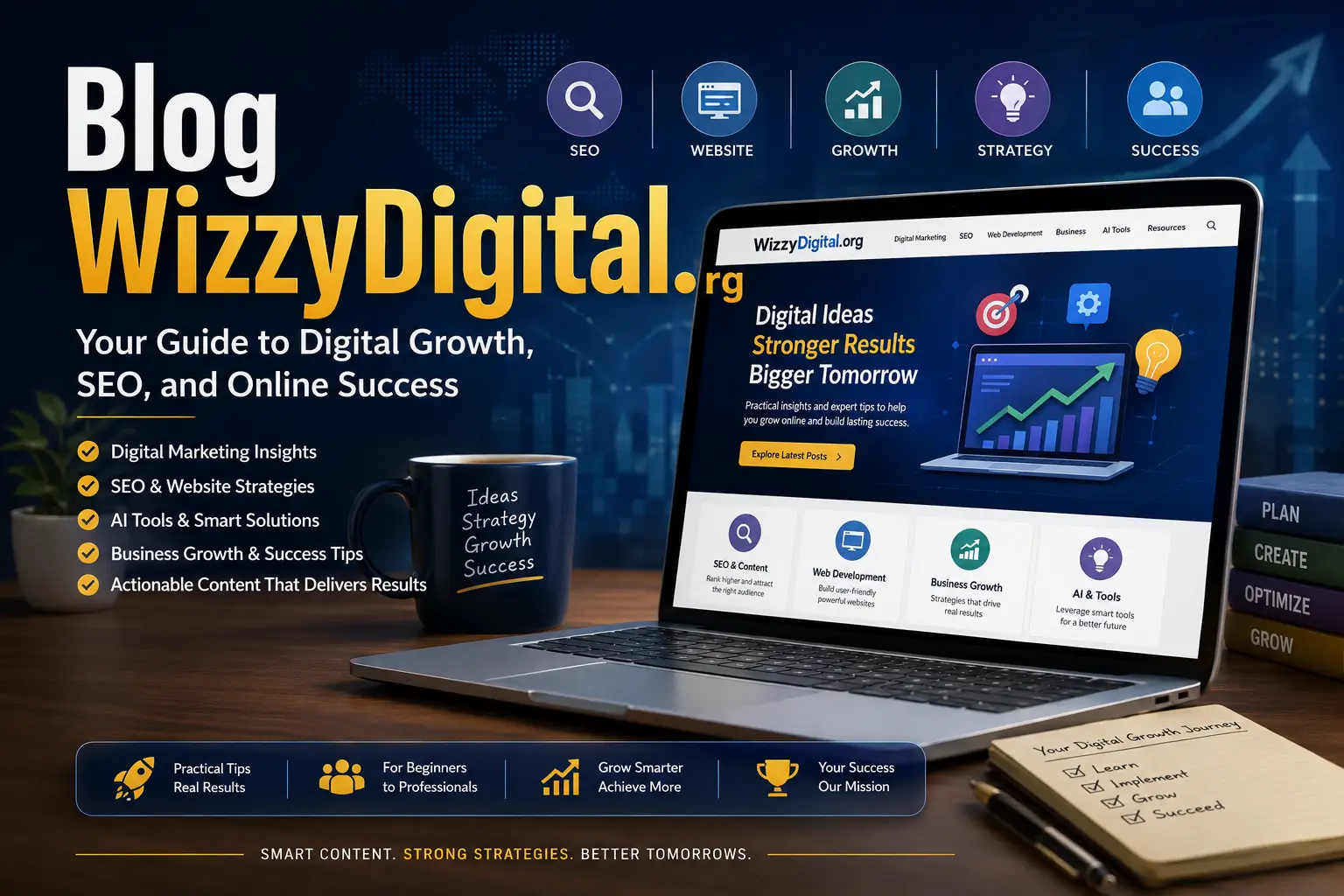
Finding reliable information about Blog WizzyDigital.org isn’t as straightforward as the name suggests. Search results often describe the site in wildly different ways. One page may call it a digital marketing resource. Another may present it as a blogging platform, training community, business-growth hub, or publishing network.
Those descriptions create a fog around a relatively simple question: What does WizzyDigital.org actually offer?
The live website operates mainly as a broad online publication. Its primary navigation highlights Web Design, Digital Marketing, SEO, About, and Contact. The homepage also promotes expertise in web design, search engine marketing, and online growth. Beyond those central subjects, however, its article stream covers software, artificial intelligence, business operations, entertainment, gaming, finance, and other specialized industries.
That wide scope makes the website interesting, though it also demands careful reading. Some articles offer useful introductions. Others focus on products, companies, promotions, or time-sensitive trends. A reader who treats every post as equally authoritative may walk away with an incomplete picture.
This guide examines the website as it currently appears. You’ll learn what it publishes, how its archives work, which readers may benefit, and where independent verification becomes essential.
The site works best as a map of digital topics, not as the final authority on every road it mentions.
What Is WizzyDigital.org?
WizzyDigital.org is a content-based website centered on digital subjects. Its visible menu directs readers toward web design, digital marketing, and SEO. The homepage mixes editorial content with service-oriented language about building websites, increasing visibility, attracting traffic, and strengthening an online presence.
That combination gives the site two distinct roles.
First, it functions as a publication. Readers can browse category archives, open individual posts, view author names, and move between older and newer content.
Second, it presents commercial expertise. Its About page says the organization aims to help businesses and individuals succeed online through website design and digital marketing services.
Neither role cancels the other. Plenty of agencies publish educational content. In fact, a thoughtful article library can demonstrate knowledge more effectively than a page filled with sales slogans.
Still, readers should recognize the difference between education and promotion.
An informational article may explain technical SEO. A promotional article may recommend a particular crawler, hosting company, casino platform, CRM system, or software provider. Both can contain useful information, though the second deserves extra scrutiny.
Why the Search Term Causes Confusion
People search for the website using several variations:
- Blog WizzyDigital org
- Posts WizzyDigital.org
- Start WizzyDigital.org
- Get WizzyDigital.org
- WizzyDigital.org blog
- Blog.WizzyDigital.org
These phrases don’t necessarily represent separate products.
In many cases, they come from article titles published on the domain or from third-party pages targeting related search queries. A phrase that resembles an email address or subdomain may simply be a keyword arranged for search visibility.
That distinction matters because users may expect features that the main website doesn’t clearly provide.
For example, “start WizzyDigital.org blog” sounds like an invitation to create a personal publication. Yet the visible navigation doesn’t clearly show a user-registration page, public publishing dashboard, blog-hosting package, or membership portal.
Is Blog.WizzyDigital.org a Separate Website?
The current navigation and category pages operate on the main WizzyDigital.org domain. They don’t clearly present a separate public subdomain as the central article platform. The site’s content appears within standard category and article paths attached to the root domain.
That doesn’t prove a separate subdomain has never existed. Websites change, migrate, or leave old references indexed.
However, readers shouldn’t assume a subdomain is official merely because a search result formats the phrase that way.
Before entering account information or payment details, check:
- The spelling of the domain
- Whether the connection is secure
- Whether the page matches the official navigation
- Whether the contact information appears consistent
- Whether policies and terms are available
- Whether the site clearly explains the requested action
Similar-looking domains can mislead hurried visitors. One missing letter may be all it takes to land somewhere entirely different.
What the Live Website Actually Shows
A useful website review begins with visible features rather than marketing claims.
As of August 1, 2026, the main menu contains these core destinations:
- Home
- Web Design
- Digital Marketing
- SEO
- About
- Contact
The homepage also links to privacy and terms pages. Its central editorial sections feature web-design posts, SEO articles, digital-marketing content, and editor-selected stories.
Notably, the main navigation doesn’t clearly display:
- A public author-registration page
- A member dashboard
- Community forums
- An online course library
- A workshop calendar
- A public webinar schedule
- A self-service blogging platform
- Pricing for blog hosting
- A formal contributor application
Some self-referential posts on the domain describe guest writers, community forums, blogging guidance, or broader participation. However, those claims aren’t matched by equally visible tools in the main navigation. Readers should treat them as promotional or descriptive statements until they locate a working feature, clear terms, and an active access point.
How the Homepage Is Arranged
The homepage begins with a digital-growth message. It then divides attention among several content areas.
These include:
- Featured web-design articles
- A dedicated SEO section
- Digital-marketing selections
- Editor’s picks
- A long stream of recent or highlighted posts
- Internal promotional pages about WizzyDigital.org itself
The structure helps visitors discover many topics quickly. However, it can also feel scattered.
A reader looking for technical SEO may encounter articles about sports, finance, software, entertainment, casinos, workplace operations, or consumer technology before reaching another search-focused post. That variety isn’t inherently bad. It simply means the homepage behaves more like a busy newsstand than a carefully shelved textbook.
Category Archives Offer Better Focus
The category pages provide a cleaner reading experience.
As of August 1, 2026:
- The Digital Marketing archive shows 13 pages.
- The Web Design archive shows 6 pages.
- The SEO archive shows 5 pages.
These numbers can change whenever the site publishes, removes, or reclassifies content. Still, they show that the three main archives contain more than a few isolated posts.
Each archive generally displays:
- The article title
- The assigned category
- An author name
- A short excerpt
- A read-more link
- Page navigation
This format helps you scan many topics without opening every post.
What Individual Articles Look Like
Article layouts may vary, though many use familiar blog elements:
- A keyword-focused headline
- An author byline
- A category label
- A table of contents
- H2 and H3 subheadings
- Images
- Bulleted or numbered lists
- Product descriptions
- Internal navigation
- Previous and next-post links
For example, the site’s SEO crawler article includes a table of contents, feature criteria, product discussions, and advice about choosing a tool. It explains crawler functions such as checking status codes, headings, redirects, canonical addresses, links, and indexing controls.
That structure makes a technical topic easier to scan.
However, polished formatting doesn’t guarantee accuracy. A beautifully organized article can still contain old pricing, shallow comparisons, missing disclosures, or unsupported conclusions.
What Topics Does the WizzyDigital.org Blog Cover?
The website’s core identity revolves around digital work. Yet its real content catalog stretches far beyond a conventional marketing publication.
Understanding that scope helps you choose relevant articles and ignore distractions.
Search Engine Optimization
SEO forms one of the website’s clearest topic clusters.
The current archive includes articles about:
- B2B SaaS link building
- Medical SEO
- Technical crawler tools
- Click depth
- French search strategy
- Local visibility
- Off-page optimization
- Landing-page speed
- Comparison websites
- Future search trends
Several recent posts carry Samuel Roman’s byline, while older or additional entries display names such as Eric Elliott and Vryndaris Zolvak.
What Readers Can Learn
A beginner can use the SEO section to understand common concepts.
For example, technical crawling involves scanning a website in a way that resembles search-engine discovery. A crawler may identify:
- Broken links
- Redirect chains
- Missing titles
- Duplicate metadata
- Indexing restrictions
- Canonical conflicts
- Orphaned pages
- Server errors
- Weak internal linking
These issues matter because search engines need to discover, interpret, and organize pages before those pages can compete in results.
Content quality alone won’t rescue a website that blocks important pages from indexing. Likewise, flawless code won’t help much when the content doesn’t answer a real query.
SEO works like a three-legged stool:
- Technical access
- Relevant content
- Credible authority
Remove one leg and the whole thing wobbles.
Local and Industry-Specific SEO
The archive also explores specialized settings, including healthcare, B2B software, and international markets.
That matters because search strategy changes with context.
A local clinic needs accurate business information, service pages, geographic relevance, and trustworthy medical content.
A software company may need comparison pages, technical documentation, industry partnerships, and links from professional publications.
A French audience may respond differently to tone, wording, cultural references, and search habits than an English-speaking audience.
The best SEO advice recognizes those differences. The weakest advice treats every market like the same machine with a different label.
Where SEO Readers Should Be Cautious
Search systems change constantly.
An article about a current search feature, interface, ranking factor, or platform policy may age quickly. Before changing a website, readers should compare the article’s advice against current search-engine documentation and real performance data.
Also watch for absolute claims.
Statements such as “this always improves rankings” or “every page must follow this rule” usually flatten a complicated subject. Search performance depends on competition, intent, technical condition, content quality, authority, geography, and dozens of other variables.
Digital Marketing
Digital marketing is the website’s largest visible core archive, with 13 pages as of the review date. Its current first page includes posts about visual conversion funnels, marketing strategy, accessibility, machine learning, search intent, push notifications, affiliate links, digital experience monitoring, influencer marketing, and customer loyalty tools.
That range reflects how broad marketing has become.
Modern digital campaigns may involve:
- Search traffic
- Social media
- Paid advertising
- Affiliate partnerships
- Influencer promotion
- Customer loyalty
- Automation
- Analytics
- Accessibility
- Conversion optimization
- Artificial intelligence
Content Strategy and Search Intent
One of the most useful marketing concepts covered by the site is search intent.
Search intent describes what a person hopes to accomplish.
Consider these queries:
- “What is email marketing?”
- “Best email platform for restaurants”
- “Mailchimp pricing”
- “Hire email marketing agency”
All four mention email marketing, though they represent different stages.
The first reader wants an explanation.
The second wants options.
The third is evaluating a specific product.
The fourth may be ready to hire someone.
A strong article matches the reader’s goal. A weak article merely repeats the keyword until the paragraph sounds like a malfunctioning parrot.
Affiliate and Influencer Marketing
The site also discusses affiliate links and influencer campaigns.
These subjects deserve practical scrutiny because financial incentives shape recommendations.
An affiliate article may earn money when readers click or buy. An influencer campaign may exchange payment, free products, or exposure for promotion.
Neither arrangement automatically invalidates the content.
Transparency is the key.
Readers should ask:
- Is the relationship disclosed?
- Does the article mention disadvantages?
- Are competing options included?
- Are claims supported by evidence?
- Does the recommendation fit the audience?
- Would the writer still recommend it without compensation?
A balanced review tells you who shouldn’t buy the product. Promotional copy rarely does.
Digital Accessibility
Accessibility appears among the current marketing topics. That placement makes sense.
Accessible communication isn’t only a design matter. It affects reach, trust, usability, and customer experience.
Practical accessibility may include:
- Readable text contrast
- Clear headings
- Keyboard navigation
- Captions
- Alternative text
- Descriptive links
- Simple forms
- Understandable instructions
A campaign loses value when part of the audience can’t comfortably use the page.
Accessibility also tends to improve general usability. Captions help people in noisy rooms. Clear labels help rushed shoppers. Logical headings help everyone scan.
Good accessibility is less like adding a ramp after construction. It’s more like drawing a better floor plan from the beginning.
Web Design and User Experience
The Web Design archive contains six pages as of August 1, 2026. Current topics include security, user decision-making, professional design processes, lightweight experiences, frontend consistency, design applications, WordPress hosting, timed offers, UX, and even casino-related interface content.
This mix shows both the archive’s value and its inconsistency.
Some articles address broad design principles. Others connect design to a particular product, platform, or industry.
Web Design Is More Than Appearance
A website can look gorgeous and still fail spectacularly.
Good design balances:
- Visual hierarchy
- Speed
- Mobile responsiveness
- Navigation
- Security
- Accessibility
- Content clarity
- Conversion flow
- Brand consistency
- Technical stability
Imagine a restaurant with elegant lighting and beautiful furniture. Now imagine that the menu has no prices, the restroom sign points outside, and customers must climb through a window to pay.
That restaurant has style. It doesn’t have usability.
Websites face the same problem.
User Decision-Making
Design affects how people judge credibility.
Visitors often notice subtle signals:
- Is the page clean?
- Does it load quickly?
- Can they find contact information?
- Does the checkout feel secure?
- Are buttons clearly labeled?
- Does the site work on a phone?
- Are important policies visible?
A customer may never consciously analyze those details. Still, they influence whether the person stays, clicks, buys, or leaves.
Website Speed
The site currently features content about lightweight digital experiences and conversion speed.
Speed matters because delays interrupt momentum.
Suppose someone clicks an advertisement for emergency plumbing. The landing page takes several seconds to appear. During that pause, the visitor returns to search and calls someone else.
The slower website didn’t merely lose a page view. It lost a customer with urgent intent.
However, speed advice needs context.
A small service website, large store, streaming platform, and software dashboard face different technical demands. The right solution depends on media weight, hosting, code quality, caching, third-party scripts, traffic, and user location.
Website Development and Technical Infrastructure
Many articles cross the line between design and development.
The broader website discusses:
- Custom development
- Ready-made solutions
- Technical stacks
- Frontend systems
- Software teams
- Application testing
- Hosting
- Proxy servers
- Virtual private servers
- Integrations
- Technical debt
- Staff augmentation
These subjects can help nontechnical readers understand why software decisions involve trade-offs.
Custom Versus Ready-Made Solutions
A ready-made platform often costs less and launches faster.
A custom system may provide greater flexibility, though it usually requires more planning, testing, maintenance, and specialized talent.
The right decision depends on:
| Factor | Ready-made solution | Custom solution |
|---|---|---|
| Initial launch | Usually faster | Usually slower |
| Upfront cost | Often lower | Often higher |
| Flexibility | Limited by platform | Built around specific needs |
| Maintenance | Vendor handles much of it | Business or developer manages it |
| Scalability | Depends on plan and architecture | Can be designed for expected growth |
| Ownership | Often platform-dependent | Greater control may be possible |
| Integrations | Limited to supported options | Can support tailored connections |
A new business doesn’t automatically need custom software. Building a private jet to cross town is impressive, though a reliable car may solve the problem better.
Technical Debt
Technical debt describes shortcuts that create future work.
Examples include:
- Poorly documented code
- Outdated plugins
- Temporary integrations
- Duplicate systems
- Weak testing
- Inconsistent interface components
- Manual processes that should be automated
Some technical debt is reasonable. A startup may accept a temporary workaround to test demand.
The trouble begins when temporary fixes become permanent foundations.
General articles can introduce this concept. Actual architecture decisions require developers who understand the system, budget, users, risks, and future plans.
Artificial Intelligence and Automation
AI-related content appears across the website rather than inside one clearly labeled archive.
Topics visible in the broader feed include:
- Machine learning
- AI content tools
- Application integrations
- Automated data collection
- AI-assisted development
- Image generation
- Passport-photo tools
- AI courses
- Minimum viable product services
The homepage currently features posts about custom machine learning, connecting business applications to Claude, AI passport-photo tools, and AI-focused software development.
Why AI Articles Age Quickly
AI products change at breakneck speed.
A tool may gain a feature on Monday, change its pricing on Wednesday, and remove the feature two months later.
Therefore, evaluate AI recommendations using current information.
Check:
- Pricing
- Usage limits
- Privacy terms
- Commercial rights
- Export options
- Data-retention rules
- Accuracy
- Supported languages
- Human-review needs
- Integration requirements
AI Doesn’t Remove Responsibility
Automation can increase speed. It doesn’t eliminate accountability.
An AI system may generate a polished answer that contains:
- Invented facts
- Outdated instructions
- Misleading citations
- Biased assumptions
- Faulty calculations
- Legally risky wording
The output may sound smoother than warm butter. That doesn’t make it true.
Businesses should assign a qualified person to review important work, especially when the result affects customers, finances, contracts, safety, or reputation.
Business Operations and Digital Tools
The publication also covers software and systems used behind the scenes.
Examples include:
- CRM tools
- HR automation
- Sales workflows
- Data governance
- Financial operations
- Equipment policies
- Service-management software
- Workflow automation
- Digital signage
- Global talent management
These subjects show how digital strategy extends beyond advertising.
A company may attract plenty of leads but lose them because nobody follows up.
A CRM can help organize contacts, conversations, estimates, tasks, and sales stages. Yet software alone won’t repair a broken process.
Automating chaos merely creates faster chaos.
Before adopting a tool, a business should define:
- The problem
- The responsible team
- Required features
- Existing systems
- Data risks
- Training needs
- Total cost
- Success metrics
Gaming, Betting, and Regulated Content
One of the most important facts about the publication is its substantial coverage of online gaming and gambling-related subjects.
The homepage includes posts about casinos, promotional codes, slot mechanics, cryptocurrency bookmakers, gaming experiences, and regulated online platforms. The Web Design archive also includes casino-related content among conventional UX articles.
That content may target adult readers in specific markets.
However, legal availability varies by location.
Before using a gambling platform, verify:
- Legal age
- Local restrictions
- Licensing authority
- Payment security
- Withdrawal rules
- Identity requirements
- Bonus conditions
- Tax obligations
- Responsible-use controls
A promotional code doesn’t prove a platform is legal or safe.
Likewise, a sleek interface doesn’t guarantee fair terms. Good design can support trust. It can also dress risk in an expensive suit.
Regulated Topics Require Better Evidence
The same principle applies to finance, healthcare, legal matters, and cybersecurity.
An article may introduce the issue. It shouldn’t replace:
- A licensed attorney
- A qualified healthcare professional
- A regulated financial adviser
- An official government source
- A cybersecurity specialist
The higher the potential harm, the stronger the evidence should be.
Content Map at a Glance
| Content area | Typical subjects | Useful for | Verification needed |
|---|---|---|---|
| SEO | Crawling, links, local search, rankings | Marketers, bloggers, site owners | Current search documentation |
| Digital marketing | Funnels, content, affiliate links, influencers | Businesses and creators | Platform rules and performance data |
| Web design | UX, speed, hosting, security | Designers and business owners | Testing and technical requirements |
| Development | Custom systems, teams, integrations | Founders and managers | Architecture, budget, compatibility |
| AI and automation | Content tools, workflows, machine learning | Teams exploring efficiency | Privacy, rights, pricing, accuracy |
| Business software | CRM, HR, sales, operations | Managers and service companies | Security, contracts, implementation |
| Regulated topics | Gambling, finance, healthcare | Specialized adult readers | Law, licensing, professional guidance |
Who Writes for WizzyDigital.org?
Several author names appear across the current archives.
Visible bylines include:
- Samuel Roman
- Eric Elliott
- Vryndaris Zolvak
- Xylarith Krynok
Samuel Roman appears frequently in the current SEO archive. Eric Elliott appears across SEO and digital marketing. Vryndaris Zolvak contributes to web design, digital marketing, and other categories. Xylarith Krynok also appears within web design and marketing content.
A Name Isn’t Proof of Expertise
A byline helps identify who receives credit for an article.
It doesn’t automatically establish qualifications.
Before relying on specialized advice, look for:
- A detailed biography
- Relevant work experience
- Professional credentials
- First-hand examples
- Original data
- Recognized publications
- Clear sourcing
- Transparent commercial relationships
Expert writing tends to include boundaries.
A knowledgeable writer may say:
- This works under certain conditions.
- Results depend on the market.
- The evidence remains limited.
- The tool suits large sites more than small ones.
- Legal requirements vary by location.
Overconfident writing often skips those details.
Evidence Matters More Than Swagger
Compare these claims:
“This method always doubles conversions.”
And:
“During a six-week test, completed bookings rose from 42 to 51 after the form was shortened.”
The first sounds exciting.
The second can be examined.
Specific numbers, methods, timeframes, and limitations make a claim more useful. Even then, one company’s result may not transfer perfectly to another.
Who Should Read the Website?
The publication serves several potential audiences.
Its value depends on your experience, goal, and willingness to verify information.
Small-Business Owners
Business owners may use the site to understand unfamiliar concepts before hiring someone.
Useful areas include:
- Local search
- Website speed
- Content marketing
- CRM systems
- User experience
- Hosting
- Advertising
- Lead tracking
This background knowledge can improve vendor conversations.
Instead of asking, “Can you fix my marketing?” you can ask:
- Which pages create the most leads?
- How will you measure phone calls?
- Who owns the advertising account?
- Which technical issues block search visibility?
- What happens after a visitor completes the form?
- Which monthly costs continue after launch?
Clear questions make vague proposals harder to sell.
Bloggers and Content Creators
Creators may find useful introductions to:
- Search intent
- Affiliate systems
- Influencer marketing
- Personal branding
- Content strategy
- Website design
- Audience retention
- AI tools
However, creators shouldn’t use the site as a rewriting factory.
A stronger article adds something new:
- Personal experience
- Original testing
- Expert interviews
- Fresh examples
- Better visuals
- Clearer organization
- More balanced analysis
Rearranging someone else’s paragraphs is like reheating yesterday’s fries. Technically possible. Rarely impressive.
Marketing Beginners
New marketers can use the publication to build vocabulary.
They may learn the difference between:
- Organic and paid traffic
- On-page and off-page SEO
- Reach and conversion
- Content and promotion
- UX and visual design
- Leads and customers
- Automation and strategy
However, introductory reading doesn’t equal professional mastery.
Real competence usually requires:
- Practice
- Measurement
- Feedback
- Tool experience
- Controlled testing
- Ongoing learning
Designers and Website Owners
The Web Design archive may help readers consider:
- Page speed
- Security
- navigation
- Mobile layouts
- Hosting
- Accessibility
- Conversion paths
- Interface consistency
It can also create a shared language between business owners and designers.
Owners often focus on sales.
Designers may focus on experience and presentation.
The best website connects both.
Developers and Technical Teams
Technical readers may discover products, trends, or business concerns.
However, many general articles won’t provide enough depth for production decisions.
A developer choosing infrastructure needs details about:
- Load
- Security
- Reliability
- Dependencies
- Maintenance
- Data location
- Team skill
- Recovery
- Compliance
A broad article may start the conversation. It shouldn’t finish the architecture.
Experienced Professionals
Specialists may use the site for:
- Topic discovery
- Industry monitoring
- Content ideas
- Product awareness
- Competitor research
- Broader business context
An experienced reader will probably skim introductory explanations and investigate the original sources behind important claims.
How to Navigate the Website Efficiently
The site becomes much more useful when you start with a clear problem.
Define What You Need
Weak goal:
- “I need better digital marketing.”
Stronger goal:
- “I need more appointment requests from local mobile searches.”
- “I need to understand why product pages aren’t indexed.”
- “I need a hosting plan that supports a growing store.”
- “I need to compare loyalty platforms.”
- “I need to shorten the checkout process.”
Specific questions help you reject irrelevant articles quickly.
Choose the Closest Category
| Your problem | Best starting section |
|---|---|
| Rankings, crawling, keywords, or local visibility | SEO |
| Promotion, content, leads, or customer retention | Digital Marketing |
| Layout, speed, hosting, security, or UX | Web Design |
| Software, AI, finance, or gaming | Wider article feed, followed by extra verification |
Check the Article’s Context
Before acting on advice, inspect:
- Author
- Date
- Category
- Evidence
- Product relationships
- Intended audience
- Geographic relevance
- Possible conflicts of interest
A detailed article written for an international software company may not fit a neighborhood bakery.
Separate Evergreen Ideas From Expiring Facts
Evergreen principles include:
- Clear navigation helps users.
- Useful content should answer a real need.
- Slow pages create friction.
- Honest offers build trust.
- Accessible design improves usability.
Time-sensitive details include:
- Software pricing
- AI features
- Bonus codes
- Hosting plans
- Platform rules
- Search interfaces
- Tax requirements
- Licensing status
The principle may remain solid while the example expires.
What the Website Does Well
Several strengths make the publication useful.
It Offers Broad Discovery
Readers can explore SEO, design, software, marketing, automation, and business operations without leaving the site.
That breadth can reveal connections.
Website speed affects SEO.
UX affects conversion.
CRM systems affect follow-up.
Content affects trust.
Digital problems rarely stay inside tidy departmental boxes.
Its Core Categories Are Easy to Find
The main archives provide clear starting points.
With 13 pages of digital-marketing content, 6 pages of web-design posts, and 5 pages of SEO articles on the review date, the site offers a substantial browsing library.
The Content Is Publicly Accessible
The reviewed homepage, archives, About page, and individual articles opened without a required paid membership or account.
That makes preliminary research easy.
You can inspect an article’s structure and quality before sharing information or making a purchase.
Many Topics Are Beginner-Friendly
Numerous headlines address recognizable questions and practical problems.
Readers can find introductions to:
- Technical audits
- Search intent
- Website processes
- Accessibility
- Affiliate links
- Hosting
- Machine learning
- CRM tools
These articles can help a beginner know what to research next.
Where Readers Should Be Cautious
Breadth creates opportunity. It also creates unevenness.
The Editorial Scope Is Extremely Wide
The website covers conventional digital subjects alongside casinos, finance, healthcare, sports, legal topics, workplace issues, and consumer content.
A publication spanning that many fields may not provide equal expertise everywhere.
Judge the article, not merely the domain.
Quality Can Vary
Review each post for:
- Accuracy
- Specificity
- Balance
- Evidence
- Freshness
- Author transparency
- Practical usefulness
- Clear limitations
One excellent article doesn’t prove every post is excellent.
One weak article doesn’t prove the entire archive is worthless.
Some Posts May Be Promotional
Watch for commercial signals:
- Heavy praise
- No disadvantages
- Repeated brand mentions
- Artificial urgency
- Bonus-centered messaging
- Missing alternatives
- Vague performance promises
- No visible disclosure
A promotional article may still contain facts. You simply need to separate the facts from the sales pitch.
A Recent Year in the Title Proves Very Little
Adding “2026” to a headline doesn’t guarantee that every detail was checked in 2026.
Confirm:
- Current pricing
- Available features
- Legal status
- Product ownership
- Platform policies
- Support options
Fresh paint doesn’t repair an old engine.
Verifiable Features and Unconfirmed Claims
| Claim | What the live site supports | What still needs evidence |
|---|---|---|
| The website publishes articles | Category archives and individual posts are visible | No major gap |
| It focuses on SEO, marketing, and design | These categories appear in the main menu | Quality varies by article |
| It presents digital services | Homepage and About language support this | Packages, pricing, and results |
| Visitors can start personal blogs | Some articles suggest blogging opportunities | Public signup and publishing system |
| The site has community forums | Self-referential content mentions forums | Visible active forum and access path |
| It welcomes guest writers | Some content discusses contributors | Current submission policy and terms |
| It offers workshops or training | Promotional descriptions may imply learning support | Current schedules and registration |
| Every author is an expert | Author names appear | Verified qualifications and experience |
The distinction is simple:
A statement on a promotional page isn’t the same thing as a working, documented feature.
Does WizzyDigital.org Let You Start a Blog?
Some pages on the domain use language about starting a blog, joining a community, sharing ideas, or contributing content.
Yet the current main navigation doesn’t clearly expose:
- Public registration
- A creator dashboard
- Blog-hosting prices
- Publishing controls
- Contributor guidelines
- Editorial review terms
- Revenue-sharing details
Based on the visible structure, the safer conclusion is that the website publishes blogging advice and editorial content. It shouldn’t automatically be described as a public blog-hosting service.
Anyone interested in contributing should contact the site directly and request clear answers about:
- Ownership
- Editorial control
- Payment
- Links
- Disclosure
- Content removal
- Rights
- Publication timelines
Never submit original work without understanding who can reuse it.
Practical Case Study: A Local Service Business
Consider a local air-conditioning company.
The owner wants more phone calls during summer. After browsing the site, she finds articles about local SEO, website speed, content strategy, and CRM tools.
The Risky Approach
She could:
- Hire the first advertised provider
- Buy several tools immediately
- Expect instant rankings
- Give an agency ownership of every account
- Measure success only through traffic
That approach creates cost without clarity.
The Better Approach
She identifies the real problems first:
- Important service pages load slowly.
- The phone number changes across directories.
- Mobile visitors struggle to find the booking button.
- Nobody tracks which leads come from search.
- Follow-up depends on handwritten notes.
Then she creates a focused plan:
- Correct business details
- Improve mobile speed
- Simplify the booking page
- Track calls and forms
- Centralize lead follow-up
- Review results monthly
The articles helped her ask better questions. They didn’t make the decision for her.
The Lesson
General information becomes valuable when you connect it to:
- A specific problem
- Measurable action
- Independent verification
- Real performance data
Practical Case Study: A Creator Comparing AI Tools
A freelance writer finds an article recommending an AI platform.
The headline promises faster content production. The screenshots look impressive.
Before subscribing, the writer asks:
- Who owns generated material?
- Can the output be used commercially?
- Does the platform store uploaded documents?
- Are prompts used for training?
- Can work be exported?
- What happens after cancellation?
- How accurate are citations?
- How much editing remains necessary?
The writer tests the tool on a low-risk project.
It saves time on brainstorming, though several factual claims are wrong. The final workflow uses AI for outlining and idea generation while keeping research and editing under human control.
The Lesson
A recommendation can introduce a useful product.
Testing determines whether the product deserves a place in your workflow.
How the Site Differs From Competitor Descriptions
Many competing pages make three mistakes.
They Narrow the Site Too Much
Some describe it only as a digital marketing blog.
That ignores its large collection of articles about software, operations, entertainment, gaming, finance, and specialized industries.
They Promise Features Without Proof
Others describe forums, workshops, publishing tools, or open blogging accounts as established features.
The main navigation doesn’t clearly support all those claims.
They Add Generic Advice
Many competitor articles drift into sections such as:
- Why digital marketing matters
- How blogs change communication
- Common online business mistakes
- Why every company needs SEO
- How to build a brand
Those sections may be useful elsewhere. They don’t directly answer what WizzyDigital.org is or how readers should evaluate it.
A stronger article focuses on:
- Visible navigation
- Actual content categories
- Current archive structure
- Author bylines
- Verifiable features
- Reader risks
- Practical navigation
Is Blog WizzyDigital.org Worth Reading?
Blog WizzyDigital.org can serve as a useful starting point for readers exploring SEO, web design, digital marketing, AI, software, or business technology.
Its greatest strength is variety.
You can move from technical search topics to conversion strategy, UX, automation, hosting, and business systems. The core archives also provide clearer paths for readers who know what they need.
Its greatest weakness is the same variety.
The publication covers so many niches that expertise, relevance, and commercial intent may vary from article to article. Product recommendations can become outdated. Regulated topics require independent checks. Promotional pages may describe features that aren’t clearly visible elsewhere.
Use the site with curiosity, not blind trust.
Read the article. Check the date. Examine the evidence. Compare other sources. Then decide whether the advice fits your situation.
Final Thoughts
WizzyDigital.org is best viewed as a broad digital publication with three central archives: SEO, Digital Marketing, and Web Design.
Its live website also reaches well beyond those areas. Readers may encounter software, artificial intelligence, business operations, gaming, finance, healthcare marketing, entertainment, and other subjects.
That breadth creates a large pool of ideas.
It doesn’t create automatic authority.
The most effective reader uses the site as a launchpad. You discover a topic, sharpen your question, verify the important details, and test the advice carefully.
That approach turns casual browsing into useful research.
Frequently Asked Questions
What is WizzyDigital.org?
WizzyDigital.org is an online publication with core categories covering SEO, digital marketing, and web design. Its larger content feed also includes software, artificial intelligence, business operations, gaming, finance, and other topics.
Is Blog.WizzyDigital.org a separate subdomain?
The current article and category structure appears on the main WizzyDigital.org domain. Readers shouldn’t assume a separate subdomain exists unless they confirm a working official address.
Is the website free to read?
The homepage, archives, About page, and reviewed articles were publicly accessible without a required paid subscription or account on August 1, 2026.
What are its main categories?
The main editorial categories are SEO, Digital Marketing, and Web Design.
How large are the category archives?
On August 1, 2026, Digital Marketing displayed 13 pages, Web Design displayed 6 pages, and SEO displayed 5 pages. Those counts can change as content is added or reorganized.
Who writes the articles?
Current archives display author names including Samuel Roman, Eric Elliott, Vryndaris Zolvak, and Xylarith Krynok.
Is it suitable for beginners?
Yes, many articles introduce common concepts in accessible language. Beginners should still verify technical, legal, financial, and product-specific claims independently.
Does the site cover technical SEO?
Yes. Its SEO content includes crawler tools, click depth, link building, local search, landing-page speed, international strategy, and other technical or strategic subjects.
Does it publish AI content?
Yes. The wider website includes articles about machine learning, AI tools, , application integrations, image generation, and AI-assisted development.
Does the publication include gambling content?
Yes. The broader article feed contains casino, betting, slot, and gaming-related posts. Readers should confirm legal age, licensing, local laws, payment terms, and risks independently.
Can anyone create a blog on the website?
The main navigation doesn’t clearly show a self-service public blogging platform. Some articles mention blogging or contribution opportunities, though readers should request current terms and a verified access process.
Does it accept guest posts?
Some self-referential content mentions guest writers. However, readers should confirm whether submissions are currently open and request written guidelines before sending content.
Are all product recommendations independent?
That can’t be assumed. Some articles may have promotional, affiliate, or brand-focused purposes. Look for disclosures, alternatives, limitations, and supporting evidence.
How can small businesses use the site?
Small-business owners can use it to learn terminology, identify possible website problems, compare general strategies, and prepare better questions for agencies or software providers.
Should the site replace professional advice?
No. Articles involving law, finance, healthcare,, regulated gambling, or major technical decisions should serve as starting points rather than replacements for qualified advice.
How can you check whether an article is current?
Review the publication date, product details, screenshots, pricing, platform features, author information, and cited evidence. Compare time-sensitive claims with current official information.
What is the best way to use the site?
Begin with a specific question. Choose the closest category, read critically, verify important claims, and test low-risk recommendations before making a major commitment.