
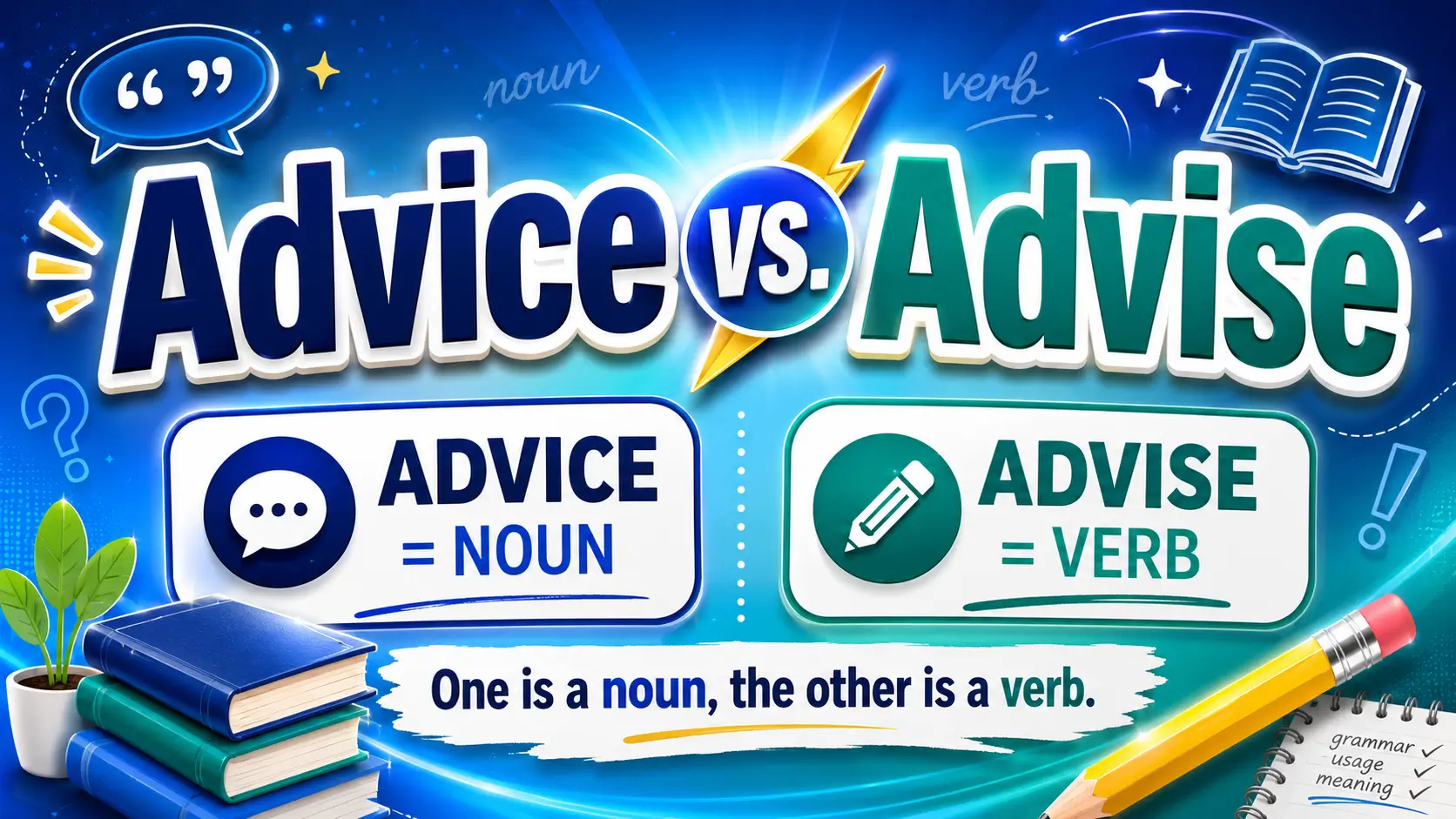
Advice vs. advise is one of the most common grammar questions because these two words look almost identical but have different meanings and grammar roles. If you’ve ever wondered whether to write “Can you advise me?” or “Can you give me advice?”, you’re not alone. The simple answer is that advice is a noun, while advise is a verb. Learning this difference will help you write more accurate English grammar, improve your word choice, and avoid one of the most commonly confused words in everyday writing.
Although advice and advise share the same origin and both relate to guidance, recommendations, and counsel, they cannot be used interchangeably. Knowing when to use each word makes your emails, school assignments, business documents, and conversations sound more natural and professional.
This guide explains the difference in simple American English with clear definitions, comparison tables, pronunciation tips, real-life examples, common mistakes, memory tricks, and practical usage advice. By the end, you’ll know exactly when to use advice and when to use advise with confidence.
Quick Answer
The difference between advice and advise is simple:
| Word | Part of Speech | Meaning | Example |
| Advice | Noun | Guidance or a recommendation | Thank you for your advice. |
| Advise | Verb | To give guidance or recommend | I advise you to save your money. |
Quick tip: If you can replace the word with recommendation, use advice. If you can replace it with recommend, use advise.
Understanding the Difference Between Advice and Advise
Although these words share the same root and meaning, they serve different grammatical purposes.
Think of it this way:
- Advice is the thing someone gives.
- Advise is the action of giving it.
For example:
- She gave me excellent advice.
- She advised me to apply early.
In the first sentence, the guidance itself is the noun. In the second, the act of giving guidance is the verb.
This simple distinction explains almost every correct use of these two words.
Advice vs. Advise at a Glance
| Feature | Advice | Advise |
| Part of speech | Noun | Verb |
| Meaning | Guidance or recommendation | To give guidance |
| Pronunciation | Ends with an S sound | Ends with a Z sound |
| Function | Names a thing | Shows an action |
| Can change tense? | No | Yes |
| Example | I appreciate your advice. | I advise you to wait. |
What Does Advice Mean?
Advice is a noun.
It means a suggestion, recommendation, or guidance offered to help someone make a decision or solve a problem.
Unlike many nouns, advice is uncountable in American English. That means you don’t usually use it in the plural form.
Examples
- My teacher gave me helpful advice.
- Can you give me some advice?
- Her financial advice saved me thousands of dollars.
- Your advice was exactly what I needed.
Notice that advice always refers to information, guidance, or recommendations—not the act of giving them.
When Do You Use Advice?
Use advice whenever you’re talking about the guidance itself.
Common situations include:
- Asking for recommendations
- Receiving professional guidance
- Giving parenting tips
- Sharing career suggestions
- Offering study strategies
Everyday Examples
School
My professor gave useful advice before the exam.
Work
His manager offered valuable advice during the meeting.
Thank you for your advice regarding the project.
Conversation
I always ask my grandmother for advice.
What Does Advise Mean?
Advise is a verb.
It means to tell someone what you think they should do or to recommend a course of action.
Unlike advice, this word shows an action.
Examples
- I advise you to back up your files.
- The doctor advised her to get more sleep.
- Our lawyer advised us not to sign the contract immediately.
- Parents often advise their children about money.
Whenever someone is actively giving guidance, advise is the correct word.
When Should You Use Advise?
Use advise when someone is performing the action of giving recommendations.
Examples include:
- Advising a friend
- Advising a customer
- Advising employees
- Advising patients
- Advising students
Everyday Examples
School
The teacher advised us to practice every day.
Office
My supervisor advised me to update the report.
Text Message
I’d advise waiting until tomorrow.
Social Media
Many creators advise checking sources before sharing news.
When Should You Use Advice or Advise?
A quick way to decide is to ask yourself this question:
Am I talking about the guidance, or the action of giving guidance?
If it’s the guidance itself, choose advice.
If it’s the action, choose advise.
Use Advice when talking about:
- Suggestions
- Recommendations
- Guidance
- Opinions
- Instructions
Examples
- Thank you for your advice.
- His advice was helpful.
- I need some career advice.
- She ignored my advice.
Use Advise when talking about:
- Recommending
- Warning
- Suggesting
- Guiding
- Counseling
Examples
- I advise taking notes.
- Doctors advise regular exercise.
- Experts advise against sharing passwords.
- The coach advised us to stay focused.
Grammar Rules for Advice and Advise
Understanding the grammar behind these words makes choosing the correct one much easier.
Advice Is Always a Noun
Because it’s a noun, advice can act as:
- Subject
- Object
- Object of a preposition
Examples
Subject
Your advice helped me.
Object
I appreciate your advice.
Object of a preposition
We talked about your advice.
Notice that advice never performs an action.
Advise Is Always a Verb
Since advise is a verb, it changes form depending on tense.
Present
- advise
- advises
Past
- advised
Present participle
- advising
Examples
- I advise everyone to read carefully.
- She advises new employees.
- They advised us yesterday.
- We are advising customers online.
Because advise is a regular verb, it follows standard English verb patterns.
Sentence Pattern for Advise
One of the most common sentence structures is:
advise + someone + to + verb
Examples:
- I advise you to arrive early.
- We advised them to call first.
- The coach advised players to warm up.
Another common structure is:
advise against + noun or -ing verb
Examples:
- Doctors advise against smoking.
- Experts advise against sharing passwords.
- Teachers advise against cheating.
Common Sentence Patterns
| Pattern | Example |
| advice + about | She gave advice about college. |
| advice + on | He offered advice on investing. |
| give + advice | They gave helpful advice. |
| advise + someone | I advised my brother. |
| advise + someone + to | I advised her to study. |
| advise against | Lawyers advise against signing immediately. |
Why People Confuse Advice and Advise
Several reasons make these words confusing.
- They have almost identical spellings.
- Their meanings are closely related.
- Their pronunciation differs by only one sound.
- Many languages don’t separate nouns and verbs this way.
- Spell-checkers don’t always catch the mistake because both words are correctly spelled.
Fortunately, once you remember that one is a noun and the other is a verb, the confusion usually disappears.
Correct vs. Incorrect Examples
| ❌ Incorrect | ✅ Correct | Why? |
| She adviced me yesterday. | She advised me yesterday. | “Adviced” is not a word. |
| Can you advice me? | Can you advise me? | A verb is needed. |
| He gave me an advice. | He gave me some advice. | Advice is uncountable. |
| I’d like many advices. | I’d like lots of advice. | Advice has no plural form. |
| They advice customers daily. | They advise customers daily. | The sentence needs a verb. |
Key Points to Remember
- Advice = noun
- Advise = verb
- Advice cannot usually be pluralized.
- Advise changes tense like any regular verb.
- Advice is something you receive.
- Advise is something someone does.
Examples of Advice and Advise in Everyday English
The easiest way to master advice vs. advise is to see how each word works in real-life situations. The examples below reflect common American English usage in school, work, emails, conversations, and social media.
Correct Examples Using Advice
Remember that advice is a noun. It refers to the guidance or recommendation itself.
- Thank you for your advice.
- She gave me excellent career advice.
- His financial advice helped me save money.
- I need some advice about buying a car.
- Our coach’s advice improved the team’s performance.
- Can you offer some parenting advice?
- Her advice was honest and practical.
- We followed the doctor’s advice.
Correct Examples Using Advise
Use advise when someone is performing the action of giving guidance.
- I advise you to read the instructions first.
- My lawyer advised me to keep copies of every document.
- Teachers advise students to ask questions.
- Experts advise against using weak passwords.
- The pharmacist advised her to take the medicine with food.
- Our manager advises new employees during training.
- Parents often advise their children about money.
- The travel agent advised us to book early.
Correct vs. Incorrect Usage
Many grammar mistakes happen because writers choose the wrong part of speech.
| ❌ Incorrect | ✅ Correct | Explanation |
| Can you advice me? | Can you advise me? | The sentence needs a verb. |
| He gave me an advice. | He gave me some advice. | Advice is uncountable. |
| She adviced me yesterday. | She advised me yesterday. | The past tense is advised, not adviced. |
| I received many advices. | I received a lot of advice. | Advice has no regular plural form. |
| They always advice customers. | They always advise customers. | The action requires the verb advise. |
Why These Corrections Matter
English grammar depends on choosing the correct part of speech. Even if your meaning is clear, using the wrong form can make your writing seem less polished or professional.
Common Grammar Mistakes with Advice and Advise
Understanding common mistakes helps you avoid them in your own writing.
Using Advice as a Verb
This is one of the most frequent errors.
❌ Please advice me.
✅ Please advise me.
Why?
Because advice is a noun. It cannot describe an action.
Using Advise as a Noun
Some writers accidentally replace the noun with the verb.
❌ Your advise was helpful.
✅ Your advice was helpful.
The sentence refers to the guidance itself, so the noun is required.
Writing “Adviced”
Many learners assume the past tense ends with -ed, creating adviced.
That spelling is incorrect.
Correct forms are:
- advise
- advises
- advised
- advising
Saying “An Advice”
Unlike words such as book, idea, or question, advice cannot normally be counted.
Instead of writing:
❌ an advice
Use:
- some advice
- a piece of advice
- a bit of advice
- a little advice
Making Advice Plural
This mistake is especially common among English learners.
❌ advices
✅ advice
If you need to show more than one suggestion, use expressions such as:
- several pieces of advice
- lots of advice
- some helpful advice
How to Remember the Difference
Simple memory tricks make the distinction much easier.
Memory Trick #1: C = Counsel
Both advice and counsel are nouns.
Notice they both end with the “c” sound in spelling.
- advice
- counsel
Both refer to guidance.
Memory Trick #2: S = Speak
The S in advise sounds like Z.
Think about speaking.
When you advise, you’re saying something to another person.
- advise
- speak
- suggest
- recommend
They all describe actions.
Memory Trick #3: Noun vs. Verb Test
Ask yourself one question:
Is someone doing something, or am I talking about the thing itself?
If someone is acting, choose advise.
If you’re referring to the recommendation itself, choose advice.
Memory Trick #4: Replace the Word
Try replacing the word.
If recommendation fits, use advice.
Example:
Thank you for your recommendation.
This sounds correct.
Therefore:
Thank you for your advice.
Now try recommend.
I recommend arriving early.
Therefore:
I advise arriving early.
Pronunciation Difference
Many people confuse these words because they look almost identical.
However, their pronunciation is different.
| Word | Pronunciation | Final Sound |
| Advice | /ədˈvaɪs/ | S sound |
| Advise | /ədˈvaɪz/ | Z sound |
Although only the final sound changes, native speakers hear the difference immediately.
Example
- Advice ends with the same sound as ice.
- Advise ends with the same sound as eyes.
Reading the words aloud can help reinforce the distinction.
Is Advice Countable or Uncountable?
This question appears in many grammar forums because it causes frequent confusion.
The answer is simple.
Advice is an uncountable noun in American English.
That means you normally don’t say:
- an advice
- two advices
- many advices
Instead, use expressions like:
- some advice
- much advice
- a little advice
- plenty of advice
- valuable advice
When you need to count individual suggestions, use a counting phrase.
Examples:
- a piece of advice
- two pieces of advice
- three useful pieces of advice
Correct Examples
- She gave me some advice.
- I’d like a piece of advice.
- He shared valuable advice.
Verb Forms of Advise
Unlike advice, advise changes according to tense.
| Verb Form | Example |
| advise | I advise patience. |
| advises | She advises clients daily. |
| advised | They advised us yesterday. |
| advising | He is advising new employees. |
Because it’s a regular verb, forming different tenses is straightforward.
Advice and Advise in Everyday American English
These words appear in many daily situations.
Understanding the context makes choosing the right word much easier.
At School
Teachers often advise students about study habits.
Students appreciate useful advice before exams.
Examples:
- The professor advised us to review every chapter.
- Her advice improved my grades.
At Work
Managers regularly advise employees on projects.
Employees often ask for career advice.
Examples:
- My supervisor advised me to update the proposal.
- His advice helped me prepare for the interview.
In Emails
Professional emails frequently include both words.
Example:
Thank you for your advice regarding the project.
Another example:
I’d advise waiting until we receive approval.
During Conversations
Friends and family exchange advice every day.
Examples:
- Can I ask your advice?
- I’d advise taking a break.
- Thanks for the helpful advice.
On Social Media
Influencers, educators, and professionals often give recommendations online.
Examples:
- Financial experts advise saving regularly.
- Parenting advice is popular on many social platforms.
- Fitness coaches advise beginners to start slowly.
Formal vs. Informal Usage
Both advice and advise work well in formal and informal English.
The difference depends more on sentence style than on the words themselves.
Professional Writing
Business communication often includes both terms.
Examples:
- We advise all customers to review the policy carefully.
- Thank you for your professional advice.
Academic Writing
Schools and universities commonly use these words.
Examples:
- Researchers advise further investigation.
- Students should seek academic advice before selecting courses.
Casual Conversation
In everyday speech, both words sound natural.
Examples:
- I’d advise waiting.
- That’s really good advice.
Whether you’re writing an email, speaking with friends, or preparing a business report, the same grammar rules apply. Choosing the correct word makes your communication clearer and more professional.
Common Collocations with Advice and Advise
A collocation is a pair or group of words that naturally go together. Learning common collocations helps your English sound more fluent and natural.
Common Collocations with Advice
These phrases are widely used in everyday American English.
| Collocation | Example Sentence |
| give advice | My mentor gave me useful advice. |
| offer advice | She offered advice about college applications. |
| take advice | It’s wise to take advice from experienced people. |
| follow advice | He followed his doctor’s advice. |
| ask for advice | Don’t hesitate to ask for advice. |
| seek advice | Many homeowners seek advice before buying a house. |
| sound advice | That’s sound advice for new drivers. |
| professional advice | Always seek professional advice before signing legal documents. |
| financial advice | Good financial advice can help you save money. |
| career advice | She gave me valuable career advice. |
Common Collocations with Advise
These combinations are common in speaking and writing.
| Collocation | Example Sentence |
| advise someone | I advise everyone to read carefully. |
| advise someone to… | The teacher advised us to practice daily. |
| strongly advise | Doctors strongly advise getting enough sleep. |
| advise against | Experts advise against sharing passwords. |
| advise carefully | Lawyers advise clients carefully before court hearings. |
| officially advise | Authorities advised residents to stay indoors. |
Grammar Tip: Use strongly advise, officially advise, or generally advise instead of highly advise. In standard English, highly advise is uncommon and is often considered incorrect. Instead, say strongly advise or highly recommend.
Synonyms and Related Words
Knowing related words helps you choose the best word for different situations.
Synonyms for Advice
Depending on the context, you may use:
- Guidance
- Recommendation
- Suggestion
- Counsel
- Direction
- Tip
- Instruction
- Opinion
- Insight
- Feedback
Synonyms for Advise
These verbs have similar meanings:
- Recommend
- Suggest
- Counsel
- Guide
- Warn
- Encourage
- Inform
- Direct
- Urge
- Instruct
Usage Note: While these words are related, they are not always interchangeable. For example, warn focuses on danger, while advise usually involves giving guidance or recommendations.
American vs. British English
Many grammar learners wonder whether advice and advise are different in American and British English.
The good news is that there is no significant difference.
| Feature | American English | British English |
| Spelling | advice / advise | advice / advise |
| Meaning | Same | Same |
| Grammar | Same | Same |
| Pronunciation | Very similar | Very similar |
Both varieties of English use these words in the same way:
- Advice is always a noun.
- Advise is always a verb.
Although accents may slightly change the pronunciation, the grammar and spelling rules remain the same.
Quick Practice Quiz
Test your understanding with these short exercises.
Fill in the Blank
Choose advice or advise.
- The doctor ________ me to drink more water.
- Thank you for your helpful ________.
- I would ________ arriving early.
- She asked her teacher for ________.
- Experts ________ against using weak passwords.
Answers
- advised
- advice
- advise
- advice
- advise
Explanation
- Questions 1, 3, and 5 need a verb, so use advise (or advised for the past tense).
- Questions 2 and 4 refer to the guidance itself, so use the noun advice.
Key Takeaways
Before you finish, remember these important points:
- Advice is a noun that means guidance or a recommendation.
- Advise is a verb that means to give guidance or recommend something.
- Advice is an uncountable noun, so don’t say an advice or advices.
- Use advise + someone + to + verb when recommending an action.
- Advice ends with an /s/ sound, while advise ends with a /z/ sound.
- If you can replace the word with recommendation, use advice.
- If you can replace it with recommend, use advise.
- Choosing the correct word makes your writing clearer, more professional, and grammatically correct.
Conclusion
Understanding **advice vs. advise **is easier once you know the role each word plays in a sentence. Advice is a noun that means guidance, counsel, or a recommendation, while advise is a verb that means to give that guidance. Although the words have similar spellings and related meanings, they are never interchangeable.
A simple way to remember the difference is to ask yourself whether you’re talking about the guidance itself or the act of giving it. If it’s the guidance, use advice. If it’s the action, use advise. This small grammar rule can make a big difference in your writing.
By practicing the examples, learning the common sentence patterns, and avoiding the mistakes covered in this guide, you’ll use advice and advise correctly in emails, school assignments, professional documents, social media posts, and everyday conversations. Mastering this pair of commonly confused words will help you write clearer, more natural, and more confident American English.
FAQs
Q1. What is the difference between advice and advise?
Advice is a noun that means guidance or a recommendation. Advise is a verb that means to give guidance or recommend an action.
Q2. Is advice a noun or a verb?
Advice is always a noun. It refers to the guidance, suggestion, or recommendation that someone gives or receives.
Q3. Is advise a noun or a verb?
Advise is always a verb. It describes the action of giving guidance, making a recommendation, or suggesting what someone should do.
Q4. Can I say “an advice”?
No. Advice is an uncountable noun, so you should say some advice, a piece of advice, or a bit of advice instead of an advice.
Q5. What is the plural of advice?
Advice does not have a plural form in standard English. If you want to refer to multiple suggestions, use pieces of advice.
Q6. What is the past tense of advise?
The past tense of advise is advised.
Example: The teacher advised us to study for the test.
Q7. How do you pronounce advice and advise?
Advice is pronounced with an /s/ sound at the end (/ədˈvaɪs/), while advise ends with a /z/ sound (/ədˈvaɪz/).
Q8. Is it “advise me” or “give me advice”?
Both are correct, but they use different grammar.
- Advise me uses the verb.
- Give me advice uses the noun.
Q9. Are advice and advise different in American and British English?
No. Both American English and British English use advice as a noun and advise as a verb. Their meanings and grammar rules are the same.
Q10. What’s the easiest way to remember the difference between advice and advise?
Remember this simple trick:
- Advice = Recommendation (noun)
- Advise = Recommend (verb)
If you can replace the word with recommendation, choose advice. If you can replace it with recommend, choose advise.