
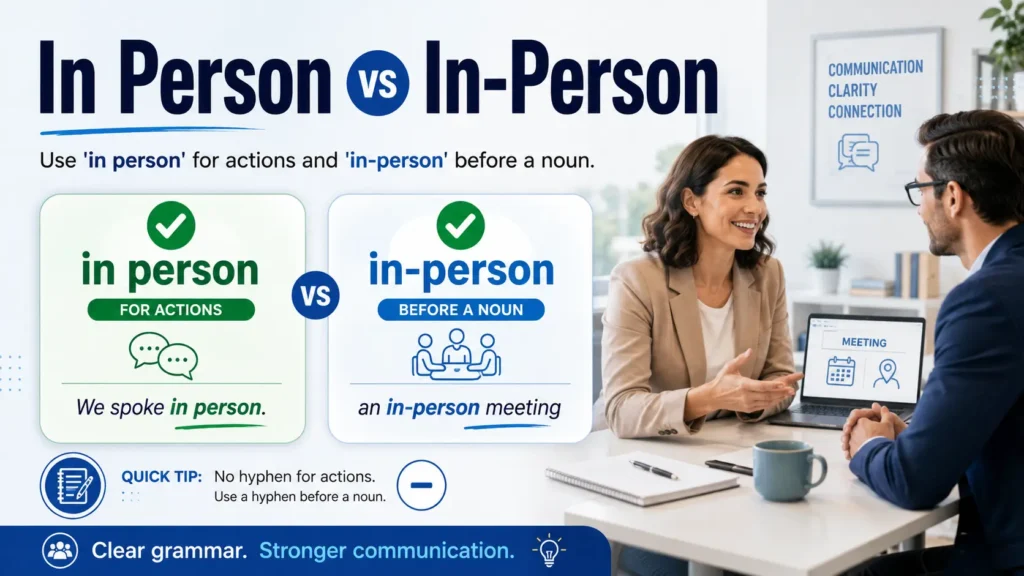
Confused about in person vs in-person? Learn simple grammar rules, examples, and differences that help you use these phrases correctly every day.
Many writers mix up these two forms because they look similar, but they have different grammar roles. This guide explains when to use in person for direct actions and when to use in-person before a noun. It also covers sentence patterns, real-life situations, and useful tips that make correct usage easier to remember.
You’ll learn how the hyphen changes the sentence, why the difference matters, and how to avoid common mistakes in emails, school work, and professional writing. With clear examples and simple explanations, understanding these phrases becomes easier for students, bloggers, and everyday English users who want to communicate more clearly. These practical grammar tips can help improve your confidence when writing or speaking in American English.
Quick Answer: Is It In Person or In-Person?
Both forms are correct, but they are used in different situations.
| Form | Correct Use | Example |
| In person | Used to describe how an action happens | I met the client in person. |
| In-person | Used before a noun as an adjective | We scheduled an in-person meeting. |
The easiest rule to remember is:
Before a noun = in-person
When describing an action = in person
Compare:
- The company offers in-person training.
- The company trains employees in person.
In the first sentence, in-person describes the noun training.
In the second sentence, in person explains how the training happens.
What Does “In Person” Mean?
In person means being physically present somewhere or interacting directly with someone instead of communicating through technology or another method.
It often means:
- face-to-face
- physically present
- physically there
- directly with another person
The phrase is commonly used when comparing physical interaction with:
- phone calls
- emails
- text messages
- video meetings
- online communication
- remote communication
For example:
I prefer discussing important topics in person.
This means the speaker prefers a direct, face-to-face conversation rather than communicating online or by phone.
The Grammar Role of “In Person”
Grammatically, in person functions as an adverbial phrase because it explains how an action takes place.
An adverb or adverbial phrase can describe:
- how something happens
- when something happens
- where something happens
With in person, the important question is usually:
How did the action happen?
Examples:
- She apologized in person.
- I interviewed the candidate in person.
- They signed the contract in person.
- We discussed the problem in person.
In each sentence, in person gives more information about the action.
A Simple Test
Look at the verb and ask:
How did the person perform the action?
If the answer is physically, directly, or face-to-face, use:
in person
For example:
She spoke to the manager in person.
How did she speak to the manager?
In person.
Examples of “In Person” in Everyday American English
You can use in person naturally in many situations.
Workplace Examples
- I need to discuss this project with you in person.
- The manager met the new employee in person.
- We spoke with the client in person.
- The interview was completed in person.
School Examples
- Students can speak with their teachers in person.
- I prefer asking questions in person instead of sending emails.
- The parents met the principal in person.
- She submitted the required documents in person.
Healthcare Examples
- The doctor wants to evaluate the patient in person.
- You may need to speak with the specialist in person.
- The patient discussed the symptoms in person.
- The doctor examined him in person.
Daily Conversation Examples
- Can we talk in person tomorrow?
- I haven’t seen her in person since college.
- I would rather explain everything in person.
- The building looks even better in person.
What Does “In-Person” Mean?
In-person is a compound adjective used to describe a noun.
It usually refers to something that involves direct physical presence rather than an online, remote, or virtual format.
Common examples include:
- in-person meeting
- in-person interview
- in-person class
- in-person appointment
- in-person event
- in-person consultation
- in-person workshop
- in-person training
The hyphen connects in and person so the two words work together as one adjective.
Why Does “In-Person” Need a Hyphen?
The hyphen shows that in and person work together to describe the noun that follows.
Consider this sentence:
❌ We attended an in person meeting.
The meaning may still be understandable, but the adjective is not formatted correctly.
The preferred form is:
✅ We attended an in-person meeting.
Here, in-person describes the noun meeting.
A useful general guideline is:
When two or more words work together before a noun as one adjective, they are often hyphenated.
Similar examples include:
- well-known author
- full-time job
- high-quality product
- face-to-face conversation
In Person vs In-Person: Main Differences
The main difference is their grammatical function.
| Feature | In Person | In-Person |
| Grammar role | Adverbial phrase | Compound adjective |
| Main purpose | Describes an action | Describes a noun |
| Typical position | Often follows an action | Usually appears before a noun |
| Hyphen | No | Yes |
| Meaning | Physically present | A face-to-face type of something |
The meaning is closely related, but the sentence structure determines which form you should use.
In Person vs In-Person Examples
Seeing both forms side by side makes the distinction easier.
Example 1: Meeting
✅ I met my supervisor in person.
This explains how the meeting happened.
✅ I had an in-person meeting with my supervisor.
This describes the type of meeting.
Example 2: Interview
✅ She completed the interview in person.
This means she physically attended the interview.
✅ She completed an in-person interview.
Here, in-person describes the interview format.
Example 3: Class
✅ Students attended the class in person.
This explains how they attended.
✅ Students attended an in-person class.
This describes the type of class.
Example 4: Appointment
✅ I spoke with the doctor in person.
The phrase explains how the conversation happened.
✅ I scheduled an in-person appointment.
The phrase describes the type of appointment.
How to Use In Person and In-Person Correctly
The easiest way to choose between them is to look at the role the phrase plays in the sentence.
Use “In Person” to Describe an Action
A common sentence pattern is:
Subject + verb + in person
Examples:
- I talked to my teacher in person.
- They met the customer in person.
- We discussed the issue in person.
- She apologized in person.
- He delivered the documents in person.
The phrase is commonly used with verbs such as:
- meet
- talk
- discuss
- explain
- apologize
- deliver
- visit
- confirm
- speak
- see
Use “In-Person” Before a Noun
A common pattern is:
in-person + noun
Examples:
- in-person meeting
- in-person appointment
- in-person interview
- in-person consultation
- in-person workshop
- in-person event
- in-person class
Ask:
What type of meeting, class, appointment, or event is it?
For example:
The company offers in-person training.
What type of training?
In-person training.
Real-Life Examples of In Person vs In-Person
Both forms appear frequently in modern American English.
Business Communication
Examples:
- We scheduled an in-person meeting with the client.
- The CEO met investors in person.
- The company offers in-person consultations.
- Our manager prefers discussing sensitive issues in person.
The hyphenated form describes a noun.
The non-hyphenated form explains how an action happens.
Education
Examples:
- The university provides in-person classes and online courses.
- Students can meet professors in person during office hours.
- The school has resumed in-person learning.
- Parents may speak with teachers in person.
Healthcare
Examples:
- The clinic offers in-person appointments and virtual consultations.
- The patient spoke with the doctor in person.
- An in-person examination may be necessary.
- The specialist wants to see the patient in person.
Remote Work
Examples:
- Our team has an in-person conference every year.
- I prefer discussing sensitive topics in person.
- The company organizes several in-person events.
- Remote employees occasionally meet in person.
Common Mistakes With In Person and In-Person
Most errors happen when writers add or remove the hyphen in the wrong place.
Mistake 1: Using “In Person” Before a Noun
Incorrect:
❌ We attended an in person meeting.
Correct:
✅ We attended an in-person meeting.
Why?
Because in-person describes the noun meeting.
Mistake 2: Adding a Hyphen When Describing an Action
Incorrect:
❌ I talked to my manager in-person.
Correct:
✅ I talked to my manager in person.
Why?
Because the phrase explains how the talking happened.
Mistake 3: Hyphenating Every Use
Some writers use in-person everywhere because the hyphenated form looks familiar.
However, the hyphen is generally needed when the phrase acts as an adjective before a noun.
Compare:
✅ We had an in-person discussion.
✅ We discussed the problem in person.
The first phrase describes discussion.
The second phrase describes discussed.
Mistake 4: Writing “Meet In-Person”
You may sometimes see:
❌ Let’s meet in-person tomorrow.
The preferred standard form is:
✅ Let’s meet in person tomorrow.
Here, in person explains how the meeting will happen.
Is “Meet In-Person” Correct?
The preferred form is:
✅ Let’s meet in person.
Because meet is a verb, in person explains how the meeting takes place.
Other correct examples include:
- Let’s meet in person next week.
- We should discuss this in person.
- I would like to speak with you in person.
You can also rewrite the sentence using the adjective form:
- We will have an in-person meeting next week.
- Let’s schedule an in-person discussion.
- We need an in-person conversation.
In Person vs Face-to-Face: Are They the Same?
In person and face-to-face are similar, but they do not always emphasize exactly the same idea.
| Expression | Main Meaning | Example |
| In person | Physical presence | I spoke with her in person. |
| Face-to-face | Direct personal interaction | We had a face-to-face discussion. |
In person mainly focuses on being physically present.
Face-to-face often emphasizes direct interaction between people.
For example:
- You can collect a document in person.
- You can have a face-to-face conversation with someone.
Both expressions can overlap in meaning, but the best choice depends on the sentence.
American English Usage Tips
Both in person and in-person are common in American English.
Formal and Professional Writing
In business, academic, and professional writing, use:
- in-person interview
- in-person meeting
- in-person appointment
- in-person consultation
- speak in person
- meet in person
Examples:
- We request an in-person interview with the applicant.
- The professor discussed the topic with students in person.
- Please schedule an in-person consultation.
- I would prefer to discuss the matter in person.
Casual Conversation
These forms are also common in everyday speech.
Examples:
- Can we talk in person?
- Are you coming to the in-person event?
- I want to see it in person.
- We finally met in person.
- Is the class online or in-person?
Easy Memory Trick for In Person vs In-Person
Use this simple test.
Before a Noun → Use “In-Person”
Examples:
- in-person class
- in-person meeting
- in-person interview
- in-person event
- in-person appointment
Ask:
Is the phrase describing a noun?
If yes, use the hyphen.
Describing an Action → Use “In Person”
Examples:
- meet in person
- talk in person
- explain in person
- speak in person
- visit in person
Ask:
Does the phrase explain how an action happens?
If yes, write it as two separate words.
Quick Memory Formula
In-person + noun
Verb/action + in person
That simple pattern can help you avoid most mistakes.
Practice Questions: In Person or In-Person?
Choose the correct option.
1. I want to discuss this issue ___.
A. in person
B. in-person
Answer: A. in person
The phrase describes how the discussion happens.
2. We scheduled an ___ appointment.
A. in person
B. in-person
Answer: B. in-person
The phrase describes the noun appointment.
3. The company provides ___ training.
A. in person
B. in-person
Answer: B. in-person
The phrase describes the type of training.
4. She explained the process ___.
A. in person
B. in-person
Answer: A. in person
The phrase explains how she performed the action.
5. We had an ___ discussion with the manager.
A. in person
B. in-person
Answer: B. in-person
The phrase describes the noun discussion.
6. I would rather speak with her ___.
A. in person
B. in-person
Answer: A. in person
The phrase explains how the speaking will happen.
Synonyms and Related Expressions
Several words and expressions are related to in person and in-person.
Synonyms for “In Person”
Depending on the context, alternatives may include:
- face-to-face
- physically present
- directly
- personally
- physically there
Example:
I spoke with him in person.
A similar sentence is:
I spoke with him face-to-face.
The meaning is close, although the emphasis can differ slightly.
Related Words and Phrases
Related expressions include:
- virtual meeting
- online meeting
- remote communication
- face-to-face interaction
- physical presence
- direct conversation
- virtual consultation
- remote interview
- online class
These terms often appear when comparing physical interaction with digital communication.
In Person vs In-Person at a Glance
Here is a quick comparison:
| Question | Correct Choice |
| I met her ___ | in person |
| an ___ meeting | in-person |
| speak ___ | in person |
| an ___ interview | in-person |
| talk ___ | in person |
| an ___ appointment | in-person |
| see something ___ | in person |
| an ___ class | in-person |
Remember:
Describing a noun? Use in-person.
Describing an action? Use in person.
Conclusion: Choosing Between In Person and In-Person Correctly
Understanding in person vs in-person becomes simple once you know their grammar roles. Use in person when you are explaining how an action happens, such as meeting, talking, or explaining something face-to-face. Use in-person when you are describing a noun, such as an in-person meeting, in-person class, or in-person interview.
The main difference is the hyphen. The hyphen turns the phrase into a compound adjective that describes a noun. Without the hyphen, in person works as an adverbial phrase that explains an action.
By remembering one simple rule — before a noun use in-person, after a verb use in person — you can avoid common grammar mistakes. This small writing detail helps make emails, academic papers, business documents, and everyday communication clearer and more professional.
Frequently Asked Questions About In Person vs In-Person
Q1: Is it correct to write in person or in-person?
Yes, both forms are correct, but they have different uses. In person is used when describing an action, while in-person is used before a noun to describe something that happens face-to-face.
Examples:
- I talked to my teacher in person.
- We had an in-person meeting.
Q2: Is in person one word?
No, in person is written as two separate words. It is not written as one word.
Correct:
- I met the client in person.
Incorrect:
- I met the client inperson.
Q3: Why does in-person have a hyphen?
The hyphen connects the words because they work together as one adjective before a noun. It helps readers understand that both words describe the same thing.
Example:
- in-person interview
Here, “in-person” describes the type of interview.
Q4: Should I write in-person meeting or in person meeting?
The correct form is in-person meeting.
Because “in-person” describes the noun “meeting,” it needs a hyphen.
Correct:
- We scheduled an in-person meeting.
Incorrect:
- We scheduled an in person meeting.
Q5: Can I use in-person after a verb?
Usually, you should use in person after a verb.
Correct:
- I spoke with my manager in person.
Less preferred:
- I spoke with my manager in-person.
When the phrase explains how an action happens, remove the hyphen.
Q6: What is the difference between in person and face-to-face?
Both expressions describe direct interaction, but they focus on slightly different ideas.
In person focuses on physical presence.
Example:
- I saw the building in person.
Face-to-face focuses on direct communication between people.
Example:
- We had a face-to-face conversation.
Q7: Is in-person used in formal writing?
Yes, in-person is commonly used in professional, academic, and business writing when it describes a noun.
Examples:
- in-person consultation
- in-person training
- in-person interview
However, use in person when describing an action.
Q8: Is “meet in-person” grammatically correct?
The preferred form is meet in person.
Example:
- Let’s meet in person tomorrow.
Because “in person” explains how the meeting happens, it works as an adverbial phrase.
Q9: What are some common mistakes with in person and in-person?
Common mistakes include:
- Adding a hyphen after a verb:
- ❌ I talked to her in-person.
- ✅ I talked to her in person.
- Removing the hyphen before a noun:
- ❌ an in person meeting
- ✅ an in-person meeting
Checking the word that follows the phrase can help you choose correctly.
Q10: How can I easily remember the difference between in person and in-person?
Use this simple memory trick:
Before a noun = in-person
Examples:
- in-person class
- in-person event
- in-person appointment
After a verb = in person
Examples:
- talk in person
- meet in person
- explain in person
If the phrase describes a thing, use the hyphen. If it describes an action, leave it out.
Eminent vs Imminent: Meaning, Differences, Examples, and Common Mistakes
Truly vs. Truely: Which Spelling Is Correct? (Meaning, Rule, Examples & Common Mistakes)
Concave vs. Convex: Meaning, Differences, Examples, and Easy Ways to Remember
