
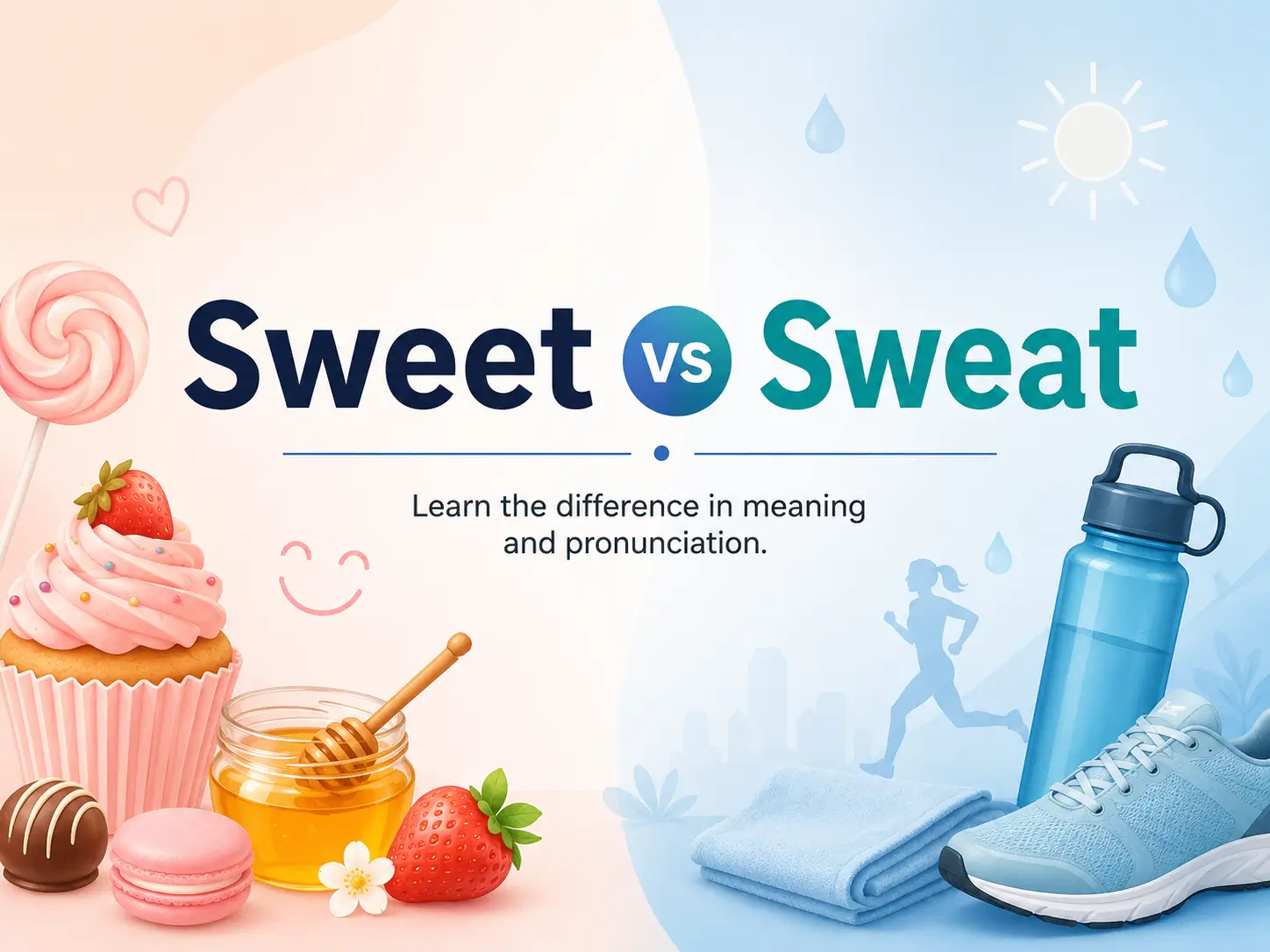
Sweet vs sweat becomes easy to understand when you check the meaning first: sweet describes taste or kindness, while sweat means body moisture. These common English words look alike because of their spelling, yet their pronunciation, grammar role, and everyday use are completely different.
Many learners mix them up in writing and speaking. A spell-check tool in word-processing software may not help because both are correctly spelled words in its dictionary. Likewise, autocorrect on mobile phones may confuse them because both start with s-w-e. Therefore, careful reading is still needed before you accept a suggested word.
Use context to make the right word choice. Pick sweet for pleasure, charm, sugary flavor, or a kind action. Choose sweat for heat, exercise, hard work, or stress. This small spelling change creates a large meaning change. Learning the logic improves accuracy, prevents common mistakes, and builds confidence in everyday English.
Quick Answer: What Is the Difference Between Sweet and Sweat?
The main difference is simple:
- Sweet relates to sugar, kindness, pleasure, affection, or approval.
- Sweat relates to body moisture, heat, physical effort, stress, or worry.
| Word | Pronunciation | Main meaning | Common role | Example |
| Sweet | /swiːt/ | Sugary, kind, pleasant, or enjoyable | Adjective | The strawberries taste sweet. |
| Sweat | /swɛt/ | Moisture produced by the body | Noun | Sweat ran down his face. |
| Sweat | /swɛt/ | To produce body moisture | Verb | I sweat when I exercise. |
A useful memory sentence is:
A sweet treat tastes good, while sweat makes you wet.
What Does Sweet Mean?
Sweet has several meanings in American English. Most often, it functions as an adjective, which means it describes a person, place, object, feeling, sound, or experience.
Its exact meaning depends on the context.
Sweet Meaning Sugary or Containing Sugar
The most basic meaning of sweet is “having a taste like sugar or honey.”
Examples:
- The peaches are ripe and sweet.
- She added sugar because the coffee wasn’t sweet enough.
- This sauce has a slightly sweet flavor.
- The bakery sells sweet bread and pastries.
In these sentences, sweet describes taste.
The opposite of sweet may be:
- bitter
- sour
- salty
- savory
- unsweetened
For example:
- The dark chocolate tastes more bitter than sweet.
- I prefer savory snacks instead of sweet ones.
Sweet Meaning Kind or Thoughtful
Sweet can also describe a kind, caring, polite, or thoughtful person or action.
Examples:
- It was sweet of you to bring her flowers.
- Your grandmother sounds like a sweet person.
- He sent me a sweet message before the interview.
- That was a sweet thing to say.
Here, sweet doesn’t describe flavor. Instead, it expresses warmth or affection.
In professional writing, words such as thoughtful, kind, or considerate may sound more precise.
Informal:
- That was so sweet of your manager.
More professional:
- That was very thoughtful of your manager.
Sweet Meaning Pleasant or Enjoyable
People also use sweet for something enjoyable, satisfying, or desirable.
Examples:
- The team celebrated a sweet victory.
- After years of saving, buying their first home felt sweet.
- The hotel gave us a sweet ocean view.
- We found a sweet deal on plane tickets.
This meaning is common in everyday American English. However, phrases such as sweet deal are casual. In formal writing, you might say excellent offer, favorable agreement, or valuable opportunity.
Sweet as an Informal Expression
In casual American English, Sweet! can mean:
- Great!
- Excellent!
- That works for me.
- I’m happy about that.
Example conversation:
“The meeting was moved to Friday.”
“Sweet! That gives me more time to prepare.”
Another example:
“I got us tickets for the game.”
“Sweet! Thanks.”
This use is informal, so it’s more suitable for conversation, texting, or casual workplace chats than formal reports.
Sweet as a Noun
Although sweet is usually an adjective, it can also be a noun.
As a noun, it may refer to:
- a sugary food
- a dessert
- a piece of candy
- something pleasant
Examples:
- He tries not to eat too many sweets.
- The children received sweets after the party.
- She has always loved sweets.
In American English, candy is more common when referring to small sugary foods. In British English, sweets is the standard word for what Americans usually call candy.
British English:
- The children bought some sweets.
American English:
- The children bought some candy.
British speakers may also use sweet to mean dessert:
- What are we having for sweet?
In American English, people normally say:
- What are we having for dessert?
What Does Sweat Mean?
Sweat can be either a noun or a verb. Both uses relate to perspiration, which is the moisture released through the skin.
People sweat because the body needs to cool itself. Sweating may also happen because of stress, fear, illness, spicy food, or hormonal changes.
Sweat as a Noun
As a noun, sweat means the liquid or moisture produced by sweat glands.
Examples:
- Sweat covered his forehead.
- She wiped the sweat from her face.
- My shirt was soaked with sweat.
- Beads of sweat appeared on his neck.
In this meaning, sweat is usually an uncountable noun. That means we normally don’t say “a sweat” or “three sweats” when talking about the liquid.
Correct:
- There was sweat on his shirt.
- A drop of sweat fell from her forehead.
Incorrect:
- There were three sweats on his shirt.
To count it, use a phrase such as:
- a drop of sweat
- a bead of sweat
- patches of sweat
Sweat as a Verb
As a verb, sweat means to produce sweat.
Examples:
- I sweat a lot during summer.
- She sweats when she feels nervous.
- We were sweating after the workout.
- He sweated through his shirt.
The main forms are:
| Verb form | Word | Example |
| Base form | sweat | I sweat during exercise. |
| Third-person singular | sweats | He sweats easily. |
| Present participle | sweating | They are sweating in the heat. |
| Past tense | sweated or sweat | She sweated during the run. |
| Past participle | sweated or sweat | He had sweated through his uniform. |
Sweated is the clearest standard past-tense form, especially in formal writing.
Examples:
- She sweated during the entire workout.
- He had sweated through two shirts.
The form sweat is also used as a past tense, especially in informal American speech.
- I sweat all night because the air conditioner stopped working.
However, sweated is often easier for learners because it clearly marks the past tense.
Sweat Meaning to Work Hard
Sweat can describe hard physical or mental effort.
Examples:
- The team sweated over every detail of the proposal.
- She sweated for weeks to finish the project.
- They put blood, sweat, and tears into the business.
Here, the word suggests intense effort rather than literal body moisture.
Sweat Meaning to Worry
In informal English, sweat can also mean to worry.
Examples:
- Don’t sweat the small details.
- He’s sweating over tomorrow’s exam.
- I wouldn’t sweat it.
- She began to sweat when her boss requested a meeting.
Some examples may be partly literal and partly figurative. A nervous person might physically sweat, but the expression can also describe worry itself.
Sweet vs Sweat Comparison
The words differ in meaning, pronunciation, spelling, and grammar.
| Feature | Sweet | Sweat |
| Main meaning | Sugary, kind, pleasant, or enjoyable | Body moisture or the act of producing it |
| Pronunciation | Long ee sound | Short e sound |
| Common part of speech | Adjective | Noun and verb |
| Related to food | Yes | No |
| Related to kindness | Yes | No |
| Related to exercise | Sometimes, but not directly | Yes |
| Related to worry | Rarely | Yes, figuratively |
| Example | She gave me a sweet gift. | The heat made me sweat. |
The meaning can be summarized in two questions:
- Does the sentence involve taste, kindness, affection, or pleasure? Use sweet.
- Does the sentence involve heat, moisture, effort, exercise, or stress? Use sweat.
How to Pronounce Sweet and Sweat
The pronunciation difference is small but important.
How to Pronounce Sweet
Sweet is pronounced /swiːt/.
It uses the long ee sound heard in:
- meet
- green
- sleep
- seat
- need
The vowel sound is held slightly longer:
- sw-ee-t
Examples:
- sweet tea
- sweet person
- sweet smell
How to Pronounce Sweat
Sweat is pronounced /swɛt/.
It uses the short e sound heard in:
- wet
- bed
- set
- red
- get
The vowel is short:
- sw-eh-t
Examples:
- break a sweat
- covered in sweat
- sweat during exercise
Pronunciation Practice
Say these pairs aloud:
| Long vowel | Short vowel |
| sweet | sweat |
| meet | met |
| seat | set |
| feet | fed |
| reach | red |
Not every pair above forms a perfect rhyme, but the contrast helps you hear the long and short vowel sounds.
Try this sentence slowly:
The sweet tea made me sweat in the summer heat.
The first word has a long ee sound. The second has a short e sound.
Grammar and Word Forms of Sweet
The word sweet belongs to a larger word family.
| Word | Part of speech | Meaning | Example |
| sweet | Adjective | Sugary, kind, or pleasant | That’s a sweet idea. |
| sweeter | Comparative adjective | More sweet | This apple is sweeter. |
| sweetest | Superlative adjective | Most sweet | That was the sweetest gift. |
| sweetly | Adverb | In a pleasant or gentle way | She smiled sweetly. |
| sweetness | Noun | The quality of being sweet | The fruit’s sweetness surprised me. |
| sweeten | Verb | To make sweeter | You can sweeten the tea with honey. |
| sweetened | Adjective or verb form | Made sweeter | I prefer unsweetened coffee to sweetened coffee. |
Comparing Sweet, Sweeter, and Sweetest
Because sweet is a short adjective, its comparative and superlative forms normally use -er and -est.
- sweet
- sweeter
- sweetest
Examples:
- This orange is sweet.
- That orange is sweeter.
- The smallest orange is the sweetest.
Avoid saying more sweeter or most sweetest because these forms repeat the comparison.
Incorrect:
- This tea is more sweeter.
Correct:
- This tea is sweeter.
Grammar and Word Forms of Sweat
The word family for sweat includes several forms.
| Word | Part of speech | Meaning | Example |
| sweat | Noun | Body moisture | His face was covered in sweat. |
| sweat | Verb | Produce body moisture | I sweat in hot weather. |
| sweats | Verb | Produces sweat | She sweats during workouts. |
| sweating | Verb form | Producing sweat | He is sweating heavily. |
| sweated | Past-tense verb | Produced sweat | We sweated in the sun. |
| sweaty | Adjective | Covered in sweat | My clothes feel sweaty. |
| perspiration | Noun | Formal word for sweat | Heavy perspiration may occur during exercise. |
Sweat vs Sweaty
Sweat is usually a noun or verb. Sweaty is an adjective.
Correct:
- My hands are sweaty.
- There is sweat on my hands.
- My hands sweat when I’m nervous.
Incorrect:
- My hands are sweat.
The adjective after are should be sweaty.
Sweetie vs Sweaty
Sweetie and sweaty sound similar, but their meanings are very different.
| Word | Meaning | Example |
| Sweetie | An affectionate name for a person | Thanks for helping me, sweetie. |
| Sweaty | Covered in or affected by sweat | I felt sweaty after the run. |
Sweetie is related to sweet because it expresses affection.
Sweaty is related to sweat because it describes someone or something covered in perspiration.
Incorrect:
- My shirt became sweetie after the workout.
Correct:
- My shirt became sweaty after the workout.
Incorrect:
- Good morning, sweaty.
Correct:
- Good morning, sweetie.
Be careful when using sweetie with strangers or coworkers. It can sound affectionate, overly familiar, or condescending depending on the situation.
Common Word Combinations with Sweet
Learning common combinations, also called collocations, can help you use sweet naturally.
Sweet and Food
Common phrases include:
- sweet taste
- sweet flavor
- sweet fruit
- sweet dessert
- sweet drink
- sweet sauce
- sweet snack
- sweet treat
Examples:
- Mangoes have a naturally sweet flavor.
- The café serves both savory meals and sweet treats.
- This drink is too sweet for me.
Sweet and Personality
Common phrases include:
- sweet person
- sweet child
- sweet gesture
- sweet message
- sweet smile
- sweet voice
- sweet personality
Examples:
- She has a sweet personality.
- Sending that card was a sweet gesture.
- He left a sweet message on my desk.
Sweet and Positive Experiences
Common phrases include:
- sweet victory
- sweet success
- sweet relief
- sweet memory
- sweet deal
- sweet moment
- sweet surprise
Examples:
- Finishing the marathon was a sweet victory.
- Hearing that everyone was safe brought sweet relief.
- The free upgrade was a sweet surprise.
Common Word Combinations with Sweat
These combinations appear often in American conversation and writing.
Sweat and Exercise
- break a sweat
- work up a sweat
- sweat heavily
- sweat during exercise
- sweat through a shirt
- covered in sweat
Examples:
- We hadn’t even broken a sweat after the warm-up.
- A fast walk can help you work up a sweat.
- He sweated through his shirt during the game.
Sweat and Physical Appearance
- beads of sweat
- drops of sweat
- sweat stains
- sweaty hands
- sweaty clothes
- sweaty forehead
Examples:
- Beads of sweat formed on her forehead.
- He tried to hide the sweat stains on his shirt.
- My palms become sweaty before presentations.
Sweat and Stress
- cold sweat
- nervous sweat
- sweat over something
- don’t sweat it
- sweat the details
Examples:
- He woke up in a cold sweat after the nightmare.
- She was sweating over the final exam.
- Don’t sweat the details until we know the full plan.
Sweet and Sweat in Everyday American English
Both words appear in casual conversations, schoolwork, workplace communication, social media, and advertising.
At Home
- The pancakes taste sweet because of the maple syrup.
- It’s so hot that I’m starting to sweat.
- That was sweet of you to wash the dishes.
- Open a window before we all sweat.
At School
- The teacher gave the class a sweet reward after the test.
- Students began to sweat when they saw the difficult questions.
- Mia wrote a sweet note to her friend.
- The gym was hot, so everyone was sweating.
At Work
- We received a sweet deal from the new supplier.
- He was sweating before his presentation.
- Your email to the client was clear and sweet.
The final example sounds unnatural in professional English. A better version would be:
- Your email to the client was clear and friendly.
- Your email was short and sweet.
The phrase short and sweet means brief, pleasant, and effective.
In Text Messages
Casual examples:
- “Dinner at seven?”
“Sweet, see you then.” - “Sorry I’m five minutes late.”
“No sweat.” - “Your birthday post was so sweet.”
- “I’m already sweating, and I just walked outside.”
On Social Media
Examples:
- The sweetest surprise from my friends!
- This workout made me sweat.
- Nothing beats a sweet iced coffee on a hot day.
- I’m sweating over tomorrow’s deadline.
Idioms and Expressions with Sweet
Sweet Dreams
Sweet dreams is a friendly phrase said before someone goes to sleep.
Example:
- Good night. Sweet dreams!
It can be used with family members, romantic partners, or close friends.
Short and Sweet
Short and sweet means brief but pleasant, clear, or effective.
Examples:
- Keep your presentation short and sweet.
- Her acceptance speech was short and sweet.
- I’ll keep this email short and sweet.
This phrase works in both casual and professional settings.
Have a Sweet Tooth
To have a sweet tooth means to enjoy sugary foods.
Examples:
- I have a sweet tooth, so I always order dessert.
- People with a sweet tooth may enjoy this bakery.
- My brother doesn’t have much of a sweet tooth.
It doesn’t mean that a person’s tooth tastes sweet.
Sweeten the Deal
To sweeten the deal means to make an offer more attractive.
Examples:
- The seller offered free delivery to sweeten the deal.
- The company added a signing bonus to sweeten the deal.
- A longer warranty could sweeten the deal for customers.
This phrase is common in business, sales, and negotiations.
Sweet Spot
A sweet spot is the ideal point, position, amount, or balance.
Examples:
- This laptop hits the sweet spot between price and performance.
- Early afternoon is the sweet spot for scheduling the meeting.
- The restaurant found a sweet spot between casual and elegant.
Revenge Is Sweet
The expression revenge is sweet means that getting even can feel satisfying.
Example:
- After years of losing, the team finally defeated its rival. Revenge was sweet.
The phrase is common, but it may sound dramatic or playful depending on the context.
Idioms and Expressions with Sweat
Break a Sweat
To break a sweat means to begin sweating because of activity or heat.
Example:
- We broke a sweat after running one mile.
It can also mean making an effort.
- She finished the easy quiz without breaking a sweat.
In this second example, it means she completed it easily.
Work Up a Sweat
To work up a sweat means to exercise or work until you begin sweating.
Examples:
- A brisk walk can help you work up a sweat.
- We worked up a sweat moving the furniture.
Don’t Sweat It
Don’t sweat it means “don’t worry about it.”
Example:
- “I’m sorry I forgot to call.”
“Don’t sweat it.”
This expression is casual. In professional communication, consider:
- Don’t worry about it.
- That’s not a problem.
- No action is needed.
- We can resolve it easily.
No Sweat
No sweat means “no problem” or “that was easy.”
Examples:
- “Can you finish this by Friday?”
“No sweat.” - The repair was no sweat for an experienced mechanic.
This phrase is informal.
In a Cold Sweat
To be in a cold sweat means to sweat because of fear, anxiety, illness, or shock.
Examples:
- He woke up in a cold sweat.
- She broke into a cold sweat before the interview.
- The sudden pain left him in a cold sweat.
Blood, Sweat, and Tears
This expression refers to extreme effort, sacrifice, and determination.
Examples:
- They built the company with blood, sweat, and tears.
- Years of blood, sweat, and tears went into the project.
It doesn’t usually describe actual blood. Instead, it emphasizes hard work and struggle.
Synonyms for Sweet
The best synonym depends on the meaning.
Synonyms Related to Taste
- sugary
- honeyed
- syrupy
- candied
- saccharine
- dessert-like
Examples:
- The drink tasted sugary.
- The glaze had a honeyed flavor.
Be careful with saccharine. It can mean excessively sweet or overly sentimental.
Synonyms Related to Kindness
- kind
- caring
- thoughtful
- gentle
- considerate
- affectionate
- warm
Example:
- That was a thoughtful gesture.
Synonyms Related to Pleasure or Approval
- great
- excellent
- pleasant
- enjoyable
- satisfying
- wonderful
- attractive
- favorable
Example:
- We received a favorable offer.
Synonyms and Related Words for Sweat
Nouns Related to Sweat
- perspiration
- moisture
- dampness
- droplets
Perspiration is a more formal word for sweat.
Example:
- Heavy perspiration may occur during intense exercise.
Verbs Related to Sweating
- perspire
- overheat
- labor
- strain
- worry
- struggle
These words aren’t exact replacements in every sentence.
For example:
- I perspire during exercise.
This is grammatically correct but more formal than:
- I sweat during exercise.
Adjectives Related to Sweat
- sweaty
- damp
- moist
- overheated
- clammy
Each word has a different shade of meaning.
- Sweaty means affected by sweat.
- Damp means slightly wet.
- Clammy often means unpleasantly cool and damp.
Common Sweet vs Sweat Mistakes
Using Sweat for a Sugary Taste
Incorrect:
- This pie tastes sweat.
Correct:
- This pie tastes sweet.
Why: Sweet describes flavor. Sweat refers to body moisture or producing it.
Using Sweet for Body Moisture
Incorrect:
- He wiped the sweet from his forehead.
Correct:
- He wiped the sweat from his forehead.
Why: The sentence refers to moisture produced by the body.
Misspelling Don’t Sweat It
Incorrect:
- Don’t sweet it.
Correct:
- Don’t sweat it.
Why: The phrase means “don’t worry.” It uses sweat, not sweet.
Confusing Sweaty and Sweetie
Incorrect:
- I felt sweetie after the gym.
Correct:
- I felt sweaty after the gym.
Why: Sweaty describes someone covered in sweat. Sweetie is a term of affection.
Using Sweet as a Verb
Incorrect:
- Please sweet my tea.
Correct:
- Please sweeten my tea.
- Please add sugar to my tea.
Why: The verb is sweeten, not sweet.
Using Sweat as an Adjective
Incorrect:
- My shirt is sweat.
Correct:
- My shirt is sweaty.
- My shirt is covered in sweat.
Why: Sweaty is the adjective form.
How Context Helps You Choose the Correct Word
When you’re unsure, look at the other words in the sentence.
Use sweet when you see ideas connected to:
- sugar
- candy
- dessert
- kindness
- affection
- pleasant sounds
- good deals
- happy memories
- approval
Use sweat when you see ideas connected to:
- heat
- exercise
- skin
- moisture
- stress
- fear
- hard work
- physical effort
- nervousness
Consider these sentences:
- The baby gave me a ___ smile.
A smile may be kind or charming, so the answer is sweet.
- The runner wiped ___ from her face.
The sentence refers to body moisture, so the answer is sweat.
- Don’t ___ the small mistakes.
The sentence means “don’t worry,” so use sweat.
- We got a ___ discount.
A very good discount can be called a sweet discount in casual English.
Easy Ways to Remember Sweet vs Sweat
Connect Sweet with Treat
Both sweet and treat contain the long ee sound.
A sweet treat may include:
- cake
- candy
- cookies
- ice cream
- fruit
- chocolate
Memory sentence:
A sweet treat is something enjoyable to eat.
Connect Sweat with Wet
Sweat makes your skin wet. The words also share the short e sound.
Memory sentence:
Sweat makes you wet.
Look for the Letter A
The word sweat contains the letter a.
You can connect that a with:
- activity
- athletics
- anxiety
All three can cause sweat.
Use a Two-Line Memory Trick
Sweet has the long “ee” sound of a treat.
Sweat has the short “e” sound of wet.
Formal and Informal Usage
Both words can appear in formal and informal English. However, some expressions are more casual.
| Informal expression | Meaning | More formal alternative |
| Sweet! | Great! | Excellent. |
| Sweet deal | Good offer | Favorable offer |
| Don’t sweat it | Don’t worry | That isn’t a concern. |
| No sweat | No problem | That can be done. |
| Sweat the details | Worry about details | Focus excessively on minor details |
Literal uses are usually acceptable in any context.
Formal:
- The patient experienced excessive sweating.
- The solution has a slightly sweet taste.
- The proposal offers a favorable balance of cost and quality.
Casual:
- This coffee is really sweet.
- I’m sweating like crazy.
- That sounds sweet!
- No sweat.
Real-Life Example: Learning the Difference Through Context
Consider an English learner named Daniel who writes:
The weather was hot, so I began to sweet.
The sentence contains clues such as weather, hot, and began. Because heat causes the body to produce moisture, the correct verb is sweat.
Corrected sentence:
The weather was hot, so I began to sweat.
Later, Daniel writes:
My coworker gave me a sweat birthday card.
A birthday card may be kind or thoughtful. Therefore, the correct adjective is sweet.
Corrected sentence:
My coworker gave me a sweet birthday card.
This example shows why context is more useful than memorizing spelling alone. Ask what the sentence is actually describing.
Practice: Choose Sweet or Sweat
Choose the correct word or word form.
- The lemonade is too ___ for me.
- I always ___ during intense workouts.
- That was a very ___ message.
- He wiped the ___ from his face.
- Don’t ___ the small mistakes.
- My clothes felt ___ after the run.
- She has a ___ tooth.
- We got a ___ deal on the apartment.
- The students were ___ over the final exam.
- Please ___ the tea with a little honey.
Answers and Explanations
- Sweet: The sentence describes flavor.
- Sweat: A verb is needed for producing body moisture.
- Sweet: The message was kind or thoughtful.
- Sweat: The sentence refers to moisture.
- Sweat: “Don’t sweat” means “don’t worry.”
- Sweaty: An adjective is needed after “felt.”
- Sweet: “Have a sweet tooth” means to enjoy sugary foods.
- Sweet: A “sweet deal” is an attractive offer.
- Sweating: The phrase describes worrying about the exam.
- Sweeten: The correct verb meaning “make sweet” is sweeten.
Frequently Asked Questions
qWhat Is the Difference Between Sweet and Sweat?
Sweet means sugary, kind, pleasant, or enjoyable. Sweat means body moisture or the action of producing that moisture.
Do Sweet and Sweat Have the Same Pronunciation?
No. Sweet is pronounced with a long “ee” sound. Sweat uses a short “e” sound and rhymes with wet.
Is Sweet an Adjective or a Noun?
Sweet is mainly an adjective, as in “sweet tea.” It can also be a noun when it refers to candy or sugary food.
Is Sweat a Noun or a Verb?
Sweat can be both. As a noun, it means body moisture. As a verb, it means to produce that moisture.
What Is the Easiest Way to Remember Sweet vs Sweat?
Connect sweet with treat because both contain a long “ee” sound. Connect sweat with wet because sweat makes your skin wet.
Conclusion
Understanding sweet vs sweat is simple once you focus on meaning and pronunciation. Sweet describes a sugary taste, a kind action, a pleasant person, or something enjoyable. In contrast, sweat refers to body moisture caused by heat, exercise, stress, or hard work.
Their spelling looks similar, but their vowel sounds are different. Sweet has a long “ee” sound, like meet, while sweat has a short “e” sound, like wet. Context can also help you select the correct word.
Remember this easy trick: a sweet treat tastes good, while sweat makes you wet. Checking the sentence meaning before writing will help you avoid mistakes in schoolwork, conversations, text messages, emails, and professional communication.