
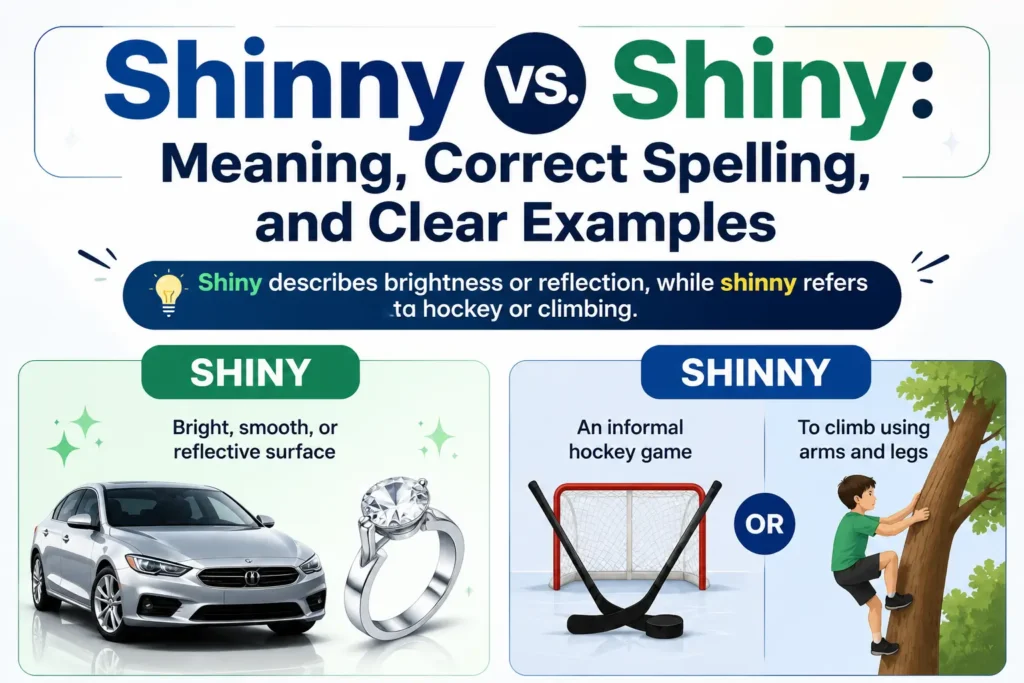
The difference in shinny vs shiny is simple: shiny describes a bright surface, while shinny refers to informal hockey or climbing with your limbs. Shiny is an adjective for something smooth, glossy, polished, or reflective, such as a car, floor, or metal object.
Shinny can be a noun for a casual hockey game played with a stick and puck. It can also be a verb meaning to climb a tree, rope, or pole by gripping it with your hands and legs. Because both are real English words, spellcheck may not catch the wrong choice.
Check the sentence meaning before choosing a spelling. Use shiny for appearance, light, or a polished surface. Use shinny for hockey or climbing. This quick rule helps students, writers, and product reviewers avoid confusing mistakes in school work, descriptions, emails, and casual posts, making the correct word easier to remember every time.
Shinny vs Shiny: Quick Answer
Use shiny when you’re describing something that reflects light or looks bright, polished, or new.
Use shinny when you’re talking about:
- An informal game of hockey
- Climbing a tree, pole, rope, or similar object using your arms and legs
Here’s the simplest way to remember the difference:
Shiny comes from shine, so it describes something bright. Shinny contains shin, a body part you might use while climbing or playing hockey.
Quick comparison table
| Word | Main meaning | Part of speech | Pronunciation | Example |
| Shiny | Bright, polished, or reflective | Adjective | SHY-nee | She bought a shiny silver bracelet. |
| Shinny | An informal hockey game | Noun | SHIN-ee | The kids played shinny after school. |
| Shinny | To climb using the arms and legs | Verb | SHIN-ee | He tried to shinny up the tree. |
| Shiney | Usually an incorrect spelling | Not standard | SHY-nee | Incorrect: The floor looked shiney. |
The extra n changes both the pronunciation and the meaning. Therefore, you need to look at the sentence’s context rather than relying only on spellcheck.
What Does Shiny Mean?
Shiny is an adjective that describes something bright, smooth, polished, or able to reflect light.
Because it’s an adjective, it normally appears before a noun or after a linking verb such as be, look, seem, or become.
- She wore a shiny necklace.
- The kitchen floor looks shiny.
- His new shoes became shiny after he polished them.
- The car was clean and shiny.
In each example, shiny describes the appearance of a person, place, or object.
Literal meaning of shiny
The most common meaning of shiny relates to light. A shiny surface reflects enough light to appear bright or glossy.
Common examples include:
- Shiny metal
- Shiny hair
- Shiny jewelry
- Shiny shoes
- Shiny glass
- Shiny plastic
- Shiny floors
- Shiny car paint
For example:
- The sunlight reflected off the shiny metal.
- Maria polished the table until it looked shiny.
- The dog’s coat appeared healthy and shiny.
- He noticed a shiny coin on the sidewalk.
The object doesn’t have to produce its own light. Instead, it usually reflects light from another source.
Shiny as a figurative description
People also use shiny figuratively to describe something new, attractive, impressive, or exciting.
Consider these examples:
- The company introduced a shiny new app.
- He was distracted by every shiny new business idea.
- The office has plenty of shiny technology, but the computers don’t work well.
- She left her old job for a shiny new opportunity.
In these sentences, the app, idea, technology, and opportunity may not literally reflect light. Instead, shiny suggests that they appear appealing, modern, or exciting.
Sometimes, this use has a slightly critical tone. A “shiny new tool” may look impressive without offering much practical value.
What does “shiny object” mean?
A shiny object can be a real object that reflects light. However, the phrase often refers to something new and exciting that distracts a person from an existing goal.
For example:
- The manager keeps chasing every shiny new trend instead of finishing the current project.
- Don’t let a shiny new feature distract you from the product’s main purpose.
This idea also appears in the informal phrase shiny object syndrome. It describes the habit of repeatedly abandoning one idea for another because the newer option seems more exciting.
The phrase is common in business, marketing, productivity, and technology discussions. Still, it’s informal and may need explanation in academic writing.
How shiny functions in a sentence
As an adjective, shiny can be used in two main positions.
Before a noun
- She carried a shiny handbag.
- A shiny black car stopped outside.
- He received a shiny gold trophy.
Here, shiny directly modifies a noun.
After a linking verb
- The handbag is shiny.
- The car looks shiny.
- The trophy remained shiny for years.
In these examples, the linking verb connects the subject to the description.
Comparative and superlative forms
The comparative form is shinier, and the superlative form is shiniest.
| Form | Use | Example |
| Shiny | Basic form | This spoon is shiny. |
| Shinier | Compares two things | This spoon is shinier than that one. |
| Shiniest | Compares three or more things | That is the shiniest spoon in the drawer. |
Notice that the final y changes to i before adding -er or -est.
- Correct: shinier
- Incorrect: shinyer
- Correct: shiniest
- Incorrect: shinyest
What Does Shinny Mean?
Shinny has two recognized meanings. It can be a noun referring to informal hockey, or it can be a verb meaning to climb using the arms and legs.
Unlike shiny, it doesn’t describe brightness or appearance.
Shinny as an informal hockey game
As a noun, shinny refers to an informal game of hockey. Players may compete on ice, a street, a driveway, or another open area.
A game of shinny often has:
- Few formal rules
- No referees
- Improvised teams
- Limited protective equipment
- No fixed positions
- Casual scoring
For example:
- We played shinny on the frozen pond.
- The neighborhood kids organized a game of shinny.
- After school, they grabbed their sticks and played shinny in the street.
- Our weekend shinny game lasted two hours.
This meaning is strongly associated with Canadian and North American hockey culture. However, not every American reader will recognize it immediately.
In general writing, you may need to explain the word:
- The children played shinny, an informal type of hockey, on the frozen lake.
That short definition helps readers who haven’t encountered the term before.
Read this also: Inexcusable vs. Unexcusable: Which Word Is Correct?
Is shinny the same as ice hockey?
Shinny is a form of hockey, but it usually isn’t a formal match.
A regulated ice hockey game has:
- Official teams
- Referees
- Scheduled periods
- Standard equipment
- Defined positions
- League rules
By contrast, shinny is usually casual. Players often join for fun, and the rules may change depending on the location or group.
Therefore, every game of shinny is a type of hockey, but not every hockey game is shinny.
Shinny as a verb meaning “to climb”
As a verb, shinny means to climb something by gripping it with your arms and legs.
It often appears with the word up:
- He tried to shinny up the tree.
- The child shinnied up the rope.
- She was shinnying up the pole when the coach called her down.
This verb usually describes climbing a narrow or upright object, such as:
- A tree trunk
- A rope
- A pole
- A pipe
- A mast
The action typically involves squeezing or gripping the object between the arms and legs.
Forms of the verb shinny
The spelling changes when shinny is used in different verb tenses.
| Verb form | Spelling | Example |
| Base form | shinny | They can shinny up the rope. |
| Third-person singular | shinnies | He shinnies up the pole. |
| Past tense | shinnied | She shinnied up the tree. |
| Past participle | shinnied | He had shinnied halfway up. |
| Present participle | shinnying | The child is shinnying up the rope. |
The past tense is shinnied, not shinnyed or shinyed.
This follows the usual spelling rule for verbs ending in a consonant plus y. The y changes to i before -ed.
- Try → tried
- Carry → carried
- Hurry → hurried
- Shinny → shinnied
However, the y remains before -ing:
- Try → trying
- Carry → carrying
- Shinny → shinnying
Key Differences Between Shinny and Shiny
Although these words differ by only one letter, they aren’t interchangeable.
They have different meanings
Shiny describes appearance.
- The watch has a shiny face.
- Her hair looked smooth and shiny.
Shinny refers to hockey or climbing.
- They played shinny on the lake.
- He shinnied up the tree.
Using the wrong word can produce a sentence that is grammatically possible but logically incorrect.
For example:
- Incorrect: She wore a shinny dress.
- Correct: She wore a shiny dress.
The incorrect sentence might pass a spelling check because shinny is a real word. However, the meaning doesn’t fit the context.
They have different grammar roles
| Word | Grammar role | What it does |
| Shiny | Adjective | Describes a noun |
| Shinny | Noun | Names an informal hockey game |
| Shinny | Verb | Describes a type of climbing |
Compare these sentences:
- The shiny helmet reflected the sun.
- The players organized a game of shinny.
- He began to shinny up the rope.
The first word describes a helmet. The second names an activity. The third expresses an action.
They have different pronunciations
Shiny is pronounced SHY-nee.
The first syllable sounds like the word shy.
Shinny is pronounced SHIN-ee.
The first syllable sounds like shin, the front part of your lower leg.
| Word | Pronunciation guide | Rhymes closely with |
| Shiny | SHY-nee | Tiny |
| Shinny | SHIN-ee | Finny |
The different vowel sounds help distinguish the words in speech. In writing, however, you need to watch the number of n’s.
Is It Shiny or Shiney?
Shiny is the standard spelling. Shiney is generally considered a spelling mistake.
The confusion happens because shiny comes from the verb shine. Some writers assume they should keep the final e before adding -y.
However, English usually drops the silent e in this word:
- Shine + y = shiny
- Not: shiney
Similar spelling patterns
Several English adjectives follow a similar pattern.
| Base word | Adjective |
| Shine | Shiny |
| Ice | Icy |
| Smoke | Smoky |
| Grease | Greasy |
| Noise | Noisy |
English spelling isn’t perfectly consistent, so it’s useful to memorize shiny as a complete word.
Can shiney ever be correct?
Shiney may appear as a surname, brand name, username, or other proper name. In those cases, it may be intentionally spelled that way.
However, when you mean “bright or reflective,” use shiny.
- Correct: The countertop is shiny.
- Incorrect: The countertop is shiney.
Why Do People Confuse Shinny and Shiny?
The most obvious reason is that the words look almost identical.
However, several other factors add to the confusion.
Spellcheck recognizes both words
A spelling checker may not correct shinny because it is a valid English word.
For example:
- She bought a shinny necklace.
A basic spellchecker may accept this sentence. Yet shinny is still wrong because the writer means that the necklace reflects light.
Grammar and writing tools can help, but they don’t replace checking the sentence’s meaning.
Shinny is less common
Most people see shiny far more often than shinny. As a result, some writers assume that every appearance of shinny must be a typo.
That assumption can also cause errors.
- Correct: We played shinny after school.
- Incorrect correction: We played shiny after school.
The first sentence is correct because it refers to informal hockey.
The pronunciation may be missed
When people speak quickly, the vowel difference can be hard to hear. Non-native speakers may also confuse the short i in shinny with the long i in shiny.
Reading the words aloud can help:
- SHY-nee = bright
- SHIN-ee = hockey or climbing
Correct Examples of Shiny
The following examples show how shiny appears in everyday American English.
Everyday conversation
- Your shoes look really shiny.
- I found a shiny penny near the door.
- Her hair was soft and shiny.
- The new refrigerator has a shiny steel surface.
School and academic contexts
- The student described the mineral as smooth and shiny.
- Some beetles have shiny outer shells.
- The experiment compared dull and shiny surfaces.
- A shiny surface reflected more visible light.
In academic writing, a more exact word may sometimes work better. Depending on the context, you could use reflective, glossy, polished, or lustrous.
Workplace and email examples
- The design looks modern, but the shiny background makes the text hard to read.
- Please avoid using shiny paper for the handouts because it creates glare.
- The team was excited about the shiny new software, although it still lacked key features.
- We replaced the dull fixtures with shiny stainless-steel ones.
Product descriptions
- The bag features shiny gold hardware.
- This cleaner leaves your floors smooth and shiny.
- The jacket has a slightly shiny finish.
- The phone case has a shiny surface that may show fingerprints.
Clear product descriptions should explain what kind of shine the buyer can expect. For example, high-gloss, metallic, and reflective may be more precise than simply saying shiny.
Social media and texting
- Look at my shiny new bike!
- That lip gloss is so shiny.
- I finally polished my boots, and now they’re super shiny.
- The room looked great until the shiny paint started reflecting the camera flash.
These uses are casual, natural, and common.
Correct Examples of Shinny
Because shinny has two meanings, the context must make the intended sense clear.
Shinny meaning informal hockey
- The children played shinny on the frozen pond.
- A weekend game of shinny brought the whole neighborhood together.
- We didn’t have enough players for a formal match, so we played shinny instead.
- His first experience with hockey was a casual game of shinny.
- They cleared the snow and started a game of shinny on the outdoor rink.
Shinny meaning to climb
- The boy tried to shinny up the tree to retrieve his kite.
- She shinnied up the rope during gym class.
- The sailor began shinnying up the narrow mast.
- He can shinny up that pole faster than anyone else.
- The cat climbed easily, but the child had to shinny up the trunk.
In modern writing, climb is often clearer than shinny, especially for international audiences.
For example:
- Less familiar: He shinnied up the tree.
- More widely understood: He climbed up the tree using his arms and legs.
Still, shinny adds a specific image. It suggests gripping a narrow object rather than using stairs, a ladder, or a marked climbing route.
Common Mistakes With Shinny and Shiny
Understanding the mistakes is often the fastest way to master the difference.
Using shinny to describe something bright
Incorrect:
- She wore a shinny necklace.
- The floor looked shinny after cleaning.
- He bought a shinny new car.
Correct:
- She wore a shiny necklace.
- The floor looked shiny after cleaning.
- He bought a shiny new car.
Use shiny because these sentences describe appearance.
Writing shiney instead of shiny
Incorrect:
- The shoes were shiney.
- I picked up a shiney stone.
- The table has a shiney finish.
Correct:
- The shoes were shiny.
- I picked up a shiny stone.
- The table has a shiny finish.
Remember to remove the silent e from shine before adding -y.
Using shiny for informal hockey
Incorrect:
- The kids played shiny on the lake.
- We organized a game of shiny after school.
Correct:
- The kids played shinny on the lake.
- We organized a game of shinny after school.
The game is called shinny, with two n’s.
Using the wrong past-tense form
Incorrect:
- He shinnyed up the tree.
- She shinyed up the rope.
Correct:
- He shinnied up the tree.
- She shinnied up the rope.
Change the final y to i before adding -ed.
Treating the words as interchangeable
Incorrect:
- You can use shinny and shiny in the same situations.
Correct:
- Shiny describes brightness.
- Shinny names a hockey game or climbing action.
The spelling difference isn’t optional. Each word has its own meaning and grammar role.
A Practical Memory Trick
Use the word inside each spelling as your clue.
Shiny contains shine
You can almost see shine inside shiny.
- Shine → bright light
- Shiny → reflecting light
Therefore:
- Shiny shoes
- Shiny jewelry
- Shiny hair
Shinny begins with shin
Your shin is part of your lower leg. You may use your legs while playing hockey or gripping a tree during a climb.
Therefore:
- Shinny hockey
- Shinny up a pole
This trick isn’t a grammar rule. However, it’s a useful way to recall the difference quickly.
Shiny, Glossy, Polished, and Reflective
These related adjectives overlap, but they don’t always mean exactly the same thing.
| Word | Main meaning | Example |
| Shiny | Bright because it reflects light | Her shoes looked shiny. |
| Glossy | Smooth with a polished or coated finish | The magazine has glossy pages. |
| Polished | Made smooth or bright through rubbing or finishing | He wore polished leather shoes. |
| Reflective | Able to send light or images back | The vest has reflective strips. |
| Lustrous | Softly shining; often used for hair, fabric, or precious materials | The pearl had a lustrous surface. |
| Gleaming | Shining brightly and cleanly | The kitchen was spotless and gleaming. |
| Sparkling | Giving off many small flashes of light | She wore a sparkling dress. |
Shiny vs glossy
Shiny is a broad description. Glossy often refers to a smooth, coated, or professionally finished surface.
- A polished spoon can be shiny.
- A magazine page is usually glossy.
- Lipstick may have a glossy finish.
Something can be shiny without being glossy. For example, a polished metal tool may shine, but you probably wouldn’t call it glossy.
Shiny vs polished
Polished often explains how something became smooth or bright.
- He wore polished shoes.
- The shoes looked shiny.
The first sentence points to treatment or preparation. The second focuses on appearance.
Shiny vs reflective
Reflective is more technical and precise. It means that a surface sends light back.
- The road sign uses reflective material.
- The metal surface looked shiny.
In safety, science, engineering, and product specifications, reflective is often a better choice.
American and British English Usage
Shiny is the standard spelling in both American English and British English.
There is no general US–UK spelling difference here.
- American English: shiny
- British English: shiny
- Incorrect standard spelling: shiney
The hockey meaning of shinny is especially associated with Canada and parts of North America. Therefore, some British or international readers may not recognize it.
The climbing verb also exists in English, but it may sound informal, old-fashioned, or regional to some speakers. In formal writing, climb may provide a clearer alternative.
Real-Life Usage Scenarios
The correct word becomes easier to choose when you connect it to an actual situation.
Scenario: Writing a product review
You’re reviewing a new laptop.
Correct:
- The laptop has a shiny screen that reflects overhead lights.
Incorrect:
- The laptop has a shinny screen.
The screen reflects light, so shiny is correct.
Scenario: Describing a neighborhood game
You’re writing about children playing informal hockey.
Correct:
- The children played shinny in the driveway.
Incorrect:
- The children played shiny in the driveway.
The sentence names a hockey activity, so use shinny.
Scenario: Writing a school story
A character climbs a pole using both arms and legs.
Correct:
- Jake shinnied up the pole to grab the flag.
Also correct:
- Jake climbed up the pole to grab the flag.
The first version is more specific. The second is more familiar.
Scenario: Sending a work email
You’re commenting on a printed brochure.
Clear:
- The glossy paper creates too much glare under office lights.
Possible but less precise:
- The shiny paper creates too much glare.
Both are grammatical. However, glossy is more exact because it describes the paper’s coated finish.
Practice: Choose Shinny or Shiny
Choose the correct word for each sentence.
- The children played ______ on the frozen pond.
- I noticed a ______ object under the couch.
- He tried to ______ up the rope.
- Her new boots looked clean and ______.
- We joined a casual game of ______ after school.
- The actor wore a ______ silver jacket.
- The child ______ up the tree to reach the branch.
- This paint becomes too ______ under bright lights.
Answers
- The children played shinny on the frozen pond.
- I noticed a shiny object under the couch.
- He tried to shinny up the rope.
- Her new boots looked clean and shiny.
- We joined a casual game of shinny after school.
- The actor wore a shiny silver jacket.
- The child shinnied up the tree to reach the branch.
- This paint becomes too shiny under bright lights.
Fix the Mistakes
Correct the wrong word or spelling in each sentence.
- She bought a shiney gold watch.
- The players met for a game of shiny.
- His hair looked healthy and shinny.
- The boy shinyed up the tree.
- The polished floor was shinny.
Corrected versions
- She bought a shiny gold watch.
- The players met for a game of shinny.
- His hair looked healthy and shiny.
- The boy shinnied up the tree.
- The polished floor was shiny.
Frequently Asked Questions
Q1.What is the difference between shinny and shiny?
Shiny is an adjective that describes something bright, polished, or reflective. Shinny is a noun for informal hockey or a verb meaning to climb with the arms and legs.
Q2.Is shinny a real word?
Yes, shinny is a real English word. It can refer to a casual hockey game or the action of climbing a tree, rope, or pole.
Q3.Is it shiny or shiney?
The correct spelling is shiny. The spelling shiney is generally incorrect when describing something bright or reflective.
Q4.How do you use shiny in a sentence?
You can use shiny before a noun or after a linking verb.
- She wore a shiny silver bracelet.
- The polished floor looked shiny.
Q5.What is the past tense of shinny?
The past tense of shinny is shinnied.
- Present: He can shinny up the tree.
- Past: He shinnied up the tree.
Conclusion
The difference between shinny vs shiny is easy to remember once you focus on meaning. Use shiny for something bright, smooth, polished, or reflective. Use shinny for an informal hockey game or the action of climbing a tree, rope, or pole with your arms and legs.
Although both are real English words, they aren’t interchangeable. Also, shiney is usually an incorrect spelling of shiny. A simple memory trick can help: shiny comes from shine, while shinny begins with shin. Checking the context of the sentence will help you choose the correct word every time.
