
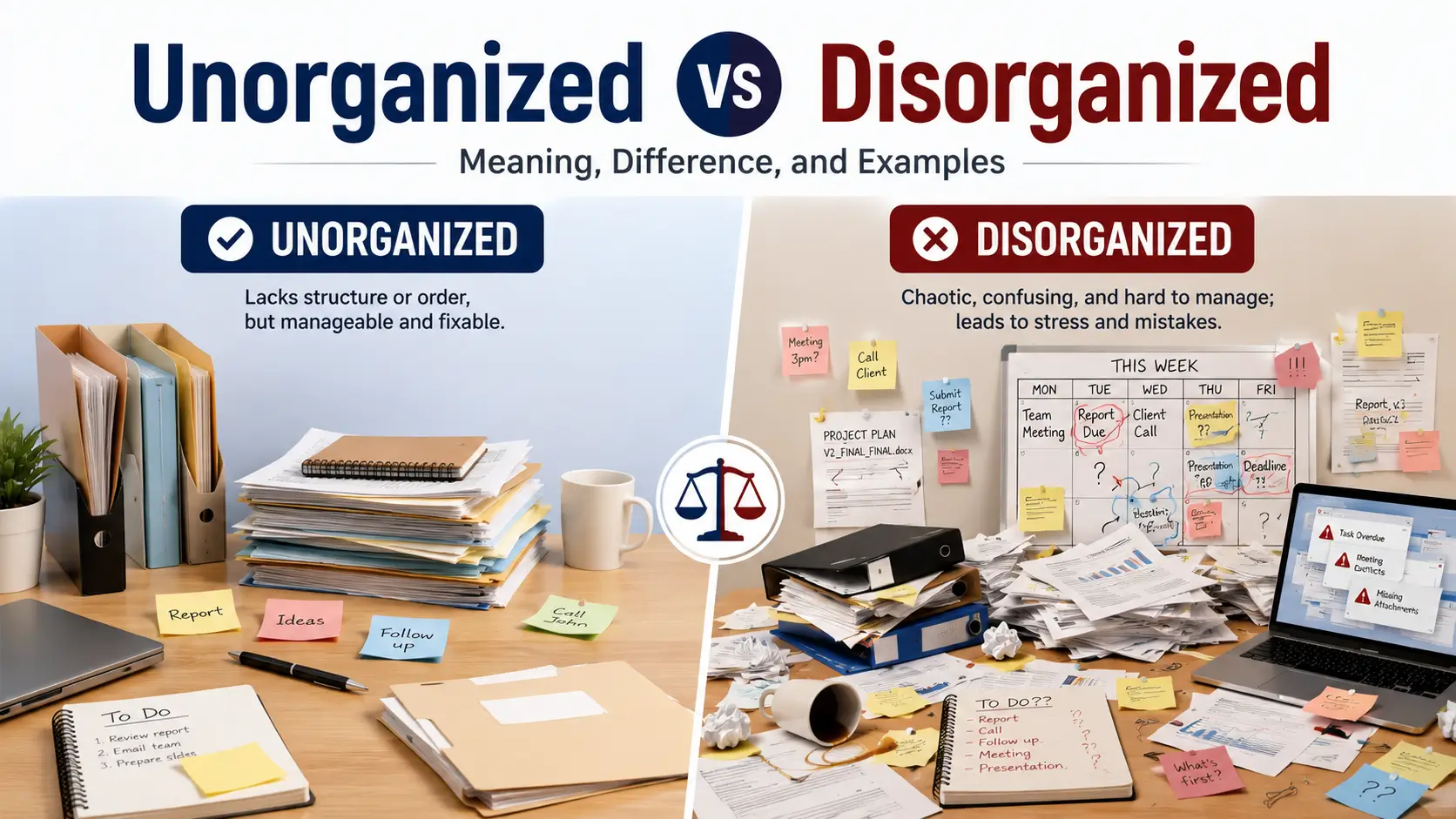
Unorganized vs disorganized can seem confusing because both words describe a lack of order, but they do not always mean the same thing. In everyday English, unorganized usually means something has not been arranged, sorted, or structured yet.
On the other hand, disorganized often means something is messy, poorly planned, confusing, or badly managed. The difference between unorganized and disorganized mostly comes down to tone, structure, and context.
For example, a folder full of unsorted files may be unorganized, while a meeting with no agenda may feel disorganized. Understanding the unorganized meaning and disorganized meaning helps you choose the right word in writing, school, work, and daily conversations. In this guide, you’ll learn the correct usage, clear examples, common mistakes, and simple tips to use both words with confidence.
Quick Answer: Unorganized vs Disorganized
| Word | Meaning | Tone | Best Used For | Example |
|---|---|---|---|---|
| Unorganized | Not arranged, sorted, or formally structured | Neutral or mildly negative | Files, notes, data, raw ideas, informal groups | “The documents are unorganized.” |
| Disorganized | Poorly arranged, confusing, messy, or badly managed | More negative | People, meetings, systems, events, habits | “The meeting was disorganized.” |
Use unorganized when something has no clear structure yet.
Use disorganized when something has poor structure, weak planning, or causes confusion.
What Does Unorganized Mean?
Unorganized means something has not been arranged into a clear order or system. It often describes things that are raw, unsorted, informal, or not yet structured.
The word usually sounds neutral. It does not always mean something is messy or badly handled.
For example, imagine you download 500 vacation photos. The photos may look great. They may even sit neatly in one folder. Still, they are unorganized if no one has sorted them by date, place, or event.
So, unorganized can mean:
- not sorted
- not arranged
- not classified
- not formally structured
- still in an early stage
- not part of an organized group
Examples of Unorganized
| Situation | Why “Unorganized” Fits |
|---|---|
| A folder full of random files | The files exist, but no system arranges them. |
| Early research notes | The ideas are useful, but they need sorting. |
| Raw survey responses | The data has not been grouped or analyzed. |
| A new community group | The group may not have leaders, roles, or rules yet. |
| A first draft | The ideas may be good, but they need a clearer order. |
Example Sentences with Unorganized
- “The project files are unorganized, so we should create folders.”
- “Your ideas are strong, but the outline still feels unorganized.”
- “The notes are helpful, although they’re a little unorganized.”
- “The receipts are unorganized, so tax preparation may take longer.”
In these examples, unorganized points to a fixable issue. It suggests that something needs structure, not that everything is a disaster.
Read this also : Who’s vs Whose: Meaning, Difference, Examples, and Easy Rules
What Does Disorganized Mean?
Disorganized means something is badly arranged, poorly planned, messy, or confusing. It often describes people, habits, meetings, systems, events, and processes.
Unlike unorganized, the word disorganized usually sounds more negative.
If someone says, “The event was disorganized,” they probably mean the event was poorly managed. Maybe people arrived late. Maybe no one knew where to go. Maybe the schedule kept changing. The word suggests frustration or confusion.
Disorganized can mean:
- messy
- poorly planned
- confusing
- inefficient
- badly managed
- hard to follow
- lacking direction
Examples of Disorganized
| Situation | Why “Disorganized” Fits |
|---|---|
| A meeting with no agenda | People don’t know what to discuss. |
| A manager who misses deadlines | The issue involves poor planning or weak habits. |
| A confusing presentation | The points do not connect clearly. |
| A slow onboarding process | New employees don’t know what to do. |
| A poorly run event | The system fails in practice. |
Example Sentences with Disorganized
- “The meeting was disorganized, so we wasted half an hour.”
- “The instructions were disorganized and hard to follow.”
- “The team became disorganized after the deadline changed.”
- “Her desk looks neat, but her workflow is disorganized.”
Here, disorganized does more than describe missing order. It shows that the lack of order causes a real problem.
The Main Difference Between Unorganized and Disorganized
The main difference between unorganized and disorganized comes down to structure and tone.
Unorganized usually means no clear system exists yet.
Disorganized means the system is poor, confusing, or not working well.
Think of a kitchen.
A kitchen is unorganized if the spices have not been labeled or arranged. It becomes disorganized when tools are missing, drawers are messy, and no one can find what they need while cooking.
Both words relate to order, but the feeling is different.
| Difference | Unorganized | Disorganized |
|---|---|---|
| Basic meaning | Lacks structure | Has poor or confusing order |
| Tone | Neutral or mildly negative | More negative |
| Common use | Files, notes, data, ideas, groups | People, systems, habits, meetings, events |
| Main problem | No system yet | Bad system or poor execution |
| Fix | Create order | Improve the order or management |
A simple way to decide:
- If something has no system yet, use unorganized.
- If something has a bad or confusing system, use disorganized.
When to Use Unorganized
Use unorganized when you want to describe something that lacks arrangement, sorting, or formal structure.
This word works best for things, materials, early-stage work, and informal groups.
Use Unorganized for Files and Documents
Files are unorganized when no one has sorted them into folders, categories, or labels.
Examples:
- “The client files are unorganized.”
- “The downloads folder is full of unorganized documents.”
- “The receipts are unorganized, so we need to sort them first.”
Use Unorganized for Data and Research
Raw information often starts out unorganized. That does not mean it has no value. It simply needs structure.
Examples:
- “The survey data is still unorganized.”
- “The interview notes are unorganized, but the insights are useful.”
- “The source material needs review because it is unorganized.”
Use Unorganized for Ideas and Drafts
Early ideas rarely come in perfect order. That is normal.
Examples:
- “The draft feels unorganized, but the argument has potential.”
- “Her brainstorm was creative yet unorganized.”
- “The lesson plan is still unorganized and needs a clearer sequence.”
Use Unorganized for Informal Groups
Sometimes, unorganized describes a group that has no formal leadership, rules, membership, or representation.
Examples:
- “The neighborhood group remained unorganized for months.”
- “The club started as an unorganized group of students.”
- “The workers were unorganized and had no formal representation.”
In this sense, unorganized does not mean the group is bad. It means the group has not formed an official structure.
When to Use Disorganized
Use disorganized when you describe poor planning, confusion, weak management, or inefficient behavior.
This word often fits people, systems, meetings, events, and habits.
Use Disorganized for People
A person may seem disorganized if they often lose track of tasks, forget deadlines, misplace things, or struggle to manage details.
Examples:
- “He’s creative, but he can be disorganized under pressure.”
- “She felt disorganized after taking on three new projects.”
- “A disorganized student may forget assignments even after studying hard.”
Be careful with this word. When used for a person, it can sound personal or critical.
Use Disorganized for Meetings and Events
Meetings and events become disorganized when they lack direction, planning, or clear communication.
Examples:
- “The meeting was disorganized because no one had an agenda.”
- “The workshop felt disorganized after the schedule changed.”
- “The conference check-in process was disorganized and slow.”
Use Disorganized for Systems and Processes
A system is disorganized when people cannot use it smoothly.
Examples:
- “The onboarding process is disorganized.”
- “The filing system became disorganized after several staff changes.”
- “The company’s approval process feels disorganized and unclear.”
In these cases, the problem affects time, work, or results.
Can Something Be Both Unorganized and Disorganized?
Yes, something can be both unorganized and disorganized, but the words focus on different problems.
For example, a box of old papers can be unorganized because no one sorted it. It can also be disorganized if the papers are crumpled, mixed with trash, and impossible to use.
However, not every unorganized thing is disorganized.
A clean folder with unsorted photos is unorganized, but it may not be messy. A new team with no official roles is unorganized, but it may still work well.
Also, not every disorganized thing has no structure. A company can have managers, departments, and procedures, but still feel disorganized if those systems don’t work well.
Ask yourself this question:
Am I describing something with no system, or something with a bad system?
If there is no system, choose unorganized.
If the system causes confusion, choose disorganized.
Side-by-Side Examples
Sometimes, both words can describe the same thing, but they highlight different issues.
Desk
- “My desk is unorganized, so I need a better filing tray.”
- “My desk is disorganized, and I can’t find the contract.”
The first sentence means the desk needs a system. The second sentence suggests the mess is causing a problem.
Team
- “The volunteer team is new and still unorganized.”
- “The project team is disorganized, even though everyone has a title.”
The first team may simply need roles. The second team already has some structure, but it is not working well.
Notes
- “These notes are unorganized, but they include useful ideas.”
- “These notes are disorganized, so I can’t understand the main point.”
The first sentence sounds hopeful. The second sounds more frustrated.
Grammar Tips for Unorganized and Disorganized
Both words are adjectives. They describe nouns.
Examples:
- “an unorganized folder”
- “a disorganized meeting”
- “an unorganized draft”
- “a disorganized manager”
Noun Forms
The common noun form of disorganized is disorganization.
Example:
- “The team’s disorganization caused delays.”
For unorganized, writers usually use a phrase instead of a noun form.
Better:
- “The lack of organization made the files hard to review.”
Awkward:
- “The unorganization of the files made them hard to review.”
People may understand unorganization, but it sounds unnatural in most writing.
Better Alternatives
Instead of writing more unorganized, you can often use less organized.
Awkward:
- “My folder is more unorganized than yours.”
Smoother:
- “My folder is less organized than yours.”
For disorganized, both forms can work:
- “The process became more disorganized after the update.”
- “The process became less organized after the update.”
American and British English Spellings
This article uses US English, so the correct spellings are:
| US English | UK English |
|---|---|
| organized | organised |
| unorganized | unorganised |
| disorganized | disorganised |
If your audience is mostly American, use organized, unorganized, and disorganized.
If your audience is mostly British, use organised, unorganised, and disorganised.
The most important rule is consistency. Don’t switch between American and British spellings in the same article unless you are directly comparing them.
Unorganized vs Disorganized in Professional Writing
Word choice matters in professional writing because tone matters.
Unorganized often sounds softer. It points to the issue without sounding too harsh.
Example:
- “The report contains useful information, but the sections are unorganized.”
This sounds like helpful feedback.
Disorganized sounds stronger. It may be accurate, but it can feel more critical.
Example:
- “The report is disorganized and hard to follow.”
That sentence may be true, but it sounds direct.
In workplace feedback, a softer sentence often works better.
Instead of saying:
- “Your presentation is disorganized.”
Say:
- “Your presentation would be easier to follow with clearer sections.”
The second version gives direction instead of only pointing out the problem.
Common Mistakes to Avoid
1. Using Disorganized for Everything Messy
Not every messy thing is disorganized.
If a folder simply lacks categories, call it unorganized. If the folder makes work confusing, disorganized may fit better.
Weak:
- “The photos are disorganized.”
Clearer:
- “The photos are unorganized because they aren’t sorted by date.”
2. Using Unorganized for People Too Often
You can say an unorganized person, and people will understand you. However, a disorganized person usually sounds more natural when you describe habits, planning, or time management.
Less natural:
- “He is an unorganized person.”
More natural:
- “He is a disorganized person.”
- “He has disorganized work habits.”
3. Ignoring Tone
Disorganized sounds more critical than unorganized.
Direct:
- “Your report is disorganized.”
Softer:
- “Your report has useful ideas, but the structure feels unorganized in a few places.”
The softer version works better when you want to give polite feedback.
4. Thinking Disorganized Always Means It Was Organized Before
Some people think disorganized means something was organized first and then became messy. That can happen, but it is not required.
This sentence is correct:
- “The event was disorganized from the beginning.”
The event did not need to be organized first. It simply lacked clear planning.
Synonyms for Unorganized
Sometimes, another word may fit better than unorganized.
| Synonym | Best Use | Example |
|---|---|---|
| unsorted | files, data, objects | “The receipts are unsorted.” |
| unstructured | plans, interviews, ideas | “The discussion was unstructured.” |
| unordered | lists or sequences | “The names are unordered.” |
| informal | groups or settings | “They held an informal meeting.” |
| unclassified | data or records | “The responses remain unclassified.” |
Choose unorganized when you want a general word. Choose a synonym when you need more precision.
For example, unsorted works better for files. Unstructured works better for interviews, lessons, and conversations.
Synonyms for Disorganized
Disorganized also has useful synonyms, but each one has a slightly different meaning.
| Synonym | Meaning | Example |
|---|---|---|
| messy | untidy or not neat | “His desk is messy.” |
| chaotic | confusing and out of control | “The airport scene was chaotic.” |
| disorderly | lacking order or control | “The crowd became disorderly.” |
| scattered | unfocused or spread out | “Her thoughts felt scattered.” |
| inefficient | wasting time or effort | “The process is inefficient.” |
| haphazard | done without clear planning | “They used a haphazard approach.” |
Use chaotic when things feel out of control. Use messy when the issue is physical clutter. Use inefficient when poor order wastes time or effort.
Practice Examples
Choose the better word in each sentence.
| Sentence | Better Word |
|---|---|
| The files are still ___ after the data export. | unorganized |
| The meeting felt ___ because no one had an agenda. | disorganized |
| The photos are clean, but they’re completely ___. | unorganized |
| The team became ___ after the manager changed the plan twice. | disorganized |
| Her thoughts felt ___ during the stressful interview. | disorganized |
| The research notes are useful but ___. | unorganized |
| The event check-in process was slow and ___. | disorganized |
| The old receipts are ___ in a shoebox. | unorganized |
These examples show the pattern clearly. Use unorganized for unsorted or unstructured things. Use disorganized for confusion, poor flow, or weak planning.
FAQs About Unorganized vs Disorganized
1. What is the main difference between unorganized and disorganized?
The main difference is tone and meaning. Unorganized means something has not been arranged, sorted, or structured yet. Disorganized means something is poorly arranged, confusing, messy, or badly managed.
2. Is unorganized the same as disorganized?
No, they are not exactly the same. Unorganized often describes something that needs structure. Disorganized usually describes something that has poor structure or causes confusion.
3. Is it correct to say an unorganized person?
Yes, people will understand “an unorganized person.” However, disorganized person usually sounds more natural when talking about poor habits, missed deadlines, messy planning, or weak time management.
4. Should I use unorganized or disorganized for files and notes?
Use unorganized for files, notes, or data that have not been sorted yet. Use disorganized if the arrangement is messy, confusing, or hard to use.
5. Is disorganized more negative than unorganized?
Yes, disorganized usually sounds more negative. It suggests poor planning, confusion, or weak management. Unorganized sounds softer because it often means something simply needs a clear system.
Conclusion
Understanding unorganized vs disorganized helps you write and speak with more clarity. Although both words relate to order, they are not always interchangeable. Use unorganized when something has no clear structure, system, or arrangement yet. Use disorganized when something feels messy, confusing, poorly planned, or difficult to follow.
The difference between unorganized and disorganized becomes easier when you think about the cause of the problem. If something simply needs sorting, the unorganized meaning fits better. If poor planning creates confusion, the disorganized meaning is more accurate. With the right correct usage, your writing sounds more natural and professional. Whether you describe files, notes, people, meetings, or systems, these grammar tips can help you choose the better word every time.