
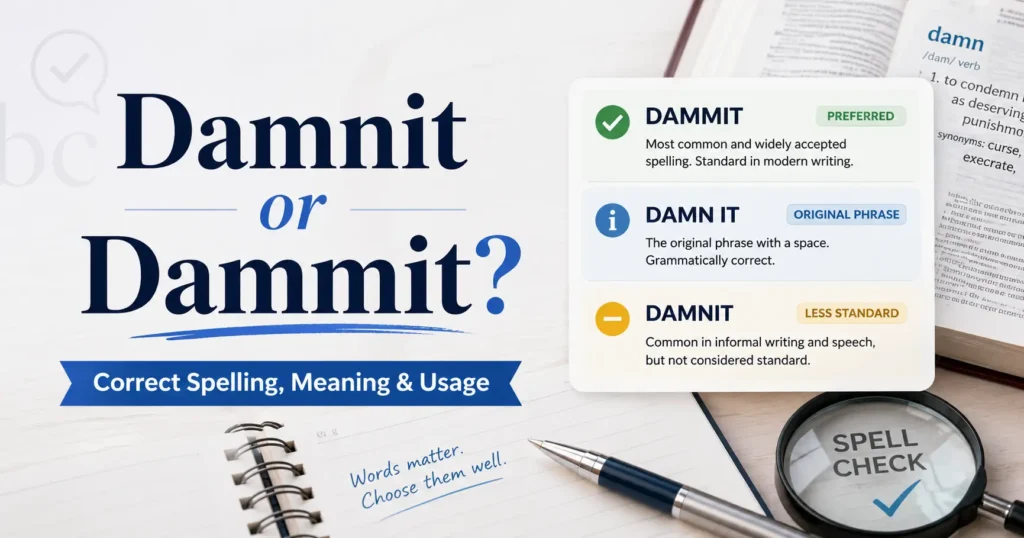
When deciding between damnit or dammit, many writers are unsure which form is correct and which one looks natural in polished English. The preferred correct spelling of dammit is dammit when you need the informal one-word form, while damn it remains the original two-word expression.
Although is damnit correct is a common search question, damnit is generally considered a less-standard variation and may appear careless in edited content. Understanding the dammit meaning, tone, and level of formality can help you choose the right version for dialogue, messages, blog posts, and everyday communication.
This guide explains dammit vs damn it, shows how to spell dammit, and clarifies when each form is appropriate. You will also learn whether dammit is a bad word and which dammit alternatives work better in professional, polite, family-friendly, or formal situations. It also helps prevent avoidable spelling and tone mistakes.
Quick Answer
| Form | Status | Best use |
| Dammit | Accepted informal spelling | Dialogue, texts, casual writing |
| Damn it | Original two-word phrase | Speech, dialogue, deliberate emphasis |
| Damnit | Less-standard variant | Very casual or intentionally unedited writing |
The simplest rule is:
Use dammit as the informal one-word form. Use damn it as the original phrase. Avoid damnit in polished writing.
What Does Dammit Mean?
Dammit is an informal exclamation used to express frustration, anger, disappointment, impatience, or surprise.
Examples:
- “Dammit, I forgot my keys.”
- “Oh, dammit. The file didn’t save.”
- “Dammit, we missed the train.”
The word does not usually add factual information. Instead, it communicates the speaker’s emotion.
Compare:
“I forgot my keys.”
“Dammit, I forgot my keys.”
The first sentence simply reports what happened. The second also shows frustration.
The exact meaning depends on the context. For example:
“Dammit, this cake is good.”
Here, the word adds playful emphasis rather than genuine anger.
By contrast:
“Dammit, you promised me.”
This sounds more serious and may express disappointment, hurt, or anger.
Read this also: Gluing vs Glueing: Which Spelling Is Correct?
Dammit vs. Damn It
Dammit and damn it have almost the same meaning, but they differ slightly in form and style.
Dammit
Dammit is the informal one-word spelling. It often appears in:
- Casual conversations
- Text messages
- Fictional dialogue
- Scripts
- Personal social media posts
Example:
“Dammit, I missed the bus.”
The one-word form feels quick and conversational.
Damn it
Damn it is the original two-word phrase. Some writers prefer it when they want the wording to feel more deliberate.
Example:
“Damn it, I told you not to touch that.”
The difference is mostly stylistic. Both forms can express the same frustration, and their emotional strength depends more on the situation than on whether they are written as one or two words.
Is Damnit Correct?
Damnit is used informally, especially online, but it is not the best choice for edited or professional writing.
The confusion is understandable. Because the original phrase is damn it, writers may assume that the combined form should keep the letter n.
However, the conventional informal spelling is dammit.
Use damnit only when there is a specific reason, such as:
- Quoting someone’s exact spelling
- Reproducing a text message
- Writing a character who spells it that way
- Referring to a username, title, brand, or meme
- Intentionally creating an unedited voice
For example:
“Damnit, I’m late again,” Jake texted.
In this sentence, the spelling may help show the character’s casual texting style. In ordinary narration or an informational article, dammit would be the safer choice.
Is Dammit a Bad Word?
Yes. Dammit is generally considered a mild swear word.
It is less offensive than stronger profanity, but it may still sound rude, disrespectful, or inappropriate in certain settings.
It may be acceptable in:
- Adult conversation
- Casual messages between friends
- Fictional dialogue
- Personal storytelling
- Informal online posts
It is usually better to avoid it in:
- Business emails
- Academic assignments
- Customer-service messages
- Resumes and cover letters
- Family-friendly content
- Religious settings
- Formal workplace documents
Audience and context matter. A word that sounds harmless among close friends may feel unprofessional when used with a customer or employer.
How Strong Is Dammit?
The strength of an expression depends on the speaker, audience, and situation. The following scale provides a general comparison:
| Expression | General strength | Typical use |
| Oh no | Very mild | Most situations |
| Oops | Very mild | Small mistakes |
| Darn it | Mild | Family-friendly frustration |
| Dang it | Mild | Casual annoyance |
| Shoot | Mild | Polite frustration |
| Dammit | Moderate | Informal adult speech |
| Damn it | Moderate | Informal adult speech |
| Goddammit | Stronger | Intense or adult dialogue |
These levels are not universal. Some readers may find religiously connected expressions more offensive than others do.
How to Use Dammit in a Sentence
As a standalone reaction
“Dammit!”
“Oh, dammit.”
A period can make the reaction sound controlled or disappointed:
“Dammit.”
An exclamation point makes it feel louder or more sudden:
“Dammit!”
At the beginning of a sentence
When dammit introduces a complete sentence, it is usually followed by a comma:
“Dammit, I forgot my phone.”
“Dammit, the store is already closed.”
An exclamation point or dash may also be appropriate when the emotion is stronger:
“Dammit! I forgot my phone.”
“Dammit—I forgot my phone.”
At the end of a sentence
When it works as an added interjection, place a comma before it:
“I told you to wait, dammit.”
“Open the door, dammit.”
This position can sound forceful, angry, or desperate, so use it carefully.
In the middle of a sentence
Commas can set it apart as a parenthetical interjection:
“I told you, dammit, not to touch that.”
This structure is dramatic and is most suitable for dialogue.
When to Avoid Dammit
Correct spelling does not automatically make a word appropriate.
Avoid dammit when the writing needs to sound calm, respectful, or professional.
Instead of:
“Dammit, the project is delayed.”
Write:
“Unfortunately, the project has been delayed.”
Instead of:
“Dammit, this problem keeps happening.”
Write:
“This issue keeps recurring and requires attention.”
The professional versions communicate the problem without sounding emotional or careless.
The word may still appear in formal writing when it is being quoted, analyzed, or discussed as a linguistic example. The important distinction is whether you are examining the word or using it as your own emotional reaction.
Polite Alternatives to Dammit
A softer expression may communicate the same feeling without sounding offensive.
| Situation | Informal expression | Softer alternative |
| Small mistake | “Dammit, I forgot.” | “Oops, I forgot.” |
| Mild frustration | “Dammit, not again.” | “Darn it, not again.” |
| Surprise | “Dammit, really?” | “Oh no, really?” |
| Disappointment | “Dammit, that failed.” | “That’s disappointing.” |
| Professional problem | “Dammit, we’re late.” | “Unfortunately, we’re running late.” |
| Family-friendly reaction | “Dammit!” | “Shoot!” |
Choose an alternative that matches the seriousness of the situation and the expectations of your audience.
Dammit in Fiction and Dialogue
Fiction writers can use dammit to reveal a character’s frustration, urgency, or personality.
Example:
“Dammit, Nora, stay behind me.”
However, the word should support the scene rather than replace description.
Weak:
“Dammit,” he said angrily.
Stronger:
“Dammit.” He slammed the drawer shut and searched the desk again.
The second example uses action to show the emotion. The exclamation adds emphasis without doing all the work.
Avoid using the word too frequently. Repeated profanity quickly loses its effect and can make different characters sound alike.
Dammit in Blog Posts and Online Content
You can use dammit in an article when the subject requires it, particularly when discussing:
- Spelling
- Informal English
- Slang
- Dialogue
- Profanity
- Word choice
For unrelated topics, adding the word merely to sound conversational may reduce professionalism.
For example:
“Dammit, SEO is harder than people think.”
A cleaner version would be:
“SEO often becomes more complicated once performance data is involved.”
The second sentence still sounds natural but is more suitable for a professional audience.
When optimizing an article about this spelling question, use related phrases naturally rather than repeating them excessively. Relevant phrases may include:
- damnit or dammit
- dammit meaning
- dammit vs. damn it
- is damnit correct
- how to spell dammit
Each phrase should appear only where it helps the reader.
Common Mistakes
Using damnit in edited content
Although readers will probably understand it, damnit can appear careless. Use dammit unless the alternative spelling is intentional.
Assuming dammit is formal
Dammit may be conventionally spelled, but it is still an informal exclamation and mild profanity.
Treating the three forms as equally standard
They are not identical:
- Dammit is the usual informal one-word spelling.
- Damn it is the original phrase.
- Damnit is a less-standard variant.
Ignoring the audience
A word that works in a novel or personal text may not work in a client email, school assignment, or company website.
Overusing it in dialogue
Frequent repetition reduces emotional impact. Use action, silence, description, and sentence rhythm to communicate emotion as well.
Frequently Asked Questions
1. Which is correct: damnit or dammit?
Dammit is the preferred informal one-word spelling. Damnit appears in casual writing, but it is less standard and may look like a spelling mistake in professionally edited content. The original two-word phrase, damn it, is also correct.
2. What is the difference between dammit and damn it?
Dammit is an informal one-word spelling, while damn it is the original two-word expression. Their meanings are almost identical, although some writers use damn it when they want the phrase to appear more deliberate or emphatic.
3. Is damnit a real word?
Damnit is used in text messages, online comments, memes, and other informal settings. However, it is not the preferred spelling in edited English. Use dammit unless you are quoting someone, reproducing a particular spelling, or intentionally creating an unedited voice.
4. Is dammit a bad word?
Yes, dammit is generally considered a mild swear word. It is less offensive than stronger profanity, but it can still sound inappropriate in professional, academic, religious, or family-friendly settings. Its effect depends on the audience and context.
5. What are the best alternatives to dammit?
Common alternatives include darn it, dang it, shoot, oh no, and that’s frustrating. In professional communication, use neutral expressions such as unfortunately, regrettably, or this issue requires attention.
Conclusion
The difference between damnit or dammit becomes simple once you separate the standard informal spelling from the original phrase. Use dammit as the accepted one-word form and damn it when you want the complete two-word expression. Although readers may encounter damnit in informal writing, it is less standard and should usually be avoided in polished articles, professional pages, and edited content. Knowing the correct spelling of dammit is only part of the decision; tone and audience are equally important. Because dammit is a swear word, it may not suit formal, religious, educational, or family-friendly material. In those situations, choose suitable alternatives to dammit, such as darn it, shoot, or unfortunately. Following these dammit usage rules will improve clarity, while understanding dammit vs damn it will help you write naturally, accurately, and appropriately for every context.

1 thought on “Damnit or Dammit? Correct Spelling, Meaning, and Usage”