
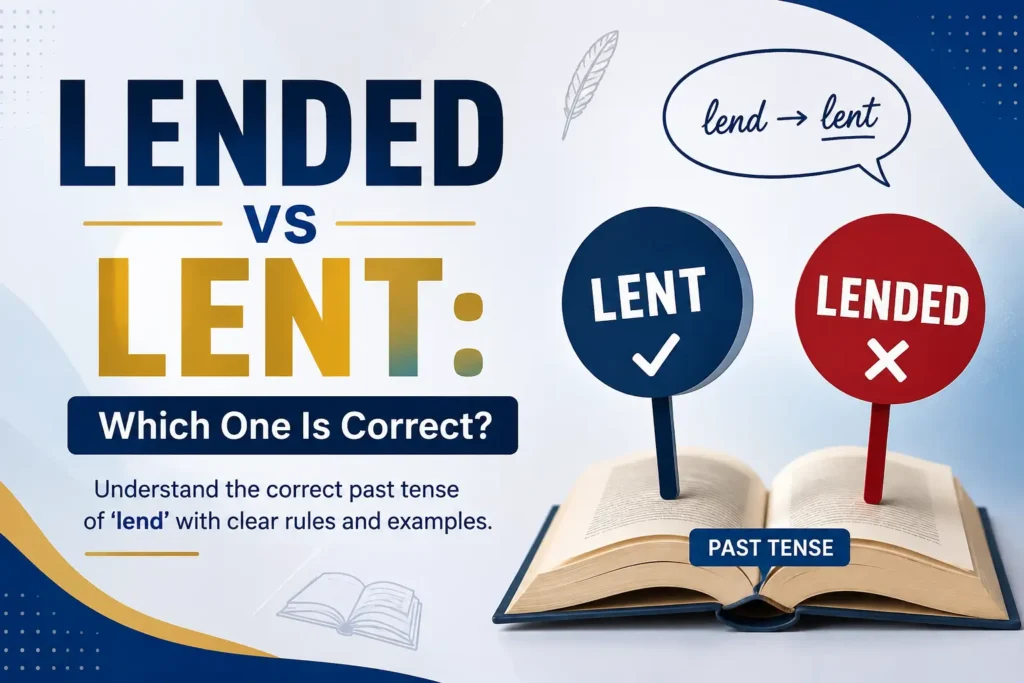
The lended vs lent choice is simple: lend is an irregular verb, so its correct past tense and correct past form are lent, never lended, in English.
For example, write, “I lent her money yesterday.” The other form may sound logical or have sounded natural when speaking fast, yet it is incorrect in standard English. I once used it in emails without thinking twice, but while reviewing a report, I noticed it looked wrong. This small check prevents the error in school, work, and everyday messages.
After checking the grammar rules, I began practicing the rule and correcting my writing habits. Soon, the mistake disappeared. This short guide can help anyone who feels confused. Use lent in formal writing and informal writing, double check irregular verbs when writing professionally, and understand the correct usage clearly to avoid common mistakes with confidence. It also makes your sentences easier for readers to trust.
Quick Answer: Is It Lended or Lent?
Use lent when the action happened in the past.
Correct:
- I lent him my charger yesterday.
- She has lent me that book before.
- The company had lent equipment to the team.
Incorrect:
- I lended him my charger yesterday.
- She has lended me that book before.
The easiest rule is:
Lend is the present form. Lent is the past form. Lended is not the standard past form.
Lended vs. Lent at a Glance
| Word | Grammar role | Standard usage | Example |
| lend | Base form and present tense | Correct | I can lend you my pen. |
| lends | Third-person singular present | Correct | He lends books to students. |
| lending | Present participle and gerund | Correct | She is lending me her car. |
| lent | Simple past | Correct | He lent me ten dollars. |
| lent | Past participle | Correct | She has lent us some chairs. |
| lended | Nonstandard past form | Usually incorrect | I lended him money. |
The key difference isn’t meaning. Instead, it’s grammar. Lent is the accepted irregular form, while lended incorrectly follows the regular -ed pattern.
Read this also: In Between or In-Between? The Correct Spelling, Meaning, and Examples
What Does “Lend” Mean?
Lend is a verb that means to give someone something for a limited time. Usually, you expect the person to return it.
For example:
- Can you lend me your phone?
- I’ll lend you my umbrella.
- The library may lend books for three weeks.
The person who lends something is the giver. The person who receives it borrows it.
Compare:
- Maya lent me her calculator.
- I borrowed Maya’s calculator.
Both sentences describe the same event from different viewpoints.
Lend as a Present-Tense Verb
Use lend for present actions, general habits, requests, future structures, and modal verbs.
Examples:
- I often lend books to my classmates.
- Please lend me your notes.
- I will lend you the money tomorrow.
- Could you lend me a hand?
- They sometimes lend equipment to local schools.
With he, she, or it in the simple present, use lends.
- She lends her car to her sister.
- The bank lends money to qualified customers.
- This detail lends credibility to the report.
Common Sentence Patterns With Lend
The verb lend usually appears in two main sentence patterns.
The first pattern is:
lend + person + thing
- She lent me her laptop.
- The teacher lent us several books.
- Could you lend him your charger?
The second pattern is:
lend + thing + to + person
- She lent her laptop to me.
- The teacher lent several books to us.
- Could you lend your charger to him?
Both patterns are correct. However, don’t add to before the person in the first pattern.
Incorrect:
- She lent to me her laptop.
Better:
- She lent me her laptop.
- She lent her laptop to me.
Other Meanings of “Lend”
The verb lend doesn’t always involve a physical object. It can also describe giving help, support, value, or a certain quality.
Lend a Hand
Lend a hand means to help someone.
- Could you lend me a hand with these boxes?
- Several volunteers lent a hand after the storm.
No actual hand is being given. The phrase is figurative.
Lend Support
Lend support means to provide help, approval, or encouragement.
- Local businesses lent their support to the project.
- Her manager lent support to the proposal.
Lend Credibility
Lend credibility means to make an idea or claim seem more believable.
- The new evidence lent credibility to his story.
- Expert testimony can lend credibility to the argument.
Lend Itself To
Lend itself to means to be suitable for a particular purpose.
- The room lends itself to small meetings.
- This topic lends itself to group discussion.
- The flexible design lent itself to several uses.
Lend an Air of
Lend an air of means to give something a certain mood or appearance.
- The candles lent an air of warmth to the room.
- Her formal language lent an air of authority to the speech.
These figurative uses follow the same verb forms: lend, lends, lending, lent.
What Does “Lent” Mean?
Lent is the simple past tense and past participle of lend.
Use it when someone gave something temporarily in the past or when a perfect or passive construction requires the past participle.
Examples:
- I lent her my coat.
- He has lent money to several friends.
- The camera was lent to the photography club.
Although lent ends in -t, it comes from the verb lend.
Lent as the Simple Past of Lend
Use lent for a completed action in the past.
Common time markers include:
- yesterday
- last week
- earlier
- in 2024
- two hours ago
- when I was in school
Examples:
- I lent my brother fifty dollars yesterday.
- She lent me her notes last week.
- The office lent us two laptops for the event.
- He lent his car to a neighbor.
- Our teacher lent the class several reference books.
You don’t need a helping verb in a basic affirmative sentence.
Correct:
- She lent me a pen.
Incorrect:
- She did lent me a pen.
The helping verb did already marks the past. Therefore, the main verb must return to its base form.
Correct:
- She did lend me a pen.
- Did she lend you a pen?
- She didn’t lend me a pen.
Lent as the Past Participle
A past participle is a verb form used with helping verbs such as have, has, had, be, and been.
For lend, the past participle is also lent.
Present Perfect
Use have lent or has lent for a past action connected to the present.
- I have lent him money before.
- She has lent us her car several times.
- They have never lent equipment to outsiders.
Past Perfect
Use had lent for an action completed before another past action.
- I had lent him the book before the class began.
- She had already lent her charger to someone else.
- The company had lent the equipment before the policy changed.
Future Perfect
Use will have lent for an action that will be complete before a future point.
- By Friday, the library will have lent all its available tablets.
- By the end of the month, the program will have lent devices to 200 students.
Although future perfect forms are less common in casual speech, they are grammatically correct.
Lent as a Religious Proper Noun
Lent with a capital L can also refer to the Christian season before Easter.
Examples:
- Some Christians fast during Lent.
- The church announced its Lent schedule.
- She gave up sweets for Lent.
This meaning is unrelated to the verb lend.
Compare:
- He lent me his jacket.
- He stopped eating candy during Lent.
The first sentence uses a past-tense verb. The second uses a proper noun, so it begins with a capital letter.
Is “Lended” a Word?
The form lended appears in informal speech, learner writing, and online posts. However, it isn’t the standard past tense or past participle of lend.
In school assignments, business emails, professional reports, and edited writing, use lent.
Incorrect:
- She lended me her laptop.
- We have lended money to them before.
- The library lended us three books.
Correct:
- She lent me her laptop.
- We have lent money to them before.
- The library lent us three books.
A nonstandard form may appear often online, but frequency doesn’t automatically make it correct in formal English.
Why “Lended” Is Usually Incorrect
The mistake happens because many English verbs form the past tense by adding -ed.
For example:
- walk → walked
- help → helped
- call → called
- borrow → borrowed
- loan → loaned
A learner may naturally apply the same rule:
- lend → lended
However, lend is an irregular verb. Its past form changes to lent.
- lend → lent
English contains many irregular verbs that don’t follow the regular -ed pattern.
Examples:
- send → sent
- spend → spent
- bend → bent
- build → built
- keep → kept
Therefore, lended may seem logical, but standard English uses lent.
Complete Verb Forms of Lend
| Verb form | Correct form | Example |
| Base form | lend | Can you lend me a pencil? |
| Simple present | lend | I lend books to friends. |
| Third-person singular | lends | She lends her notes to classmates. |
| Present participle | lending | He is lending me his car. |
| Simple past | lent | They lent us some chairs. |
| Past participle | lent | We have lent them equipment. |
This pattern stays the same in both American and British English.
Lended vs. Lent: The Main Grammar Difference
The difference between lended and lent isn’t a difference in definition. Both forms attempt to describe the past of lend.
However, only lent is standard.
| Sentence type | Incorrect | Correct |
| Simple past | I lended him money. | I lent him money. |
| Present perfect | I have lended him money. | I have lent him money. |
| Past perfect | I had lended him money. | I had lent him money. |
| Passive voice | The book was lended to me. | The book was lent to me. |
Use lended only when you are quoting someone’s exact wording, discussing the error itself, or referring to a special name or title.
How to Use Lend and Lent in Different Tenses
Choosing the correct form becomes easier when you identify the tense.
Simple Present
Use lend or lends for habits, facts, and present actions.
- I lend books to my friends.
- She lends money only to close relatives.
- The program lends laptops to students.
Present Continuous
Use am, is, or are lending for an action happening now or around now.
- I am lending him my car this week.
- She is lending us her meeting room.
- They are lending equipment to the volunteers.
Simple Past
Use lent for a completed past action.
- I lent him my car yesterday.
- She lent us her meeting room.
- They lent equipment to the volunteers.
Past Continuous
Use was or were lending for an ongoing past action.
- The library was lending tablets during the summer.
- They were lending tools to local residents.
Present Perfect
Use have or has lent.
- I have lent him money twice.
- She has lent us her car before.
Past Perfect
Use had lent.
- I had lent him the keys before I left.
- She had already lent the book to someone else.
Future Forms
Use will lend, going to lend, or another future structure.
- I will lend you the money tomorrow.
- She is going to lend us her van.
- The library will lend more devices next semester.
Using “Did” With Lend
After did, use the base form lend, not lent.
Correct:
- Did you lend him your phone?
- I did lend her the money.
- She didn’t lend me the book.
Incorrect:
- Did you lent him your phone?
- I did lent her the money.
- She didn’t lent me the book.
The word did already shows that the action happened in the past. As a result, the next verb stays in its base form.
This rule also applies to other verbs:
- Did you go, not did you went
- Did she send, not did she sent
- Did they spend, not did they spent
Using Modal Verbs With Lend
After modal verbs, use lend.
Common modal verbs include:
- can
- could
- may
- might
- should
- would
- will
- must
Examples:
- Can you lend me a dollar?
- She might lend us her car.
- You should lend him the book.
- I would lend you the money if I had it.
- The bank may lend funds to the company.
Don’t use lent directly after a modal verb.
Incorrect:
- She might lent me her car.
Correct:
- She might lend me her car.
Lend vs. Borrow: What Is the Difference?
Lend and borrow describe the same exchange from opposite viewpoints.
The lender gives something temporarily. The borrower receives it temporarily.
| Word | Viewpoint | Common pattern | Example |
| lend | The giver | lend something to someone | Ava lent the book to Ben. |
| borrow | The receiver | borrow something from someone | Ben borrowed the book from Ava. |
Compare:
- I lent Marcus my bike.
- Marcus borrowed my bike from me.
Both sentences are correct. However, the subject changes.
Common Lend and Borrow Errors
Incorrect:
- Can you borrow me your pen?
Correct:
- Can you lend me your pen?
- Can I borrow your pen?
Incorrect:
- I lent a laptop from the office.
Correct:
- I borrowed a laptop from the office.
- The office lent me a laptop.
A useful rule is:
You lend to someone, but you borrow from someone.
Lent vs. Loaned
Lent and loaned can often express similar ideas in American English.
Examples:
- She lent me her car.
- She loaned me her car.
Both are acceptable in American English. However, lend often sounds more natural in everyday conversation.
Loan is also common in business, banking, and formal financial settings.
Examples:
- The bank loaned the company $50,000.
- The museum loaned the painting to another gallery.
- The dealership loaned me a replacement vehicle.
The noun loan refers to the thing or money given temporarily.
- He applied for a loan.
- The museum arranged a temporary loan of the artwork.
Don’t confuse the past forms:
- lend → lent
- loan → loaned
Correct:
- She lent me a book.
- She loaned me a book.
Incorrect:
- She lended me a book.
Passive Voice With “Lent”
In passive voice, the focus falls on the thing that was given rather than the giver.
Use a form of be plus lent.
Examples:
- The laptop was lent to a student.
- Three books were lent to the class.
- The money has been lent to a local business.
- The equipment had been lent before the event.
- The vehicle will be lent to another department.
The past participle remains lent in every passive structure.
Incorrect:
- The laptop was lended to a student.
Correct:
- The laptop was lent to a student.
Real-Life Uses of “Lent”
The word lent appears naturally in conversation, schoolwork, emails, news reports, and financial writing.
Everyday Conversation
- I lent my sister my headphones.
- He lent me a few dollars for lunch.
- We lent our neighbors a ladder.
- She lent me her jacket because it was cold.
- My friend lent me his car for the weekend.
School and Academic Settings
- The teacher lent me a calculator.
- Mia lent her notes to a classmate.
- The library lent us several research books.
- Our professor lent credibility to the theory by citing new evidence.
- The school has lent tablets to students since 2023.
Workplace Communication
- The IT department lent us two laptops.
- My manager lent support to the proposal.
- Another team lent us a conference room.
- The company has lent equipment to its remote staff.
- The new data lent weight to our recommendation.
Financial Contexts
- The bank lent money to the business.
- She lent her cousin $500.
- The organization has lent funds to several local projects.
- Money was lent under a written agreement.
- The investor had lent the company enough capital to continue operating.
In formal financial writing, loaned may also appear. However, lent remains correct.
Emails and Text Messages
Casual message:
- Thanks for the charger you lent me.
Work email:
- The equipment you lent our team has been returned.
School email:
- I appreciate the book you lent me for my research.
Short text:
- I already lent it to Sam.
Figurative Uses of Lent
The past form lent also appears in figurative expressions.
Lent Support
- Several community leaders lent support to the campaign.
- Her supervisor lent his support to the request.
Lent Credibility
- The documents lent credibility to her claim.
- His calm explanation lent credibility to the report.
Lent Weight To
Lent weight to means made something seem more important or believable.
- The witness’s statement lent weight to the accusation.
- The new results lent weight to the earlier theory.
Lent an Air Of
- Soft lighting lent an air of elegance to the room.
- His uniform lent an air of authority to his appearance.
Lent Itself To
- The open space lent itself to group activities.
- The simple format lent itself to quick reading.
These examples don’t involve borrowing physical objects. Still, lent remains the correct past form.
Common Mistakes With Lended vs. Lent
Using Lended in the Simple Past
Incorrect:
- I lended her my notes.
Correct:
- I lent her my notes.
The action happened in the past, so use lent.
Using Lended After Have or Had
Incorrect:
- We have lended them money.
- She had lended him her car.
Correct:
- We have lent them money.
- She had lent him her car.
Perfect tenses require the past participle lent.
Using Lent After Did
Incorrect:
- Did you lent me this book?
Correct:
- Did you lend me this book?
After did, use the base form.
Using Lent After a Modal Verb
Incorrect:
- Can you lent me your phone?
Correct:
- Can you lend me your phone?
Modal verbs are followed by the base form.
Mixing Up Lend and Borrow
Incorrect:
- She borrowed me her calculator.
Correct:
- She lent me her calculator.
- I borrowed her calculator.
The giver lends. The receiver borrows.
Capitalizing Lent Incorrectly
Incorrect:
- She Lent me her umbrella.
Correct:
- She lent me her umbrella.
Capitalize Lent only when referring to the religious season or when the word begins a sentence.
Correct and Incorrect Examples
| Incorrect sentence | Correct sentence | Why |
| I lended him my phone. | I lent him my phone. | Lent is the past tense of lend. |
| She has lended us money. | She has lent us money. | Lent is the past participle. |
| Did he lent you the car? | Did he lend you the car? | Use the base form after did. |
| Can you lent me a pen? | Can you lend me a pen? | Use the base form after can. |
| I borrowed him my notes. | I lent him my notes. | The giver lends. |
| He lent a book from me. | He borrowed a book from me. | The receiver borrows. |
| The camera was lended out. | The camera was lent out. | Passive voice requires lent. |
| She Lented me a dollar. | She lent me a dollar. | Lented is not a standard form. |
Similar Irregular Verb Patterns
The change from lend to lent follows a pattern seen in several other English verbs.
| Base form | Past tense | Past participle |
| lend | lent | lent |
| send | sent | sent |
| spend | spent | spent |
| bend | bent | bent |
| build | built | built |
| keep | kept | kept |
The first three are especially useful for memory:
- send → sent
- spend → spent
- lend → lent
All three change the final d sound to a t sound in the past form.
However, don’t assume every similar verb follows the same pattern. English irregular verbs must often be learned individually.
Pronunciation of Lend and Lent
In American English, lend and lent have different final sounds.
- lend ends with a d sound
- lent ends with a t sound
Simple pronunciation:
- lend: rhymes closely with send
- lent: rhymes with sent
This sound connection creates a useful memory pair:
- send → sent
- lend → lent
The form lended adds an extra syllable, but standard English doesn’t use that form for the verb’s past tense.
A Simple Memory Trick
Think of send and lend together.
- Today, I send a message.
- Yesterday, I sent a message.
- Today, I lend a book.
- Yesterday, I lent a book.
Use this sentence:
If send becomes sent, then lend becomes lent.
No extra -ed is needed.
Read this also: Trek vs Treck — Meaning, Spelling Confusion, Usage Rules, and Real Examples (2026 Guide)
Formal, Informal, Academic, and Professional Usage
The form lent is standard across all major contexts.
Formal Writing
- The organization lent financial support to the project.
- The findings lent credibility to the original claim.
Academic Writing
- The additional evidence lent weight to the researchers’ conclusion.
- The library lent rare materials under controlled conditions.
Professional Emails
- Thank you for the equipment you lent our department.
- The laptop lent to our team has been returned.
Informal Conversation
- I lent Jake my car.
- She lent me ten bucks.
- Who lent you that jacket?
The form lended may appear in casual learner speech. Still, it should be corrected in standard writing and careful speech.
American vs. British English
Both American and British English use:
- lend
- lent
- lending
Neither variety normally uses lended as the standard past form.
American English often accepts loan as a verb in everyday and professional use.
- The bank loaned him money.
- She loaned me her car.
British speakers also use loan as a verb, though lend may be preferred in many everyday contexts.
The central rule remains the same in both varieties:
Lend becomes lent, not lended.
Synonyms and Related Words
Several words relate to lend, although they aren’t always exact substitutes.
Loan
Loan can mean to give something temporarily.
- The museum loaned the painting to another gallery.
Advance
In financial contexts, advance can mean to provide money before it is normally due.
- The company advanced him part of his salary.
Provide
Provide means to supply something, but it doesn’t always suggest that the item must be returned.
- The office provided new laptops.
Supply
Supply means to make something available.
- The school supplied students with tablets.
Give
Give usually suggests permanent transfer, while lend suggests temporary use.
- She gave me the book. I can keep it.
- She lent me the book. I should return it.
Borrow
Borrow describes receiving something temporarily.
- I borrowed a pen from Carlos.
- Carlos lent me a pen.
Quick Editing Checklist
Before using lend, lent, or borrow, ask these questions:
- Is the action happening now? Use lend or lends.
- Did the action happen in the past? Use lent.
- Does the sentence use have, has, or had? Use lent.
- Does the sentence use did? Use lend.
- Does a modal verb appear before it? Use lend.
- Is the subject giving something? Use lend or lent.
- Is the subject receiving something? Use borrow or borrowed.
- Does the word name the Christian season? Use capitalized Lent.
Practice: Choose Lend, Lent, or Borrowed
Choose the correct word for each sentence.
- Can you ______ me your calculator?
- She ______ me her notes yesterday.
- I have ______ him money before.
- We ______ a ladder from our neighbor.
- Did he ______ you his car?
- The company had ______ equipment to the event organizers.
- I ______ this book from the school library.
- My sister will ______ me her suitcase.
- The camera was ______ to the media team.
- Who ______ you that jacket?
Answers:
- lend
- lent
- lent
- borrowed
- lend
- lent
- borrowed
- lend
- lent
- lent
Practice: Correct the Sentence
Incorrect:
- I lended her my phone.
Correct:
- I lent her my phone.
Incorrect:
- Did you lent him the keys?
Correct:
- Did you lend him the keys?
Incorrect:
- She has lend me money before.
Correct:
- She has lent me money before.
Incorrect:
- Can you borrowed me a pen?
Correct:
- Can you lend me a pen?
- Can I borrow a pen?
Incorrect:
- The book was lended to another student.
Correct:
- The book was lent to another student.
Frequently Asked Questions
Q1: Is “lended” a correct word?
Lended isn’t the standard past tense of lend. You may see it in informal learner writing, but correct American English uses lent.
Q2: What is the past tense of lend?
The simple past tense of lend is lent.
Example: She lent me her laptop yesterday.
Q3: Is it “I lent” or “I lended”?
The correct form is I lent.
Correct: I lent him some money.
Incorrect: I lended him some money.
Q4: Is “lent” also the past participle of lend?
Yes. Lent works as both the simple past and the past participle.
Examples:
- I lent her a book.
- I have lent her several books.
Q5: Can I use “lent” after “did”?
No. Use the base form lend after did because did already shows past time.
Correct: Did you lend him your car?
Incorrect: Did you lent him your car?
Q6: Should I say “have lent” or “have lend”?
Use have lent. Perfect tenses require the past participle.
Correct: We have lent them equipment before.
Incorrect: We have lend them equipment before.
Q7: What is the difference between lent and borrowed?
Lent describes the giver’s action. Borrowed describes the receiver’s action.
Example: Maya lent me a pen, and I borrowed it from her.
Q8: Are “lent” and “loaned” both correct?
Yes. In American English, lent and loaned can often express the same idea.
Examples:
- She lent me her car.
- She loaned me her car.
However, lent often sounds more natural in everyday speech.
Q9: Should “Lent” be capitalized?
Capitalize Lent when referring to the Christian season before Easter.
Example: Some people fast during Lent.
Use lowercase lent for the past tense of lend.
Example: She lent me her coat.
Q10: How can I remember lended vs lent?
Connect lend with send:
- send → sent
- lend → lent
This pattern makes it easier to remember that lended isn’t the correct standard form.
Conclusion
The difference between lended vs lent follows one simple grammar rule. Lend is an irregular verb, so its correct past tense and past participle are both lent. The form lended is nonstandard and should be avoided in careful American English.
Use lend for present, future, modal, and did constructions. Use lent for completed past actions, perfect tenses, and passive voice. Also, remember that the person who gives something lends it, while the person who receives it borrows it.
