
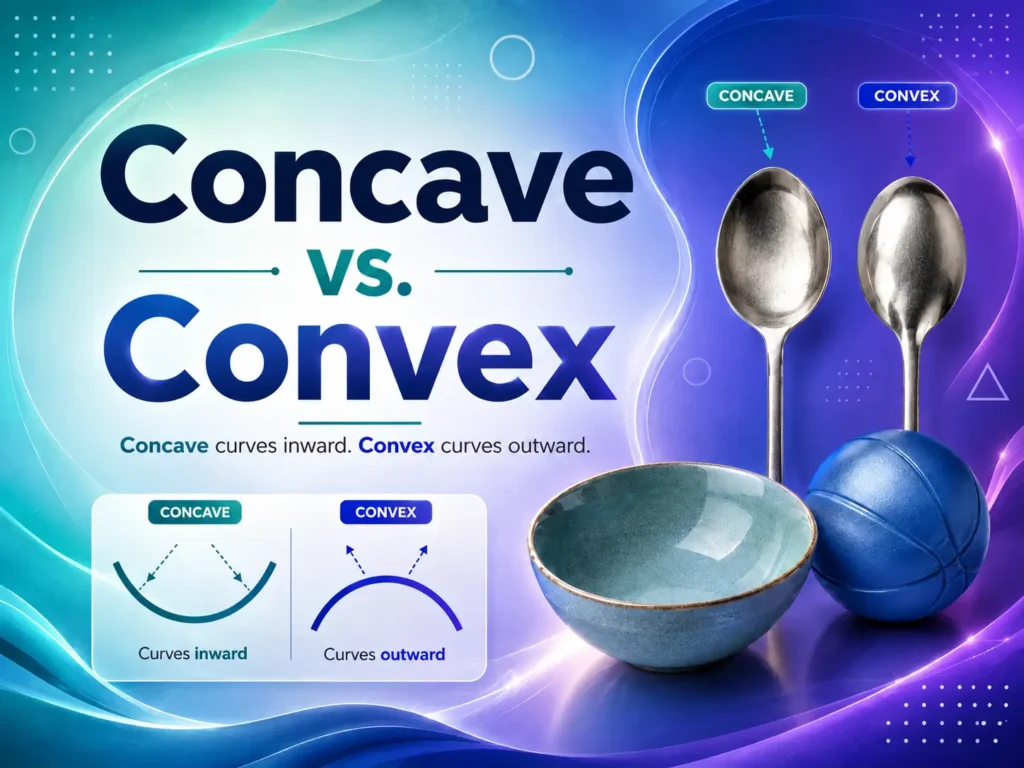
Concave vs. convex describes two opposite ways that a line, shape, or surface can curve. A concave surface bends inward, like the inside of a bowl. A convex surface curves outward, like the outside of a ball.
These words appear in geometry, optics, engineering, medicine, product design, and everyday American English. You may use them to describe spoons, mirrors, lenses, dents, domes, buttons, screens, or geometric figures.
The difference seems simple. However, many people confuse the terms because both refer to curved surfaces. The easiest solution is to focus on the curve’s direction. If the surface sinks inward, it is concave. If it bulges outward, it is convex.
Quick Answer: What Is the Difference Between Concave and Convex?
Concave means curved inward. Convex means curved outward.
Think about a spoon:
- The side that holds soup is concave.
- The rounded back of the spoon is convex.
Another useful comparison is a dent and a bump. A dent moves inward, so it is concave. A bump rises outward, so it is convex.
| Feature | Concave | Convex |
| Basic meaning | Curves inward | Curves outward |
| Appearance | Hollow, sunken, or indented | Rounded, raised, or bulging |
| Simple example | Inside of a bowl | Outside of a ball |
| Spoon example | Side that holds food | Rounded back |
| Surface direction | Toward the center | Away from the center |
| Common memory clue | Contains the word “cave” | Opposite of concave |
Concave goes inward. Convex comes outward.
What Does Concave Mean?
Concave describes something that curves inward or has a hollowed surface. It may look sunken, depressed, indented, or cave-like.
The word most often works as an adjective. An adjective describes a person, place, object, idea, or feature.
Common examples include:
- a concave mirror
- a concave lens
- a concave surface
- a concave curve
- a concave polygon
- a concave depression
The inside of a bowl is concave because its surface moves inward and downward. Similarly, the front of a satellite dish is concave because it forms a hollow shape.
Concave Meaning in Simple Words
A surface is concave when its middle sits lower or farther inward than its outer edges.
Imagine pressing your finger into soft clay. The hollow mark left behind is concave. By contrast, the clay around that mark may still curve outward.
Concave Examples in Everyday Life
You can find concave surfaces in many familiar objects:
- The inside of a soup bowl
- The food-holding side of a spoon
- A dent in a metal door
- The inside of a cave
- The front of a satellite dish
- A shaving mirror
- A makeup mirror
- The inner surface of certain lenses
- A deep serving plate
- A hollow section of a sculpture
Not every concave object has a deep hollow. Some surfaces curve inward only slightly. Therefore, a shallow dent can still be concave.
Concave in a Sentence
Correct: The artist carved a concave section into the center of the sculpture.
The sentence is correct because the carved section sinks inward.
Correct: Water collected in the concave part of the stone.
The surface holds water because it forms a hollow area.
Correct: The makeup mirror has a concave reflective surface.
Here, concave directly modifies the noun phrase reflective surface.
Incorrect: The outside of the basketball is concave.
A normal basketball curves outward. Therefore, convex is the correct word.
Corrected: The outside of the basketball is convex.
What Does Convex Mean?
Convex describes something that curves or bulges outward. Its center usually extends farther outward than its edges.
Like concave, convex is mainly an adjective. It can describe surfaces, curves, lenses, mirrors, shapes, and physical features.
Common phrases include:
- a convex mirror
- a convex lens
- a convex surface
- a convex curve
- a convex polygon
- a convex shape
A ball is convex because its surface rounds outward. A dome, raised button, or smooth bump may also be convex.
Convex Meaning in Simple Words
A surface is convex when it sticks out, rises, or rounds away from its center.
Picture a bubble on the surface of water. The bubble curves outward, so its visible surface is convex.
Convex Examples in Everyday Life
Common convex objects and surfaces include:
- The outside of a basketball
- The rounded back of a spoon
- The outer surface of a globe
- A dome-shaped roof
- A raised button
- A smooth bump in a wall
- A car’s side-view mirror
- A rounded camera lens
- The outside of a bowl
- A watch with raised glass
A surface does not need to form a complete sphere to be convex. Even a slight outward curve may qualify.
Convex in a Sentence
Correct: The watch has a convex glass cover.
The glass rises slightly above the watch face.
Correct: The building’s convex wall creates a rounded exterior.
The wall bulges outward rather than sinking inward.
Correct: The designer added a convex button to the control panel.
The word describes the button’s raised shape.
Incorrect: Water stays inside the convex side of the spoon.
The food-holding side curves inward. Therefore, it is concave.
Corrected: Water stays inside the concave side of the spoon.
Concave vs. Convex: Key Differences
The central difference between concave and convex is the direction of the curve. However, several other features can help you tell them apart.
| Point of comparison | Concave | Convex |
| Curve direction | Inward | Outward |
| Visual effect | Hollow or sunken | Rounded or raised |
| Common object | Bowl interior | Ball exterior |
| Spoon surface | Front or bowl side | Back side |
| Dent or bump | Dent | Bump |
| Mirror shape | Reflective surface curves inward | Reflective surface curves outward |
| Polygon shape | Has an inward-pointing section | Has no inward dents |
| Related noun | Concavity | Convexity |
| Plain-language alternative | Hollow, indented | Rounded, bulging |
The two words are opposites, but they often describe different sides of the same object.
For example, a bowl has a concave inner surface and a convex outer surface. A spoon also has one concave side and one convex side. Therefore, you should identify the exact surface you mean.
Why Viewpoint Matters
The description may change depending on which side of an object you are viewing.
Imagine a metal panel with a dent. From the damaged side, the dent curves inward and appears concave. However, the opposite side may bulge outward and appear convex.
This difference does not mean that one description is wrong. Instead, each word refers to a different surface.
Compare these sentences:
- The front of the panel became concave after the impact.
- The back of the panel became convex after the impact.
Both statements can describe the same damage accurately.
For clear writing, name the specific side, face, edge, or surface.
Instead of writing:
Unclear: The spoon is concave.
Write:
Clear: The food-holding side of the spoon is concave.
The second sentence gives the reader a precise image.
Concave and Convex as Parts of Speech
Both concave and convex are usually adjectives in modern American English.
They can appear before a noun:
- a concave mirror
- a convex lens
- a concave surface
- a convex curve
They can also appear after a linking verb. Common linking verbs include is, looks, appears, seems, feels, and becomes.
Examples:
- The surface is concave.
- The button looks convex.
- The metal became concave after it cooled.
- The lens appears convex from this angle.
In each example, the adjective describes the subject.
Concavity and Convexity
The noun form of concave is concavity. The noun form of convex is convexity.
| Adjective | Noun | Meaning |
| Concave | Concavity | The state or degree of curving inward |
| Convex | Convexity | The state or degree of curving outward |
Examples:
- The engineer measured the concavity of the dish.
- The lens’s convexity changes how it bends light.
- The doctor noted a slight concavity in the bone.
- The designer adjusted the convexity of the screen.
In everyday writing, the adjective forms usually sound more natural.
Technical: The surface displays noticeable convexity.
Plain: The surface is noticeably convex.
Both sentences are correct. However, the second is easier for a general audience to understand.
How to Pronounce Concave and Convex
In common American English, these words are usually pronounced as follows:
- Concave: con-KAYV or CON-kayv
- Convex: con-VEKS or CON-veks
The final part of concave sounds like cave. The final part of convex sounds like vex.
Pronunciation may vary slightly by speaker, region, or field. However, the meanings remain the same.
A simple guide is:
- Concave rhymes with “cave.”
- Convex ends like “vex.”
Concave and Convex in Geometry
In geometry, the words have specific meanings. They describe whether a shape has an inward-pointing section.
Convex Shapes
A convex shape has no inward dents. If you draw a straight line between any two points inside the shape, the entire line stays inside it.
Common convex shapes include:
- Triangles
- Squares
- Rectangles
- Circles
- Regular pentagons
- Regular hexagons
- Most simple rounded shapes
A convex polygon has all interior angles smaller than 180 degrees.
For example, a square is convex. No corner points inward, and every diagonal remains inside the square.
Concave Shapes
A concave shape has at least one section that points inward. A straight line connecting two points inside the shape may pass outside it.
Common concave shapes include:
- A dart shape
- An arrowhead shape
- Some star-like figures
- An irregular polygon with an inward corner
- A crescent-shaped region in certain contexts
A concave polygon has at least one interior angle greater than 180 degrees.
A Simple Geometry Test
Use this method to identify a shape:
- Choose any two points inside the shape.
- Connect them with a straight line.
- Check whether the whole line stays inside.
If every possible line remains inside, the shape is convex.
If at least one line passes outside, the shape is concave.
Geometry Example
Suppose a student draws a five-sided shape. Four corners point outward, but one corner points toward the center.
That shape is concave because it contains an inward indentation. Even one inward corner changes the classification.
Concave and Convex Mirrors
Curved mirrors are named according to the direction of their reflective surface.
Concave Mirrors
A concave mirror curves inward. Its reflective surface resembles the inside of a bowl.
Concave mirrors can make nearby objects appear larger. However, the image changes depending on the object’s distance from the mirror.
Common uses include:
- Makeup mirrors
- Shaving mirrors
- Dental mirrors
- Reflecting telescopes
- Flashlights
- Searchlights
- Some vehicle headlights
For example, a makeup mirror may enlarge facial details when your face is close to it. That magnification can help with shaving or applying makeup.
Convex Mirrors
A convex mirror curves outward. Its reflective surface resembles the outside of a ball.
Convex mirrors show a wider area than flat mirrors. However, objects usually appear smaller and farther away.
Common uses include:
- Car side-view mirrors
- Store security mirrors
- Parking garages
- Driveways
- Hallway corners
- Road intersections
- Warehouses
A store may install a convex mirror near the ceiling. The wider view helps employees see around shelves and monitor more of the room.
Concave vs. Convex Mirror Table
| Feature | Concave mirror | Convex mirror |
| Reflective surface | Curves inward | Curves outward |
| Basic appearance | Like the inside of a bowl | Like the outside of a ball |
| Field of view | Usually narrower | Wider |
| Image size | May appear enlarged | Usually appears smaller |
| Common use | Makeup or shaving mirror | Vehicle or security mirror |
Concave and Convex Lenses
Lenses are also classified by their shape and how they bend light.
Convex Lenses
A typical convex lens is thicker in the center and thinner at the edges.
It usually brings light rays together. For this reason, it is often called a converging lens.
Common uses include:
- Magnifying glasses
- Cameras
- Microscopes
- Telescopes
- Projectors
- Some eyeglasses
A magnifying glass uses a convex lens. When held at the correct distance, it makes an object appear larger.
Concave Lenses
A typical concave lens is thinner in the center and thicker at the edges.
It spreads light rays apart. Therefore, it is often called a diverging lens.
Common uses include:
- Certain prescription eyeglasses
- Door peepholes
- Optical instruments
- Some camera systems
- Scientific equipment
Concave vs. Convex Lens Table
| Feature | Concave lens | Convex lens |
| Center thickness | Thinner | Thicker |
| Edge thickness | Thicker | Thinner |
| Effect on light | Spreads rays apart | Brings rays together |
| Other name | Diverging lens | Converging lens |
| Common example | Certain eyeglasses | Magnifying glass |
Lens systems can be more complex than these basic forms. For example, modern cameras may combine several concave and convex elements to control focus, distortion, and image quality.
Real-Life Examples of Concave and Convex
These words become easier to understand when you connect them with familiar objects.
The Spoon Example
A spoon provides one of the clearest comparisons.
The front side holds food or liquid. It curves inward, so it is concave.
The back side rounds outward. Therefore, it is convex.
This example also shows why naming the surface matters. The spoon itself is not only concave or only convex.
The Bowl Example
The inside of a bowl is concave because it creates a hollow space. The outside is convex because it curves away from the center.
A deep bowl has stronger concavity than a shallow plate. Still, both can have inward-curving inner surfaces.
The Car Mirror Example
Most passenger-side mirrors are convex. Their outward curve gives drivers a wider field of view.
However, objects appear smaller. As a result, drivers may think another vehicle is farther away than it really is.
The Dent Example
A dented car door is concave on the side where the metal bends inward. From behind the panel, the same damaged area may appear convex.
This case shows how viewpoint changes the correct description.
The Building Example
Architects may design walls with concave or convex curves.
A concave wall bends inward and may create a sheltered space. In contrast, a convex wall projects outward and can make a building appear rounded.
Practical Case Studies
Case Study: Choosing a Security Mirror
A small store has a blind corner near the checkout area. Employees need to see customers approaching from two aisles.
A flat mirror would show only a limited section. A concave mirror could distort the view and would not provide the broad coverage needed.
A convex mirror is the best choice because its outward curve shows a wider area. Although objects look smaller, the expanded field of view improves visibility.
Case Study: Describing Product Damage
A customer reports that a metal lid arrived damaged. The center of the lid bends downward.
The clearest description is:
The lid has a concave dent in the center.
Calling the dent convex would be inaccurate from the top-facing side. However, the underside of the lid may have a convex bulge.
Case Study: Identifying a Geometric Shape
A student draws an irregular six-sided polygon. One corner points toward the middle of the figure.
The polygon is concave because it has an inward angle. A line drawn between certain interior points may also pass outside the shape.
The number of sides does not determine whether the polygon is concave or convex. The direction of its angles does.
Common Mistakes with Concave and Convex
Confusing Any Curve with a Convex Curve
Some writers use convex as a general word for curved. However, not every curve is convex.
Incorrect: The bowl’s inner surface is convex because it is curved.
Correct: The bowl’s inner surface is concave because it curves inward.
The direction matters more than the fact that the surface is curved.
Calling a Bump Concave
A bump rises outward. Therefore, it is usually convex.
Incorrect: The wall has a concave bump.
Correct: The wall has a convex bump.
A hollow or dent would be concave.
Calling an Entire Object Concave or Convex
Many objects have both types of surfaces.
Unclear: The bowl is concave.
Clearer: The inside of the bowl is concave.
Unclear: The spoon is convex.
Clearer: The back of the spoon is convex.
Specific wording prevents confusion.
Using Concavity as an Adjective
Concavity is a noun, not the standard adjective form.
Incorrect: The dish has a concavity surface.
Correct: The dish has a concave surface.
You may use the noun in a different sentence:
Correct: The dish has a noticeable concavity in the center.
Writing “Convexed” or “Concaved”
Writers sometimes create forms such as convexed or concaved. These forms usually sound unnatural in standard descriptions.
Awkward: The metal became concaved.
Better: The metal bent inward.
Better: The metal developed a concave shape.
Awkward: The glass is convexed.
Better: The glass is convex.
Ignoring the Viewer’s Position
A surface may appear concave from one side and convex from the other.
To avoid confusion, state the viewpoint:
- The panel is concave from the front.
- The same area is convex from the back.
Grammar Tips for Using Concave and Convex
Place the Adjective Before the Noun
This structure is common and direct:
- a concave mirror
- a convex surface
- a concave shape
- a convex lens
Use a Linking Verb
You can also place the adjective after a linking verb:
- The mirror is concave.
- The glass looks convex.
- The shape appears concave.
- The surface became convex.
Use “More” for Comparisons
In most American English, more concave and more convex sound more natural than concaver or convexer.
Preferred: This bowl is more concave than the plate.
Preferred: The new lens is more convex than the old one.
For the highest degree, use most concave or most convex.
Example: This section is the most concave part of the surface.
Avoid Unnecessary Technical Language
Choose wording that suits your audience.
Technical: The panel exhibits increased convexity.
Simple: The panel curves outward more sharply.
Both versions may be correct. However, the second sentence is easier for general readers.
Formal, Informal, Academic, and Professional Usage
Concave and convex are standard words. They are not slang, and they are appropriate in formal writing.
Academic Usage
Students may use the terms in math, physics, biology, or engineering.
Example: A concave polygon contains at least one interior angle greater than 180 degrees.
Professional Usage
Designers, doctors, engineers, architects, and technicians may use these words to describe exact shapes.
Example: The engineer recommended a slightly convex surface to improve water runoff.
Casual Usage
In normal conversation, people may prefer simpler words.
Instead of saying:
The lid has become concave.
Someone may say:
The lid has sunk inward.
Instead of saying:
The button is convex.
Someone may say:
The button sticks out.
The technical terms are more precise, but the plain alternatives are often easier in casual speech.
Email and Workplace Usage
Clear descriptions are valuable in reports, repair requests, and product feedback.
Example:
The center of the metal panel is slightly concave, while the outer edge remains flat.
This sentence is professional because it identifies the location and direction of the curve.
Memory Tricks for Concave vs. Convex
The best-known memory trick uses the word cave.
Concave Contains “Cave”
A cave goes inward. Therefore:
ConCAVE = curves inward
Once you remember concave, convex becomes the opposite.
Think Bowl and Ball
- Concave = bowl
- Convex = ball
A bowl’s inside is hollow. A ball’s outside is rounded.
Think Dent and Bump
- Concave = dent
- Convex = bump
This comparison works well for walls, metal panels, and other surfaces.
Think Spoon Sides
- Food side = concave
- Back side = convex
Because a spoon contains both surfaces, it is an excellent visual reminder.
Think “Vex Sticks Out”
The word convex contains vex. You can imagine that something annoying or “vexing” sticks out and catches your attention.
This trick is less direct than the cave method, but some learners find it useful.
Synonyms and Plain-Language Alternatives
Concave and convex do not have perfect synonyms in every context. Still, several words can express similar ideas.
| Concave-related words | Convex-related words |
| Hollow | Rounded |
| Sunken | Bulging |
| Indented | Raised |
| Depressed | Domed |
| Inward-curving | Outward-curving |
| Recessed | Protruding |
| Dished | Swollen |
Use these alternatives carefully. For example, sunken may describe position rather than exact curvature. Similarly, swollen often suggests injury or expansion, not simply a convex shape.
Concave Alternatives in Sentences
- The surface is hollowed inward.
- The panel has a sunken center.
- The sculpture contains an indented area.
- The lid has a recessed middle.
Convex Alternatives in Sentences
- The surface is rounded outward.
- The button has a raised center.
- The wall has a bulging section.
- The roof forms a domed shape.
Related Words and Concepts
Several terms often appear near concave and convex.
Curve
A curve is a line or surface that changes direction smoothly. A curve may be concave, convex, or more complex.
Surface
A surface is the outer or exposed part of an object. Concave and convex usually describe the shape of a surface.
Radius
A radius is the distance from the center of a circle or sphere to its edge. It often appears in geometry and discussions of curved surfaces.
Focal Point
A focal point is the place where light rays meet or appear to meet. This concept is important when discussing mirrors and lenses.
Converging
Converging means coming together. A basic convex lens is often described as a converging lens.
Diverging
Diverging means spreading apart. A basic concave lens is often called a diverging lens.
Indentation
An indentation is a sunken area or inward mark. It is commonly concave.
Projection
A projection extends outward from a surface. It may have a convex form.
Concave vs. Convex Examples at a Glance
| Object or feature | Concave part | Convex part |
| Spoon | Food-holding side | Rounded back |
| Bowl | Inner surface | Outer surface |
| Dent in metal | Indented side | Opposite bulging side |
| Car mirror | Usually not concave | Reflective side is often convex |
| Makeup mirror | Reflective side may be concave | Back casing may be convex |
| Magnifying glass | Usually not the main lens form | Lens is generally convex |
| Satellite dish | Front receiving surface | Back may curve outward |
| Dome | Interior may appear concave | Exterior is convex |
| Cave | Hollow interior | Outer hill may be convex |
| Button | Underside may be concave | Top may be convex |
Here are the conclusion and 10 FAQs for the article:
Conclusion
The difference between concave and convex depends on the direction of the curve. A concave surface bends inward, like the inside of a bowl or spoon. A convex surface curves outward, like the outside of a ball or dome.
A simple way to remember the difference is that concave contains the word cave, and a cave goes inward. Also, remember that one object can have both surfaces. For example, the inside of a spoon is concave, while its back is convex.
Understanding concave vs. convex helps you describe shapes, mirrors, lenses, dents, and everyday objects more accurately. When you’re unsure, check whether the surface sinks inward or bulges outward.
Frequently Asked Questions
Q1. What is the main difference between concave and convex?
Concave means curved inward, while convex means curved outward.
Q2. What is an easy way to remember concave?
Remember that concave contains cave. A cave goes inward, just like a concave surface.
Q3. Is a spoon concave or convex?
A spoon is both. The side that holds food is concave, while the back is convex.
Q4. Is the inside of a bowl concave or convex?
The inside of a bowl is concave because it curves inward.
Q5. Is a ball concave or convex?
The outside surface of a ball is convex because it curves outward.
Q6. Is a dent concave or convex?
A dent is usually concave when viewed from the side where the surface was pushed inward.
Q7. Is a magnifying glass concave or convex?
A standard magnifying glass uses a convex lens that is thicker in the center.
Q8. Can an object be both concave and convex?
Yes. Different sides or parts of the same object can have different curves.
Q9. What is the difference between concave and convex mirrors?
A concave mirror curves inward, while a convex mirror curves outward and provides a wider field of view.
Q10. Are concave and convex adjectives?
Yes. They are usually adjectives that describe shapes, lines, lenses, mirrors, or surfaces.
