
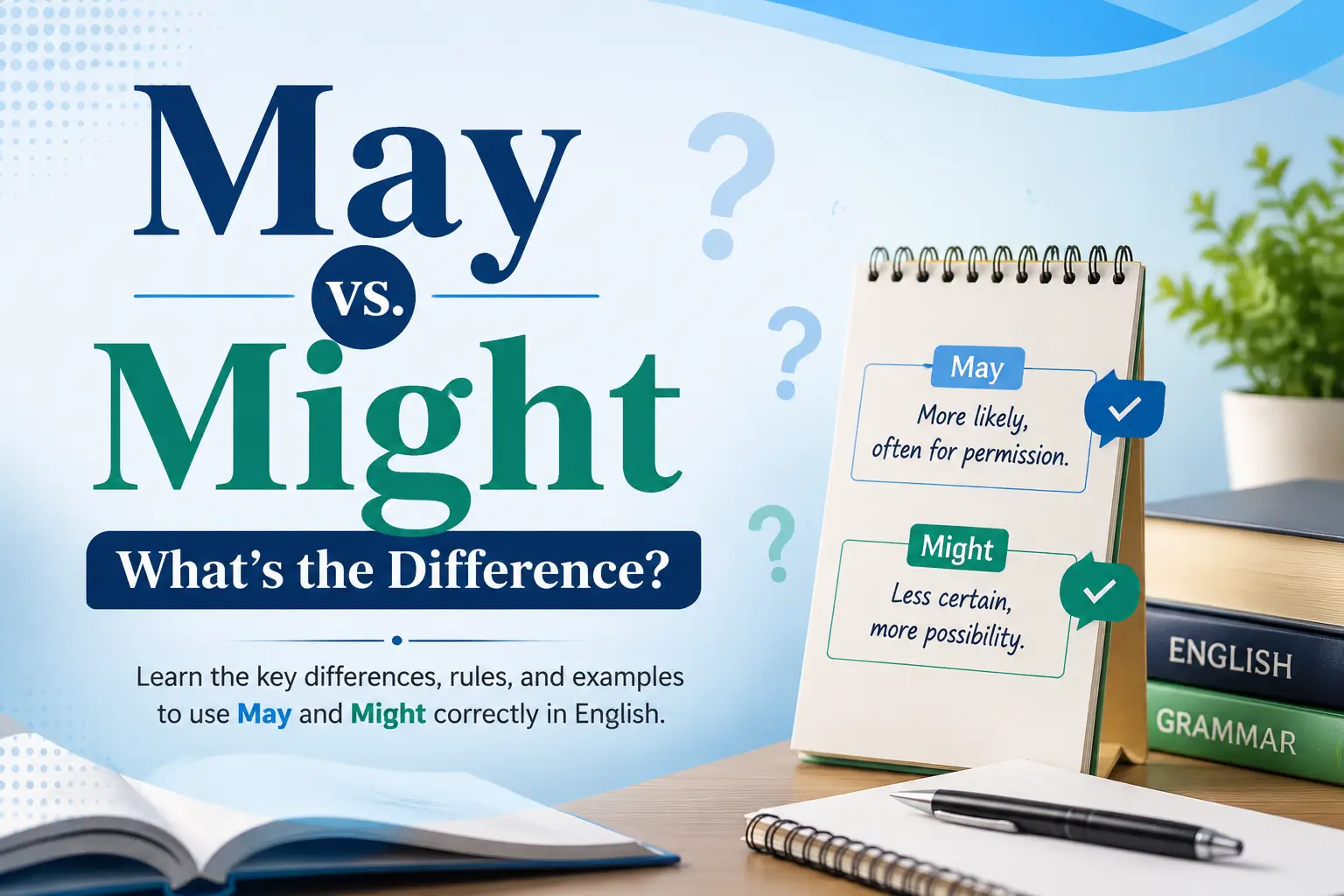
May vs. might is one of the most common grammar questions in English grammar, especially for students, writers, and English learners. Although these modal verbs often express possibility, they don’t always mean exactly the same thing. Understanding the difference helps you choose the right word when speaking, writing, sending emails, or having everyday conversations. By learning a few simple grammar rules, you’ll write more naturally, avoid common mistakes, and communicate with greater confidence.
Many people wonder whether may and might can be used interchangeably. In some situations they can, but in others the choice changes the meaning or the level of certainty. For example, may often suggests a stronger possibility or is used to ask for permission, while might usually expresses a less certain or more hypothetical possibility.
This guide explains the difference, meaning, usage, and correct usage of may vs. might using clear explanations, comparison tables, practical examples, and everyday American English. Whether you’re improving your grammar for school, work, exams, or professional writing, you’ll learn when each word fits best and how to use both with confidence.
Quick Answer: May vs. Might
The main difference between may and might is the level or type of possibility they express.
| Usage | May | Might |
| Possibility | Reasonable or slightly stronger possibility | Weaker or more uncertain possibility |
| Permission | Common and standard | Rare and overly formal |
| Hypothetical situations | Possible, but less common | Very common |
| Gentle suggestions | Less common | Common |
| Past possibility | May have + past participle | Might have + past participle |
| Formality | More formal | More conversational |
Simple Examples
- The package may arrive tomorrow.
This suggests that tomorrow is reasonably likely. - The package might arrive tomorrow.
This suggests that tomorrow is possible, but the speaker is less certain.
Quick Tip: When asking for or giving permission, use may rather than might in standard English.
What Do “May” and “Might” Mean?
Both may and might are modal verbs. A modal verb works with a main verb to express an idea such as possibility, permission, advice, ability, necessity, or uncertainty.
Modal verbs follow a few important grammar rules:
- They do not change form.
- They do not take -s, -ed, or -ing endings.
- They are followed by the base form of a verb.
- They do not normally use to before the main verb.
Correct examples:
- She may arrive early.
- They might leave tonight.
- You may enter now.
Incorrect examples:
- She may arrives early.
- They might leaving tonight.
- You may to enter now.
Meaning of May
The modal verb may commonly expresses:
- Possibility
- Permission
- Formal wishes or hopes
Examples:
- We may visit New York next month.
- You may begin the exam.
- May your dreams come true.
The exact meaning depends on the context.
Meaning of Might
The modal verb might commonly expresses:
- A less certain possibility
- Uncertainty
- Hypothetical situations
- Gentle suggestions
- Past possibilities
Examples:
- She might call later.
- If we leave now, we might catch the train.
- You might want to restart the computer.
- They might have forgotten the meeting.
How Modal Verbs Change Meaning
Compare these sentences:
- She goes home.
- She may go home.
- She might go home.
The main action, go, stays the same. The modal verb changes how certain the speaker feels about the action.
May vs. Might: The Main Difference
Traditional grammar often teaches that may expresses a stronger possibility than might.
A useful general rule is:
- May = There is a reasonable chance.
- Might = It is possible, but I am less certain.
For example:
- The team may win the match.
The speaker believes winning is reasonably possible. - The team might win the match.
The speaker sees winning as possible but is less confident.
However, modern English is flexible. In many everyday situations, native speakers use may and might almost interchangeably.
Is There Still a Real Difference?
In casual American English, both of these sentences sound natural:
- I may go shopping later.
- I might go shopping later.
Most listeners will understand the same basic message: the shopping trip is possible.
The difference becomes more important when you are:
- Asking for permission
- Describing a hypothetical situation
- Writing formally
- Trying to communicate a precise level of certainty
Formal and Informal Usage
May is common in:
- Academic writing
- Business communication
- Official instructions
- Policies and regulations
- Formal requests
Examples:
- Applicants may submit their documents online.
- Students may use calculators during the exam.
- May I ask a question?
Might is common in:
- Everyday conversation
- Informal messages
- Uncertain predictions
- Hypothetical statements
- Gentle suggestions
Examples:
- We might grab coffee after work.
- I might watch a movie tonight.
- You might want to check the address again.
Neither word is automatically incorrect. The context determines which one sounds more natural.
When to Use May
Although may has several meanings, it is most commonly used for possibility and permission.
Use May for a Reasonable Possibility
Use may when something has a reasonable chance of happening.
Examples:
- It may snow this weekend.
- Sales may increase next quarter.
- She may already know the answer.
- The meeting may finish early.
- We may need additional information.
These statements express possibility without guaranteeing the result.
Use May to Ask for Permission
In formal English, may is the traditional way to ask for permission.
Examples:
- May I leave early today?
- May I ask a question?
- May we come inside?
- May I use your phone?
- May I speak to the manager?
In everyday conversation, people often use can instead:
- Can I borrow your pen?
- Can I sit here?
Both forms are common, but may I sounds more formal and polite.
| Sentence | Typical Use |
| May I borrow your pen? | Formal or polite |
| Can I borrow your pen? | Informal conversation |
Use May to Give Permission
Teachers, managers, officials, and organizations frequently use may when allowing someone to do something.
Examples:
- You may begin.
- Visitors may park here.
- Employees may work remotely on Fridays.
- Students may leave after completing the test.
- Customers may request a refund within 30 days.
This use sounds professional and authoritative.
Use May for Formal Wishes
May also appears in traditional wishes, blessings, speeches, and greetings.
Examples:
- May peace be with you.
- May you always succeed.
- May your family stay healthy.
- May the new year bring you happiness.
- May all your dreams come true.
Common Sentence Patterns with May
| Pattern | Example |
| May + base verb | She may arrive soon. |
| May be + adjective | It may be difficult. |
| May be + noun | That may be the answer. |
| May not + base verb | He may not attend. |
| May have + past participle | They may have forgotten. |
Remember that the verb after may stays in its base form.
Correct:
- She may go.
- They may leave.
- He may call.
Incorrect:
- She may goes.
- They may leaving.
- He may called.
When to Use Might
Like may, the modal verb might expresses possibility. However, it often emphasizes uncertainty, imagination, or a condition that has not been fulfilled.
Use Might for a Less Certain Possibility
Use might when something is possible but far from certain.
Examples:
- We might see deer during the hike.
- The restaurant might still be open.
- I might order pizza tonight.
- She might join us later.
- The delivery might arrive before noon.
Each sentence suggests uncertainty.
Use Might in Hypothetical Situations
Might commonly appears in conditional sentences.
Examples:
- If we leave now, we might avoid traffic.
- If she studies more, she might pass the exam.
- If they hurry, they might catch the flight.
- If I had more time, I might learn Spanish.
- Without the map, we might get lost.
These outcomes depend on another event or condition.
Use Might for Gentle Suggestions
Might can make advice sound softer and less demanding.
Examples:
- You might try restarting your computer.
- You might want to save your work first.
- We might consider another option.
- You might check the spelling again.
- They might benefit from additional training.
Compare:
- Check the address again.
Direct instruction. - You might want to check the address again.
Polite, gentle suggestion.
Use Might for Past Possibilities
A common structure is:
Might have + past participle
Use it when something was possible in the past, but you are not certain whether it happened.
Examples:
- She might have missed the bus.
- They might have forgotten the meeting.
- I might have left my keys at work.
- He might have taken the earlier train.
- The email might have gone to your spam folder.
Common Sentence Patterns with Might
| Pattern | Example |
| Might + base verb | She might come later. |
| Might be + adjective | It might be expensive. |
| Might not + base verb | We might not stay long. |
| Might have + past participle | They might have finished. |
| Might want to + base verb | You might want to wait. |
Grammar Tip: Both may and might are followed by the base form of a verb. Do not add -s, -ed, or -ing directly after them.
Can May and Might Be Used Interchangeably?
In many modern English sentences, may and might can both be used when discussing possibility.
Compare:
- I may visit Chicago next month.
- I might visit Chicago next month.
Both sentences are grammatically correct. The first may sound slightly more confident, while the second may sound slightly more uncertain.
Situations Where Both Are Correct
| With May | With Might |
| We may order takeout tonight. | We might order takeout tonight. |
| She may join the meeting. | She might join the meeting. |
| They may arrive after lunch. | They might arrive after lunch. |
| It may rain tomorrow. | It might rain tomorrow. |
| He may call this evening. | He might call this evening. |
Situations Where May Is Preferred
Use may when asking for or giving permission.
Correct:
- May I use your phone?
- You may leave now.
- Visitors may enter through this door.
Less natural:
- Might I use your phone?
- You might leave now.
Might I is grammatically possible, but it sounds extremely formal or old-fashioned in modern conversation.
Situations Where Might Is Preferred
Use might for unreal, conditional, or strongly hypothetical situations.
Examples:
- If I had more money, I might buy a larger house.
- Without your help, we might have failed.
- If she had left earlier, she might have caught the train.
- If the weather improves, we might go hiking.
In these situations, might normally sounds more natural than may.
Side-by-Side Comparison: May vs. Might
| Feature | May | Might |
| Main meaning | Possibility or permission | Possibility or uncertainty |
| Level of certainty | Often slightly stronger | Often weaker |
| Asking permission | Standard | Rare |
| Giving permission | Common | Uncommon |
| Hypothetical situations | Possible | Very common |
| Gentle suggestions | Less common | Common |
| Past possibility | May have | Might have |
| Formal writing | Very common | Common |
| Everyday speech | Common | Very common |
| Example | It may rain. | It might rain. |
May Be vs. Might Be
Both may be and might be combine a modal verb with the base verb be.
- May be means “possibly is” or “possibly are.”
- Might be also means “possibly is” or “possibly are,” but can sound less certain.
Examples:
- This may be the best solution.
- This might be the best solution.
- She may be at home.
- She might be at home.
- The answer may be correct.
- The answer might be correct.
In most of these sentences, both forms are possible. Might be simply sounds a little more uncertain.
May Be vs. Maybe
Do not confuse may be with maybe.
| Form | Function | Example |
| May be | Modal verb phrase | It may be true. |
| Maybe | Adverb meaning “perhaps” | Maybe it is true. |
Correct:
- Maybe we should leave early.
- We may be late.
- Maybe she forgot.
- She may be busy.
Incorrect:
- We maybe late.
- She maybe busy.
A simple test is to replace maybe with perhaps:
- Perhaps we should leave.
- Maybe we should leave.
If perhaps works, use the one-word form maybe.
May Have vs. Might Have
Both may have and might have describe an uncertain event in the past.
The structure is:
May or might + have + past participle
Examples:
- She may have left already.
- She might have left already.
- The package may have arrived yesterday.
- The package might have arrived yesterday.
- They may have forgotten the appointment.
- They might have forgotten the appointment.
What Is the Difference?
The difference is usually the speaker’s level of confidence:
- May have can suggest a somewhat stronger possibility.
- Might have can suggest a weaker or more speculative possibility.
Example:
- She may have fallen asleep.
You believe this explanation is fairly likely. - She might have fallen asleep.
You see it as one possible explanation.
In everyday use, however, the distinction is often small.
Common Mistakes with Past Forms
Incorrect:
- She might has left.
- They may had forgotten.
- He might went home.
Correct:
- She might have left.
- They may have forgotten.
- He might have gone home.
Examples of May and Might in Everyday English
At School
May
- May I go to the restroom?
- Students may use notes during the quiz.
- You may submit the assignment online.
Might
- I might join the study group tonight.
- The professor might extend the deadline.
- We might have a test next week.
At Work
May
- The company may announce a new policy tomorrow.
- Employees may work from home on Fridays.
- The meeting may begin earlier than expected.
Might
- We might need additional budget approval.
- The client might request revisions.
- The project might take another week.
Workplace policies often use may because it sounds formal and authoritative.
In Daily Conversation
- I may stop by later.
- I might stop by later.
- We may go to the beach this weekend.
- We might go to the beach this weekend.
- She may call tonight.
- She might call tonight.
In these examples, the two words are nearly interchangeable.
In Emails
More formal:
- We may need further documentation before processing your request.
- The delivery may be delayed due to weather conditions.
Softer or less definite:
- We might need further documentation before processing your request.
- The delivery might be delayed due to weather conditions.
Both versions are correct, but might sounds slightly less certain.
In Text Messages
People often use might in casual messages:
- Might be there in ten minutes.
- I might be late.
- Might grab coffee first.
- We might stay home tonight.
The subject is sometimes omitted in very informal texting, although complete sentences are better in formal writing.
Common Mistakes with May and Might
Using May to Express Ability
Incorrect:
- I may swim.
This sentence sounds as though swimming is possible or permitted.
Correct:
- I can swim.
Use can for general ability.
Using Might to Give Permission
Incorrect or unnatural:
- You might leave now.
If a teacher or manager is giving permission, use:
- You may leave now.
Using the Wrong Verb Form
Incorrect:
- She may goes.
- They might coming.
- He may called later.
Correct:
- She may go.
- They might come.
- He may call later.
Mixing Past-Tense Forms
Incorrect:
- He may went home.
- She might forgot.
- They may had left.
Correct:
- He may have gone home.
- She might have forgotten.
- They may have left.
Confusing May Be and Maybe
Incorrect:
- We maybe late.
Correct:
- We may be late.
- Maybe we will be late.
Treating May and Might as Exact Percentages
There is no fixed percentage that separates may from might. The difference depends on tone, context, dialect, and the speaker’s intention.
Do not assume that may always means a specific probability and might always means a lower numerical probability.
May vs. Might in American and British English
The basic grammar is largely the same in American and British English, although usage patterns can vary slightly.
American English Usage
In American English:
- May is common in formal and professional writing.
- Might is extremely common in conversation.
- Can often replaces may in informal permission questions.
Examples:
- Can I get some water?
Common and conversational. - May I get some water?
More formal.
Professional and academic documents often use may:
- Applicants may submit materials electronically.
- Participants may withdraw at any time.
- Students may contact the department for assistance.
British English Usage
British speakers also use both forms. Might may appear somewhat more often in formal, cautious, or literary statements.
Example:
- I might have done it differently.
These differences are tendencies rather than strict grammar rules.
A Simple Decision Guide
Ask yourself the following questions before choosing may or might.
Are You Asking or Giving Permission?
Use may.
- May I come in?
- You may begin.
- Students may leave after the exam.
Are You Talking About a General Possibility?
Both may and might can work.
- It may rain later.
- It might rain later.
Is the Situation Highly Uncertain or Hypothetical?
Use might.
- If we hurry, we might catch the train.
- I might move abroad one day.
- Without your help, we might have failed.
Are You Making a Gentle Suggestion?
Use might.
- You might want to review the document again.
- We might consider a different approach.
Are You Writing a Formal Rule or Policy?
Use may.
- Customers may return unused products within 30 days.
- Employees may access the system remotely.
Memory Tricks for May vs. Might
Permission Means May
Connect the two words:
Permission → May
Examples:
- May I come in?
- You may leave now.
Whenever permission is involved, may should usually be your first choice.
Might Sounds More Uncertain
Compare:
- I may come.
- I might come.
The second sentence sounds less definite.
Remember:
- May = a reasonable possibility
- Might = possible, but uncertain
Past Possibility Needs Have
When talking about an uncertain past event, use:
- May have + past participle
- Might have + past participle
Examples:
- She may have forgotten.
- She might have forgotten.
Never write:
- May has forgotten
- Might had forgotten
Related Words and Alternatives
Depending on the context, may or might can sometimes be replaced with other possibility expressions.
| Word or Phrase | Meaning | Example |
| Could | Possible option or result | We could leave early. |
| Perhaps | Possibly | Perhaps she will call later. |
| Possibly | There is a chance | It will possibly snow tomorrow. |
| Maybe | Informal possibility | Maybe we will stay home. |
| Probably | More likely than not | They will probably arrive soon. |
These words are not always interchangeable.
For permission:
Correct:
- May I sit here?
Incorrect:
- Perhaps I sit here?
The second sentence does not express permission correctly.
Practice: Choose May or Might
Choose the best option for each sentence. In some cases, both words may be correct.
- It ______ rain later this evening.
- ______ I borrow your laptop for a few minutes?
- We ______ visit our grandparents this weekend.
- If traffic is light, we ______ arrive before noon.
- She ______ have forgotten about the appointment.
- Students ______ use calculators during the exam.
- I ______ order dessert, but I am not sure yet.
- The package ______ already be at your house.
- If we hurry, we ______ catch the last train.
- They ______ have taken the earlier flight.
Answers
- May or might
- May
- May or might
- Might
- May have or might have
- May
- Might
- May or might
- Might
- Might have
Quick Summary Table
| Situation | Best Choice |
| Asking for permission | May |
| Giving permission | May |
| Reasonable possibility | May |
| Less certain possibility | Might |
| Hypothetical situation | Might |
| Gentle suggestion | Might |
| Formal wish or blessing | May |
| Formal policy or rule | May |
| Past possibility | May have or might have |
| Casual uncertain plan | Might |
Frequently Asked Questions
Q1: What Is the Main Difference Between May and Might?
The main difference is usually the level or type of certainty. May often suggests a reasonable or slightly stronger possibility and is also used for permission. Might often expresses greater uncertainty or a hypothetical situation.
Q2: Can May and Might Be Used Interchangeably?
Yes. In many everyday sentences, both words are acceptable when expressing possibility.
For example:
- She may arrive later.
- She might arrive later.
However, may is preferred for permission, while might is often more natural in hypothetical situations.
Q3: Is May More Formal Than Might?
Generally, yes. May is commonly used in academic, legal, business, and professional writing. Might often sounds more conversational or cautious.
Q4: When Should I Use May Instead of Might?
Use may when:
- Asking for permission
- Giving permission
- Expressing a reasonable possibility
- Writing a formal policy
- Making a formal wish
Examples:
- May I leave early today?
- The meeting may begin at 10 a.m.
- Employees may park in this area.
Q5: When Should I Use Might?
Use might when:
- The possibility is uncertain
- The situation is hypothetical
- You are making a gentle suggestion
- You are discussing an uncertain past event
Examples:
- We might visit the museum tomorrow.
- You might want to save your work first.
- She might have missed the train.
Q6: What Is the Difference Between May Be and Might Be?
Both expressions communicate possibility.
- This may be the answer.
- This might be the answer.
The version with might can sound slightly less certain.
Q7: What Is the Difference Between May Be and Maybe?
May be is a two-word verb phrase:
- She may be busy.
Maybe is a one-word adverb meaning “perhaps”:
- Maybe she is busy.
Q8: What Is the Difference Between May Have and Might Have?
Both describe uncertain events in the past.
- She may have forgotten her keys.
- She might have forgotten her keys.
May have can sound somewhat more likely, while might have can sound more speculative. In many contexts, both are acceptable.
Q9: Is Might the Past Tense of May?
Historically, might developed as a past form of may. In modern English, however, both words function as independent modal verbs in many contexts. Might is not simply treated as the past tense of may in every sentence.
Q10: Which Word Is More Common in American English?
Both are common.
- May frequently appears in formal writing, policies, instructions, and permission.
- Might frequently appears in everyday conversation and uncertain statements.
Q11: How Can I Remember the Difference?
Use this simple memory guide:
- Permission = May
- Less certainty = Might
- Hypothetical situation = Might
- Formal policy = May
Conclusion
Understanding may vs. might becomes much easier once you focus on what each word communicates. Both modal verbs express possibility, but may generally shows a stronger chance or gives permission, while might usually expresses greater uncertainty or hypothetical situations. In modern American English, both words are common, and many sentences allow either choice. However, choosing the right one helps your writing sound more natural and precise.
Instead of memorizing complicated grammar rules, pay attention to the context, the level of certainty, and the purpose of your sentence. If you’re asking permission, may is usually the correct choice. If you’re describing a less certain possibility, might often sounds more natural. The more you read, write, and practice, the easier this decision becomes.
By understanding these simple differences and avoiding common mistakes, you’ll improve your English grammar, write with greater confidence, and communicate more clearly in school, at work, and in everyday conversations.