
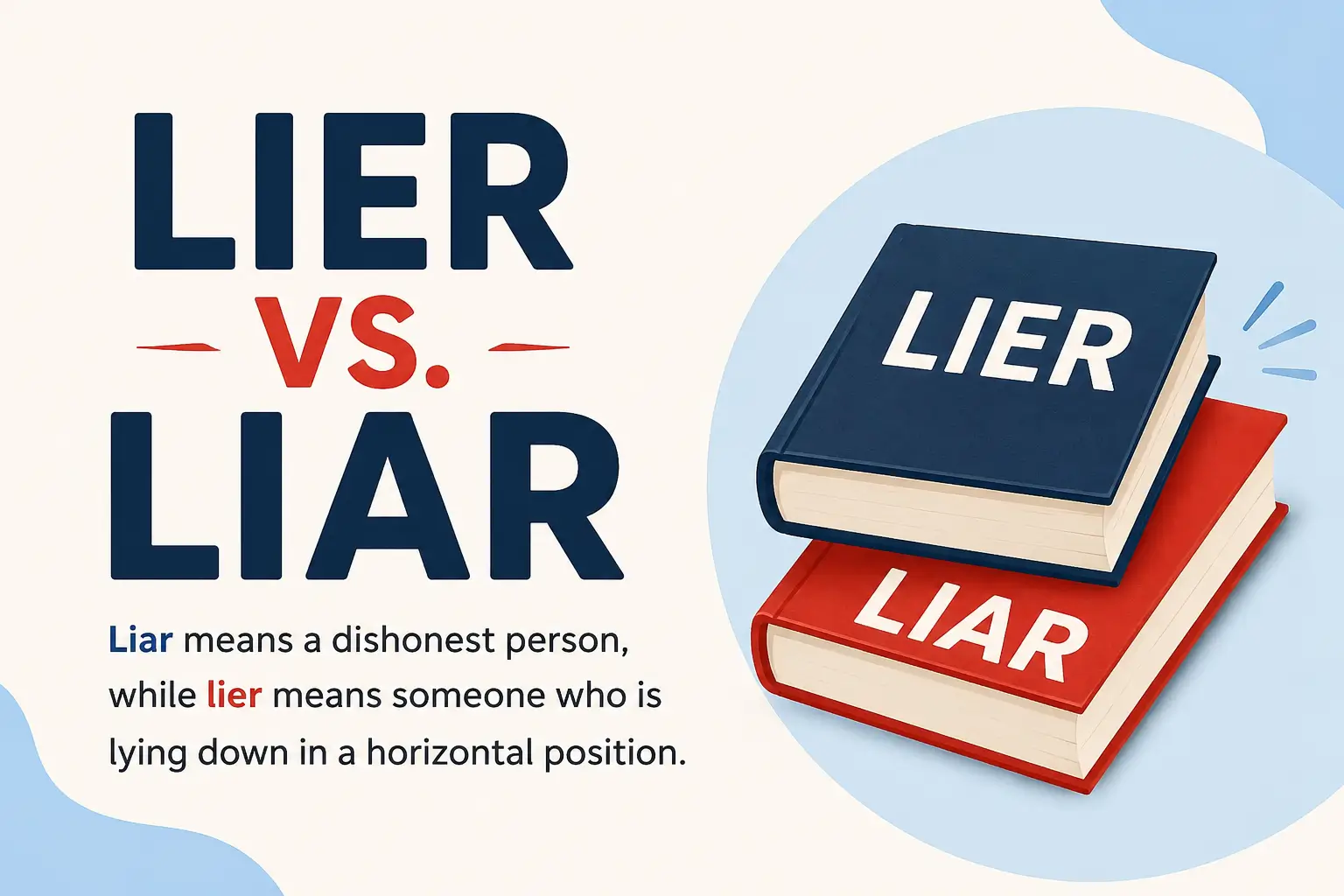
Lier vs liar becomes simple once you know that liar means a dishonest person, while lier means someone who is lying down in a horizontal position. Both words come from the verb lie, but each follows a different meaning in English.
A liar knowingly makes a false statement or tries to deceive others. The word is a noun and often carries a negative tone. By contrast, lier is a real word but a rare agent noun for a person, animal, or thing that is resting, reclining, or lying in wait. For example, “He is a liar” refers to dishonesty.
Use liar when the sentence concerns truth, trust, deception, or dishonesty. Use lier only for a physical position, although “person lying down” sounds clearer in modern American English. Also, don’t confuse lie with lay: lie means to rest, while lay means to place something. Writing lier for a dishonest person is a spelling error.
Quick Answer: Is It Lier or Liar?
Use liar when you mean a person who says something untrue.
Use lier when you mean someone or something that lies in a place or waits in concealment. This meaning is uncommon, so a clearer phrase often sounds more natural.
| Intended meaning | Correct word | Example |
| A person who tells lies | Liar | She discovered that he was a liar. |
| A person or thing lying somewhere | Lier | The lier remained hidden beside the path. |
| A person resting on a bed | Usually person lying down | The person lying down needed assistance. |
| A person placing an object somewhere | Neither | She laid the folder on the desk. |
Easy rule: A person who tells a lie is a liar.
Although lier is a valid dictionary word, most people rarely use it in everyday writing. Merriam-Webster defines it as “one that lies,” such as someone lying in ambush. In contrast, a liar is a person who tells lies.
Lier vs. Liar at a Glance
The two words look almost identical. They may also sound alike in normal speech. Still, their meanings are different.
| Feature | Liar | Lier |
| Part of speech | Noun | Noun |
| Main meaning | A person who tells lies | One that lies in a position or in wait |
| Root verb | Lie, meaning “say something untrue” | Lie, meaning “rest or remain somewhere” |
| Common in modern English? | Yes | No, it is rare |
| Plural | Liars | Liers |
| Example | The witness was called a liar. | The hidden lier watched the entrance. |
| Best everyday alternative | Dishonest person, deceiver | Person lying down, hidden observer |
The practical distinction is simple:
- Dishonesty requires liar.
- Physical position can technically use lier.
- Everyday English usually replaces lier with a clearer phrase.
What Does “Liar” Mean?
A liar is a person who tells a lie or regularly makes false statements.
It is a noun, which means it names a person. It is not normally an adjective.
- Noun: He is a liar.
- Adjective: He is dishonest.
- Verb: He lied.
- Noun for the statement: He told a lie.
Cambridge and Merriam-Webster both identify liar as a noun for someone who tells lies.
Does “Liar” Always Mean Deliberate Dishonesty?
Calling someone a liar usually suggests that the person knew the statement was false. Therefore, the word carries a stronger accusation than words such as mistaken, incorrect, or confused.
Consider these situations:
- Jordan says the meeting begins at 10:00 because he read the schedule incorrectly. Jordan is mistaken.
- Jordan knows the meeting begins at 9:00 but tells a coworker it begins at 10:00. Jordan is lying.
- Jordan repeatedly gives false information to mislead people. Others may call Jordan a liar.
A person can provide incorrect information without being a liar. The key difference is often knowledge and intent.
Someone who makes an honest mistake is wrong, but that doesn’t automatically make the person a liar.
Because liar can sound harsh, use it carefully in professional, academic, and public communication.
Is “Liar” a Noun or an Adjective?
Liar is a noun.
It names the person who tells lies. However, some writers incorrectly place it before another noun as though it were a normal descriptive adjective.
Incorrect:
- He is a liar person.
- She accused the liar employee.
- They hired a liar contractor.
Better:
- He is a liar.
- She accused the employee of lying.
- They hired a dishonest contractor.
English sometimes allows one noun to modify another, as in office chair or school bus. However, combinations such as liar person sound unnatural.
Use dishonest, deceptive, untruthful, or misleading when you need an adjective.
Pronunciation of “Liar”
In American English, liar is commonly pronounced LY-er.
It normally has two syllables:
- li sounds like the word lie
- ar sounds like a reduced er
The dictionary pronunciation is often shown as ˈlī(-ə)r. Merriam-Webster gives similar pronunciation forms for both liar and lier, which explains why speakers can’t always distinguish them by sound alone.
Because the words can sound the same, context and spelling carry the meaning.
Examples of “Liar” in Sentences
Here are natural examples from everyday American English.
Everyday conversation
- I stopped believing him because he had a reputation as a liar.
- Don’t call her a liar until you know what happened.
- He isn’t confused. He knows the truth, and he’s being a liar.
- She called me a liar, but I had the receipt to prove my story.
School and academic settings
- The student felt hurt when a classmate called her a liar.
- A factual error doesn’t necessarily make the writer a liar.
- The essay describes the narrator as an unreliable storyteller rather than a liar.
- The teacher asked for evidence before accepting the accusation that someone was a liar.
Workplace communication
- Calling a colleague a liar during a meeting can create serious conflict.
- The manager didn’t use the word liar; instead, she said the report contained inaccurate information.
- The customer claimed that the salesperson was a liar.
- Before accusing an employee of being a liar, review the records carefully.
Text messages and social media
- “You said you weren’t coming! Liar!”
- That account spreads false claims, but calling its owner a liar may require proof of intent.
- My friend jokingly called me a liar when I said I didn’t eat the last cookie.
- The comment section was full of people accusing each other of being liars.
In friendly conversations, people sometimes use liar jokingly. Tone matters. The same word can sound playful between close friends but aggressive during a disagreement.
Forms of “Liar”
The spelling changes depending on number and possession.
| Form | Meaning | Example |
| Liar | One person | The liar changed his story. |
| Liars | More than one person | The liars repeated the same excuse. |
| Liar’s | Something belonging to one liar | The liar’s explanation made no sense. |
| Liars’ | Something belonging to multiple liars | The liars’ stories contradicted each other. |
Don’t add an apostrophe to make the word plural.
- Correct plural: liars
- Incorrect plural: liar’s
The apostrophe in liar’s shows possession or a shortened verb:
- Possession: The liar’s story changed.
- Contraction: The liar’s been caught again.
Here, liar’s means liar has.
What Does “Lier” Mean?
A lier is a person, animal, or thing that lies in a particular place. It can also describe someone who lies in wait, such as a hidden watcher or attacker.
It comes from the physical-position meaning of lie:
- The cat lies beneath the table.
- A person lies on the bed.
- The cabin lies beyond the river.
- Someone lies in wait behind the wall.
A lier, therefore, is “one that lies.” Merriam-Webster records the word as a noun and specifically gives lying in ambush as an example of its meaning.
Is “Lier” a Real Word?
Yes, lier is a real word.
However, being a valid word doesn’t mean it is common or useful in most modern sentences. Many readers may assume lier is a misspelling of liar because they rarely encounter it.
For example:
- Technically possible: The lier rested beneath the tree.
- Clearer: The person lying beneath the tree was asleep.
The second sentence is more natural because it immediately tells the reader what the person is doing.
Examples of “Lier” in Sentences
The following examples illustrate its rare meaning:
- The lier remained hidden near the entrance.
- A patient lier waited silently in the tall grass.
- The animal was a motionless lier beneath the leaves.
- The guard searched for a lier concealed beside the trail.
- The lier watched the road from behind a fallen tree.
These examples are grammatically understandable. Still, they may sound literary, old-fashioned, or unnatural to many modern readers.
In everyday American English, writers would usually say:
- person lying down
- animal resting
- hidden person
- person lying in wait
- concealed observer
- someone waiting in ambush
When Should You Use “Lier”?
Use lier only when all three conditions apply:
- You mean someone or something that physically lies somewhere.
- The word fits the tone of the sentence.
- Your audience will understand the rare term.
In most other situations, rewrite the phrase.
| Rare wording | Clearer modern wording |
| A lier was beneath the window. | Someone was lying beneath the window. |
| The lier waited in the bushes. | The hidden person waited in the bushes. |
| The dog was a quiet lier by the fire. | The dog lay quietly by the fire. |
| The lier remained near the road. | The person lying in wait remained near the road. |
Clear writing matters more than using an unusual dictionary word. Therefore, choose the expression your reader will understand immediately.
The Key Difference Between Lier and Liar
The central difference comes from the two meanings of the verb lie.
Lie can mean “to tell an untruth”
- Present: I lie when I feel afraid.
- Past: I lied yesterday.
- Past participle: I have lied before.
- Person: A person who lies is a liar.
Lie can mean “to rest or remain in a position”
- Present: I lie on the couch.
- Past: I lay on the couch yesterday.
- Past participle: I have lain there before.
- Person or thing: One that lies can technically be called a lier.
This produces two different word families:
| Meaning | Verb | Past tense | Person or thing |
| Say something untrue | Lie | Lied | Liar |
| Rest or remain somewhere | Lie | Lay | Lier |
The spelling liar is tied to false statements. Meanwhile, lier is tied to position, location, or waiting.
Why Is It “Liar” Instead of “Lier”?
English often adds -er to a verb to name the person who performs an action:
- teach → teacher
- work → worker
- write → writer
- lie → lier
That pattern helps explain lier, meaning “one who lies in a position.” However, the noun for a person who tells lies developed with the spelling liar.
English spelling isn’t always perfectly regular. For that reason, you shouldn’t assume that every person who performs an action receives a simple -er ending.
Learn liar as the fixed spelling for dishonesty:
- lie + person who tells it = liar
A helpful comparison is beggar, which also has a spelling that doesn’t follow the most obvious modern pattern. Established words sometimes preserve older spelling forms.
“Lier” Does Not Mean a Person Who Lays Something Down
A common online error claims that lier comes from the verb lay. That explanation is incorrect.
The verb lay means to place an object somewhere. It usually requires a direct object—a person or thing receiving the action.
- Lay the book on the desk.
- She laid the baby in the crib.
- He is laying the tiles carefully.
The verb lie, meaning to recline, doesn’t take a direct object.
- I lie on the couch.
- She lay on the floor.
- The dog has lain beside the door.
Cambridge explains that lay takes an object, while the position-related verb lie does not. It also lists lay as the past tense of that form of lie.
Lie, Lay, Lain, Lied, and Laid
This table shows the complete difference.
| Meaning | Present tense | Past tense | Past participle | Present participle |
| Rest or recline | lie | lay | lain | lying |
| Place an object | lay | laid | laid | laying |
| Say something untrue | lie | lied | lied | lying |
Examples:
- Today, I lie down after lunch.
- Yesterday, I lay down after lunch.
- I have lain here for an hour.
- Please lay the keys on the table.
- She laid the keys there yesterday.
- He sometimes lies about his age.
- He lied about it last week.
- He has lied before.
Notice that lying can relate to either reclining or dishonesty:
- The child is lying on the carpet.
- The child is lying about the broken lamp.
Context reveals the meaning.
Correct and Incorrect Examples of Lier vs. Liar
Studying corrections is one of the easiest ways to remember the difference.
Talking About Dishonesty
Incorrect:
She called her brother a lier.
Correct:
She called her brother a liar.
Why: The sentence describes a person who tells lies. Therefore, liar is required.
Incorrect:
Nobody trusts a known lier.
Correct:
Nobody trusts a known liar.
Why: Trust relates to honesty, not physical position.
Incorrect:
He became a skilled lier who could invent convincing excuses.
Correct:
He became a skilled liar who could invent convincing excuses.
Why: Inventing false excuses is a form of deception.
Talking About Physical Position
Possible but rare:
The lier remained beside the road.
More natural:
The person lying beside the road remained still.
Why: The rare noun is technically possible, but the rewritten version is clearer.
Possible but rare:
The hidden lier watched the doorway.
More natural:
The person lying in wait watched the doorway.
Why: “Lying in wait” expresses the intended action directly.
Talking About Placing an Object
Incorrect:
She was the lier of the books on the shelf.
Better:
She placed the books on the shelf.
Possible in a specialized context:
She was the layer of the tiles.
Why: Someone who lays materials may be called a layer, as in bricklayer or tile layer. The word lier does not come from this meaning.
Lier, Liar, Layer, and Lair
Several similar-looking words can cause spelling mistakes.
| Word | Meaning | Example |
| Liar | Someone who tells lies | The liar changed his story. |
| Lier | One that lies in a place or in wait | The lier remained concealed. |
| Layer | A level, covering, or person who lays something | Add another layer of paint. |
| Lair | An animal’s den or a hidden resting place | The bear returned to its lair. |
Liar vs. Lair
A liar is a dishonest person. A lair is a place.
- The liar denied taking the money.
- The fox returned to its lair.
Merriam-Webster defines lair as a resting or living place, especially the home of a wild animal.
Lier vs. Layer
A lier lies somewhere. A layer may be a level of material or a person who places material.
- The cake has a chocolate layer.
- The tile layer worked quickly.
- The hidden lier remained still.
However, because lier is uncommon, the third sentence may be clearer as “The hidden person remained still.”
Liar vs. Lying
A liar is a noun. Lying can function as a verb form or an adjective.
- Noun: He is a liar.
- Verb form: He is lying to us.
- Adjective: It was a lying statement.
Merriam-Webster recognizes lying as both the present participle of lie and an adjective meaning false or containing untrue statements.
Common Mistakes With “Lier” and “Liar”
Using “Lier” as an Alternative Spelling of “Liar”
The most common mistake is treating the words as two spellings of the same term.
They aren’t interchangeable.
- Wrong for dishonesty: He is a lier.
- Right for dishonesty: He is a liar.
Assuming Every False Statement Makes Someone a Liar
People can repeat false information without knowing it is false.
Suppose Maya receives an outdated schedule and tells her team that an event begins at noon. The event actually begins at 11:00. Maya gave incorrect information, but she didn’t intentionally deceive anyone.
Calling her a liar would be unfair unless she knew the correct time and deliberately changed it.
Better descriptions include:
- mistaken
- misinformed
- incorrect
- confused
- working with outdated information
Writing “Liar Person”
Because liar is already a noun for a person, adding person is unnecessary.
- Awkward: He is a liar person.
- Natural: He is a liar.
- Natural adjective form: He is a dishonest person.
Confusing “Lied” and “Laid”
Use lied for dishonesty:
- She lied about completing the assignment.
Use laid for placing something:
- She laid the assignment on the desk.
Use lay as the past tense of reclining:
- She lay on the couch after work.
Writing “Layed”
The standard past tense of lay is laid, not layed.
- Incorrect: He layed the papers down.
- Correct: He laid the papers down.
Adding an Apostrophe to “Liars”
Use liars for the plural.
- Correct: The two liars blamed each other.
- Incorrect: The two liar’s blamed each other.
Use liar’s only for singular possession or a contraction.
- The liar’s excuse was unbelievable.
- The liar’s been repeating the same story.
How to Use “Liar” in Formal and Informal English
The basic meaning remains the same, but tone changes across situations.
Casual Conversation
In informal speech, liar may be serious or playful.
Serious:
- You knew that wasn’t true. You’re a liar.
Playful:
- You finished the whole pizza? Liar!
Facial expression, relationship, and context help listeners understand the tone.
Texting and Social Media
Online messages lack vocal tone. As a result, even a joking use of liar can appear hostile.
Instead of writing:
- You’re a liar.
You might write:
- I don’t think that information is correct.
- That doesn’t match what you said earlier.
- Can you explain why the details changed?
- I found a different date in the official notice.
These options challenge the statement without immediately attacking the person.
Professional Communication
Avoid personal accusations when you can address the evidence instead.
Too aggressive:
- You are a liar, and your report is false.
More professional:
- Several statements in the report conflict with the available records.
- The figures don’t match the approved financial summary.
- Please clarify the difference between these two versions.
- The claim appears unsupported by the current documentation.
Professional writing should identify the problem clearly. However, it should also avoid claims about someone’s intent unless evidence supports them.
Academic Writing
Academic writing usually focuses on the accuracy of a claim rather than labeling the writer.
Prefer:
- The statement is inaccurate.
- The claim lacks supporting evidence.
- The conclusion doesn’t follow from the data.
- The source misrepresents the original findings.
- The account contains several factual errors.
Avoid:
- The researcher is a liar.
- The author lied.
Those accusations require evidence of deliberate deception. A weak method, incorrect conclusion, or factual error doesn’t automatically prove dishonesty.
Memory Tricks for Lier vs. Liar
The “I Told a Lie” Trick
The word liar contains the letter a, but its clearest memory connection is the full phrase:
I told a lie, so they called me a liar.
Repeat the pair together:
- lie
- liar
Connect “Lier” With “Lie Down”
Think of the -er ending as “one that performs the action.”
- lie down → lier
Even so, remember that modern speakers usually say person lying down rather than lier.
Use the Trust Test
Ask yourself:
Does the sentence discuss truth, trust, deception, or honesty?
If yes, choose liar.
- Don’t trust him; he’s a liar.
- The witness was accused of being a liar.
- She didn’t want anyone to think she was a liar.
Use the Position Test
Ask:
Does the sentence discuss resting, reclining, remaining somewhere, or waiting in ambush?
If yes, lier may be technically correct. However, consider rewriting the sentence for clarity.
Synonyms for “Liar”
No synonym matches liar perfectly in every context. Each alternative adds a different tone or meaning.
| Word | Meaning or tone | Example |
| Fibber | Informal; tells small or less serious lies | He’s a fibber who exaggerates his stories. |
| Deceiver | Intentionally misleads others | The deceiver used a fake identity. |
| Fabricator | Invents false details or stories | The reporter exposed him as a fabricator. |
| Prevaricator | Avoids the truth or speaks misleadingly | The official sounded like a practiced prevaricator. |
| Fabulist | Invents elaborate stories; meaning depends on context | Critics described the memoirist as a fabulist. |
| Impostor | Pretends to be someone else | The impostor used another person’s credentials. |
| Perjurer | Lies while under oath | The court convicted the witness as a perjurer. |
| Con artist | Deceives people for money or advantage | The con artist created a fake investment plan. |
Merriam-Webster lists related terms such as fibber, prevaricator, fabricator, and fabulist, but their meanings and levels of formality differ.
Fibber vs. Liar
A fibber usually tells small or relatively harmless lies.
- The child was a little fibber about brushing his teeth.
- The criminal was a liar who created a false identity.
Calling someone a fibber may sound lighter or less severe.
Deceiver vs. Liar
A liar deceives through false statements. A deceiver can mislead through words, actions, appearances, or hidden information.
For example, someone may deceive another person by hiding an important fact without directly stating a lie.
Fabricator vs. Liar
A fabricator invents information, stories, evidence, or explanations.
- He fabricated the entire conversation.
- Investigators discovered that the supposed witness was a fabricator.
The word often emphasizes the creation of false details.
Antonyms and Related Words
Useful opposites of liar include:
- truth-teller
- honest person
- reliable witness
- straight shooter
- person of integrity
Related adjectives include:
- honest
- truthful
- reliable
- sincere
- trustworthy
- candid
Be careful with truth-teller. It is understandable and correct, but it may sound more deliberate than simply saying honest person.
Real-Life Usage Scenarios
A Workplace Disagreement
A manager discovers that an employee submitted the wrong sales total.
The manager shouldn’t immediately say:
- You’re a liar.
First, the manager should determine whether the employee made a data-entry mistake, used an outdated spreadsheet, or knowingly changed the figures.
A better opening would be:
- This total doesn’t match the accounting report. Can you explain the difference?
This response focuses on evidence and allows room for an honest mistake.
A School Conflict
A student says another student copied an assignment. The accused student denies it.
Neither statement alone proves that someone is a liar. A teacher should compare the assignments, review timestamps, and ask both students for details.
The key lesson is that liar describes a person, but using the label responsibly requires more than disagreement.
A Casual Text Message
A friend writes:
- I didn’t see your message.
You reply:
- Liar! You left me on read.
Among close friends, this may be playful. However, the same message could sound hostile during an argument.
Adding context can soften it:
- Liar 😂 You left me on read!
Although emojis can clarify tone, they don’t erase every misunderstanding. Use the word carefully.
A Person Waiting in Concealment
A mystery story describes someone hiding beside a road.
The writer could use lier:
- The lier waited beside the road.
However, most readers would find this version clearer:
- The person lying in wait watched the road.
The second sentence uses familiar language and creates a stronger image.
Conclusion
The difference between lier vs. liar is simple once you understand the meaning of each word. A liar is a person who tells lies or knowingly gives false information. This is the correct word in sentences about dishonesty, truth, trust, or deception.
A lier is a real but rare word for someone or something that lies down, rests in a horizontal position, or lies in wait. However, most modern writers use clearer phrases such as “a person lying down” or “someone lying in wait.”
Remember this easy rule: A person who tells a lie is a liar. Use lier only when the sentence clearly refers to physical position, not dishonesty.
Frequently Asked Questions
Q1:Is lier or liar the correct spelling?
Both words are correct, but they have different meanings. Use liar for a person who tells lies. Use lier for someone or something that lies in a physical position, although this word is rare.
Q2: What does liar mean?
A liar is a person who knowingly says something that is false. The word is a noun and often carries a strong negative meaning.
Q3:Is lier a real English word?
Yes, lier is a real English word. It means a person, animal, or thing that lies down, remains in a place, or lies in wait. Still, it is uncommon in everyday American English.
Q4: Is liar a noun or an adjective?
Liar is a noun. It names a person who tells lies. Use dishonest, untruthful, or deceptive when you need an adjective.
Q5: What is the easiest way to remember lier vs. liar?
Connect liar with the word lie. A person who tells a lie is a liar. Connect lier with “lie down,” but remember that this form is rarely used in normal conversation.