
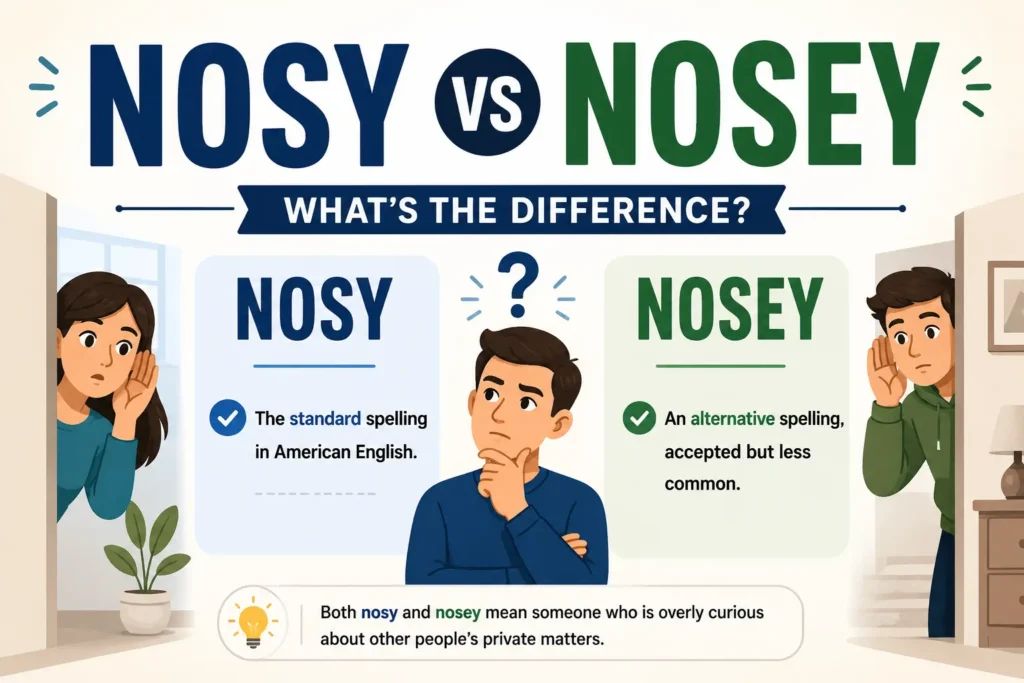
In nosy vs nosey, both spellings describe someone who is overly curious, but nosy is the standard choice in clear American English writing today.
Common signs include asking overly personal questions, prying, snooping, or eavesdropping by listening to other people’s conversations. This behavior enters other people’s business, shows a lack of respect for privacy, and may be described with the phrasal verbs nose in or stick one’s nose in.
The term is usually mildly negative and somewhat playful in everyday conversation. For example, a neighbor asks where I’m going, asks where I’ve been, or keeps looking in a private notebook. However, nosy isn’t strong enough for serious violations of privacy or harmful violations of privacy. In those cases, intrusive or abusive is more accurate. Context, purpose, and consent help you decide whether curiosity has clearly crossed a personal boundary.
Quick Answer: Is It Nosy or Nosey?
Use nosy in most situations, especially in American English.
Both nosy and nosey are correct spellings of the same adjective. They have the same meaning:
Too interested in other people’s private information or personal affairs.
However, nosy is the standard spelling in US English. It’s also the safer choice for school assignments, professional emails, articles, reports, and other formal writing.
Consider these examples:
- Standard: My nosy neighbor keeps asking about my visitors.
- Accepted but less common: My nosey neighbor keeps asking about my visitors.
Neither sentence changes in meaning. Only the spelling is different.
Nosy vs Nosey at a Glance
| Feature | Nosy | Nosey |
| Meaning | Too interested in private matters | Same meaning |
| Pronunciation | NOH-zee | NOH-zee |
| Part of speech | Adjective | Adjective |
| Status | Standard spelling | Accepted variant |
| Common in American English | Yes | Less common |
| Suitable for formal writing | Yes | Usually avoided |
| Comparative form | Nosier | Usually nosier |
| Superlative form | Nosiest | Usually nosiest |
| Noun form | Nosiness | Nosiness |
The main difference is spelling preference, not definition, grammar, or pronunciation.
What Does Nosy Mean?
Nosy is an adjective that describes a person, question, comment, or action that shows inappropriate interest in private matters.
A nosy person may ask questions that feel too personal. They may also listen to private conversations, look through someone’s belongings, or interfere in situations that don’t concern them.
For example:
- Why are you asking how much I earn? That’s nosy.
- Our nosy neighbor watches everyone who enters the building.
- She asked several nosy questions about their divorce.
- He wasn’t trying to help. He was simply being nosy.
The word usually has a negative meaning. It suggests that someone has crossed a social boundary.
Nosy as an Adjective
An adjective describes a person, place, thing, or idea. Nosy can appear before a noun or after a linking verb.
Before a noun:
- a nosy coworker
- a nosy question
- a nosy reporter
- a nosy neighbor
After a linking verb:
- My brother is nosy.
- That question seemed nosy.
- You’re being nosy.
- Her comments sounded nosy.
In these examples, nosy describes either a person or behavior that invades someone else’s privacy.
Pronunciation of Nosy and Nosey
Both spellings are pronounced the same way:
NOH-zee
The first syllable rhymes with go, and the second sounds like the letter Z.
Because the pronunciation is identical, you can’t hear whether someone means nosy or nosey in conversation. The difference only appears in writing.
What Does Nosey Mean?
Nosey means exactly the same thing as nosy. It’s an alternative spelling, not a separate word.
For example:
- The nosey customer wanted to know why the employee had been absent.
- Stop being so nosey and mind your own business.
- His nosey questions made the guests uncomfortable.
These sentences are understandable and grammatically correct. However, most American writers would use nosy instead.
Is Nosey a Misspelling?
Nosey isn’t always a misspelling. Many dictionaries recognize it as a valid variant of nosy.
Still, some teachers, editors, spell-checking tools, and style guides may prefer or recommend nosy. As a result, nosey may be marked as unusual even when it isn’t technically wrong.
For clear American English, follow this rule:
Use nosy unless you have a specific reason to use nosey.
You might keep nosey when quoting someone, preserving a title, or following a publisher’s chosen spelling.
Nosy vs Nosey: What’s the Difference?
The difference between nosy and nosey comes down to spelling convention.
Both words:
- Have the same definition
- Have the same pronunciation
- Work as adjectives
- Carry the same negative tone
- Can describe people, questions, behavior, or comments
However, nosy is more common and more widely accepted as the standard form.
Difference in Spelling
The word nosy comes from nose, but it drops the final e before adding -y.
- nose + y = nosy
- alternative spelling = nosey
The spelling may look strange because readers often expect the original word nose to remain complete. Still, English spelling doesn’t always follow one fixed pattern.
Difference in American English
In American English, nosy is the preferred form.
You’ll commonly see it in:
- Newspapers
- Books
- School materials
- Workplace communication
- Online articles
- Professional editing
- American dictionaries
For example:
- The interviewer asked a nosy question.
- A nosy coworker read the message on my screen.
- Don’t sound nosy in your follow-up email.
Using nosey in these sentences wouldn’t change their meaning. However, it may look less polished to an American audience.
Difference in British English
British English may use both nosy and nosey. The preferred spelling can vary by dictionary, publisher, region, or house style.
Still, nosy is widely understood in both American and British English. Therefore, it’s a practical choice when writing for an international audience.
Formal and Informal Usage
In formal writing, nosy is the better choice.
Formal examples include:
- The survey included questions that some participants considered nosy.
- Employees should avoid making nosy inquiries about medical leave.
- The journalist was criticized for using nosy and intrusive tactics.
In informal writing, either spelling may appear:
- You’re so nosy!
- Don’t be nosey, but did they break up?
- My cousin keeps asking nosy questions.
Even in texts and social media posts, nosy remains more common.
Why Is Nosy Spelled Without the E?
The adjective developed from the noun nose. In a figurative sense, a person who “puts their nose” into another person’s affairs is interfering or showing unwanted curiosity.
Over time, nosy became the standard adjective.
The final e in nose disappears before the -y ending:
- nose → nosy
- nosy → nosier
- nosy → nosiest
- nosy → nosiness
However, don’t treat this as a universal spelling rule. English word formation contains many irregular patterns, and similar-looking words don’t always change in the same way.
The safest approach is to remember nosy as its own standard spelling.
Examples of Nosy in Sentences
The word appears in many everyday situations. These examples show how Americans use it at home, at work, at school, and online.
Everyday Conversation
- Don’t be nosy. The conversation is private.
- I don’t mean to sound nosy, but are you moving?
- Why is your aunt so nosy about your relationships?
- He asked where I was going, but I didn’t think he was being nosy.
- That may be a little nosy, so you don’t have to answer.
The phrase “I don’t mean to be nosy” often softens a personal question. However, it doesn’t automatically make the question appropriate.
For example:
I don’t mean to be nosy, but how much did your house cost?
The speaker recognizes that the question may cross a boundary. Still, the listener may choose not to answer.
Workplace Examples
- My nosy coworker keeps asking why I take time off.
- The manager avoided asking nosy questions about the employee’s health.
- Reading someone else’s email is more than curious; it’s nosy and intrusive.
- Her question about my salary felt nosy.
- A professional interviewer should avoid questions that seem nosy or discriminatory.
At work, personal questions can create discomfort. Therefore, employees should consider whether the information is relevant before asking.
A question such as “When will you finish the report?” is work-related. In contrast, “Why aren’t you married yet?” is usually personal and potentially nosy.
School Examples
- The students became nosy when they saw the principal enter the classroom.
- His classmates asked nosy questions about his parents.
- The teacher reminded everyone not to read another student’s journal.
- I was curious about the new student, but I didn’t want to seem nosy.
- A nosy classmate looked over my shoulder during the test.
Curiosity is natural in school. However, curiosity becomes nosiness when it ignores privacy or permission.
Texting and Social Media
- Not to be nosy, but who was that in your photo?
- People became nosy about the influencer’s private relationship.
- Her post received hundreds of nosy comments.
- Don’t scroll through my messages. That’s nosy.
- Online followers sometimes feel entitled to personal details.
Social media can blur the line between public and private information. Someone may share part of their life online without inviting questions about everything else.
Examples of Nosey in Sentences
The less common spelling works in the same grammatical positions:
- My nosey neighbor watches everyone from her window.
- Stop being nosey and leave the package alone.
- The reporter asked several nosey questions.
- He sounded nosey, even though he was trying to help.
- Her nosey relatives wanted every detail about the engagement.
These sentences are grammatically acceptable. Still, replacing nosey with nosy would make them more consistent with standard American usage.
Correct and Incorrect Usage
Understanding spelling is only part of using the word correctly. You also need to choose the right sentence pattern and word form.
Correct Examples
- She’s nosy about her neighbors’ lives.
- That was a nosy question.
- He became nosier after hearing the argument.
- She’s the nosiest person in our department.
- His nosiness made everyone uncomfortable.
- The child looked around nosily.
Each sentence uses the correct form for its grammatical role.
Incorrect or Awkward Examples
Incorrect: She is nosy into my personal life.
Better: She is nosy about my personal life.
Incorrect: He is more nosy than his brother.
Better: He is nosier than his brother.
Incorrect: She is the most nosy person here.
Better: She is the nosiest person here.
Incorrect: His noseyness caused a problem.
Correct: His nosiness caused a problem.
Although “more nosy” may appear in casual speech, nosier is the normal comparative form.
Nosy About, Nose Around, and Poke Your Nose Into
Several expressions involve nose, but they use different grammar patterns.
Nosy About
Use nosy about when someone is overly interested in a topic.
- She’s nosy about my finances.
- He became nosy about their relationship.
- Why are you so nosy about the meeting?
This is the most natural preposition after the adjective.
Nose Around
Nose around is a phrasal verb. It means to search or investigate, often without permission.
- Someone was nosing around my desk.
- The detective nosed around the abandoned building.
- Don’t nose around in my closet.
The phrase can describe physical searching or an attempt to discover private information.
Poke Your Nose Into Something
This expression means to interfere in a situation that doesn’t concern you.
- He keeps poking his nose into family arguments.
- Don’t poke your nose into my business.
- She poked her nose into a decision that wasn’t hers to make.
The phrase is informal and usually critical.
Word Forms Related to Nosy
The spelling changes when you form the comparative, superlative, adverb, and noun.
| Word Form | Part of Speech | Meaning | Example |
| Nosy | Adjective | Too interested in private matters | A nosy neighbor |
| Nosier | Comparative adjective | More nosy | He is nosier than I expected |
| Nosiest | Superlative adjective | Most nosy | She is the nosiest person here |
| Nosily | Adverb | In a nosy manner | He listened nosily |
| Nosiness | Noun | The quality of being nosy | Her nosiness annoyed them |
Comparative Form: Nosier
When an adjective ends in a consonant followed by y, change the y to i and add -er.
- nosy → nosier
Examples:
- My new neighbor is nosier than the previous one.
- He became nosier after hearing part of the conversation.
- Children may grow nosier when adults hide information.
Don’t write nosyer. Also, more nosy is less natural than nosier in standard writing.
Superlative Form: Nosiest
To form the superlative, change the y to i and add -est.
- nosy → nosiest
Examples:
- She’s the nosiest person in the office.
- That was the nosiest question anyone asked.
- He may be the nosiest neighbor on the street.
Adverb Form: Nosily
The adverb nosily describes how someone performs an action.
- She nosily examined the papers on his desk.
- The child nosily listened outside the door.
- He nosily asked what everyone had discussed.
The word is correct but less common in everyday conversation. Speakers often use a phrase instead:
- She looked through the papers in a nosy way.
- He listened because he was being nosy.
Noun Form: Nosiness
Nosiness names the behavior or quality of being nosy.
- His nosiness damaged their friendship.
- I was surprised by her nosiness.
- Curiosity can become nosiness when it ignores privacy.
- The employee complained about a coworker’s nosiness.
Notice the spelling:
- Correct: nosiness
- Incorrect: noseyness
- Incorrect: nosyness
- Incorrect: noseiness
Nosy vs Curious: What’s the Difference?
Curious and nosy both involve wanting information. However, their tone and social meaning are different.
Curious is often neutral or positive. It can show interest, a desire to learn, or thoughtful attention.
Nosy is usually negative. It suggests that someone wants information they aren’t entitled to have.
| Situation | Curious | Nosy |
| Asking how a computer works | Yes | No |
| Asking a friend what book they’re reading | Usually | Usually not |
| Asking a coworker’s salary without a reason | No | Yes |
| Reading someone’s private messages | No | Yes |
| Checking whether an injured person needs help | Yes | Not usually |
| Listening through a closed door | No | Yes |
| Asking a teacher for more details about a lesson | Yes | No |
| Demanding details about a stranger’s divorce | No | Yes |
When Does Curiosity Become Nosiness?
Curiosity often becomes nosiness when one or more of these conditions apply:
- The information is private.
- The person hasn’t invited questions.
- The question has no useful purpose.
- The speaker continues after seeing discomfort.
- The behavior involves spying or searching.
- The person ignores a clear boundary.
- The information doesn’t concern the person asking.
For example, asking a coworker, “Did you enjoy your vacation?” is friendly. Asking, “How much did the trip cost, and who paid for it?” may sound nosy.
Context matters. A doctor, lawyer, teacher, or manager may need certain information for a legitimate reason. The same question from a stranger could feel inappropriate.
Is Nosy Always Negative?
Nosy is usually negative, but tone can soften it.
Friends sometimes use the word playfully:
- I’m being nosy, but what did she say?
- Call me nosy, but I want to know what happened.
- We’re all a little nosy when there’s exciting news.
In these examples, the speaker admits to being overly curious. The tone may be humorous rather than insulting.
However, calling someone else nosy can sound critical:
- You’re too nosy.
- Stop being nosy.
- She’s a nosy person.
The effect depends on the relationship, situation, and tone of voice.
Synonyms for Nosy
Several words have meanings related to nosy, but they aren’t always interchangeable.
| Synonym | Meaning and Tone |
| Curious | Interested in learning; often neutral or positive |
| Inquisitive | Eager to ask questions; may be positive or mildly critical |
| Prying | Trying to uncover private information; strongly negative |
| Intrusive | Entering another person’s privacy or space; formal and negative |
| Meddlesome | Interfering in matters that don’t concern you |
| Snooping | Secretly searching for information |
| Interfering | Becoming involved without being asked |
| Inquisitorial | Asking questions in a severe or aggressive way |
| Pushy | Too forceful, though not always related to private information |
Choosing the Right Synonym
Use curious when the interest is reasonable:
- The child was curious about the stars.
Use inquisitive for someone who asks many questions:
- She has an inquisitive mind.
Use prying when the questions invade privacy:
- He asked prying questions about her marriage.
Use meddlesome when the person interferes:
- A meddlesome relative tried to control the wedding plans.
Use snooping when someone searches secretly:
- She caught him snooping through her phone.
Use intrusive in formal or professional contexts:
- The application requested intrusive personal information.
Antonyms and Opposite Ideas
No single word works as a perfect opposite of nosy in every sentence. However, these terms describe people who respect privacy:
- Discreet
- Respectful
- Reserved
- Unobtrusive
- Tactful
- Considerate
- Mindful of boundaries
Examples:
- A discreet employee doesn’t share private office information.
- A tactful friend knows when not to ask questions.
- A respectful neighbor gives others personal space.
Related Phrases and Expressions
Several common expressions describe nosiness or unwanted interference.
Mind Your Own Business
This phrase tells someone to focus on their own affairs.
- Mind your own business.
- He told the reporter to mind her own business.
It’s direct and may sound rude. In professional settings, a softer response is usually better:
- I’d rather keep that private.
- I’m not comfortable discussing that.
- That’s a personal matter.
Keep Your Nose Out of It
This phrase tells someone not to interfere.
- Keep your nose out of my personal life.
- She told him to keep his nose out of the argument.
It’s informal and confrontational.
Poke Your Nose Into Someone’s Business
This phrase describes unwanted involvement.
- He always pokes his nose into other people’s business.
- Don’t poke your nose into their disagreement.
A Nosy Parker
Nosy Parker is an informal British expression for a person who takes too much interest in other people’s affairs.
- Don’t be such a nosy Parker.
- The character is the neighborhood’s resident nosy Parker.
The phrase is understood by some American speakers, but it isn’t common in everyday US English.
Real-Life Usage Scenarios
The following situations show how context changes the meaning of a question.
A Coworker Asks About Your Salary
Question: How much do you make?
This may feel nosy because salary is often treated as private. However, context matters. Coworkers discussing pay equity may have a valid reason to compare salaries.
The question becomes more respectful when permission is included:
You don’t have to answer, but would you be comfortable discussing salary ranges?
A Friend Asks Whether You’re Okay
Question: You seem upset. Is everything all right?
This is usually concerned, not nosy. The friend offers support without demanding details.
However, repeated questioning after the person says, “I don’t want to talk,” can become intrusive.
A Neighbor Watches Your Visitors
Noticing a visitor isn’t necessarily nosy. People naturally observe their surroundings.
However, recording arrival times, asking who each visitor is, or spreading rumors crosses into nosiness.
A Parent Checks a Child’s Phone
This example depends on age, safety, trust, and family rules. A parent may have a responsibility to protect a young child. Still, secret monitoring without clear expectations can feel intrusive.
Therefore, the word nosy alone may oversimplify the situation.
Common Mistakes With Nosy and Nosey
Thinking the Spellings Have Different Meanings
Nosy and nosey don’t describe different behaviors. They are spelling variants of the same adjective.
- Nosy neighbor = nosey neighbor
- Nosy question = nosey question
- Nosy person = nosey person
The standard US spelling is simply nosy.
Confusing Nosy With Noisy
Nosy and noisy look similar, but they have different meanings and pronunciations.
| Word | Meaning | Pronunciation | Example |
| Nosy | Too interested in private matters | NOH-zee | My neighbor is nosy |
| Noisy | Making a lot of sound | NOI-zee | The restaurant is noisy |
Compare:
- The children are noisy because they’re shouting.
- The children are nosy because they’re listening at the door.
A person can be both:
- Our nosy, noisy neighbor asks personal questions and plays loud music.
Writing Nosyer or Noseyer
The standard comparative form is nosier.
- Incorrect: nosyer
- Incorrect: noseyer
- Correct: nosier
The standard superlative form is nosiest.
- Incorrect: nosyest
- Incorrect: noseyest
- Correct: nosiest
Using Nosy When You Mean Concerned
Wanting to help isn’t automatically nosy.
- Concerned: Are you feeling okay?
- Nosy: What medical condition do you have, and which medicine are you taking?
A concerned question allows the other person to choose how much to share. A nosy question often demands private details.
Overusing “I Don’t Mean to Be Nosy”
This phrase can soften a question, but it doesn’t erase the question’s effect.
For example:
I don’t mean to be nosy, but why don’t you have children?
The introduction recognizes the privacy issue. However, the question may still feel personal or painful.
Before asking, consider whether you truly need the answer.
Grammar Tips for Using Nosy Correctly
Follow these practical tips in everyday writing:
- Use nosy as the standard American spelling.
- Use nosier, not “more nosy,” in most edited writing.
- Use nosiest, not “most nosy,” when comparing three or more people.
- Write nosiness for the noun.
- Use nosy about when naming the topic of someone’s curiosity.
- Use nose around as a verb phrase.
- Don’t confuse nosy with noisy.
- Consider tone before calling a person nosy.
- Stay consistent with one spelling throughout a document.
How to Remember Nosy vs Nosey
Use this simple memory trick:
A nosy person puts their nose where it doesn’t belong, but the adjective drops the final e.
You can also remember that nosy is the shorter spelling and the standard American form.
Another useful pattern is:
- nose
- nosy
- nosier
- nosiest
- nosiness
Once you remember the base adjective nosy, the other forms become easier to spell.
Which Spelling Should You Use?
Choose nosy for nearly all modern American writing.
It works best in:
- Essays
- Blog posts
- Business documents
- Academic papers
- News articles
- Emails
- Text messages
- Social media posts
- Fiction
- Professional editing
Use nosey only when:
- You’re quoting a source that uses it.
- It appears in an official title or name.
- A publisher requires that spelling.
- You’re intentionally following a regional style.
- A fictional character’s spelling reflects their voice.
Above all, remain consistent. Don’t switch between nosy and nosey in the same article unless you’re explaining the difference.
Conclusion
The difference between nosy vs nosey is mainly about spelling, not meaning. Both words describe someone who asks overly personal questions, interferes in private matters, or shows too much interest in other people’s lives. However, nosy is the standard and more common spelling in American English.
For clear, professional, and formal writing, use nosy. The spelling nosey is accepted, but it is less common and may look unusual to US readers. Also, remember that nosy is usually negative, while curious can be neutral or positive. When in doubt, choose nosy.
Frequently Asked Questions
Q1:Is nosy or nosey correct?
Both spellings are correct, but nosy is the standard form in American English. Nosey is a less common spelling variant with the same meaning.
Q2: What does nosy mean?
Nosy describes someone who is too interested in private information or other people’s personal affairs. It often refers to prying questions, snooping, or unwanted interference.
Q3: Is nosey a misspelling?
No, nosey is not always a misspelling. Many dictionaries recognize it as an alternative spelling. However, nosy is more common and preferred in formal US writing.
Q4: What is the difference between nosy and noisy?
Nosy means overly interested in private matters. Noisy means loud or full of sound. For example, a nosy neighbor asks personal questions, while a noisy neighbor plays loud music.
Q5: Is nosy always a negative word?
Nosy usually has a negative meaning because it suggests a lack of respect for privacy. However, friends may sometimes use it in a playful or joking way.
