
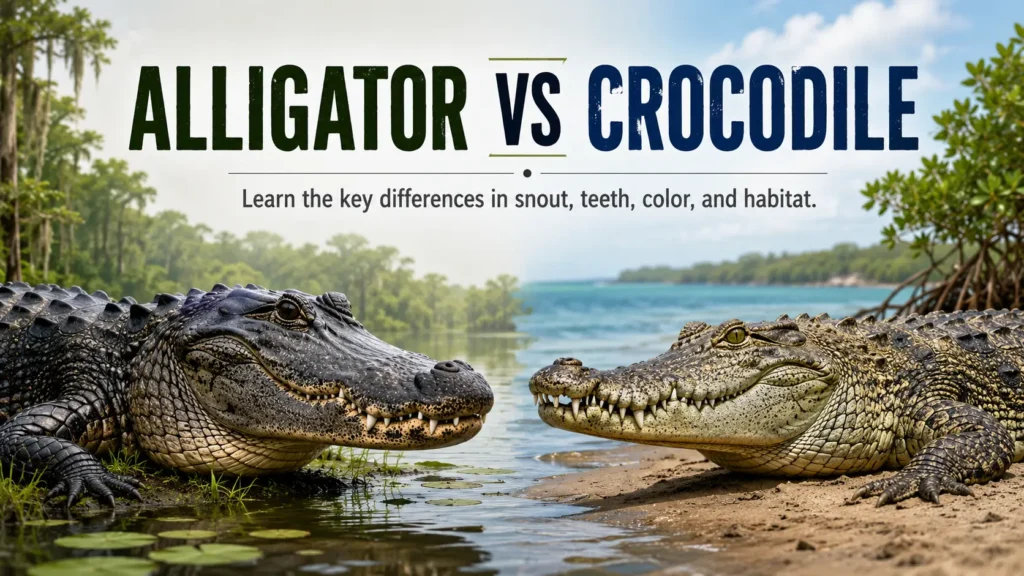
Alligator vs crocodile identification starts with the snout, teeth, color, habitat, and location because these reptiles can look nearly identical.
Alligators usually have broader, rounded snouts and mostly hidden lower teeth when their mouths are closed. Crocodiles often have narrower snouts, while several visible lower teeth may remain outside the upper jaw. These physical clues make it easier to tell them apart, especially when you consider animal color and where each species lives. In the United States, location is especially useful in southern Florida.
However, the familiar U-shaped snout versus V-shaped snout rule isn’t perfect. Some crocodile species have broad snouts, while environmental conditions such as mud, algae, age, and lighting can change an animal’s color. Therefore, accurate identification requires several clues, not one feature. Compare the jawline, tooth visibility, habitat, and geographic location, and never approach a wild crocodilian.
Quick Answer: What Is the Difference Between an Alligator and a Crocodile?
The easiest way to compare an alligator vs. crocodile is to look at the closed mouth.
An alligator’s upper jaw is usually wider than its lower jaw. As a result, most lower teeth fit inside the mouth and remain hidden. A crocodile’s upper and lower jaws are closer in width, so teeth from both jaws may remain visible.
You can also use these clues:
- Alligator: Broad snout, darker body, mostly freshwater habitat
- Crocodile: Usually narrower snout, lighter coloring, better saltwater tolerance
- Alligator range: Mainly the southeastern United States and China
- Crocodile range: Tropical areas across Africa, Asia, Australia, and the Americas
- Largest species: Saltwater crocodile
- Best identification clue: The fourth lower tooth and overall jawline
Florida wildlife authorities use head shape, color, and the visible fourth lower tooth to distinguish American crocodiles from American alligators.
Simple memory rule: Location first, snout second, teeth third.
Alligator vs. Crocodile Comparison Table
| Feature | Alligator | Crocodile |
| Broader group | Crocodilian | Crocodilian |
| Family | Alligatoridae | Crocodylidae |
| Typical snout | Broad and rounded | Usually narrow and tapered |
| Common shape comparison | U-shaped | V-shaped |
| Closed-mouth teeth | Lower teeth mostly hidden | Upper and lower teeth may show |
| Fourth lower tooth | Fits into an upper-jaw socket | Usually fits into an outer notch |
| Common coloring | Dark gray or nearly black | Olive, tan, gray, or brown |
| Main habitat | Freshwater | Freshwater, brackish water, or saltwater |
| Salt tolerance | Limited | Generally stronger |
| Natural US range | Southeastern states | Mainly southern Florida |
| Living species | Two true alligator species | Sixteen currently recognized true crocodile species |
| Largest example | American alligator | Saltwater crocodile |
| General human risk | Dangerous when approached or fed | Risk varies greatly by species |
These descriptions are useful general patterns. However, they don’t apply perfectly to every species, age group, or individual. The mugger crocodile, for example, has a fairly broad snout and can resemble an alligator from some angles.
Are Alligators and Crocodiles the Same Animal?
Alligators and crocodiles aren’t the same animal, but they are close relatives.
Both belong to the order Crocodilia, also commonly spelled Crocodylia in scientific literature. Members of this group are called crocodilians. The group includes:
- Alligators
- Crocodiles
- Caimans
- Gharials
- False gharials
The IUCN Crocodile Specialist Group currently recognizes 26 living crocodilian species. They are divided among three families:
| Family | Animals Included | Recognized Species |
| Alligatoridae | Alligators and caimans | 8 |
| Crocodylidae | True crocodiles | 16 |
| Gavialidae | Gharial and false gharial | 2 |
Taxonomy can change when genetic studies reveal hidden species or show that two populations belong together. The specialist group also notes that additional proposed species haven’t yet received full formal recognition.
Is an Alligator a Type of Crocodile?
In casual conversation, people sometimes use “crocodile” for any large crocodilian. Scientifically, though, an alligator isn’t a true crocodile.
A better statement is:
- Correct: An alligator is a crocodilian.
- Incorrect in strict classification: An alligator is a crocodile.
- Correct: Alligators and crocodiles are related reptiles.
That wording may sound picky, but it prevents confusion between the broader order and the crocodile family.
Similarities Between Alligators and Crocodiles
These animals look similar because they share many adaptations.
Both have:
- Long, muscular tails
- Short, strong legs
- Armored skin
- Bony plates called scutes or osteoderms
- Eyes and nostrils near the top of the head
- Powerful jaws
- Replaceable teeth
- Strong swimming ability
- Carnivorous diets
- Nest-building behavior
- Maternal care of eggs and young
Their eye and nostril placement allows most of the body to remain underwater. Meanwhile, the animal can continue watching, smelling, and breathing above the surface.
Both are also ectothermic, meaning they rely on external heat instead of producing a stable internal body temperature like mammals. Therefore, you may see them basking in sunlight or resting in warm, shallow water.
How to Tell an Alligator From a Crocodile
No single feature works in every situation. Instead, combine several signs.
Snout Shape
The best-known difference is the shape of the snout.
An American alligator usually has a broad, rounded muzzle. From above, it may resemble the letter U. In contrast, many crocodiles have longer, narrower snouts that taper toward the tip.
This difference partly reflects feeding adaptations. Broad snouts can handle powerful crushing forces, while narrow snouts can close quickly around fish and other moving prey.
However, don’t treat the letter rule as absolute. Crocodile snouts vary significantly. For example, the mugger crocodile has a broad head, while slender-snouted crocodile species have extremely narrow jaws.
Useful rule: A rounded snout supports an alligator identification, but it doesn’t prove it.
Teeth and Jaw Structure
The closed mouth often provides a stronger clue than the snout.
An alligator usually has a wider upper jaw. Consequently, the lower teeth fit into sockets inside the upper jaw and become difficult to see.
A crocodile’s teeth tend to interlock along the outside of the jaw. Therefore, both upper and lower teeth may remain visible when the mouth closes.
The most important tooth is the fourth tooth in the lower jaw. In an alligator, it fits into a socket and usually disappears from view. In many crocodiles, it fits into a notch outside the upper jaw and remains visible.
The Smithsonian describes this lower fourth tooth as a reliable distinction between American alligators and crocodiles.
Never approach a wild animal to inspect its teeth. Use binoculars, a zoom lens, or a photograph instead.
Color
Color can support an identification, but it shouldn’t be your main test.
American alligators often look:
- Dark gray
- Charcoal
- Nearly black
- Greenish when covered with algae
American crocodiles are often:
- Olive gray
- Brownish gray
- Tan
- Lighter than nearby alligators
Water quality, mud, sunlight, algae, and age can all affect appearance. A crocodile in dark water may look black, while an alligator covered in vegetation may appear bright green.
Florida’s wildlife agency specifically warns that the common image of a green alligator often comes from algae or floating plants attached to its body.
Jawline
Look at the sides of the closed mouth.
An alligator often has a smoother jawline because its lower teeth fit inside the upper jaw. A crocodile may have a more irregular or jagged outline because several lower teeth remain exposed.
This clue works well in clear side-view photographs. However, it becomes less useful when the animal is partly underwater.
Body Size
People often say crocodiles are larger than alligators. That statement is broadly true only when comparing the largest species.
The saltwater crocodile grows much larger than either living alligator species. However, several smaller crocodiles can be shorter than a large American alligator.
Therefore, body size alone can’t identify the animal.
Feet and Legs
Some guides claim that alligator feet are more webbed or that crocodiles have more visible fringes along their toes. These differences exist among certain species, but they are poor field markers.
The feet may be underwater, covered in mud, or too far away to inspect. In addition, toe structure varies among species.
Use the head, teeth, habitat, and location before trying to identify feet.
Habitat Differences
Habitat offers one of the most practical clues.
Where Alligators Live
American alligators mainly favor:
- Freshwater marshes
- Swamps
- Lakes
- Ponds
- Bayous
- Slow-moving rivers
- Wetland canals
They can enter brackish water and may tolerate saltwater for short periods. However, they aren’t built for long-term life in highly saline environments.
The American alligator ranges across much of the southeastern United States. Its distribution extends from parts of North Carolina westward through the Gulf Coast region to Texas.
The much smaller Chinese alligator has a highly restricted range in eastern China.
Where Crocodiles Live
Crocodiles occupy a wider global range. Depending on the species, they live in:
- Freshwater rivers
- Lakes
- Seasonal wetlands
- Mangrove forests
- Coastal lagoons
- Estuaries
- Brackish channels
- Marine shorelines
True crocodiles occur naturally across tropical and subtropical regions of:
- Africa
- Asia
- Australia
- North America
- Central America
- South America
- Several island groups
Despite its name, the saltwater crocodile doesn’t live only in the ocean. It also uses freshwater rivers, swamps, estuaries, and inland waterways.
Likewise, many crocodile species are mainly freshwater animals. Therefore, “freshwater means alligator” is false.
Why Can Crocodiles Handle Saltwater Better?
Crocodiles possess specialized glands associated with the tongue that help remove excess salt. These glands allow many species to tolerate brackish or marine environments more effectively.
Alligators lack equally effective salt-excreting glands. For that reason, they usually depend on freshwater and can tolerate salty conditions only temporarily.
Even crocodiles have limits. Young American crocodiles, for example, can struggle when salinity becomes too high. Salt tolerance doesn’t mean every crocodile can live indefinitely in open ocean water.
The main distinction is relative ability, not a simple yes-or-no rule.
Where Do Alligators and Crocodiles Live Together?
South Florida is famous because American alligators and American crocodiles naturally occur in the same broad region.
Alligators generally use freshwater wetlands, marshes, ponds, and inland waterways. American crocodiles are more closely connected with coastal areas, mangrove-lined shorelines, estuaries, and brackish water.
Everglades National Park lies near the southern edge of the American alligator’s range and the northern edge of the American crocodile’s range. That overlap makes South Florida the only natural location where these two particular species coexist.
Real-Life Identification Example: South Florida
Imagine that you see a large reptile beside a canal in inland central Florida.
It has a wide, rounded head and dark body. Its lower teeth aren’t obvious. The animal is probably an American alligator because of its appearance and location.
Now imagine seeing a paler crocodilian near a mangrove shoreline in the Florida Keys.
Its snout looks narrower, and the fourth lower tooth remains visible. That combination points toward an American crocodile.
The lesson is simple: Location can confirm or challenge your visual guess.
Which Is Bigger: An Alligator or a Crocodile?
The correct answer depends on the species, age, and sex.
American Alligator Size
Average adult American alligators are large, but males grow considerably larger than females.
Smithsonian figures give average adult lengths of approximately:
- Female: 8.2 feet
- Male: 11.2 feet
Exceptional males may weigh close to 1,000 pounds, although most adults are smaller.
Florida’s official records include males longer than 14 feet and heavier than 1,000 pounds. Those are exceptional animals, not typical backyard sightings.
Chinese Alligator Size
Chinese alligators are far smaller.
They usually grow to about 5 feet, and most weigh less than 50 pounds. The largest recently measured individuals have exceeded 7 feet, but that size is unusual.
Saltwater Crocodile Size
The saltwater crocodile is the largest living crocodilian and the largest living reptile.
Adults often measure between 10 and 16 feet, while large mature males may reach 16 to 20 feet. Reliable measurements above 20 feet are rare, and dramatic claims of 25- or 30-foot crocodiles usually lack physical evidence.
The IUCN Crocodile Specialist Group describes 5 to 6 meters, or roughly 16 to 20 feet, as the normal maximum range for large adult males. The Australian Museum reports adult averages around 3 to 5 meters.
Size Comparison by Species
| Animal | Typical Adult Size | Important Note |
| Chinese alligator | About 5 feet | Smallest true alligator |
| Dwarf crocodile | About 5–6 feet | Smaller than many alligators |
| Female American alligator | Around 8 feet | Males grow larger |
| Male American alligator | Around 11 feet | Exceptional males exceed 14 feet |
| American crocodile | Often 9–14 feet | Large males may grow longer |
| Nile crocodile | Commonly 10–16 feet | Large, powerful African species |
| Saltwater crocodile | Commonly 10–16 feet | Large males may reach 20 feet |
So, crocodiles aren’t automatically bigger. The largest crocodile species are bigger than alligators, but small crocodiles are not.
Alligator vs. Crocodile Behavior
Behavior varies more by species and individual than simple comparison articles suggest.
Feeding Behavior
Both animals are ambush predators.
They may wait near shorelines, hide beneath the water, or approach prey with only their eyes and nostrils exposed. Then, they strike quickly at close range.
Their diets can include:
- Fish
- Turtles
- Birds
- Crabs
- Snakes
- Frogs
- Small mammals
- Larger mammals when the predator is big enough
- Carrion
Young animals eat insects, small fish, crustaceans, and other small prey. As they grow, they can handle larger food.
Neither animal spends every moment hunting. Crocodilians conserve energy and may go long periods between large meals.
Social Behavior
Crocodilians aren’t mindless or completely antisocial.
They use:
- Bellows
- Grunts
- Hisses
- Head slaps
- Water vibrations
- Body posture
- Jaw displays
Mothers guard nests and may help hatchlings reach the water. Young crocodilians also produce calls that attract the mother’s attention.
Which Is More Aggressive?
The common answer—“crocodiles are aggressive, alligators are calm”—is too crude.
American alligators often avoid humans when left alone. However, they may become dangerous when:
- People feed them
- Someone approaches a nest
- Pets move near the shoreline
- An animal feels trapped
- Humans swim or wade nearby
- Breeding behavior increases territorial activity
Crocodile behavior varies sharply by species. Large Nile crocodiles, saltwater crocodiles, and mugger crocodiles present much greater human-conflict risks than small or specialized crocodile species.
Therefore, species and situation matter more than the simple label “crocodile.”
Which Is More Dangerous to Humans?
Both animals deserve distance and respect. However, large crocodile species are generally responsible for more severe human conflict worldwide.
The Nile crocodile and saltwater crocodile are especially dangerous because they combine:
- Large body size
- Powerful bites
- Aquatic ambush behavior
- Broad diets
- Habitats that overlap with human activity
Attack databases contain reporting gaps, especially in remote regions. As a result, exact global totals shouldn’t be treated as complete. Still, available records consistently identify Nile and saltwater crocodiles among the species most often linked to fatal attacks.
American alligator attacks are much less frequent, but they do happen. A large alligator can seriously injure or kill a person, especially when people ignore warnings or teach the animal to associate humans with food.
Safety Around Alligators and Crocodiles
Follow these rules in crocodilian habitat:
- Never feed a wild animal.
- Stay away from the water’s edge.
- Don’t swim in posted crocodilian areas.
- Avoid swimming at dusk or night.
- Keep children close.
- Keep pets on a short leash.
- Don’t let dogs drink or swim at the shoreline.
- Never approach a nest or hatchlings.
- Don’t assume a motionless animal is asleep.
- Follow local signs and wildlife instructions.
Correct identification is less important than safe behavior. You don’t need to know whether the animal is an alligator, crocodile, or caiman before moving away.
Which Has the Stronger Bite?
Both have extremely powerful jaws.
A large laboratory-tested saltwater crocodile produced a bite force of about 3,700 pounds-force, one of the highest directly measured values for a living animal.
However, size drives much of the difference. Research covering living crocodilian species found that bite force strongly increases with body size. Snout shape had much less influence than many people assume.
This distinction matters because websites often confuse pounds-force with pounds per square inch. They are not the same measurement.
- Pounds-force: Measures total force
- Pounds per square inch: Measures pressure over a specific area
Therefore, saying “3,700 psi” when a study reported roughly 3,700 pounds-force is inaccurate.
Which Is Faster?
Both crocodiles and alligators can move quickly over short distances.
In water, they use their muscular tails for propulsion. Their feet mainly help with steering and positioning.
On land, crocodilians can:
- Belly crawl
- High walk
- Sprint briefly
- Gallop in a few species
However, exact speed comparisons are often misleading. Tests involve different species, surfaces, temperatures, body sizes, and measurement methods.
Don’t rely on a supposed speed advantage. The smart strategy is to keep enough distance that you never need to outrun one.
The Two Living Alligator Species
American Alligator
Scientific name: Alligator mississippiensis
The American alligator is native to the southeastern United States. It lives mainly in freshwater wetlands, lakes, ponds, rivers, and marshes.
Key traits include:
- Broad, rounded snout
- Dark gray body
- Large adult size
- Strong freshwater preference
- Hidden fourth lower tooth
- Important wetland engineering behavior
Alligators create depressions known as alligator holes. These areas can hold water during dry periods and provide refuge for fish, turtles, insects, and birds.
The species once suffered major declines from hunting and habitat loss. Legal protection and management allowed substantial recovery, making it a major US conservation success.
Chinese Alligator
Scientific name: Alligator sinensis
The Chinese alligator is smaller, more heavily armored, and far rarer than the American species.
Key traits include:
- Typical length near 5 feet
- Restricted range in eastern China
- Extensive body armor
- Seasonal use of burrows
- Critically endangered conservation status
Wild numbers remain extremely low, although captive breeding programs maintain a larger managed population.
Major Crocodile Species
American Crocodile
Scientific name: Crocodylus acutus
The American crocodile lives in parts of Florida, Mexico, Central America, the Caribbean, and northern South America.
It often has:
- A narrower snout than an alligator
- Pale olive or gray coloring
- Visible lower teeth
- Stronger use of coastal and brackish habitats
Nile Crocodile
Scientific name: Crocodylus niloticus
The Nile crocodile is a large African species found in rivers, lakes, wetlands, and other freshwater environments.
Its name creates a common misunderstanding. It doesn’t live only in the Nile River. Instead, it occupies a wide range across parts of sub-Saharan Africa.
Saltwater Crocodile
Scientific name: Crocodylus porosus
The saltwater or estuarine crocodile lives across parts of South and Southeast Asia, New Guinea, northern Australia, and nearby islands.
It is known for:
- Exceptional adult size
- Strong salt tolerance
- Long-distance movement
- Powerful territorial behavior
- Use of rivers, estuaries, coasts, and freshwater wetlands
Mugger Crocodile
Scientific name: Crocodylus palustris
The mugger crocodile lives mainly in South Asia.
Its broad snout makes it an important exception to the U-shaped versus V-shaped shortcut. From some angles, a mugger may look more like an alligator than a narrow-snouted crocodile.
Dwarf Crocodile
Dwarf crocodiles live in parts of western and central Africa.
They prove that “crocodile” doesn’t always mean enormous. Adults commonly remain around 5 to 6 feet long, making them smaller than many American alligators.
Alligator vs. Caiman vs. Crocodile vs. Gharial
Several crocodilians are commonly mistaken for one another.
| Animal | Family | Typical Snout | Main Range | Key Clue |
| Alligator | Alligatoridae | Broad and rounded | US and China | Lower teeth mostly hidden |
| Caiman | Alligatoridae | Varies | Central and South America | Often strong eye ridges |
| Crocodile | Crocodylidae | Usually tapered | Tropical regions worldwide | Fourth lower tooth often visible |
| Gharial | Gavialidae | Extremely long and narrow | South Asia | Specialized fish-catching jaws |
What Is a Caiman?
A caiman is more closely related to an alligator than to a true crocodile.
Caimans live naturally in Central and South America. Species range from relatively small animals to the large black caiman.
Calling every caiman a “small crocodile” is inaccurate because caimans form their own branch within the alligator family.
What Is a Gharial?
A gharial has an extremely long, narrow snout filled with sharp teeth.
Its jaw is adapted mainly for catching fish. Adult males develop a rounded growth near the tip of the snout called a ghara.
A gharial is neither an alligator nor a true crocodile, although all three are crocodilians.
Common Alligator and Crocodile Mistakes
Mistake: Every Crocodile Has a V-Shaped Snout
Many do, but not all.
Broad-snouted crocodiles can break this rule. Use teeth and location as additional evidence.
Mistake: Crocodiles Only Live in Saltwater
False.
Many crocodile species live mainly or entirely in freshwater habitats.
Mistake: Alligators Can’t Enter Saltwater
Alligators can enter salty or brackish water temporarily. However, they aren’t as well adapted to it as crocodiles.
Mistake: Every Green Crocodilian Is a Crocodile
Color changes with water, mud, algae, lighting, and age.
An alligator covered in green algae may look greener than a crocodile.
Mistake: All Crocodiles Are Larger
A saltwater crocodile can become much larger than an alligator. However, dwarf crocodiles and other small species remain shorter than many adult American alligators.
Mistake: You Can Safely Approach a Small One
A smaller animal can still bite, and a mother may be nearby.
Never touch, feed, chase, or corner a wild crocodilian.
Easy Memory Tricks
Use SALT to remember the strongest crocodile clues:
- Snout is often slimmer
- All teeth may appear visible
- Lives in more saline habitats
- Tropical worldwide range
Use GATOR for alligators:
- Gray or dark coloring
- American Southeast or China
- Teeth below mostly hidden
- Often freshwater
- Rounded snout
These tricks aren’t scientific tests. However, they help you remember the main patterns.
Related Words and Terminology
| Term | Meaning |
| Crocodilian | Any member of the order containing alligators, crocodiles, caimans, and gharials |
| Gator | Informal American word for alligator |
| Croc | Informal abbreviation for crocodile |
| Reptile | An ectothermic vertebrate group that includes crocodilians |
| Scute | A hard external plate or scale |
| Osteoderm | A bony plate embedded within the skin |
| Brackish water | Water containing more salt than freshwater but less than seawater |
| Estuary | A coastal area where river water mixes with seawater |
| Ambush predator | An animal that waits and attacks suddenly |
| Ectothermic | Dependent mainly on external heat sources |
In formal writing, use alligator, crocodile, or the exact species name. In casual American English, gator and croc are common.
Introduction
Alligator vs crocodile is a common comparison because these large crocodilians look similar but have clear differences in their snout shape, teeth, habitat, color, size, and geographic range. The quickest way to tell them apart is to study the mouth. Alligators usually have broad, rounded snouts and mostly hidden lower teeth. Crocodiles often have narrower snouts and visible lower teeth when their jaws are closed.
However, one clue isn’t always enough. Some crocodile species have broad snouts, while mud, algae, age, and lighting can change their appearance. Therefore, accurate animal identification should include the jaw structure, tooth visibility, body shape, habitat, and location.
This guide explains the main differences between alligators and crocodiles in simple terms. You’ll also learn where they live, which animal is larger, how dangerous they can be, and how to identify them safely without getting too close.
Conclusion
The main alligator vs crocodile differences involve the snout, teeth, jaw structure, habitat, size, color, and location. Alligators usually have broad, rounded snouts, darker skin, and lower teeth that remain hidden when the mouth is closed. Crocodiles often have narrower snouts, lighter coloring, and visible lower teeth.
Still, no single feature gives a perfect answer. Some species break the usual identification rules, and environmental conditions can change how an animal looks. For a more accurate result, compare the snout, closed-mouth teeth, habitat, and geographic range together.
Both alligators and crocodiles are powerful wild reptiles. Observe them from a safe distance, follow local wildlife warnings, and never approach or feed them.
Frequently Asked Questions
Q1. What is the main difference between an alligator and a crocodile?
The main difference is their snout and teeth. Alligators usually have broad, rounded snouts and hidden lower teeth, while crocodiles often have narrower snouts and visible lower teeth.
Q2. Which is bigger, an alligator or a crocodile?
The largest crocodiles are bigger than alligators. The saltwater crocodile is the largest living crocodilian, but some smaller crocodile species are shorter than adult American alligators.
Q3. Which is more dangerous, an alligator or a crocodile?
Both can be dangerous. However, large Nile crocodiles and saltwater crocodiles are generally linked to more serious attacks on humans than American alligators.
Q4. Can alligators and crocodiles live in the same place?
Yes. American alligators and American crocodiles naturally live in parts of South Florida. Alligators prefer freshwater, while crocodiles are more common near brackish and coastal water.
Q5. Is a caiman an alligator or a crocodile?
A caiman is neither a true alligator nor a true crocodile. However, it belongs to the Alligatoridae family, so it is more closely related to alligators.
