
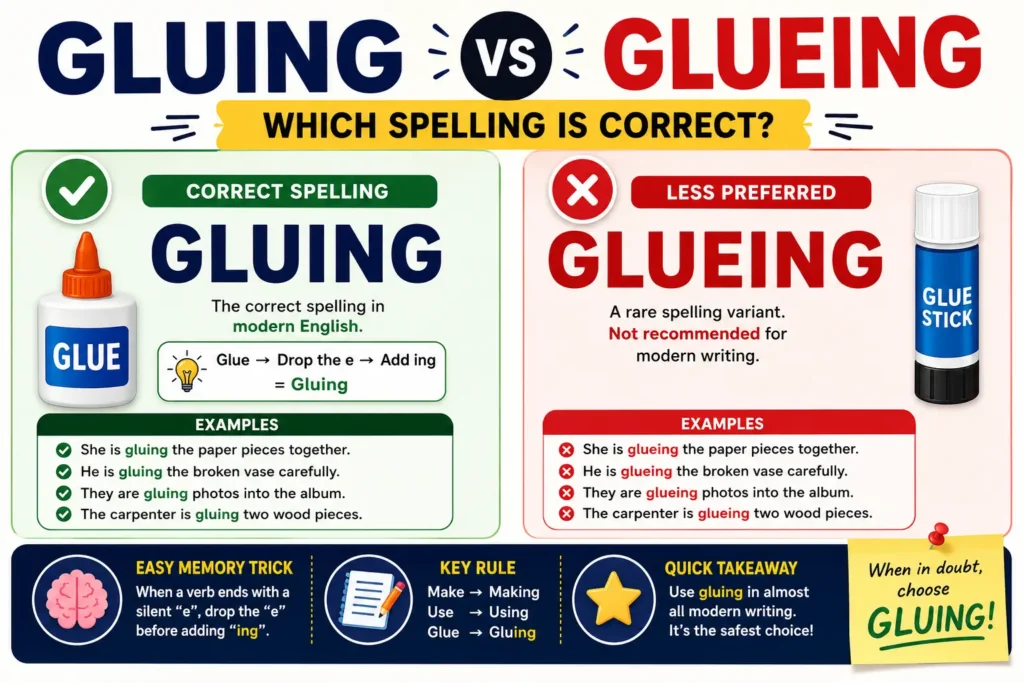
Many people wonder whether they should write gluing or glueing. The two spellings look similar, so it is easy to see why they cause confusion.
The good news is that the answer is simple. In modern English, gluing is the preferred spelling. Most teachers, editors, and style guides recommend using it.
The spelling glueing may appear in older texts or some dictionaries, but it is uncommon today. For school work, business writing, blog posts, and everyday communication, gluing is the safer choice.
In this guide, you’ll learn the difference between gluing vs glueing, discover the spelling rule behind the word, see real examples, and use an easy memory trick to remember the correct form.
Gluing vs Glueing: The Quick Answer
The correct spelling for most modern writing is gluing.
Examples:
- She is gluing photos into her scrapbook.
- He is gluing the broken frame together.
- The carpenter is gluing two pieces of wood.
Although glueing exists as a rare variant, it is not the preferred spelling.
| Spelling | Status | Best Use |
|---|---|---|
| Gluing | Preferred spelling | Modern writing |
| Glueing | Rare variant | Usually avoided |
If you want the safest choice, use gluing.
What Does Gluing Mean?
Gluing means joining one thing to another with glue.
The word comes from the verb glue, which means to stick or attach something using an adhesive.
Examples:
- She is gluing paper flowers onto a card.
- Dad is gluing the broken chair leg.
- The teacher is gluing a chart to the wall.
In each example, glue is used to hold things together.
Is Glueing a Real Word?
Yes, glueing is a real word. However, it is much less common than gluing.
Most readers expect to see gluing. Because of that, the shorter spelling looks more natural in modern writing.
If you are writing an essay, article, email, or report, choose gluing.
Why Is It Spelled Gluing?
The spelling follows a common English rule.
When a verb ends in a silent e, English usually drops the e before adding -ing.
Examples:
| Base Word | -ing Form |
|---|---|
| make | making |
| use | using |
| move | moving |
| write | writing |
| glue | gluing |
This rule explains why glue becomes gluing.
Gluing vs Glueing: Key Differences
Although both words refer to the same action, one spelling is more widely accepted.
| Feature | Gluing | Glueing |
|---|---|---|
| Modern usage | Yes | Rare |
| Preferred by editors | Yes | No |
| Good for essays | Yes | Usually no |
| Good for business writing | Yes | Usually no |
| Common in everyday English | Yes | No |
For most situations, gluing is the better option.
Using Glueing in Formal Writing
Less preferred:
The students are glueing pictures into their project.
Better:
The students are gluing pictures into their project.
Mixing Both Spellings
Avoid using both versions in the same article.
Wrong:
Start gluing the paper. After glueing the edges, press them down.
Correct:
Start gluing the paper. After gluing the edges, press them down.
Writing Vague Sentences
Weak:
She was gluing stuff.
Better:
She was gluing dried flowers onto a handmade card.
Specific details make writing stronger.
Examples of Gluing in Sentences
Here are some simple examples:
- She is gluing the label onto the bottle.
- The children are gluing paper stars to a poster.
- He is gluing the wooden pieces together.
- We are gluing photos into a family album.
- The artist is gluing fabric onto a canvas.
- Dad is gluing a loose tile back into place.
Easy Memory Trick
Remember this simple rule:
Glue → Drop the e → Add ing → Gluing
Another helpful trick:
Making, moving, using, gluing
All of these words follow the same pattern.
FAQs
Q1:Is it gluing or glueing?
The preferred spelling is gluing.
Q2:Is glueing wrong?
Not completely. It is a rare spelling variant, but most writers avoid it.
Q3:Why does gluing drop the e?
English often removes a silent e before adding -ing.
Q4:Do British and American English use different spellings?
Not usually. Both varieties commonly use gluing.
Q5:Can I use glueing in an essay?
It is better to use gluing because it is the standard modern spelling.
Final Takeaway
The correct spelling in modern English is gluing.
While you may occasionally see glueing, it is much less common and can look unusual to many readers. For essays, blog posts, emails, manuals, and business documents, gluing is the best choice.
A simple rule makes it easy to remember: when a word ends in a silent e, English often drops the e before adding -ing. That is why glue becomes gluing.
If you are unsure which spelling to use, choose gluing every time.
